Questions

2 Marks Questions

Take a timed test

6 questions · self-marked practice — reveal the answer and mark yourself.

Question 12 Marks
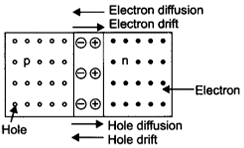
Describe briefly, with the help of a diagram, the role of the two important processes involved in the formation of a p-n junction.
Answer
Two important processes occurring during the formation of a p-n junction are (i) diffusion and (ii) drift.
i. Diffusion: In n-type semiconductor, the concentration of electrons is much greater as compared to concentration of holes; while in p-type semiconductor, the concentration of holes is much greater than the concentration of electrons. When a p-n junction is formed, then due to concentration gradient, the holes diffuse from p-side to n-side $( p \rightarrow n )$ and electrons diffuse from n-side to p-side $( n \rightarrow p )$. This motion of charge carriers gives rise diffusion current across the junction.
Image

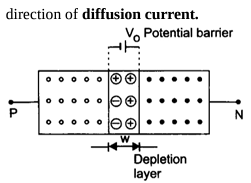
ii. Drift: The drift of charge carriers occurs due to electric field. Due to build in potential barrier, an electric field directed from n-region to p-region is developed across the junction. This field causes motion of electrons on p-side of the junction to n-side and motion of holes on n-side of junction to p-side. Thus a drift current starts. This current Depletion is opposite to the direction of diffusion current.
Image
View full question & answer
Question 22 Marks
An e.m. wave is travelling in a medium with a velocity v = $v \hat{i}$. The electric field oscillations, of this e.m. wave, are along the $y$-axis.
a. Identify the direction in which the magnetic field oscillations are taking place, of the e.m. wave.
b. How are the magnitudes of the electric field and magnetic fields in the electromagnetic wave related to each other?
Answer
a. Here e.m. wave travels in $x$-direction and electric field oscillates along $y$-direction. But the e.m. wave propagates in the direction of $\vec{E} \times \vec{B}$. Hence magnetic field must oscillate along z-direction because $(+\hat{j}) \times(+\hat{k})=+\hat{i}$
b. $\frac{E_0}{B_0}=c$, the speed of light.
View full question & answer
Question 32 Marks
A long straight wire carrying a current of $30 A$ is placed in an external uniform magnetic field of $4.0 \times 10^{-4} T$ parallel to the current. Find the magnitude of the resultant magnetic field at a point $2.0 \ cm$ away from the wire.
Answer
Here $I =30 A, r =2.0 \ cm=2.0 \times 10^{-2} m$
Field due to straight current carrying wire is
$B _1=\frac{\mu_0 I}{2 \pi r}=\frac{4 \pi \times 10^{-7} \times 30}{2 \pi \times 2.0 \times 10^{-2}}$
$=3.0 \times 10^{-4} T$
This field will act perpendicular to the external field $B _2=4.0 \times 10^{-4} T$.
Hence the magnitude of the resultant field is
$ B =\sqrt{B_1^2+B_2^2}$
$=\sqrt{\left(3 \times 10^{-4}\right)^2+\left(4.0 \times 10^{-4}\right)^2}$
$=5 \times 10^{-4} T$
View full question & answer
Question 42 Marks
The maximum torque acting on a coil of effective area $0.04 m^2$ is $4 \times 10^{-8} Nm$ when the current in it is $100 pA$ . Find the magnetic induction in which it is kept.
Answer
$A =0.04 m^2, \tau_{\max }=4 \times 10^{-8} Nm$
$I =100 \mu A=10^{-4} A, N =1$
As $\tau_{\max }= \text {NIBA}$
$\therefore$ Magnetic induction,
$B=\frac{\tau_{\max }}{N I A}$
$=\frac{4 \times 10^{-8}}{1 \times 10^{-4} \times 0.04}$
$=10^{-2} Wb m ^{-2}$
View full question & answer
Question 52 Marks
An $\alpha-$ particle after passing through a potential difference of $2 \times 10^6 V$ falls on a silver foil. The atomic number of silver is $47$ . Calculate $(i)$ the kinetic energy of the $\alpha-$ particle at the time of falling on the foil $(ii)$ the kinetic energy of the $\alpha-$ particle at a distance of $5 \times 10^{-14} m$ from the nucleus and $(iii)$ the shortest distance from the nucleus of silver to which the $\alpha-$ particle reaches.
Answer
$i$. Charge on $a-$ particle $, q=2 e , V =2 \times 10^6 V$
$K.E$. of $\alpha-$ particle,
$K = qV =2 \times 1.6 \times 10^{-19} \times 2 \times 10^6$
$=6.4 \times 10^{-13} J$
$ii$. Charge on silver nucleus $= Ze = 47 e$
$P.E$. of the $a-$ particle at a distance of $5 \times 10^{-14} m$ from the silver nucleus
$=\frac{1}{4 \pi \varepsilon_0} \cdot \frac{47 e \times 2 e}{5 \times 10^{-14}}$
$=\frac{9 \times 10^9 \times 94 \times\left(1.6 \times 10^{-19}\right)^2}{5 \times 10^{-14}}=4.3 \times 10^{-13} J$
So, $4.3 \times 10^{-3} J$ of $K .E$. gets converted into $P.E$.
$\therefore K.E$. of the $a-$ particle at a distance of $5 \times 10 \sim 14 m$ from the silver nucleus
$=6.4 \times 10^{-13}-4.3 \times 10^{-13}$
$=2.1 \times 10^{-13} J$
$iii$. Distance of closest approach,
$r_0=\frac{2 k Z e^2}{K}$
$=\frac{2 \times 9 \times 10^9 \times 47 \times\left(1.6 \times 10^{-10}\right)^2}{6.4 \times 10^{-13}}$
$=3.4 \times 10^{-14} m$
 
View full question & answer
Question 62 Marks
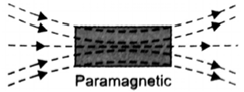
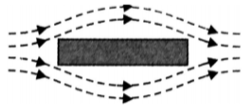
Two identical bars, one of paramagnetic material and other of diamagnetic material are kept in a uniform external magnetic field parallel to it. Draw diagrammatically the modifications in the magnetic field pattern in each case.
Answer
Inside a paramagnetic bar, field concentrates slightly in the bar, figure.
Image

Inside a Diamagnetic bar, magnetic field lines are repelled or expelled and the field inside the material is reduced. This is shown in the figure.
Image
View full question & answer