Question
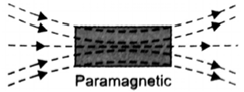
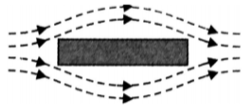
Two identical bars, one of paramagnetic material and other of diamagnetic material are kept in a uniform external magnetic field parallel to it. Draw diagrammatically the modifications in the magnetic field pattern in each case.
Answer

Inside a paramagnetic bar, field concentrates slightly in the bar, figure.
Image

Inside a Diamagnetic bar, magnetic field lines are repelled or expelled and the field inside the material is reduced. This is shown in the figure.
Image

Need a full question paper?

Generate a complete, print-ready paper with questions like this in minutes — across 16+ boards, with answer keys.
Start Generating Free

Similar questions

When can the internal resistance of the cell can be neglected? Derive the formula for the current when cell is connected to the external resistance $R$.
Can a plane mirror ever form a real image?
What is the impact parameter? Explain the trajectory of $\alpha$-particle from it.
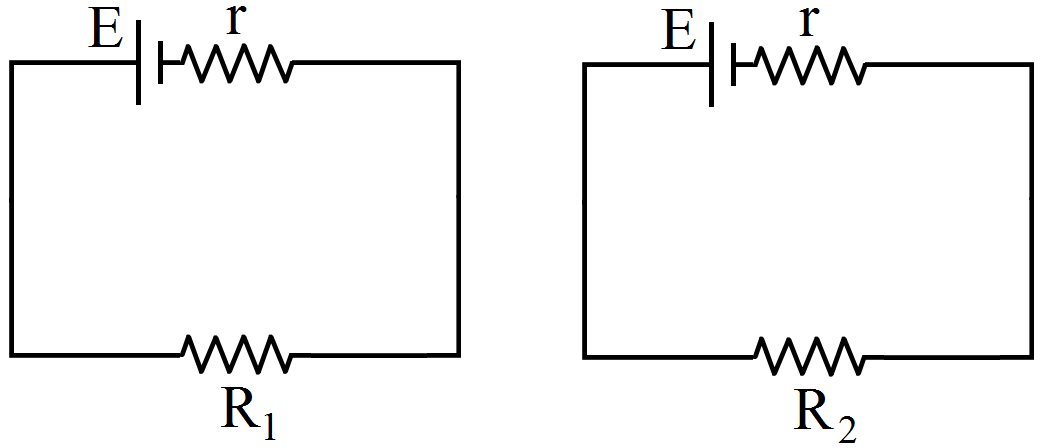
Two unequal resistances $R_1$ and $R_2$ are connected across two identical batteries of emf $\varepsilon$ and internal resistance $r.$ Can the thermal energies developed in $R_1$ and $R_{2}$ be equal in a given time. If yes, what will be the condition?
Balmer series was observed and analysed before the other series. Can you suggest a reason for such an order?
Draw and explain the phasor diagram and the graph of $v$ and $i$ versus $\omega$t, for an AC circuit having pure inductor.
Compare the direction of the magnetic field inside a solenoid with that of the field there if the solenoid is replaced by its equivalent combination of north pole and south pole.
By what percent will the capacitance of a spherical conductor increase if the amount of charge on a spherical conductor is tripled?
When three identical capacitors are connected in series, their equivalent (total) capacitance is $1 \mu F$. If they are connected in parallel, what will be their total capacitance? If the capacitors are connected to the same source in both the conditions (combinations), then find the ratio of the stored energy in these two types of combinations.
Let $\vec{\text{a}}=4\vec{\text{i}}+3\vec{\text{j}}$ and $\vec{\text{b}}=3\vec{\text{i}}+4\vec{\text{j}}.$ (a) Find the magnitudes of:
  1. $\vec{\text{a}}$
  2. $\vec{\text{b}}$
  3. $\vec{\text{a}}+\vec{\text{b}}$
  4. $\vec{\text{a}}-\vec{\text{b}}$