Questions

2 Marks Questions

Take a timed test

6 questions · self-marked practice — reveal the answer and mark yourself.

Question 12 Marks
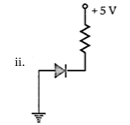
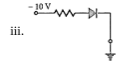
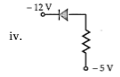
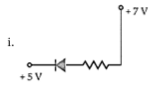
In the following diagrams indicate which of the diodes are forward biased and which are reverse biased.
Image
Image
Image
Image
Answer
i. Forward biased, because p-side is at higher potential (+7 V) than n-side (+ 5 V).
ii. Reverse biased, because the p-side is at lower potential (0V) than the n-side (+5 V).
iii. Reverse biased, because p-side is at lower potential (-10 V) than n-side (0 V).
iv. Forward biased, because p-side is at higher potential (- 5 V) than n-side (- 12 V).
View full question & answer
Question 22 Marks
Suppose you are given a chance to repeat the alpha-particle scattering experiment using a thin sheet of solid hydrogen in place of the gold foil. (Hydrogen is a solid at temperatures below 14 K). What results do you expect?
Answer
Hydrogen nuclei (or protons) are much lighter than a-particles. So $\alpha$-particles are not scattered by solid hydrogen. They pass through solid hydrogen almost undeflected from their paths.
View full question & answer
Question 32 Marks
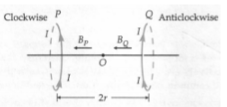
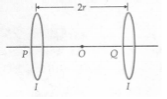
Two identical circular loops, P and Q. each of radius r and carrying currents are kept in the parallel planes having a common axis passing through O. The direction of current in P is clockwise and in Q is anti-clockwise as seen from O which is equidistant from the loops P and Q. Find the magnitude of the net magnetic field at O.

Image
Answer
Image
$\left|\vec{B}_P\right|=\left|\vec{B}_Q\right|=\frac{\mu_0 I r^2}{2\left(r^2+r^2\right)^{3 / 2}}=\frac{\mu_0 I}{4 \sqrt{2}}$
The net magnetic field at O is
$|\vec{B}|=\left|\vec{B}_P\right|+\left|\vec{B}_Q\right|=2 \frac{\mu_0 I}{4 \sqrt{2} r}=\frac{\mu_0 I}{2 \sqrt{2} r}$
View full question & answer
Question 42 Marks
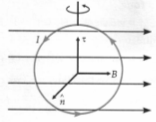
A circular coil of $25$ turns and radius $6.0 \ cm,$ carrying a current of $10 A,$ is suspended vertically in a uniform magnetic field of magnitude $1.2 T$. The field lines run horizontally in the plane of the coil. Calculate the force and the torque on the coil due to the magnetic field. In which direction should a balancing torque be applied to prevent the coil from turning?
Answer
Consider any element $\overrightarrow{d l}$ of the wire.
Force on this element is $I \overrightarrow{d l} \times \vec{B}$.
For each element $\overrightarrow{d l}$ there is another element $-\overrightarrow{d l}$ on the current loop.
Forces on each pair of such elements Cancel out.
Hence net force on the coil in a uniform magnetic field is zero.
Image

In Fig. $n$ is a unit vector normal to the plane of the loop, directed outward.
The angle between $n$ and $B$ is $90^\circ$ .
The magnitude of the torque acting on the loop is
$\tau = \text {NIBA} \sin \theta$
$=25 \times 10 \times 1.2 \times \pi(0.06)^2 \times \sin 90^{\circ}$
$=3.4\ Nm $
This torque acts in the vertically upward direction producing a turning effect in the direction of the curved arrow.
To prevent the coil from turning, a balancing to torque $\tau^{\prime}=\tau$ must be applied.
View full question & answer
Question 52 Marks
Magnetic force is always normal to the velocity of a charge and therefore does no work. An iron nail held near a magnet, when released, increases its kinetic energy as it moves to cling to the magnet. What agency is responsible for this increase in kinetic energy if not the magnetic field?
Answer
We can think of the nail as so many charges in motion. In the bar's magnetic field, each charge in motion in the nail experiences a magnetic force that alters its velocity but not speed. The total energy of the system (the nail) cannot change, since magnetic force does no work. But because of changes in individual velocity directions, the velocity of the centre of mass can increase, obviously at the expense of the nail's internal energy. Magnetic field provides force, while internal energy of the nail provides the increase in internal energy of the nail as a whole.
View full question & answer
Question 62 Marks
In which situation is there a displacement current, but no conduction current?
Answer
During charging or discharging there is a displacement current but no conduction current between plates of capacitor.
View full question & answer