Questions

2 Marks Questions

Take a timed test

6 questions · self-marked practice — reveal the answer and mark yourself.

Question 12 Marks
A sample of paramagnetic salt contains $2.0 \times 10^{24}$ atomic dipoles each of dipole moment $1.5 \times 10^{-23} JT ^{-1}$. The sample is placed under homogeneous magnetic field of $0.84 T$ and cooled to the temperature of $4.2 K$ . The degree of magnetic saturation achieved is equal to $15 \%$. What is the total dipole moment of the sample for a magnetic field of $0.98 T$ and a temperature of $2.8 K ($assume Curie's law$)$?
Answer
Dipole moment of each atomic dipole,
$m =1.5 \times 10^{-23} JT ^{-1}$
Total number of atomic dipoles, $N =2.0 \times 10^{24}$
Initial total magnetic moment at temperature $T _1=4.2 K$ is
$ M _1=15 \% \text { of } mN$
$=\frac{15}{100} \times 1.5 \times 10^{-23} \times 2.0 \times 10^{24} JT ^{-1}$
$=4.5 JT ^{-1}$
According to Curie's law,
$ M =\text { Constant } \times \frac{B}{T}$
$\therefore \frac{M_2}{M_1}=\frac{B_2}{B_1} \times \frac{T_1}{T_2}$
Now $B_1=0.84 T, T _1$
$=4.2 K, B _2$
$=0.98 T, T _2=2.8 K$
Hence the final dipole moment at temperature $T _2=2.8 K$ is
$ M _2=M_1 \times \frac{B_2}{B_1} \times \frac{T_1}{T_2}$
$=4.5 \times \frac{0.98}{0.84} \times \frac{4.2}{2.8} JT ^{-1}$
$=7.9 JT ^{-1}$
View full question & answer
Question 22 Marks
a. It is not advisable to use a galvanometer as such to measure current directly. Why?
b. Why should the value of resistance connected in parallel to a galvanometer be low?
c. Is the reading shown by an ammeter in a circuit less than or more than the actual value of current flowing in the circuit? Why?
Answer
a. It will not measure accurate value of current because its high resistance will affect the current in the circuit.
b. To reduce the galvanometer resistance a small resistance is connected in parallel.
c. It is less than the actual value of current because it has some resistance which consume some energy and hence the reading shown by an ammeter in a circuit less than the actual value of current flowing in the circuit.
View full question & answer
Question 32 Marks
Answer the following:
a. Magnetic field lines can be entirely confined within the core of a toroid, but not within a straight solenoid. Why?
b. Does a bar magnet exert a torque on itself due to its own field? Justify your answer.
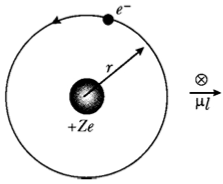
c. When an electron revolves around a nucleus, obtain the expression for the magnetic moment associated with it.
Answer
a. If field lines were extremely confined between two ends of a straight solenoid, the flux through the cross section at each end would be non zero. But the flux of field B through any closed surface must always be zero, For a toroid this difficulty is absent.
b. No, there is no force on torque on an element due to the field produced by that element itself.
c.
$\begin{aligned} I & =\frac{e}{T}, T=\frac{2 \pi r}{v} \\
I & =\frac{e v}{2 \pi r}, \mu=I \pi r^2=\frac{e v r}{2}\end{aligned}$
Image

View full question & answer
Question 42 Marks
Explain why the spectrum of hydrogen atom has many lines, although a hydrogen atom contains only one electron.
Answer
A source of hydrogen spectrum has billions of hydrogen atoms. Each hydrogen atom has many stationary states. All possible transitions can occur from any higher level to any lower level. This gives rise to a large number of spectral lines.
View full question & answer
Question 52 Marks
Distinguish between intrinsic and extrinsic semiconductors. Although in an extrinsic semiconductor $n_e \neq n_h$, yet it is electrically neutral. Why?
Answer
Intrinsic semiconductors: are pure semiconductors while extrinsic semiconductors are doped with either trivalent or pentavalent impurities.
Extrinsic semiconductor: maintains an overall charge neutrality as the charge of additional charge carriers is just equal and opposite to that of the ionised cores in the lattice.
View full question & answer
Question 62 Marks
Compare the following:
i. Wavelengths of the incident solar radiation absorbed by the earth's surface and the radiation re-radiated by the earth.
ii. Tanning effect produced on the skin by UV incident directly on the skin and that coming through glass window.
Answer
i. Radiation re-radiated by earth has greater wavelength
ii. Tanning effect is significant for direct UV radiation due to high intensity ; but it is negligible for radiation coming through the glass.
View full question & answer