Question
a. It is not advisable to use a galvanometer as such to measure current directly. Why?
b. Why should the value of resistance connected in parallel to a galvanometer be low?
c. Is the reading shown by an ammeter in a circuit less than or more than the actual value of current flowing in the circuit? Why?
Answer

a. It will not measure accurate value of current because its high resistance will affect the current in the circuit.
b. To reduce the galvanometer resistance a small resistance is connected in parallel.
c. It is less than the actual value of current because it has some resistance which consume some energy and hence the reading shown by an ammeter in a circuit less than the actual value of current flowing in the circuit.

Need a full question paper?

Generate a complete, print-ready paper with questions like this in minutes — across 16+ boards, with answer keys.

Start Generating Free

Similar questions

The $\text{K}_\beta$ X-ray of argon has a wavelength of 0.36nm. The minimum energy needed to ionize an argon atom is 16eV. Find the energy needed to knock out an electron from the K shell of an argon atom.
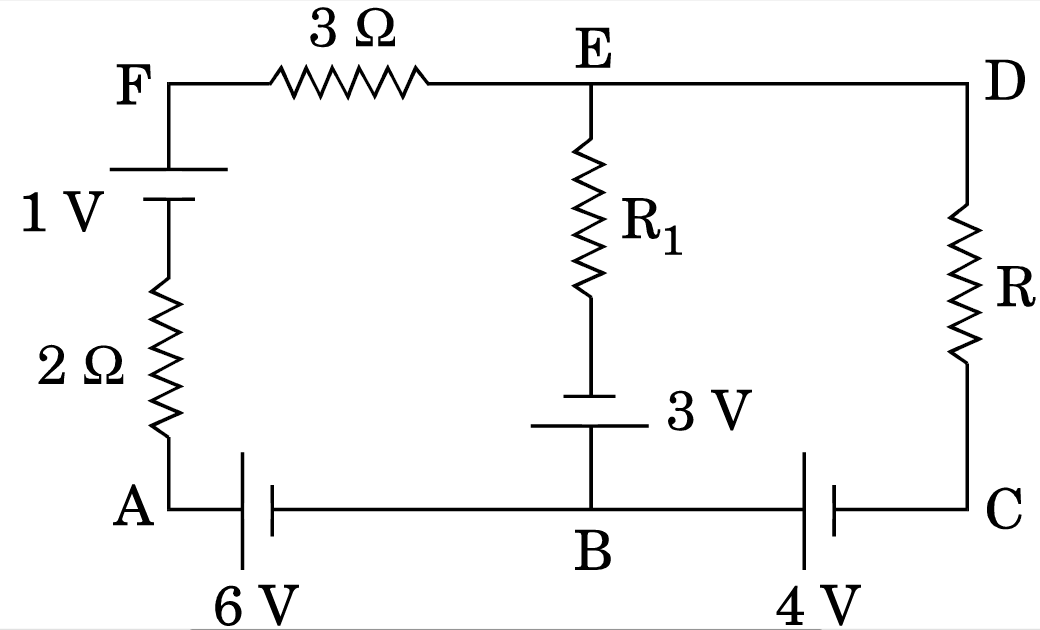
Use Kirchhoff ’s rules to determine the potential difference between the points $A$ and $D$ when no current flows in the arm $BE$ of the electric network shown in the figure.
$^{57}Co$ decays to $^{57}Fe$ by $\beta^+-\text{ emission.}-$ emission.
The resulting $^{57}Fe$ is in its excited state and comes to the ground state by emitting $\gamma-\text{rays}.$ The half $-$ life of $\beta^+-\text{decay}$ is $270$ days and that of the $\gamma-\text{emissions}$ is $10^{-8} s.$ A sample of $^{57}Co$ gives $5.0 \times 10^9$ gamma rays per second.
How much time will elapse before the emission rate of gamma rays drops to $2.5 \times 10^9$ per second?
What is absolute refractive index? On what factors does it depend ?
Write down the definition of energy density and derive the equation of energy density of electric field.
Can the potential barrier across a p-n junction be measured by simply connecting a voltmeter across the junction?
The magnetic properties of the different materials A, B and C are shown in the following table:
Material Permeability Susceptibility Temperature dependence of susceptibility.
A Low positive Small but negative Independent of temperature
B High Very high 1 Susceptibility decreases with temperature
C Greater than 1  Small but positive Decreases with temperature
Which of the above three materials should be used for making an electromagnet and why?
An optical fibre $(\mu=1.72)$ is surrounded by a glass coating $(\mu=1.50).$ Find the critical angle for total internal/ reflection at the fibre-glass interface.
A particle executes simple harmonic motion with an amplitude of 10cm. At what distance from the mean position are the kinetic and potential energies equal?
The gravitational field in a region is given by $\text{E}=(2\hat{\text{i}}+3\hat{\text{i}})\text{N/kg}.$ Show that no work is done by the gravitational field when a particle is moved on the line 3y + 2x = 5.
Hint: If a line y = mx + c makes angle $\theta$ with the X-axis, m $=\tan\theta$