Questions

3 Marks Question

Take a timed test

8 questions · self-marked practice — reveal the answer and mark yourself.

Question 13 Marks
Write the basic features of the photon picture of electromagnetic radiation on which Einstein's photoelectric equation is based.
Answer
The basic features of the photon picture of e.m. radiation are as follows:
i. Light is composed of discrete packets of energy called quanta or photons.
ii. Each photon carries an energy $E (=h \nu)$ and momentum $p (= h / \lambda)$, which depend on the frequency $\nu$ of the incident radiation and not on its intensity.
iii. During the collision of a photon with an electron, the total energy of the photon gets absorbed by the electron.
iv. Photoelectric emission from the metal surface occurs due to the absorption of a photon by an electron.
View full question & answer
Question 23 Marks
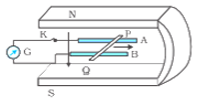
Figure shows a metallic rod PQ of length l, resting on the smooth horizontal rails AB positioned between the poles of a permanent magnet. The rails, the rod, and the magnetic field are in three mutually perpendicular directions. A galvanometer G connects the rails through a switch K. Assume the magnetic field to be uniform. Given the resistance of the closed-loop containing the rod is R.
Image

i. Suppose K is open and the rod is moved with a speed v in the direction shown. Find the polarity and magnitude of induced emf.
ii. With K open and the rod moving uniformly, there is no net force on the electrons in the rod PQ even though they do experience a magnetic force due to the motion of the rod. Explain.
iii. What is the induced emf in the moving rod if the magnetic field is parallel to the rails instead of being perpendicular?
Answer
i. e = Bvl
P is a positive end
Q is a negative end
ii. Magnetic force is cancelled by the electric force set-up due to the excess charge of opposite nature at both ends of the rod. There is no net force on the electrons in rod PQ when key K is open and the rod is moving uniformly. This is because the magnetic force is cancelled by the electric force set-up due to the excess charge of opposite nature at both ends of the rods.
iii. Induced emf is zero as a motion of rod not cutting field lines.
In this case, no emf is induced in the coil because the motion of the rod does not cut across the field lines. Or when the permanent magnet is rotated in vertical position the field becomes parallel to rails. The motion of the rod will not cut across the lines of the field. so no emf is produced.
View full question & answer
Question 33 Marks
A coil of cross $-$ sectional area A lies in a uniform magnetic field $B$ with its plane perpendicular to the field. In this position the normal to the coil makes an angle of $0^\circ$ with the field. The coil rotates at a uniform rate to complete one rotation in time $T$. Find the average induced emf in the coil during the interval when the coil rotates:
$i$. from $0^{\circ}$ to $90^{\circ}$ position
$ii$. from $90^{\circ}$ to $180^{\circ}$ position
$iii$. from $180^{\circ}$ to $270^{\circ}$ and
$iv$. from $270^{\circ}$ to $360^{\circ}$
Answer
$i$. For rotation from $0^{\circ}$ to $90^{\circ}$
$\phi_1= BA \cos 0^{\circ}= BA , \phi_2= BA \cos 90^{\circ}=0, t =\frac{T}{4}$
$\therefore$ Average induced $\text{emf},$
$\varepsilon=-\frac{\phi_2-\phi_1}{t}=-\frac{0-B A}{T / 4}=\frac{4 B A}{T}$
$ii$. For rotation from $90^{\circ}$ to $180^{\circ}$
$\phi_1= BA \cos 90^{\circ}=0, \phi_2= BA \cos 180^{\circ}=- BA , t =\frac{T}{4}$
$\therefore \varepsilon=-\frac{-B A-0}{T / 4}=\frac{4 B A}{T}$
$iii.$ For rotation from $180^{\circ}$ to $270^{\circ}$
$\phi_1= BA \cos 180^{\circ}=- BA , \phi_2= BA \cos 270^{\circ}=0, t =\frac{T}{4}$
$\therefore \varepsilon=-\frac{0+B A}{T / 4}=-\frac{4 B A}{T}$
$iv$. For rotation from $270^{\circ}+360^{\circ}$
$\phi_1= BA \cos 270^{\circ}=0, \phi_2= BA \cos 360^{\circ}= BA , t =\frac{T}{4}$
$\therefore \varepsilon=-\frac{B A-0}{T / 4}=-\frac{4 B A}{T}$
As the sense of the induced emf in the second half rotation is opposite to that in the first half rotation, the induced current will change its direction after first-half rotation.
View full question & answer
Question 43 Marks
An electron in a hydrogen atom makes transitions from orbits of higher energies to orbits of lower energies.
a. When will such transitions result in (a) Lyman (b) Balmer series?
b. Find the ratio of the longest wavelength in Lyman series to the shortest wavelength in Balmer series.
Answer
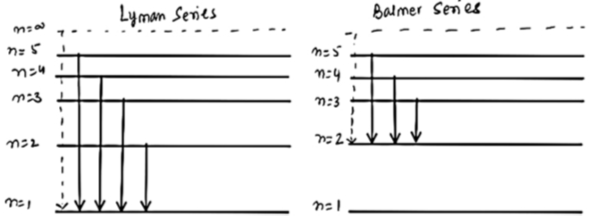
a. Transition result in Lyman series if electron will jump from a higher energy orbit to n = 1 orbit
Transition result in Balmer series if electron will jump from a higher energy orbit to n = 2 orbit Image
b. Longest wavelength in Lyman Series
$\frac{1}{\lambda_L}=R \cdot\left[\frac{1}{n_1^2}-\frac{1}{n_2^2}\right]=R\left[\frac{1}{1^2}-\frac{1}{2^2}\right]=\frac{3 R}{4}$
Shorted wavelength in Balmer Series
$\frac{1}{\lambda_S}=R\left[\frac{1}{n_1{ }^2}-\frac{1}{n_2^2}\right]=R\left[\frac{1}{2^2}-\frac{1}{\infty}\right]=\frac{R}{4}$
Ratio $\frac{\lambda_2}{\lambda_S}=\frac{4}{3 R} \times \frac{R}{4}=\frac{1}{3}$

View full question & answer
Question 53 Marks
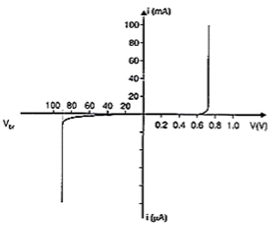
The following figure shows the V-I characteristics of a semiconductor diode.
i. Identify the semiconductor diode used.
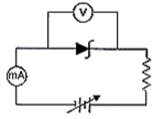
ii. Draw the circuit diagram to obtain the given characteristics of this device.
iii. Briefly explain how this diode can be used as a voltage regulator.
Image
Answer
i. The semiconductor diode whose V-I characteristic is shown in figure is Zener diode.
ii. Circuit diagram to obtain the given characteristic is shown in figure.
Image

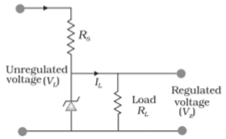
iii. The circuit of Zener diode used as voltage regulator is shown in figure.
Image
The unregulated dc voltage (filtered output of a rectifier) is connected to the Zener diode through a series resistance $R_{ s }$ such that the Zener diode is reverse biased.
without any change in the voltage across the Zener diode. This is because in the breakdown region, Zener voltage remains constant even though the current through the Zener diode changes. Similarly, if the input voltage decreases, the current through $R _{ s }$ and Zener diode also decreases. The voltage drop across $R _{ s }$ decreases without any change in the voltage across the Zener diode. Thus any increase/decrease in the input voltage results in, increase/decrease of the voltage drop across $R _{ s }$ without any change in voltage across the Zener diode. Thus the Zener diode acts as a voltage regulator.
View full question & answer
Question 63 Marks
In a single slit diffraction experiment $,a$ slit of width $d$ is illuminated by red light of wavelength $650 \ nm$. For what value of $d$ will
$i$. the first minimum fall is at an angle of diffraction of $30^\circ$ and
$ii$. the first maximum fall is at an angle of diffraction of $30^\circ$ ?
Answer
$i.$ In single slit diffraction pattern, first minimum occurs at $d \sin \theta=\lambda$
$(\theta$ and $\lambda$ are diffraction angle and wavelength of the ligh used$)$
$\therefore$ Slit width, $d=\frac{\lambda}{\sin \theta} ..(a)$
Given, $\lambda=650 \times 10^{-9} m$ and $\theta=30^{\circ}$
Now from equation $(a)$ we get slit width,
$d=\frac{650 \times 10^{-9}}{\sin 30^{\circ}}$
$=\frac{650}{(1 / 2)} \times 10^{-9}$
$=1300 \times 10^{-9} m$
$\therefore d=1.3 \times 10^{-6} m$
$=1.3 \mu m$
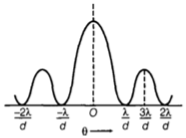
$ii.$ In single slit diffraction pattern, maximum and minima occurs as per the below diagram $-$
Image

Now for first maximum,
$d \sin \theta=\frac{3 \lambda}{2}\left[u \operatorname{\sin\ g}, d \sin \theta=(2 n+1) \frac{\lambda}{2}\right]$
where $, n = 1($for first maximum$)$
$\Rightarrow d=\frac{3 \lambda}{2 \sin \theta}$
where, $\theta=30^{\circ}, \lambda=650 \times 10^{-9} m$
$\therefore d=\frac{3 \lambda}{2 \sin \theta}$
$=\frac{3 \times 650 \times 10^{-9}}{2 \times \sin 30^{\circ}}$
$=1950 \times 10^{-9} m$
$\therefore d=1.95 \times 10^{-6} m$
$=1.95 \mu m$
View full question & answer
Question 73 Marks
Calculate and compare the energy released by
a. fusion of 1.0 kg of hydrogen deep within Sun and
b. the fission of 1.0 kg of ${ }^{235} U$ in a fission reactor.
Answer
a. Mass of hydrogen, $m =1 kg=1000 g$
Since 1 mole of hydrogen contains $6.023 \times 10^{23}$ atoms which are equivalent to 1 g of hydrogen then, 1 kg of hydrogen contains,
$N =6.023 \times 10^{23} \times 1000=6.023 \times 10^{26}$ atoms
In sun, 4 hydrogen atoms, ${ }_1^1 H$ combine to form one helium atom, ${ }_2^4 He$ in fusion process which releases 26 MeV of energy.
Thus,
The energy released from the fusion of 1kg of hydrogen is,
$E=\frac{N}{4} \times 26=\frac{6.023 \times 10^{23}}{4} \times 26 \times 10^3 MeV \ldots(1)$
$=\frac{156.598 \times 10^{26}}{} MeV =39.1495 \times 10^{26} MeV$
b. Mass of uranium, m = 1kg = 1000 g
Since 1 mole of Uranium contains $6.023 \times 10^{23}$ atoms which are equivalent to 235 g of Uranium then, 1 kg of Uranium contains,
$N =\frac{1000}{235} \times 6.023 \times 10^{23}=25.63 \times 10^{23}$
During fission reaction of 1 atom of ${ }_{92}^{235} U$ releases 200 MeV of energy.
Thus,
The energy released from fission of 1kg of Uranium is,
$E = N \times 200=25.63 \times 10^{23} \times 200 MeV =5.106 \times 10^{26} MeV \ldots(2)$
Divide (1) by (2) we get,
$x=\frac{39.1495 \times 10^{26}}{5.106 \times 10^{26}}=7.67 \approx 8$
Hence, the energy released in fusion is 8 times the energy released in fission.
View full question & answer
Question 83 Marks
$a.$ Write the relationship between mobility and drift velocity in a current carrying conductor.
$b.$ Two aluminium wires have their lengths in the ratio $2 : 3$ and radii in the ratio $1 : 3.$ These are connected in parallel across a battery of $emf \ E$ and of negligible internal resistance. Find the ratio of drift velocities of the electrons in the two wires.
Answer
$a. \mu=\frac{V_d}{E}$
$b. V _{ d }=\frac{e \tau E}{m}=\frac{e \tau V}{m l}$
$\frac{V_{d l }}{V_{d 2}}=\frac{l_2}{l_1}=\frac{3}{2}$
Hence, the ratio of drift velocities of the electrons in the two wires is $3:2$
View full question & answer