Questions

5 Marks Questions

Take a timed test

6 questions · self-marked practice — reveal the answer and mark yourself.

Question 15 Marks
$i$. Define the capacitance of a capacitor. Obtain the expression for the capacitance of a parallel plate capacitor in vacuum in terms of plate area $A$ and separation d between the plates.
$ii.$ A slab of material of dielectric constant $k$ has the same area as the plates of a parallel plate $\frac{3 d}{4}$ capacitor but has a thickness $ -$. Find the ratio of the capacitance with dielectric inside it to its capacitance without the dielectric.
Answer
$a$ .The capacitance $C$ of a capacitor is defined as the ratio of the maximum charge $Q$ that can be stored in a capacitor to the applied voltage $V$ across its plates.
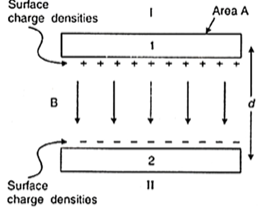
Image
Electric field between the plates of capacitor
$E =\frac{\sigma}{\varepsilon_0}=\frac{ Q }{ A \varepsilon_0}$
$\therefore V = Ed =\frac{ Qd }{ A \varepsilon_0}$
Capacitance, $C =\frac{ Q }{ V }=\frac{\varepsilon_0 A}{d}$
$b$. Ratio of capacitances
$i$. Capacitance equals the magnitude of the charge on each plate needed to raise the potential difference between the plates by unity
$ii$. Capacitance without dielectric,
$C=\frac{A \varepsilon_0}{d}$
Capacitance when filled with dielectric having thickness $\frac{3 d}{4}$
$C=\frac{A \varepsilon_0}{\left(d-t+\frac{t}{x}\right)}$
$=\frac{A E_0}{\left(d-\frac{3 d}{4}+\frac{3 d}{4 \kappa}\right)}\left[\text { As t }=\frac{3 d}{4}\right]$
$=\frac{4 \varepsilon_0 k A}{d(x+3)}$
Ratio $\frac{C^{\prime}}{C}
=\frac{A \varepsilon_0 4 \kappa}{d(k+3)} \times \frac{d}{A \varepsilon_0}$
$=\frac{4 \kappa}{(x+3)}$
View full question & answer
Question 25 Marks
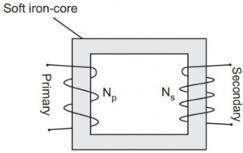
With the help of a diagram, explain the principle of a device which changes a low voltage into a high voltage but does not violate the law of conservation of energy. Give any one reason why the device may not be $100\%$ efficient.
Answer
Device $-$ transformer
$\varepsilon_p=- N _{ p } \frac{\Delta \phi}{\Delta t} \ldots (i)$
and emf induced in the secondary coil
$=- N _{ S } \frac{\Delta \phi}{\Delta t} \ldots( ii )$
From $(i)$ and $(ii)$
$\frac{\varepsilon_S}{\varepsilon_p}=\frac{N_S}{N_p} \ldots \text { (iii) }$
$\frac{V_S}{V_p}=\frac{\varepsilon_S}{\varepsilon_p}=\frac{N_S}{N_p}= r \text { (say) } \ldots \text { (iv) }$
$V _{ p } i _{ p }= V _{ S } i _{ S }$
$\therefore \frac{i_S}{i_p}=\frac{V_p}{V_S}=\frac{N_p}{N_S}=\frac{1}{r} \ldots \text { (v) }$
In step up transformer, $N _{ s }> N _{ p } \rightarrow r >1$;
So $V_S>V_p$ and $i_S$ i.e., step up transformer increases the voltage.
Image

Two coils on separate limbs of the core
Principle: It is based on the principle of mutual inductance and transforms the alternating low voltage to alternating high voltage and in this the number of turns in secondary coil is more than that in primary coil.$($i.e., $N _{ S }> Np).$
Efficiency : Assuming no energy losses, the transformer is $100 \%$ efficient i.e. $I _{ p } V _{ P }= I _{ s } V _{ s }$
View full question & answer
Question 35 Marks
a. State the condition for resonance to occur in series LCR a.c. circuit and derive an expression for resonant frequency.
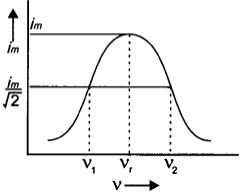
b. Draw a plot showing the variation of the peak current $\left( i _{ m }\right)$ with frequency of the a.c, source used. Define the quality factor Q of the circuit.
Answer
Condition for resonance to occur in series LCR ac circuit: For resonance the current produced in the circuit and emf applied must always be in the same phase.
Image

Phase difference $(\phi)$ in series LCR circuit is given by
$\tan \phi=\frac{X_{C^{-}} X_L}{R}$
For resonant $\phi=0 \Rightarrow X _{ C }- X _{ L }=0$
or $X _{ C }- X _{ L }$
If $\omega_r$ is resonant frequency, then $X_C=\frac{1}{\omega_r C}$ and $X _{ C }=\omega_r L$
$\frac{1}{\omega_r C}=\omega_r L \Rightarrow \omega_r=\frac{1}{\sqrt{L C}}$
Linear resonant frequency, $\nu_r=\frac{\omega_r}{2 \pi}=\frac{1}{2 \pi \sqrt{L C}}$
The graph of variation of peak current $i_m$ with frequency is shown in fig.
Half power frequencies are the frequencies on either side of resonant frequency for which current reduces to half of its maximum value. In fig. $v _1$ and $v _2$ are half power frequencies.
Quality Factor (Q): The quality factor is defined as the ratio of resonant frequency to the width of half power frequencies.
i.e., $Q=\frac{\omega_r}{\omega_2-\omega_1}=\frac{\nu_r}{\nu_2-\eta_1}=\frac{\omega_r L}{R}$

View full question & answer
Question 45 Marks
$a.$ Explain why, for any charge configuration, the equipotential surface through a point is normal to the electric field at that point.
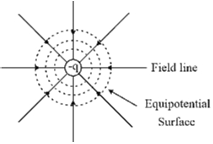
Draw a sketch of equipotential surfaces due to a single charge $(-q),$ depicting the electric field lines due to the charge.
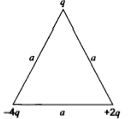
$b.$ Obtain an expression for the work done to dissociate the system of three charges placed at the vertices of an equilateral triangle of side a as shown alongside.
Answer
$a.$ The work done in moving a charge from one point to another on an equipotential surface is zero. If the field is not normal to an equipotential surface, it would have a non zero component along the surface. This would imply that work would have to be done to move a charge on the surface which is contradictory to the definition of equipotential surface. Mathematically
Work done to move a charge $dq,$ on a surface, can be expressed as $d W=d q(\vec{E} \cdot \overrightarrow{d r})$
But $dW = 0$ on an equipotential surface
$\therefore \vec{E} \perp \overrightarrow{d r}$
Equipotential surfaces for a charge $-q$ is shown alongside.
Image

$b.$ Work required to dissociate the system of three charges
$=- \text { P.E.}$ of the system
$=-\frac{1}{4 \pi \varepsilon_0}\left[\frac{q \times(-4 q)}{a}+\frac{q \times 2 q}{a}+\frac{(-4 q) \times 2 q}{a}\right]$
$=-\frac{1}{4 \pi \varepsilon_0}\left[-4 q^2+2 q^2-8 q^2\right]$
$=+\frac{10 q^2}{4 \pi \varepsilon_0 a}$
Image
View full question & answer
Question 55 Marks
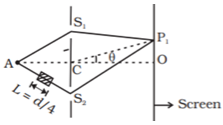
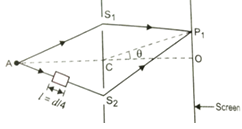
A small transparent slab containing material of $\mu=1.5$ is placed along $AS _2 $$Figure$)$. What will be the distance from $O$ of the principal maxima and of the first minima on either side of the principal maxima obtained in the absence of the glass slab?
Image

$AC = CO = D , S _1 C = S _2 C = d < D$
Answer
As is clear from figure and difference between waves reaching $P_1$ from $A$ is
$=2 d \sin \theta+(u-1) l$
For principal maximum, path difference $= 0$
$\text { i.e., } 2 d \sin \theta+(\mu-1) l=0$
$2 d=\sin \theta+(1.5-1) \frac{d}{4}=0, \sin \theta=\frac{-1}{16}$
$\therefore O P_1=(C O) \tan \theta \cong D\left(-\frac{1}{16}\right)$
For the first minimum, an angle $\theta_1$, say,
path difference $=2 d \sin \theta_1+0.5 l= \pm \lambda / 2$
$\sin \theta_1=\frac{ \pm \lambda / 2-0.5 l}{2 d}$
As diffraction occurs when $d =\lambda$,
$\therefore \sin \theta_1=\frac{ \pm \lambda / 2-\lambda / 8}{2 \lambda}= \pm \frac{1}{4}-\frac{1}{16}$
on the positive side, $\sin \theta_1=+\frac{1}{4}-\frac{1}{16}=\frac{3}{16}$, on the negative side,
$\sin \theta_1=-\frac{1}{4}-\frac{1}{16}=\frac{-5}{16}$
The first principal maximum on the positive side is at distance $($above $O)$
$= D$ than $\theta_1=D \frac{\sin \theta_1}{\sqrt{1-\sin ^2 \theta_1}}=\frac{D .3 / 16}{\sqrt{1}-9 / 256}=\frac{3 D}{\sqrt{16^2-3^2}}$
On the negative side, the distance of first principal maximum $($below $O)$ will be
$=D \theta_1^{\prime}=D \frac{\sin \theta_1^{\prime}}{\sqrt{1-\sin ^2 \theta_1}}=\frac{D(-5 / 16)}{\sqrt{1-(5 / 16)^2}}=\frac{-5 D}{\sqrt{16^2-5^2}}$

Image
View full question & answer
Question 65 Marks
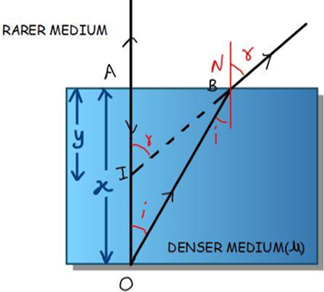
$i. A$ coin is placed inside a denser medium. Why does it appear to be raised? Obtain an expression for the height through which the object appears to be raised in terms of refractive index of the medium and real depth.
$ii. A$ compound microscope consists of an objective lens of focal length $2 \ cm$ and an eyepiece of focal length $6.25 \ cm$ separated by a distance of $15 \ cm.$ How far from the objective should an object be placed in order to obtain the final image at the least distance of distinct vision $(25 \ cm)$ ? Calculate the magnifying power of the microscope.
Answer
$i$ . Due to refraction of light
Image
In $ \triangle OAB$
$\sin i =\frac{A B}{O B}$
In $\triangle IAB , \sin r =\frac{A B}{I B}$
According to Snell's law
$\frac{1}{\mu}=\frac{\sin i}{\sin r}=\frac{I B}{O B}$ When angles are small $, OB \approx OA$ and $IB \approx IA$
$\mu=\frac{O A}{I A}=\frac{x}{y}$
Height through which object is raised $= x - y$
$= x -\frac{x}{\mu}$
$= x \left(1-\frac{1}{\mu}\right)$
ii. $f _0=2 \ cm$
$ f _{ e }=6.25 \ cm$
$L = v _0+\left| u _{ e }\right|=15 \ cm$
$v _{ e }=-25 \ cm$
$\frac{1}{V_e}-\frac{1}{u_e}=\frac{1}{f_e}$
$\frac{1}{-25}-\frac{1}{u_e}=\frac{1}{6.25}$
$u _{ e }=-5 \ cm$
Now $, L=v_0+|-5|=15 \ cm$
$V_o=10 \ cm$
Now $,  \frac{1}{f_o}=\frac{1}{V_o}-\frac{1}{u_o}$
$u _0=2.5 \ cm$
$MP =\frac{V_o}{u_o}\left[1+\frac{D}{f_o}\right]$
$=-20$
View full question & answer