Question
$a.$ Explain why, for any charge configuration, the equipotential surface through a point is normal to the electric field at that point.
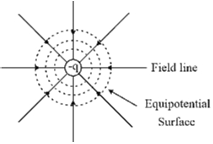
Draw a sketch of equipotential surfaces due to a single charge $(-q),$ depicting the electric field lines due to the charge.
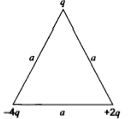
$b.$ Obtain an expression for the work done to dissociate the system of three charges placed at the vertices of an equilateral triangle of side a as shown alongside.
Answer

$a.$ The work done in moving a charge from one point to another on an equipotential surface is zero. If the field is not normal to an equipotential surface, it would have a non zero component along the surface. This would imply that work would have to be done to move a charge on the surface which is contradictory to the definition of equipotential surface. Mathematically
Work done to move a charge $dq,$ on a surface, can be expressed as $d W=d q(\vec{E} \cdot \overrightarrow{d r})$
But $dW = 0$ on an equipotential surface
$\therefore \vec{E} \perp \overrightarrow{d r}$
Equipotential surfaces for a charge $-q$ is shown alongside.
Image

$b.$ Work required to dissociate the system of three charges
$=- \text { P.E.}$ of the system
$=-\frac{1}{4 \pi \varepsilon_0}\left[\frac{q \times(-4 q)}{a}+\frac{q \times 2 q}{a}+\frac{(-4 q) \times 2 q}{a}\right]$
$=-\frac{1}{4 \pi \varepsilon_0}\left[-4 q^2+2 q^2-8 q^2\right]$
$=+\frac{10 q^2}{4 \pi \varepsilon_0 a}$
Image

Need a full question paper?

Generate a complete, print-ready paper with questions like this in minutes — across 16+ boards, with answer keys.

Start Generating Free

Similar questions

The temperatures of equal masses of three different liquids $A, B$ and $C$ are $12^\circ C, 19^\circ C$ and $28^\circ C$ respectively. The temperature when $A$ and $B$ are mixed is $16^\circ C,$ and when $B$ and $C$ are mixed, it is $23^\circ C$. What will be the temperature when $A$ and $C$ are mixed?
Two cells of emf $1V, 2V$ and internal resistances $2\Omega$ and $1\Omega$ respectively are connected in $(i)$ series. $(ii)$ Parallel. What should be the external resistance in the circuit so that the current through the resistance be the same in the two cases? In which case is more heat generated in the cells?
Keeping the source frequency equal to the resonating frequency of the series $LCR$ circuit, if the three elements $, L, C$ and $R$ are arranged in parallel, show that the total current in the parallel $\ce{LCR}$ circuit is minimum at this frequency. Obtain the current rms value in each branch of the circuit for the elements and source specified in Exercise $7.11$ for this frequency.
The capacitance between the adjacent plates shown in figure is 50nF. A charge of $1.0\mu\text{C}$ is placed on the middle plate:
  1. What will be the charge on the outer surface of the upper plate?
  2. Find the potential difference developed between the upper and the middle plates.
Explain electric charge. Verify by experiment that there is repulsion between like charges and attraction between unlike charges.
Two wires are kept tight between the same pair of supports. The tensions in the wires are in the ratio $2 : 1$, the radii are in the ratio $3 : 1$ and the densities are in the ratio $1 :2.$ Find the ratio of their fundamental frequencies.
The force of buoyancy exerted by the atmosphere on a balloon is B in the upward direction and remains constant. The force of air resistance on the balloon acts opposite to the direction of velocity and is proportional to it. The balloon carries a mass M and is found to fall down near the earth's surface with a constant velocity v. How much mass should be removed from the balloon so that it may rise with a constant velocity v?
A narrow beam of singly charged potassium ions of kinetic energy $32keV$ is injected into a region of width $1.00\ cm$ with a magnetic field of strength $0.500T,$ as shown in the figure. The ions are collected at a screen $95.5\ cm$ away from the field region. If the beam contains isotopes of atomic weights $39$ and $41,$ find the separation between the points where these isotopes strike the screen. Take the mass of a potassium ion $= A (1.6 \times 10^{-27})kg,$ where $A$ is the mass number.
Define electric flux. Find the expression for the electric field intensity due to the electric dipole at its axial point. Draw a diagram.
A charge of $8 \ mC$ is located at the origin. Calculate the work done in taking a small charge of $–2 \times 10^{–9} C$ from a point $P (0, 0, 3 \ cm)$ to a point $Q (0, 4 \ cm, 0),$ via a point $R (0, 6 \ cm, 9 \ cm)$.