Question 12 Marks
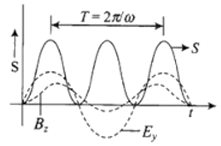
Poynting vectors $\vec{S}$ is defined as a vector whose magnitude is equal to the wave intensity and whose direction is along the direction of wave propogation. Mathematically, it is given by $\vec{S}=\frac{1}{\mu_0} \vec{E} \times \vec{B}$. Show the nature of $S$ vs $t$ graph.
Answer
View full question & answer→Poynting vectors $S$ is defined as a vector whose magnitude is equal to the wave intensity and whose direction is along the direction of wave propagation. In an electromagnetic wave,
let $\vec{E}$ be varying along $y-$ axis, $\vec{B}$ is along $z-$ axis and propagation of wave be along $x-$ axis.
Then $\vec{E} \times \vec{B}$ will tell the direction of propagation of energy flow in electromagnetic wave, along $x-$ axis.
Let $\vec{E}= E _0 \sin (\omega t - kx ) \hat{j}$
$\vec{B}= B _0 \sin (\omega t - kx ) \hat{k}$
$S=\frac{1}{\mu_0}(\vec{E} \times \vec{B})=\frac{1}{\mu_0} E_0 B_0 \sin ^2(\omega t-k x)(\hat{j} \times \hat{k})$
$\Rightarrow S=\frac{E_0 B_0}{\mu_0} \sin ^2(\omega t-k x) \hat{i}( As \hat{j} \times \hat{k}=\hat{i})$
Since $\sin ^2(\omega t - kx )$ is never negative, $\vec{S}( x , t )$ always points in the positive $X-$ direction,
i.e, in the direction of wave propagation.
The variation of $|S|$ with time $T$ will be as given in the figure below:
let $\vec{E}$ be varying along $y-$ axis, $\vec{B}$ is along $z-$ axis and propagation of wave be along $x-$ axis.
Then $\vec{E} \times \vec{B}$ will tell the direction of propagation of energy flow in electromagnetic wave, along $x-$ axis.
Let $\vec{E}= E _0 \sin (\omega t - kx ) \hat{j}$
$\vec{B}= B _0 \sin (\omega t - kx ) \hat{k}$
$S=\frac{1}{\mu_0}(\vec{E} \times \vec{B})=\frac{1}{\mu_0} E_0 B_0 \sin ^2(\omega t-k x)(\hat{j} \times \hat{k})$
$\Rightarrow S=\frac{E_0 B_0}{\mu_0} \sin ^2(\omega t-k x) \hat{i}( As \hat{j} \times \hat{k}=\hat{i})$
Since $\sin ^2(\omega t - kx )$ is never negative, $\vec{S}( x , t )$ always points in the positive $X-$ direction,
i.e, in the direction of wave propagation.
The variation of $|S|$ with time $T$ will be as given in the figure below: