Question
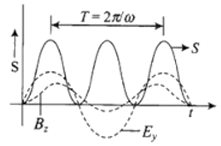
Poynting vectors $\vec{S}$ is defined as a vector whose magnitude is equal to the wave intensity and whose direction is along the direction of wave propogation. Mathematically, it is given by $\vec{S}=\frac{1}{\mu_0} \vec{E} \times \vec{B}$. Show the nature of $S$ vs $t$ graph.
Answer

Poynting vectors $S$ is defined as a vector whose magnitude is equal to the wave intensity and whose direction is along the direction of wave propagation. In an electromagnetic wave,
let $\vec{E}$ be varying along $y-$ axis, $\vec{B}$ is along $z-$ axis and propagation of wave be along $x-$ axis.
Then $\vec{E} \times \vec{B}$ will tell the direction of propagation of energy flow in electromagnetic wave, along $x-$ axis.
Let $\vec{E}= E _0 \sin (\omega t - kx ) \hat{j}$
$\vec{B}= B _0 \sin (\omega t - kx ) \hat{k}$
$S=\frac{1}{\mu_0}(\vec{E} \times \vec{B})=\frac{1}{\mu_0} E_0 B_0 \sin ^2(\omega t-k x)(\hat{j} \times \hat{k})$
$\Rightarrow S=\frac{E_0 B_0}{\mu_0} \sin ^2(\omega t-k x) \hat{i}( As \hat{j} \times \hat{k}=\hat{i})$
Since $\sin ^2(\omega t - kx )$ is never negative, $\vec{S}( x , t )$ always points in the positive $X-$ direction,
i.e, in the direction of wave propagation.
The variation of $|S|$ with time $T$ will be as given in the figure below:
Image ​​​​​​​

Need a full question paper?

Generate a complete, print-ready paper with questions like this in minutes — across 16+ boards, with answer keys.

Start Generating Free

Similar questions

A nucleus  $\frac{23}{10}$ Ne undergoes β− decay and becomes $\frac{23}{11}$Na. Calculate the maximum kinetic energy of electrons emitted assuming that the daughter nucleus and anti-neutrino carry negligible kinetic energy.$\left\{\text{mass of} \frac{23}{10} Ne = 22.994466 u\right\}$
$\left\{\text{mass of}\frac{23}{11}Na=22.989770u\right\}$
$\left\{ 1u = 931.5\text{MeV}/ c^{2}\right\}$
Find the thermo-emf developed in a copper-silver thermocouple when the junctions are kept at $0^\circ C$ and $40^\circ C$. Use the data in table.
Metal with
$a$
$b$
lead (Pb)
$\mu\text{V}/^\circ\text{C}$
$\mu\text{V}/^\circ(\text{C})^2$
Aluminium
$-0.47$ $0.003$
Bismuth
$-43.7$ $-0·47$
Copper
$2.76$ $0·012$
Gold
$2.90$ $0.0093$
Iron
$16.6$ $-0.030$
Nickel
$19.1$ $-0.030$
Platinum
$-1.79$ $-0.035$
Silver
$2.50$ $0.012$
Steel
$10.8$ $-0.016$
 
The electric current in a charging R-C circuit is given by $\text{i}=\text{i}_0\text{e}^{-\frac{\text{t}}{\text{RC}}}$ where $\text{i}_0,$ R and C are constant parameters of the circuit and t is time. Find the rate of change of current at
  1. t = 0.
  2. t = RC.
  3. t = 10RC.
  1. The peak voltage of an ac supply is $300V$. What is the rms voltage?
  2. The rms value of current in an ac circuit is $10A$. What is the peak current?
A parallel beam of monochromatic light is used in a Young's double slit experiment. The slits are separated by a distance $d$ and the screen is placed parallel to the plane of the slits. Show that if the incident beam makes an angle $\theta=\sin^{-1}\Big(\frac{\lambda}{2\text{D}}\Big)$ with the normal to the plane of the slits, there will be a dark fringe at the centre $P_0$ of the pattern.
A photographic film is coated with a silver bromide layer. When light fells on this film, silver bromide molecules dissociate end the film records the light there. A minimum of $0.6\ eV$ is needed to dissociate a silver bromide molecule. Find the maximum wavelength of light that can be recorded by the film.
Horizontal component of earth’s magnetic field at a place is $\sqrt{3}$ times its vertical component. What is the value of angle of dip at that place?
Write the number of significant digits in:
  1. 1001
  2. 100.1
  3. 100.10
  4. 0.001001
Why do semiconductors obey Ohm's law for only low fields?
Explain the proof of validity of Einstein's equation of photoelectric effect.