Questions

1 Marks Question

Take a timed test

26 questions · self-marked practice — reveal the answer and mark yourself.

Question 11 Mark
Why is it found experimentally difficult to detect neutrinos in nuclear $\beta$-decay?
Answer
Neutrinos are neutral (chargeless), (almost) massless particles that hardly interact with matter.
Alternate Answer
The neutrinos can penetrate large quantity of matter without any interaction

Alternate Answer
Neutrinos are chargeless and (almost) massless particles.
View full question & answer
Question 21 Mark
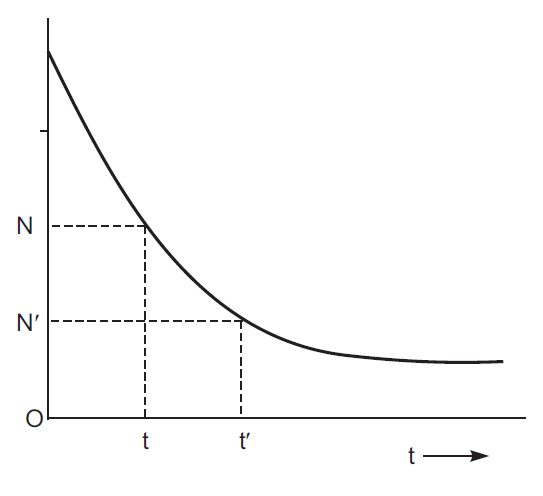
Define the activity of a given radioactive substance. Write its S.I. unit.
Answer
The rate of decay of a radioactive substance is called activity of that substance. It is negative of the rate of decay of the radioactive substance. Activity, $\text{R} = \frac{\text{N}' - \text{N}}{\text{t}' - \text{t}}$ $ = - \frac{\Delta\text{N}}{\Delta\text{t}}$ $ \DeclareMathOperator*{\median}{\text{lim}} \median_{\Delta\text{t}\rightarrow0}\bigg(-\frac{\Delta\text{N}}{\Delta\text{t}}\bigg) = -\frac{\text{dN}}{\text{dt}}$ S.I. unit of activity
  1. becquerel (Bq).
  2. decay per second.
View full question & answer
Question 31 Mark
Write any two characteristic properties of nuclear force.
Answer
Characteristic properties of nuclear force are short ranged, strong, attractive, charge independent, spin dependent, does not obey inverse square law, saturated, non central.
View full question & answer
Question 41 Mark
Two nuclei have mass numbers in the ratio 1 : 8. What is the ratio of their nuclear radii?
Answer
$\text{R}= \text{R}_{0}\text{A}^{1/3}$

$\frac{\text{R}_{1}}{\text{R}_{2}} =\frac{1}{2}.$
View full question & answer
Question 51 Mark
State two characteristic properties of nuclear force.
Answer
Properties of Nuclear Force:
  • Short range/saturation.
  • Strongest.
  • Charge independent.
View full question & answer
Question 61 Mark
Define the term 'activity' of radionuclide. Write its SI unit.
Answer
The total decay rate of a sample of one or more radionuclide is called activity.Alternate Answer
Radioactive disintegration taking place per second.Alternate Answer
$\text{R} = - \frac{\text{dN}}{\text{dt}} , $where N is the total number of radionuclides at any time ‘t’. SI unit-becquerel(Bq) .
 
View full question & answer
Question 71 Mark
Two nuclei have mass numbers in the ratio 1:2. What is the ratio of their nuclear densities?
Answer
Ratio of nuclear density equals 1:1.
View full question & answer
Question 81 Mark
State the reason, why heavy water is generally used as a moderator in a nuclear reactor.
Answer
(HOTS) Lesser absorption probability of neutrons/more effective in slowing down neutrons to thermal energies.
View full question & answer
Question 91 Mark
An electron and alpha particle have the same de-Broglie wavelength associated with them. How are their kinetic energies related to each other?
Answer
$\text{K.E.} = \frac{p^2}{2m}$$\therefore \text{K.E.} \propto \frac{1}{m} $ ( For same P)
(as $\lambda = h/ p $ is the same)
Alternate Answer
$\therefore \frac{E_ke}{E_ka} = \frac{m_a}{m}_e$
View full question & answer
Question 101 Mark
The radioactive isotope D decays according to the sequence $\text{D}\xrightarrow{\beta}^{- }$ $\text{D}_{1}\xrightarrow{\alpha - particle}$ $\text{D}_{2}$If the mass number and atomic number of $\text{D}_{1}$ are 176 and 71 respectively, what is (i) the mass number (ii) atomic number of D?
Answer
  1. Mass number 180
  2. Atomic number 72
Alternate Answer
$\text{D}^{180}_{72}$
View full question & answer
Question 111 Mark
Four nuclei of an element undergo fusion to form a heavier nucleus, with release of energy. Which of the two - the parent or the daughter nucleus - would have higher binding energy per nucleon?
Answer
Daughter nucleus have higher binding energy per nucleon because they are more stable and higher stabilitymeans higher binding energy per nucleon.
View full question & answer
Question 121 Mark
The nuclear radius of $^{27}_{13}\text{Al}$ is 3.6 fermi. Find the nuclear radius of $^{64}_{29}\text{Cu}.$
Answer
$\frac{\text{R}_2}{\text{R}_1}=\Big(\frac{\text{A}_2}{\text{A}_1}\Big)^\frac{1}{3}$
$\Rightarrow\text{R}_2=3.6\Big(\frac{64}{27}\Big)^\frac{1}{3}=3.6\times\frac{4}{3}$
$=4.3\text{ Fermi}.$
View full question & answer
Question 131 Mark
${ }^{32} \mathrm{p}$ beta-decays to ${ }^{32} \mathrm{S}$. Find the sum of the energy of the antineutrino and the kinetic energy of the $\beta$-particle. Neglect the recoil of the daughter nucleus. Atomic mass of ${ }^{32} \mathrm{p}=31.974 \mathrm{u}$ and that of ${ }^{32} \mathrm{S}=31.972 \mathrm{u}$.
Answer
$\text{P}^{32}\rightarrow\text{S}^{32}+ \ _0\bar{\text{v}}^0+ \ _1\beta^0$
Energy of antineutrino and $\beta$-particle
= (31.974 - 31.972)u = 0.002u = 0.002 × 931 = 1.862MeV = 1.86.
View full question & answer
Question 141 Mark
Among alpha, beta and gamma radiations, which get affected by electric field?
Answer
Alpha and beta radiations are charged, so they are affected by electric field.
View full question & answer
Question 151 Mark
A nucleus of mass number A, has a mass defect $\triangle \text{m}.$ Give the formula, for the binding energy per nucleon, of this nucleus.
Answer
BE per nucleon, $B_n=\frac{\text{Total binding energy}}{\text{Number of nucleons}}$
$=\frac{\triangle \text{mc}^2}{\text{A}}$
Where c is the speed of light in vacuum.
View full question & answer
Question 161 Mark
If the nuclei of masses X and Y are fused together to form a nucleus of mass m and some energy is released, then:
  1. X + Y = m
  2. X + Y < m
  3. X + Y > m
  4. X − Y = m
Answer
  1. X + Y > m
Explanation:

Since some energy is released, so one part of total mass of reactants is converted into energy
Therefore, total mass of reactants

X + Y

is more than the mass of nucleus (m).
View full question & answer
Question 171 Mark
The binding energy per nucleon of the two nuclei A and B are 4 MeV and 8.2 MeV. Which of the two nuclei is more stable?
Answer
The nucleus (B) having larger binding energy is more stable.
View full question & answer
Question 181 Mark
When a p-type impurity is doped in a semiconductor, a large number of holes are created. This does not make the semiconductor charged. But when holes diffluse from the p-side to the n-side in a p-n junction, the n-side gets positively charged. Explain.
Answer
A p-type semiconductor is formed by doping a group 13 element with group 14 element (Si or Ge). As the group 13 element has only 3 electrons in its valence shell and the group 14 element has 4 electrons in its valence shell, when the group 13 element, say, Al, replaces one Si in the silicon crystal, only 3 covalent bonds are formed by it. And the fourth covalent bond is left in need of one electron. So, it creates a hole. Since the atom as a whole is electriclly neutral, the p-type semiconductor is also neutral.
In a p‒n junction, when the diffusion of holes takes place across the junction because of the difference in the concentration of charge carriers from p to n sides, these holes neutralise some of the electrons on the n side. So, the atom attached with that electron becomes one electron deficient and hence positively charged. This makes the n side of the p‒n junction positively charged and the p side of the p‒n junction negatively charged.
View full question & answer
Question 191 Mark
What will be the ratio of radii of two nuclei of mass numbers $A_1$ and $A_2$ ?
Answer
Ra dius of nuceus R $=\text{R}_0\text{A}^{\frac{1}{3}}$
$\Rightarrow \frac{\text{R}_1}{\text{R}_2}=\Big(\frac{\text{A}_1}{\text{A}_2}\Big)^{\frac{1}{3}}$
View full question & answer
Question 201 Mark
What percentage of a given mass of a radioactive substance will be left undecayed after four half periods?
Answer
Percentage of mass of radioactive substance undecayed after n = 4 half-lives.
$=\Big(\frac{1}{2}\Big)^4\times100\%=\frac{100}{16}$
$=6.25\%$
View full question & answer
Question 211 Mark
  1. a. Calculate the energy released if ${ }^{238} U$ emits an \$lalpha\$-particle.
  2. Calculate the energy to be supplied to ${ }^{238} \mathrm{U}$ it two protons and two neutrons are to be emitted one by one. The atomic masses of ${ }^{238} \mathrm{U},{ }^{234} \mathrm{Th}$ and ${ }^4 \mathrm{He}$ are $238.0508 \mathrm{u}, 234.04363 \mathrm{u}$ and 4.00260 u respectively.
Answer
$\text { a. } \mathrm{U}^{238}{ }_2 \mathrm{He}^4+\mathrm{Th}^{234}$
E= $ {\left.\left[M u-\left(N_{H C}+M_{T h}\right)\right] u=238.0508-(234.04363+4.00260)\right] u=4.25487 \mathrm{Mev}=4.255 \mathrm{Mev} . } $
$ \text { b. } E=U^{238}-\left[T h^{234}+2 n_0^{\prime}+2 p_1^{\prime}\right]$
$ =\{238.0508-[234.64363+2(1.008665)+2(1.007276)]\} u $
$ =0.024712 u=23.0068=23.007 \mathrm{MeV}$
View full question & answer
Question 221 Mark
Write any one equation representing nuclear fusion reaction.
Answer
Equation of fusion reaction.
$^2_1\text{H}\ \ +\ \ ^2_1\text{H}\ \ \rightarrow\ \ ^3_1\text{H}\ \ +\ \ ^1_1\text{H}\ \ +\ \ 4.03\text{MeV}$
View full question & answer
Question 231 Mark
Calculate the minimum energy needed to separate a neutron from a nucleus with Z protons and N neutrons it terms of the masses $M_{Z.N}, M_{Z,N-1}$ and the mass of the neutron.
Answer
$\text{E}_2\text{N}=\text{E}_{\text{Z,N}-1}+\text{ }^1_0\text{n}.$
Energy released $= ($Initial Mass of nucleus - Final mass of nucleus$)c^2=\left(M_{Z, N-1}+M_0-M_{Z N}\right) c^2$.
View full question & answer
Question 241 Mark
Show that the minimum energy needed to separate a proton from a nucleus with Z protons and N neutrons is:
$\Delta\text{E}=(\text{M}_{\text{Z}-1,\text{N}}+\text{M}_{\text{H}}-\text{M}_{\text{Z,N}})\text{c}^2$
where $M_{Z,N}$= mass of an atom with Z protons and N neutrons in the nucleus and $M_H=$ mass of a hydrogen atom. This energy is known as proton-separation energy.
Answer
$E_{Z.N.} → E_{Z-1, }N + P_1 ⇒ E_{Z.N. }→ E_{Z-1, }N +_1H^1 [$As hydrogen has no neutrons but protons only$]$
$\Delta E = (M_{Z-1, }N + N_H - M_{Z,N)}c^2$
View full question & answer
Question 251 Mark
Calculate the energy equivalent of $1 g$ of substance.
Answer
Energy, $E=10^{-3} \times\left(3 \times 10^8\right)^2 J$
$
E=10^{-3} \times 9 \times 10^{16}=9 \times 10^{13} J
$
Thus, if one gram of matter is converted to energy, there is a release of enormous amount of energy.
View full question & answer
Question 261 Mark
Given the mass of iron nucleus as $55.85 u$ and $A =56$, find the nuclear density?
Answer
$
m_{ Fe }=55.85, \quad u =9.27 \times 10^{-26} kg
$
Nuclear density $=\frac{\text { mass }}{\text { volume }}=\frac{9.27 \times 10^{-26}}{(4 \pi / 3)\left(1.2 \times 10^{-15}\right)^3} \times \frac{1}{56}$
$
=2.29 \times 10^{17} kg m ^{-3}
$
The density of matter in neutron stars (an astrophysical object) is comparable to this density. This shows that matter in these objects has been compressed to such an extent that they resemble a big nucleus.
View full question & answer