Questions

3 Marks Question

Take a timed test

4 questions · self-marked practice — reveal the answer and mark yourself.

Question 13 Marks
What are the utilities of moderator, coolant and controlling rods with reference to nuclear reactor.
Answer
Moderator : In the fission of uranium, fast neutrons of energy 2 MeV are released. These fast neutrons have more tendency to escape instead of triggering another fission reaction. Also, slow neutrons are more efficient in inducing fission in ${ }_{92}^{235} Ur$ nuclei than fast neutrons. By the use of a moderator, the fast neutrons are slowed to thermal velocities. Usually, heavy water, graphite and beryllium oxide are used as moderators.
Control rods : To start, stop or control the chain reaction, rods of neutron absorbing material like cadmium or boron are inserted into the reactor core. The rate of neutron production is controlled by adjusting the depth of control rods.
Coolant : It is the material used to cool the fuel rods and the moderator and is capable of carrying away large amount of heat produced in the fission process. The coolant transfers heat to the working liquid like water and produces steam. The steam drives a turbine which, in turn, runs a generator to generate electric power. The coolant must have high boiling point and high specific heat. Heavy water and liquid sodium are good coolants.
View full question & answer
Question 23 Marks
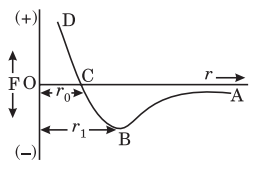
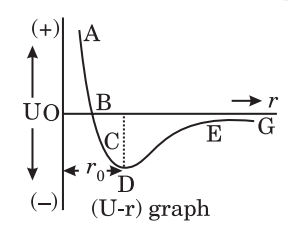
Draw the graphs for variation of potential energy and nuclear force between two nucleons as a function of distance between them.
View full question & answer
Question 33 Marks
Explain Yukawa's Principle for the origin of nuclear forces.
Answer
Yukawa's Theory for the Origin of Nuclear Forces : In 1935, Japanese scientist Yukawa attributed the origin of these forces to a new particle called 'π-meson' which, later on, was discovered experimentally in cosmic rays. The rest mass of a π-meson is a little more than the rest mass of electron but less than the mass of proton or neutron. Mesons are of three types, positively charged, negatively charged and uncharged $\left(\pi^{+}, \pi^{-}, \pi^0\right)$. The magnitude of charge on a charged meson is equal to electronic charge. According to Yukawa, there is a cloud of π-mesons around every nucleon (proton and neutron). The difference between proton and neutron is only due to different structures of meson clouds around them. There is a continuous exchange of π-mesons between protons and neutrons due to which they continue to be converted into one another.
According to Yukawa, when a proton and a neutron interact, the proton emits a positively charged π-meson which is absorbed by the neutron. As a result, the proton is converted into neutron and the neutron is converted into proton:
$p - \pi^{+} \rightarrow n; n + \pi^{+} \rightarrow p$
Similarly, when a neutron emits a negatively charged π-meson which is absorbed by a proton, then the neutron is converted into proton and proton is converted into neutron:
$n-\pi^{+} \rightarrow p ; p+\pi^{-} \rightarrow n$
The exchange of $\pi^{-}$ and $\pi^{+}$ mesons between protons and neutrons is responsible for the origin of nuclear forces between them. Similarly, nuclear forces between two protons and between two neutrons are generated by a continuous exchange of $\pi^{0}$-mesons between them. Thus, the basis of nuclear forces is the exchange of mesons and hence these are also called 'exchange forces'.
Since mesons are continuously moving between the nucleons, so their mass is not added to the mass of the nucleus.
View full question & answer
Question 43 Marks
Pick up (i) Isotones, (ii) Isotopes, (iii) Isobars among the following:
$ {}_{6}^{12}C, {}_{2}^{3}He, {}_{80}^{198}Hg, {}_{1}^{3}H, {}_{79}^{197}Au, {}_{6}^{14}C $.
Answer
(i) Isotones : (A-Z) has the same value for these.
Hence: ${ }_{80}^{198} Hg ,{ }_6^{14} C$ are isotones.
(ii) Isotopes : 'Z' should be equal and A should be different for these.
Hence : $ {}_{6}^{12}C, {}_{6}^{14}C $ are isotopes of carbon.
(iii) Isobars : 'A' should be equal and Z should be different for these.
Hence : $ {}_{2}^{3}He, {}_{1}^{3}H $ are isobars.
View full question & answer