Questions

3 Marks Question

Take a timed test

10 questions · self-marked practice — reveal the answer and mark yourself.

Question 13 Marks
A carrom board (4ft × 4ft square) has the queen at the centre. The queen, hit by the striker moves to the front edge, rebounds and goes in the hole behind the striking line. Find the magnitude of displacement of the queen:
  1. From the centre to the front edge.
  2. From the front edge to the hole.
  3. From the centre to the hole.
Answer
In $\triangle\text{ABC},\tan\theta=\frac{\text{x}}{2}$ and $\triangle\text{DCE},\tan\theta=\frac{(2-\text{x})}{4\tan\theta}=\Big(\frac{\text{x}}{2}\Big)=\frac{(2-\text{x})}{4}=4\text{x}$$\Rightarrow4-2\text{x}=4\text{x}$
$\Rightarrow6\text{x}=4\Rightarrow\text{x}=\frac{2}{3}\text{ft}$
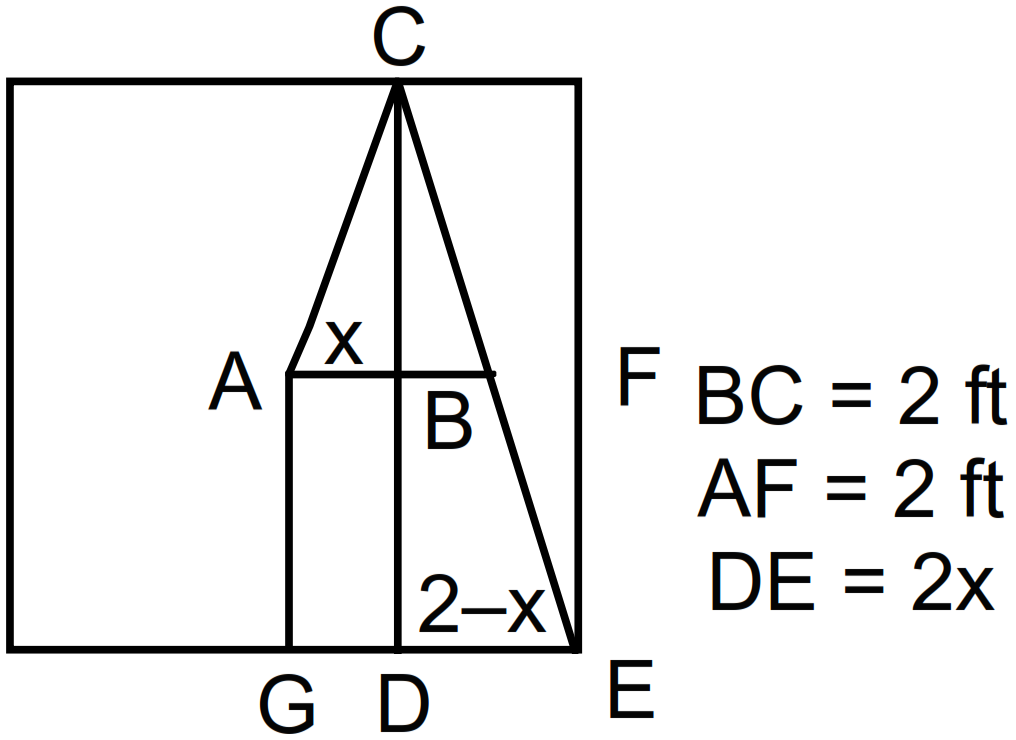
  1. In $\triangle\text{ABC, AC}=\sqrt{\text{AB}^2+\text{BC}^2}=\frac{2}3{}\sqrt{10}\text{ft}$
  2. In $\triangle\text{CDE, DE}=1-\Big(\frac{2}{3}\Big)=\frac{4}{3}\text{ft}$
$\text{CD}=4\text{ft}.$ So, $\text{CE}=\sqrt{\text{CD}^2+\text{DE}^2}=\frac{4}{3}\sqrt{10}\text{ft}$
  1. In $\triangle\text{AGE, AE}=\sqrt{\text{AG}^2+\text{GE}^2}=2\sqrt{2}\text{ft}.$
View full question & answer
Question 23 Marks
Let $\varepsilon_1$ and $\varepsilon_2$ be the angles made by $\overrightarrow{\text{A}}$ and $-\overrightarrow{\text{A}}$ with the positive X-axis. Show that $\tan\varepsilon_1=\tan\varepsilon_2.$ Thus, giving tane does not uniquely determine the direction of $\overrightarrow{\text{A}}.$
Answer
If a vector A makes α with x-axis then -A makes an angle $(\pi+\alpha)=\beta$ with same positive direction of x-axis.$\Rightarrow\tan\beta=\tan(\pi+\alpha)=\tan\alpha \ ...\text{QED}$
So yes if we only give $\tan\theta$ of a vector where $\theta$ is the angle made by the x-axis, it doesn’t uniquely determine the direction of a vector.
View full question & answer
Question 33 Marks
The thickness of a glass plate is measured to be 2.17mm, 2.17mm and 2.18mm at three different places. Find the average thickness of the plate from this data.
Answer
We know that,
Average thickness $=\frac{2.17+2.17+2.18}{3}=2.1733\text{mm}$
Rounding off to 3 significant digits, average thickness = 2.17mm.
View full question & answer
Question 43 Marks
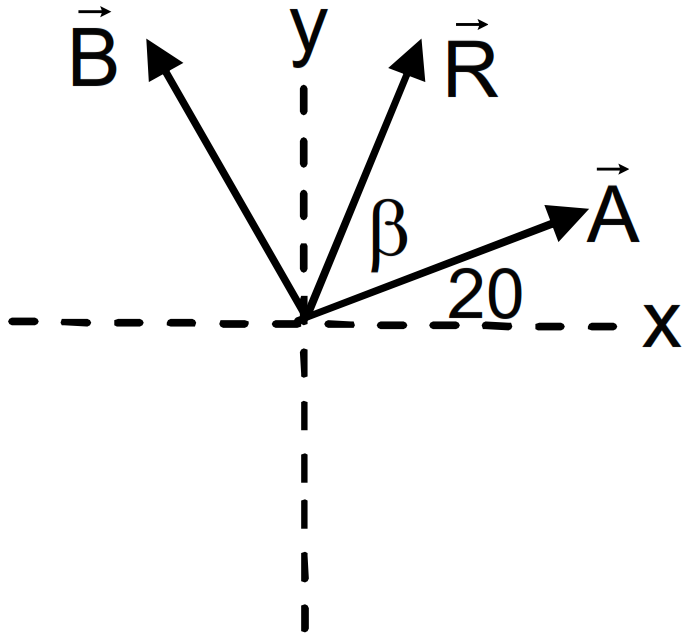
A vector $\overrightarrow{\text{A}}$ makes an angle of 20° and $\overrightarrow{\text{B}}$ makes an angle of 110° with the X-axis. The magnitudes of these vectors are 3 m and 4 m respectively. Find the resultant.
Answer
As shown in the figure, The angle between $\overrightarrow{\text{A}}$ and $\overrightarrow{\text{B}} = 110^{\circ}-20^{\circ}=90^{\circ}$$|\overrightarrow{\text{A}}|=4$ and $|\overrightarrow{\text{B}}|=4\text{m}$
Resultant $\text{R}=\sqrt{\text{A}^2+\text{B}^2+2\text{AB}\cos\theta}=5\text{m}$ Let $\beta$ be the angle between $\overrightarrow{\text{R}}$ and $\overrightarrow{\text{A}}$$\beta=\tan^{-1}\Big(\frac{4\sin90^{\circ}}{3+4\cos90^{\circ}}\Big)=\tan^{-1}\Big(\frac{4}{3}\Big)=53^{\circ}$
$\therefore$ Resultant vector makes angle (53° + 20°) = 73° with x-axis.
View full question & answer
Question 53 Marks
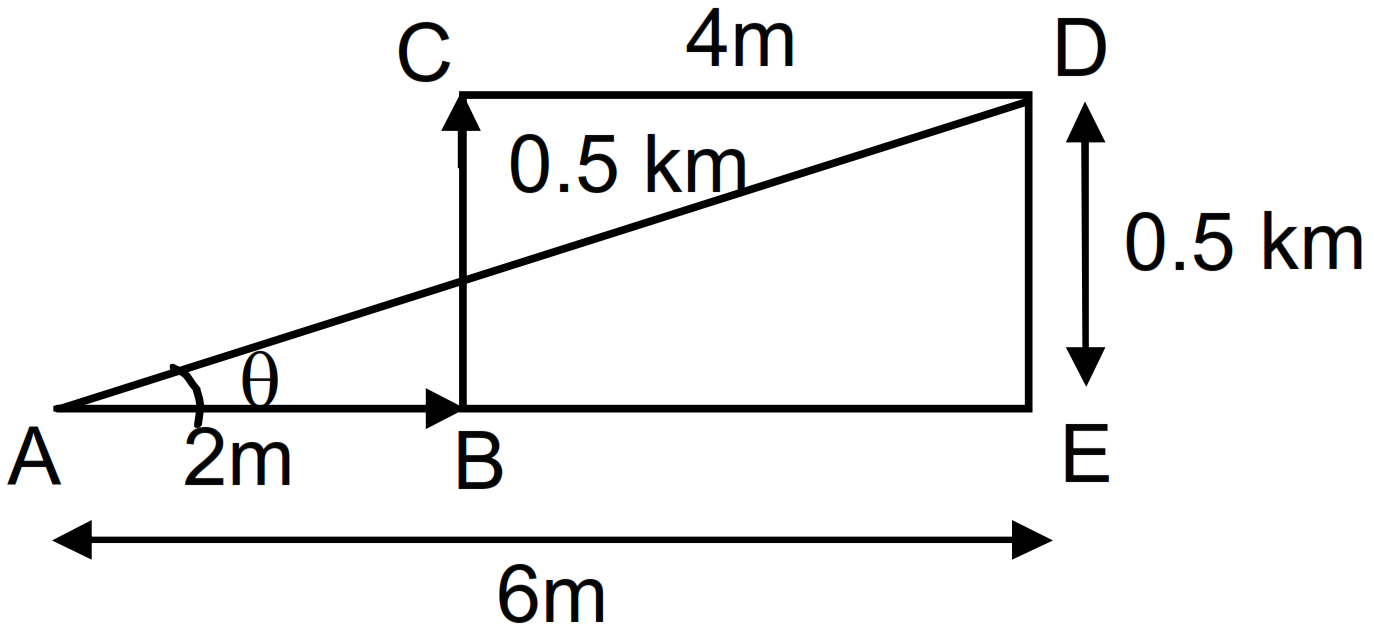
A spy report about a suspected car reads as follows. "The car moved 2.00km towards east, made a perpendicular left turn, ran for 500m, made a perpendicular right turn, ran for 4.00km and stopped". Find the displacement of the car.
Answer
$\overrightarrow{\text{AD}}=2\hat{\text{i}}+0.5\hat{\text{j}}+4\hat{\text{k}}=6\hat{\text{i}}+0.5\hat{\text{j}}$$\text{AD}=\sqrt{\text{AE}^2+\text{DE}^2}=6.02\text{ KM}$
$\tan\theta=\frac{\text{DE}}{\text{AE}}=\frac{1}{12}$
$\theta=\tan^{-1}\Big(\frac{1}{12}\Big)$
The displacement of the car is 6.02km along the distance $\tan^{-1}\Big(\frac{1}{12}\Big)$ with positive x-axis.
View full question & answer
Question 63 Marks
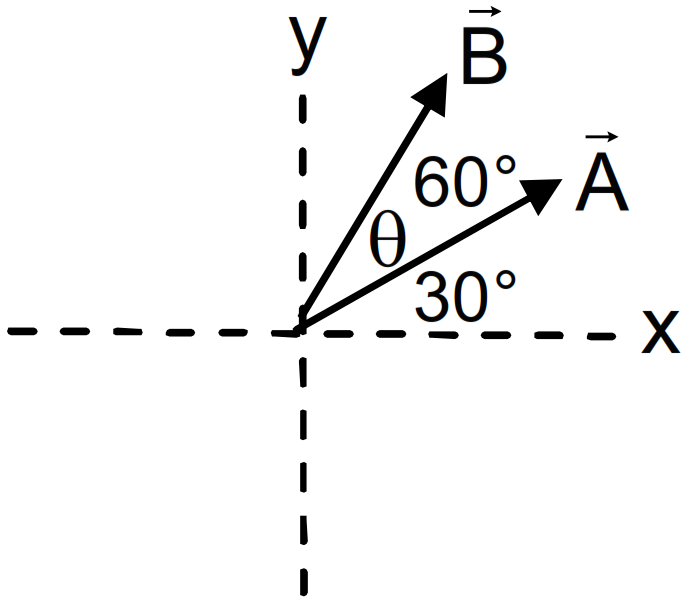
Let $\overrightarrow{\text{A}}$ and $\overrightarrow{\text{B}}$ be the two vectors of magnitude 10 unit each. If they are inclined to the X-axis at angles 30° and 60° respectively, find the resultant.
Answer
Angle between $\overrightarrow{\text{A}}$ and $\overrightarrow{\text{B}}$ is $\theta=60^{\circ}-30^{\circ}=30^{\circ}$$\big|\overrightarrow{\text{A}}\big|$ and $\big|\overrightarrow{\text{B}}\big|=10\text{ unit}$
$\text{R}=\sqrt{10^2+10^2+2.10.10.\cos30^{\circ}}=19.3$
$\beta$ be the angle between $\overrightarrow{\text{R}}$ and $\overrightarrow{\text{A}}$
$\beta=\tan^{-1}\Big(\frac{10\sin30^{\circ}}{10+10\cos30^{\circ}}\Big)$
$=\tan^{-1}\Big(\frac{1}{2+\sqrt{3}}\Big)$
$=\tan^{-1}(0.26795)=15^{\circ}$
$\therefore$ Resultant makes 15° + 30° = 45° angle with x-axis.
View full question & answer
Question 73 Marks
The momentum p of a particle changes with time t according to the relation $\frac{\text{dp}}{\text{dt}}=(10\text{N})+(2\text{N/s)t}.$ If the momentum is zero at t = 0, what will the momentum be at t = 10s?
Answer
$\frac{\text{dp}}{\text{dt}}=(10\text{N})+(2\text{N/s)t}$momentum is zero at t = 0
$\therefore$ momentum at t = 10 sec will be
dp = [(10 N) + 2Ns t]dt
$\int\limits^{\text{P}}_0\text{dp}=\int\limits^{10}_010\text{dt}+\int\limits^{10}_0(2\text{tdt})=10\text{t}]^{10}_0+2\frac{\text{t}^2}{2}\Big]^{10}_0=200\text{kg m/s}.$
View full question & answer
Question 83 Marks
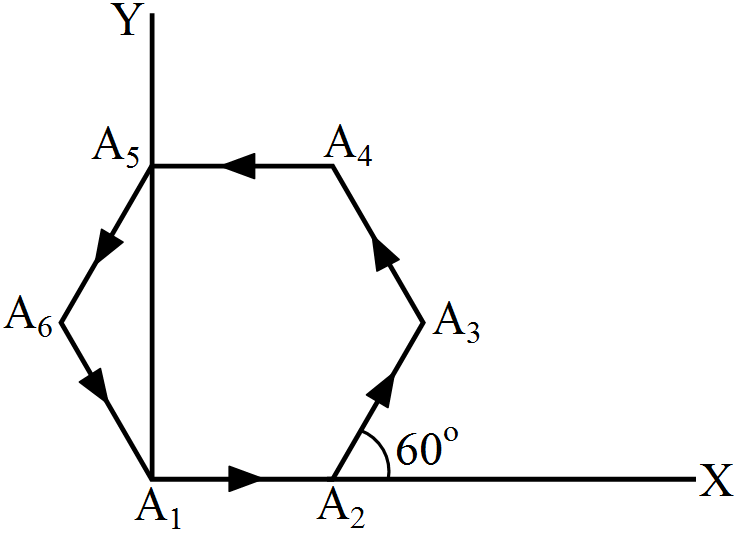
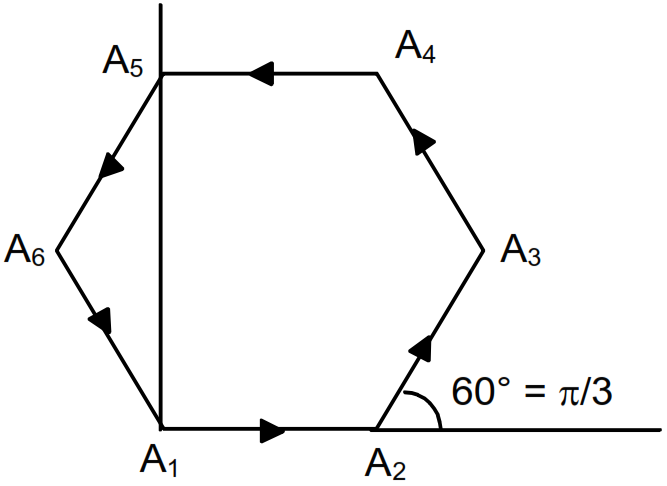
Let $A_1A_2A_3 A_4 A_5 A_6 A_1$ be a regular hexagon. Write the x-components of the vectors represented by the six sides taken in order. Use the fact that the resultant of these six vectors is zero, to prove that$\cos0+\cos\frac{\pi}{3}+\cos\frac{2\pi}{3}+\cos\frac{3\pi}{3}+\cos\frac{4\pi}{3}+\cos\frac{5\pi}{3}=0.$
Use the known cosine values to verify the result.
Answer
We know that according to polygon law of vector addition, the resultant of these six vectors is zero. Here A = B = C = D = E = F (magnitude) So, $\text{R}_\text{x} = \text{A}\cos\theta+\text{A}\cos\frac{\pi}{3}+\text{A}\cos\frac{2\pi}{3}+\text{A}\cos\frac{3\pi}{3}\\+\text{A}\cos\frac{4\pi}{4}+\text{A}\cos\frac{5\pi}{5}=0 [$As resultant is zero. X component of resultant $R_x = 0]$$=\cos\theta+\cos\frac{\pi}{3}+\cos\frac{2\pi}{3}+\cos\frac{3\pi}{3}+\cos\frac{4\pi}{3}+\cos\frac{5\pi}{3}=0$
Note: Similarly it can be proved that,$\sin\theta+\sin\frac{\pi}{3}+\sin\frac{2\pi}{3}+\sin\frac{3\pi}{3}+\sin\frac{4\pi}{3}+\sin\frac{5\pi}{3}=0$
View full question & answer
Question 93 Marks
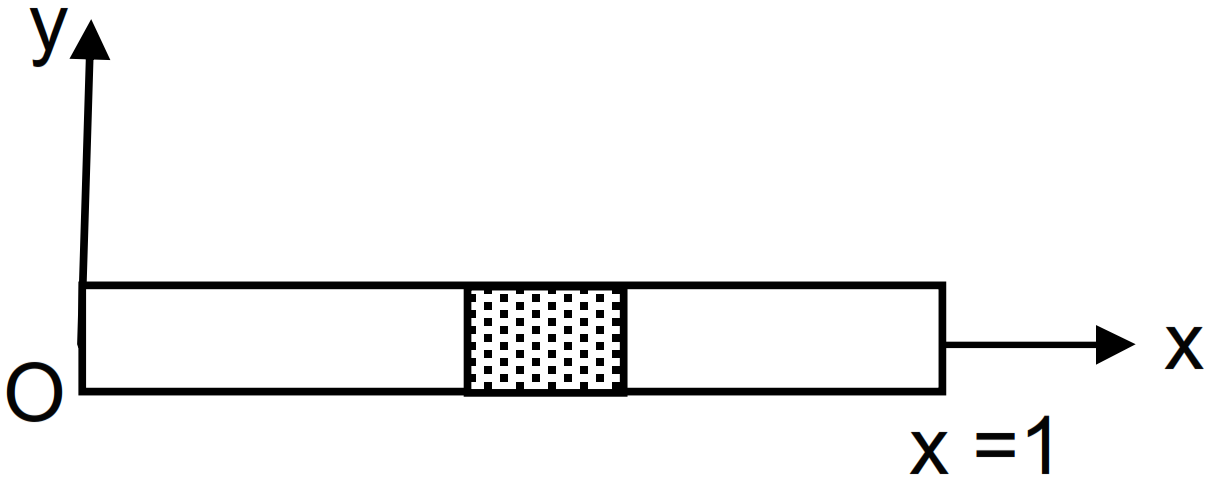
A rod of length L is placed along the X-axis between x = 0 and x = L. The linear density (mass/ length) $\rho$ of the rod varies with the distance x from the origin as $\rho=\text{a + bx.}$
  1. Find the SI units of a and b.
  2. Find the mass of the rod in terms of a, b and L.
Answer
$\rho=\frac{\text{mass}}{\text{length}}=\text{a + bx}$
  1. S.I. unit of ‘a’ = kg/m and SI unit of $‘b’ = kg/m^2$ (from principle of homogeneity of dimensions)
  2. Let us consider a small element of length ‘dx’ at a distance x from the origin as shown in the figure.
$\therefore\text{dm = mass of the element}=\rho\text{ dx = (a + bx)dx}$
So, $\text{mass of the rod = m = }\int\text{dm}=\int\limits^{\text{L}}_0(\text{a + bx)dx}\\=\Big[\text{ax}+\frac{\text{bx}^2}{2}\Big]^{\text{L}}_0=\text{aL}+\frac{\text{bL}^2}{2}$
View full question & answer
Question 103 Marks
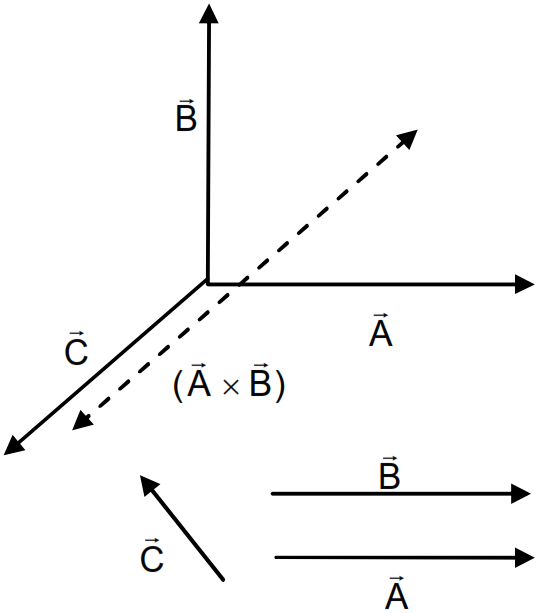
If $\vec{\text{A}},\vec{\text{B}},\vec{\text{C}}$ are mutually perpendicular, show that $\vec{\text{C}}\times(\vec{\text{A}}\times\vec{\text{B}})=0.$ Is the converse true?
Answer
Given that $\vec{\text{A}},\vec{\text{B}}$ and $\vec{\text{C}}$ are mutually perpendicular$\vec{\text{A}}\times\vec{\text{B}}$ is a vector which direction is perpendicular to the plane containing $\vec{\text{A}}$ and $\vec{\text{B}}.$ Also $\vec{\text{C}}$ is perpendicular to $\vec{\text{A}}$ and $\vec{\text{B}}$$\therefore$ Angle between $\vec{\text{C}}$ and $\vec{\text{A}}\times\vec{\text{B}}$ is $0^{\circ}$ or $180^{\circ}$
So, $\vec{\text{C}}\times(\vec{\text{A}}\times\vec{\text{B}})=0$ The converse is not true. For example, if two of the vector are parallel, then also$\vec{\text{C}}\times(\vec{\text{A}}\times\vec{\text{B}})=0$
So, they need not be mutually perpendicular.
View full question & answer