Questions

2 Marks Questions

Take a timed test

17 questions · self-marked practice — reveal the answer and mark yourself.

Question 12 Marks
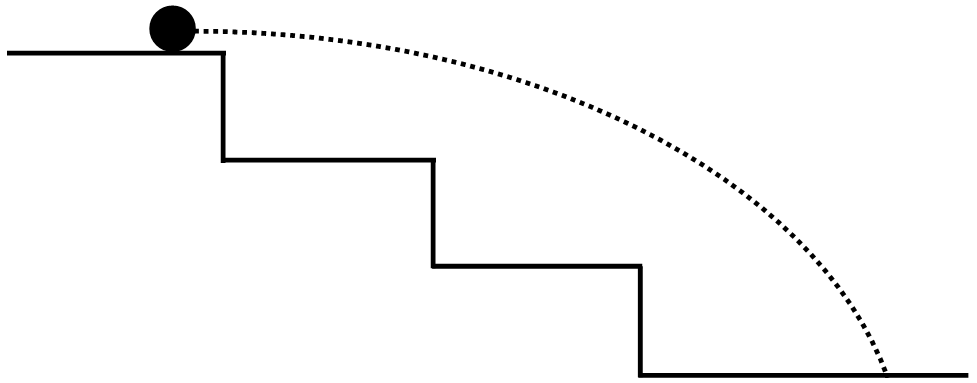
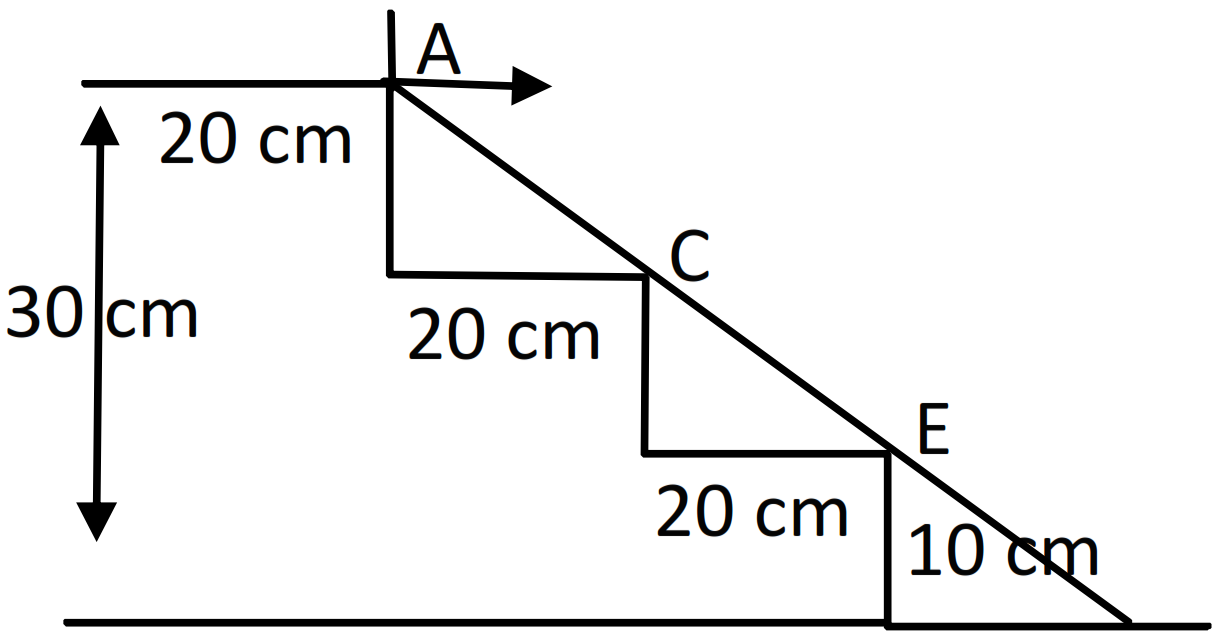
A staircase contains three steps each 10cm high and 20cm wide (figure). What should be the minimum horizontal velocity of a ball rolling off the uppermost plane so as to hit directly the lowest plane?
Answer
At minimum velocity it will move just touching point E reaching the ground. A is origin of reference coordinate. If u is the minimum speed.$\text{X}=40,\text{Y}=-20,\theta=0^{\circ}$
$\therefore\text{Y = x}\tan\theta-\text{g}\frac{\text{x}^2\sec^2\theta}{2\text{u}^2}$ $\big($because $\text{g}=10\text{m/s}^2=1000\text{cm/s}^2\big)$
$\Rightarrow-20=\text{x}\tan\theta-\frac{1000\times40^2\times1}{2\text{u}^2}$
$\Rightarrow\text{u}=200\text{cm/s}=2\text{m/s}.$
$\therefore$ The minimum horizontal velocity is 2m/s.
View full question & answer
Question 22 Marks
Give examples where:
  1. The velocity of a particle is zero but its acceleration is not zero.
  2. The velocity is opposite in direction to the acceleration.
  3. The velocity is perpendicular to the acceleration.
Answer
Particle thrown upwards:
  1. At highest point.
  2. While going up.
  3. At the highest point of projectile.
View full question & answer
Question 32 Marks
A ball is thrown vertically upward with a speed of 20m/s. Draw a graph showing the velocity of the ball as a function of time as it goes up and then comes back.
View full question & answer
Question 42 Marks
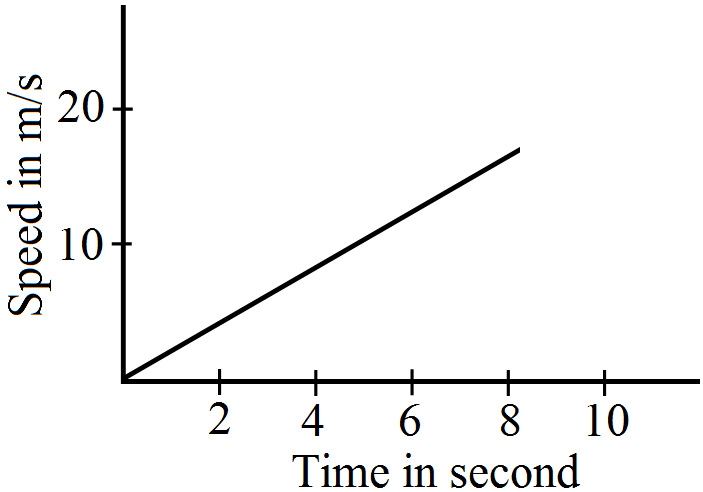
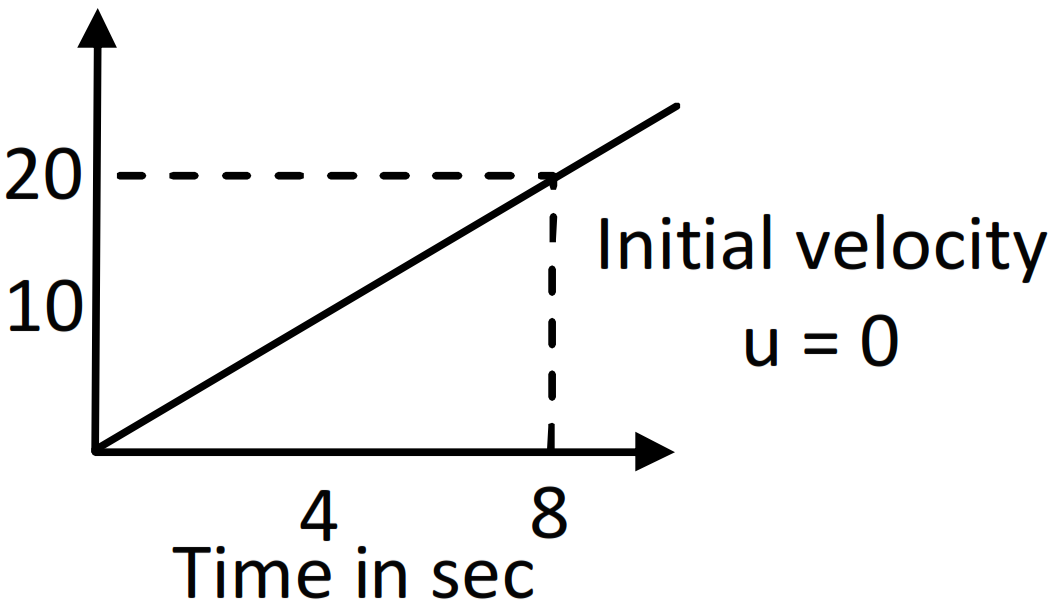
The speed of a car as a function of time is shown in figure. Find the distance travelled by the car in 8 seconds and its acceleration.
Answer
In the interval 8sec the velocity changes from 0 to 20m/s. Average acceleration $=\frac{20}{8}=2.5\text{m/s}^2\Big(\frac{\text{change in velocity}}{\text{time}}\Big)$ Distance travelled $\text{s = ut}+\frac{1}{2}\text{at}^2$$\Rightarrow0+\frac{1}{2}(2.5)8^2=80\text{m}.$
View full question & answer
Question 52 Marks
A bullet going with speed 350m/s enters a concrete wall and penetrates a distance of 5.0cm before coming to rest. Find the deceleration.
Answer
u = 350m/s, s = 5cm = 0.05m, v = 0
Deceleration $\text{a}=\frac{\text{v}^2-\text{u}^2}{2\text{s}}=\frac{0-(350)^2}{2\times0.05}=-12.5\times10^5\text{m/s}^2.$
Deceleration is $-12.5 × 10^5m/s^2$.
View full question & answer
Question 62 Marks
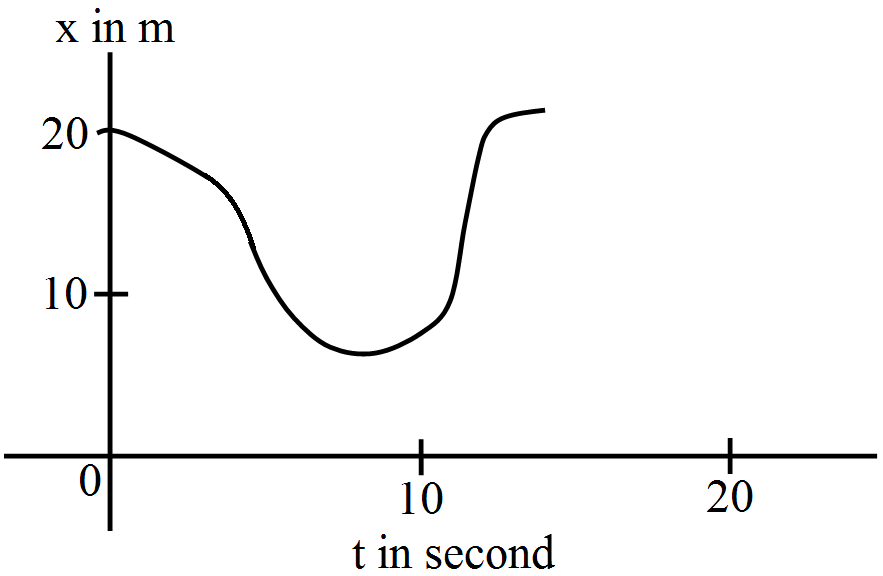
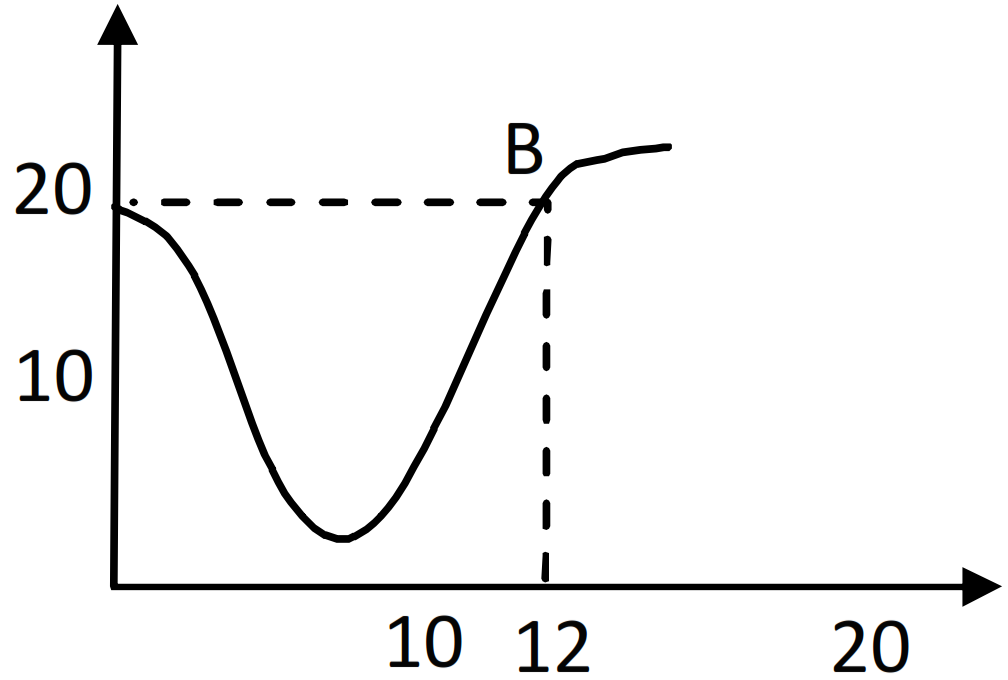
Figure shows x-t graph of a particle. Find the time t such that the average velocity of the particle during the period 0 to t is zero.
Answer
Consider the point B, at t = 12 sec At t = 0; s = 20m and t = 12 sec s = 20m So for time interval 0 to 12 sec Change in displacement is zero. So, average velocity $=\frac{\text{displacement}}{\text{time}}=0$$\therefore$ The time is 12 sec.
View full question & answer
Question 72 Marks
A particle starting from rest moves with constant acceleration. If it takes 5.0s to reach the speed 18.0km/h find:
  1. The average velocity during this period.
  2. The distance travelled by the particle during this period.
Answer
u = 0, v = 18km/hr = 5m/s, t = 5 sec$\text{a}=\frac{\text{v}-\text{u}}{\text{t}}=\frac{5-0}{5}=1\text{m/s}^2.$
$\text{s = ut}+\frac{1}{2}\text{at}^2=12.5\text{m}$
  1. Average velocity $\text{V}_{\text{ave}}=\frac{(12.5)}{5}=2.5\text{m/s}.$
  2. Distance travelled is 12.5m.
View full question & answer
Question 82 Marks
A driver takes 0.20s to apply the brakes after he sees a need for it. This is called the reaction time of the driver. If he is driving a car at a speed of 54km/h and the brakes cause a deceleration of $6.0m/s^2$, find the distance travelled by the car after he sees the need to put the brakes on.
Answer
In reaction time the body moves with the speed $54 \mathrm{~km} / \mathrm{hr}=15 \mathrm{~m} / \mathrm{sec}$ (constant speed) Distance travelled in this time is $\mathrm{S}_1=15 \times 0.2=3 \mathrm{~m}$. When brakes are applied, $\mathrm{u}=15 \mathrm{~m} / \mathrm{s}, \mathrm{v}=0, \mathrm{a}=-6 \mathrm{~m} / \mathrm{s}^2$ (deceleration)
$\mathrm{S}_2=\frac{\mathrm{v}^2-\mathrm{u}^2}{2 \mathrm{a}}=\frac{0-15^2}{2(-6)}=18.75 \mathrm{~m}$
Total distance $s=s_1+s_2=3+18.75=21.75=22 \mathrm{~m}$.
View full question & answer
Question 92 Marks
When a person leaves his home for sightseeing by his car, the meter reads 12352km. When he returns home after two hours the reading is 12416km.
  1. What is the average speed of the car during this period?
  2. What is the average velocity?
Answer
  1. Total distance covered 12416 - 12352 = 64km in 2 hours.
Speed $=\frac{64}{2}=32\text{km/h}$
  1. As he returns to his house, the displacement is zero.
$\text{Velocity}=\Big(\frac{\text{displacement}}{\text{time}}\Big)=0$
View full question & answer
Question 102 Marks
An athelete takes 2.0s to reach his maximum speed of 18.0km/h. What is the magnitude of his average acceleration?
Answer
Initial velocity u = 0 ($\therefore$ starts from rest) Final velocity v = 18km/hr = 5sec (i.e. max velocity) Time interval t = 2sec.$\therefore\text{Acceleration = a}_{\text{ave}}=\frac{\text{v}-\text{u}}{\text{t}}=\frac{5}{2}=2.5\text{m/s}^2.$
View full question & answer
Question 112 Marks
If a particle is accelerating, it is either speeding up or speeding down. Do you agree with this statement?
Answer
Acceleration doesn’t mean speeding up or down. It means change of velocity either change in magnitude or direction.
View full question & answer
Question 122 Marks
Rain is falling vertically. A man running on the road keeps his umbrella tilted but a man standing on the street keeps his umbrella vertical to protect himself from the rain. But both of them keep their umbrella vertical to avoid the vertical sun-rays. Explain.
Answer
We can change the direction of relative velocity of rain as its speed is less but speed of light is very high so if we run also relative velocity of light with respect to us remain constant.
View full question & answer
Question 132 Marks
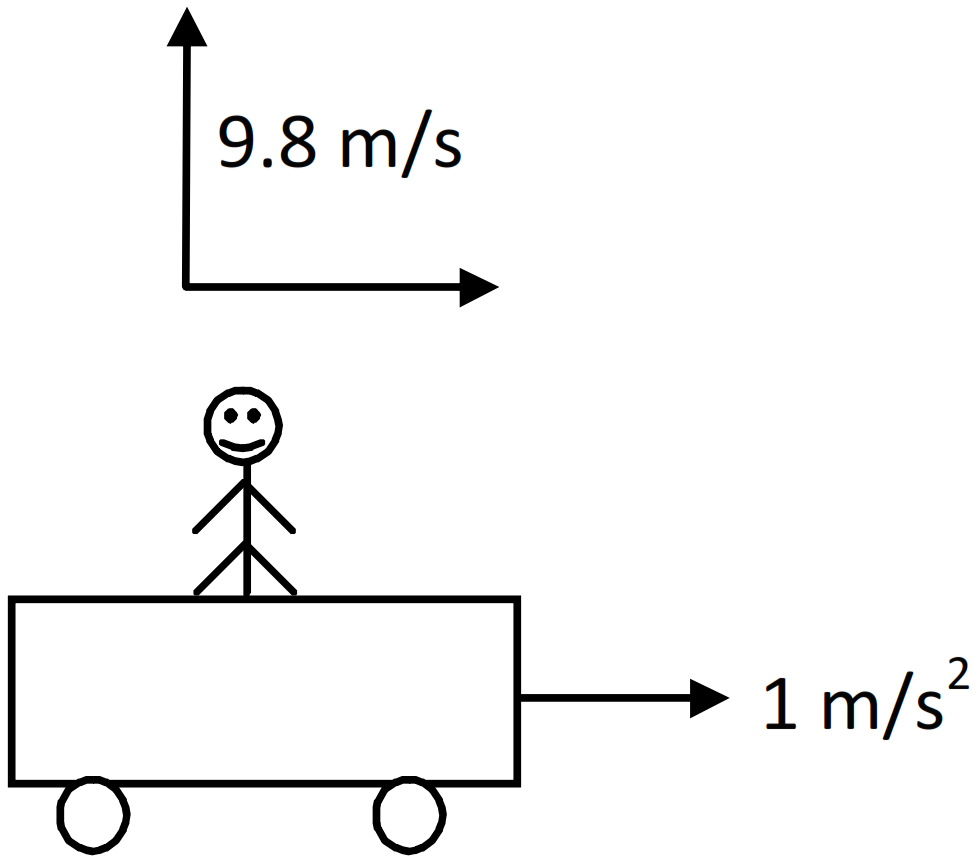
A boy standing on a long railroad car throws a ball straight upwards. The car is moving on the horizontal road with an acceleration of $1m/s^2$ and the projection velocity in the vertical direction is 9.8m/s. How far behind the boy will the ball fall on the car?
Answer
Let the velocity of car be u when the ball is thrown. Initial velocity of car is = Horizontal velocity of ball. Distance travelled by ball B Sb = ut (in horizontal direction) And by car $\text{S}_{\text{c}}=\text{ut}+\frac{1}{2}\text{at}^2$ where t → time of flight of ball in air.$\therefore$ Car has travelled extra distance $\text{S}_{\text{c}}-\text{S}_{\text{b}}=\frac{1}{2}\text{at}^2.$
Ball can be considered as a projectile having $\theta=90^{\circ}.$$\therefore\text{t}=\frac{2\text{u}\sin\theta}{\text{g}}=\frac{2\times9.8}{9.8}=2\sec.$
$\therefore\text{S}_{\text{c}}-\text{S}_{\text{b}}=\frac{1}{2}\text{at}^2=2\text{m}$
$\therefore$ The ball will drop 2m behind the boy.
View full question & answer
Question 142 Marks
A food packet is dropped from a plane going at an altitude of 100m. What is the path of the packet as seen from the plane? What is the path as seen from the ground? If someone asks "what is the actual path", what will you answer?
Answer
Path seen from the plane is straight line as plane and food packet has same horizontal velocity.
Path will be parabola, actual path is not defined path is respect to a reference frame, absolute reference frame is not defined.
View full question & answer
Question 152 Marks
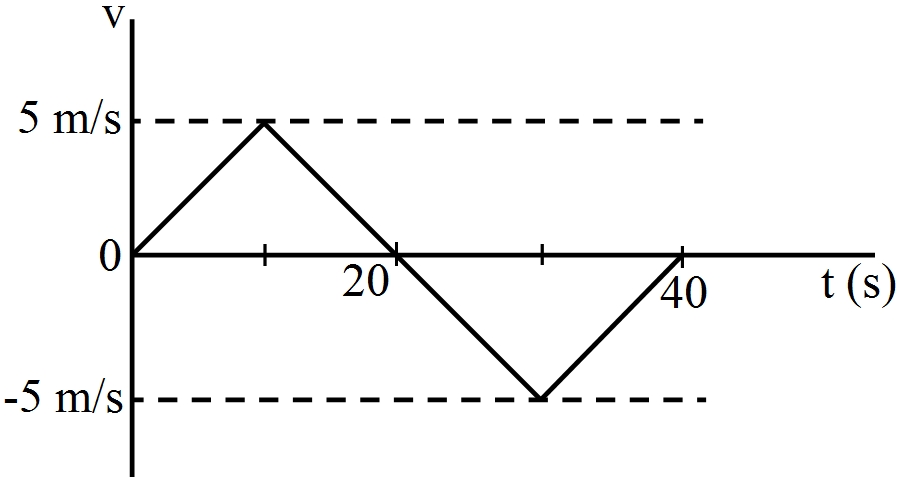
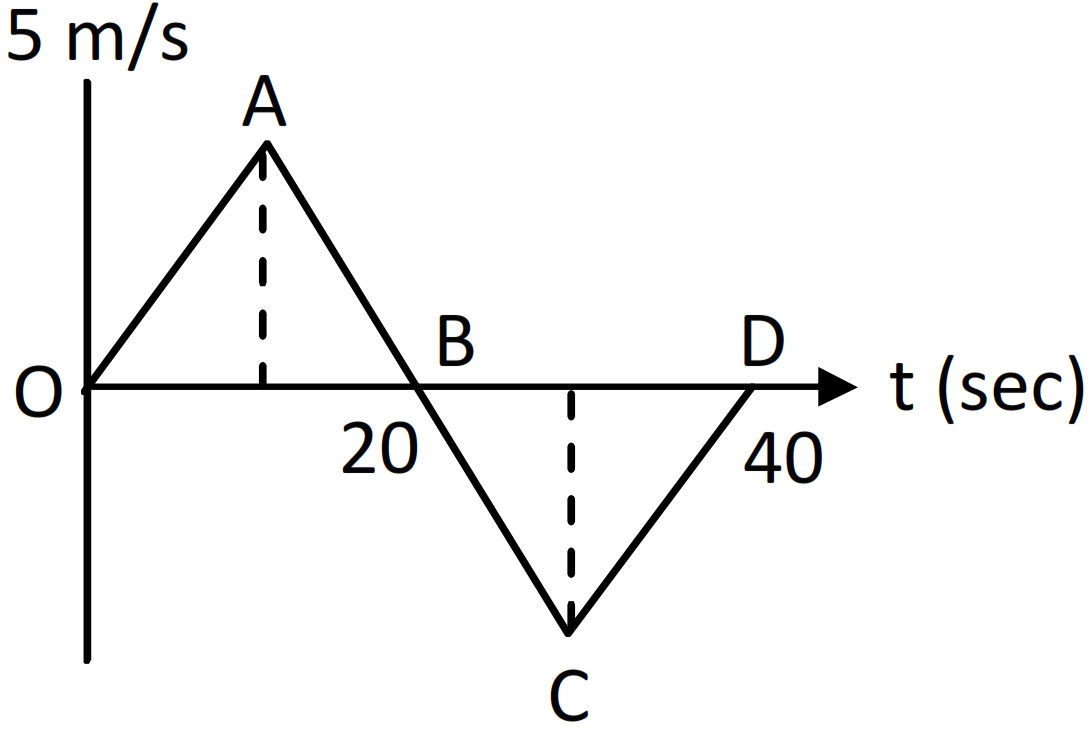
From the velocity-time plot shown in figure, find the distance travelled by the particle during the first 40 seconds. Also find the average velocity during this period.
Answer
Distance in first 40 sec is, $\triangle\text{OAB}+\triangle\text{BCD}$$=\frac{1}{2}\times5\times20+\frac{1}5{}\times5\times20=100\text{m.}$
Average velocity is 0 as the displacement is zero.
View full question & answer
Question 162 Marks
A ball is projected from a point on the floor with a speed of 15m/s at an angle of 60° with the horizontal. Will it hit a vertical wall 5m away from the point of projection and perpendicular to the plane of projection without hitting the floor? Will the answer differ if the wall is 22m away?
Answer
Here $\text{u}=15\text{m/s},\theta=60^{\circ},\text{g}=9.8\text{m/s}^2$
Horizontal range $\text{x}=\frac{\text{u}^2\sin2\theta}{\text{g}}=\frac{(15)^2\sin(2\times60^{\circ})}{9.8}=19.88\text{m}$
In first case the wall is 5m away from projection point, so it is in the horizontal range of projectile. So the ball will hit the wall. In second case (22m away) wall is not within the horizontal range. So the ball would not hit the wall.
View full question & answer
Question 172 Marks
A bullet travelling with a velocity of 16m/s penetrates a tree trunk and comes to rest in 0.4m. Find the time taken during the retardation.
Answer
u = 16m/s (initial), v = 0, s = 0.4m.Deceleration $\text{a}=\frac{\text{v}^2-\text{u}^2}{2\text{s}}=-320\text{m/s}^2.$
Time $=\text{t}=\frac{\text{v}-\text{u}}{\text{a}}=\frac{0-16}{-320}=0.05\text{ sec}.$
View full question & answer