Question types

Rest and Motion: Kinematics question types

87 questions across 6 question groups — pick any mix to generate a Physics paper with step-by-step answer keys.

87
Questions
6
Question groups
5
Question types
Sample Questions

Rest and Motion: Kinematics questions

One sample from each question group in this chapter. Select any group above to see the full set with answer keys.

A person standing near the edge of the top of a building throws two balls $A$ and $B.$ The ball $A$ is thrown vertically upward and $B$ is thrown vertically downward with the same speed. The ball A hits the ground with a speed $\mathrm{v}_{\mathrm{A}}$ and the ball B hits the ground with a speed $\mathrm{v}_{\mathrm{B}}.$ We have:
  • A
    $\mathrm{v}_{\mathrm{A}}  > \mathrm{v}_{\mathrm{B}}$
  • B
    $\mathrm{v}_{\mathrm{A}} < \mathrm{v}_{\mathrm{B}} $
  • $\mathrm{v}_{\mathrm{A}} = \mathrm{v}_{\mathrm{B}}$
  • D
    The relation between $\mathrm{v}_{\mathrm{A}}$ and $\mathrm{v}_{\mathrm{B}}$ depends on height of the building above the ground.

Answer: C.

View full solution
In a projectile motion the velocity:
  • A
    Is always perpendicular to the acceleration.
  • B
    Is never perpendicular to the acceleration.
  • Is perpendicular to the acceleration for one instant only.
  • D
    Is perpendicular to the acceleration for two instants.

Answer: C.

View full solution
Two bullets are fired simultaneously, horizontally and with different speeds from the same place. Which bullet will hit the ground first?
  • A
    The faster one.
  • B
    The slower one.
  • Both will reach simultaneously.
  • D
    Depends on the masses.

Answer: C.

View full solution
A person travelling on a straight line moves with a uniform velocity $v_1$ for some time and with uniform velocity $v_2$ for the next equal time. The average velocity is given by:
  • $\text{v}=\frac{\text{v}_1+\text{v}_2}{2}$
  • B
    $\text{v}=\sqrt{\text{v}_1\text{v}_2}$
  • C
    $\frac{2}{\text{v}}=\frac{1}{\text{v}_1}+\frac{1}{\text{v}_2}$
  • D
    $\frac{1}{\text{v}}=\frac{1}{\text{v}_1}+\frac{1}{\text{v}_2}$

Answer: A.

View full solution
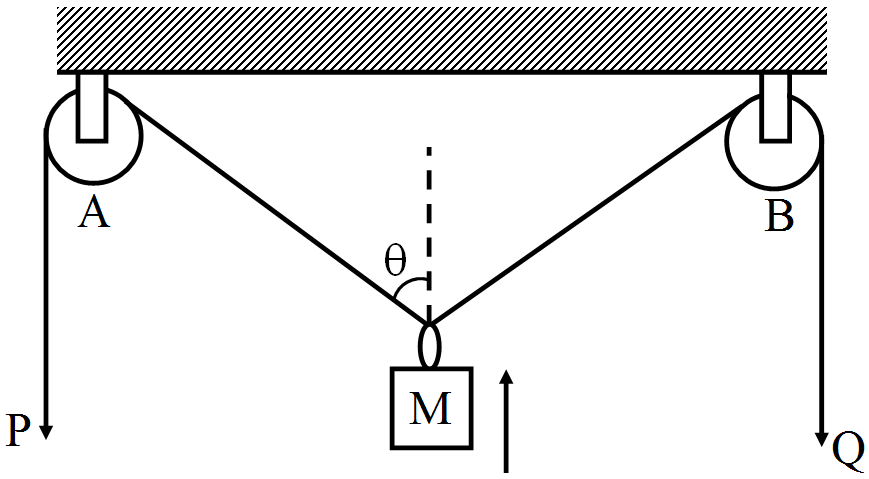
In the arrangement shown in figure, the ends P and Q of an inextensible string move downwards with uniform speed u. Pulleys A and B are fixed. The mass M moves upwards with a speed
:
  • A
    $2\text{u}\cos\theta$
  • $\frac{\text{u}}{\cos\theta}$
  • C
    $\frac{\text{2u}}{\cos\theta}$
  • D
    $\text{u}\cos\theta$

Answer: B.

View full solution
Two particles A and B start from rest and move for equal time on a straight line. The particle A has an acceleration a for the first half of the total time and 2a for the second half. The particle B has an acceleration 2a for the first half and a for the second half. Which particle has covered larger distance?
View full solution
The increase in the speed of a car is proportional to the additional petrol put into the engine. Is it possible to accelerate a car without putting more petrol or less petrol into the engine?
View full solution
When a particle moves with constant velocity, its average velocity, its instantaneous velocity and its speed are all equal. Comment on this statement.
View full solution
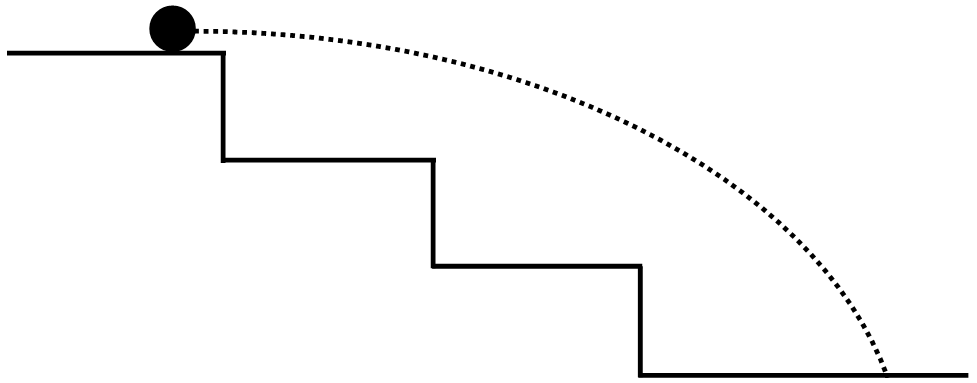
A staircase contains three steps each 10cm high and 20cm wide (figure). What should be the minimum horizontal velocity of a ball rolling off the uppermost plane so as to hit directly the lowest plane?
View full solution
Give examples where:
  1. The velocity of a particle is zero but its acceleration is not zero.
  2. The velocity is opposite in direction to the acceleration.
  3. The velocity is perpendicular to the acceleration.
View full solution
A ball is thrown vertically upward with a speed of 20m/s. Draw a graph showing the velocity of the ball as a function of time as it goes up and then comes back.
View full solution
Q 163 Marks Question3 Marks
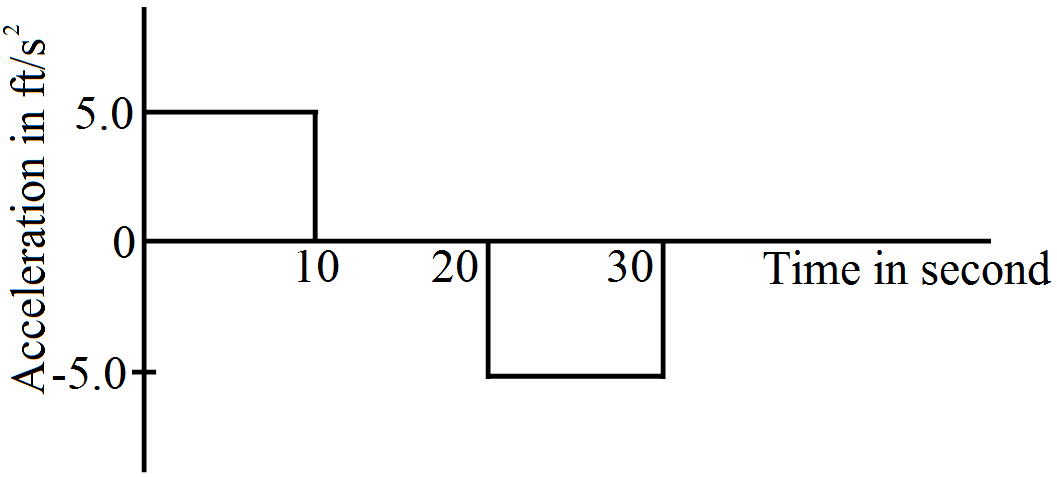
The acceleration of a cart started at t = 0, varies with time as shown in figure. Find the distance travelled in 30 seconds and draw the position-time graph.
View full solution
Q 173 Marks Question3 Marks
A man has to go 50m due north, 40m due east and 20m due south to reach a field.
  1. What distance he has to walk to reach the field?
  2. What is his displacement from his house to the field?
View full solution
Q 183 Marks Question3 Marks
Suppose A and B in the previous problem change their positions in such a way that the line joining them becomes perpendicular to the direction of wind while maintaining the separation x. What will be the time lag B finds between seeing and hearing the drum beating by A?
View full solution
Q 193 Marks Question3 Marks
A ball is dropped from a height. If it takes 0.200s to cross the last 6.00m before hitting the ground, find the height from which it was dropped. Take $g = 10m/s^2.$
View full solution
Q 203 Marks Question3 Marks
A person sitting on the top of a tall building is dropping balls at regular intervals of one second. Find the positions of the $3^{\text {rd }}, 4^{\text {th }}$ and $5^{\text {th }}$ ball when the $6^{\text {th }}$ ball is being dropped.
View full solution
A stone is thrown vertically upward with a speed of 28m/s.
  1. Find the maximum height reached by the stone.
  2. Find its velocity one second before it reaches the maximum height.
  3. Does the answer of part.
  4. Change if the initial speed is more than 28m/s suchas 40m/s or 80m/s?
View full solution
An aeroplane has to go from a point A to another point B, 500km away due 30° east of north. A wind is blowing due north at a speed of 20m/s. The air-speed of the
plane is 150m/s.
  1. Find the direction in which the pilot should head the plane to reach the point B.
  2. Find the time taken by the plane to go from A to B.
View full solution
A car travelling at 60km/h overtakes another car travelling at 42km/h. Assuming each car to be 5.0m long, find the time taken during the overtake and the total road distance used for the overtake.
View full solution
A ball is dropped from a height of 5m onto a sandy floor and penetrates the sand up to 10cm before coming to rest. Find the retardation of the ball in sand assuming it to be uniform.
View full solution
Consider the situation of the previous problem. The man has to reach the other shore at the point directly opposite to his starting point. If he reaches the other shore somewhere else, he has to walk down to this point. Find the minimum distance that he has to walk.
View full solution
A player hits a baseball at some angle. The ball goes high up in space. The player runs and catches the ball before it hits the ground. Which of the two (the player or the ball) has greater displacement?
View full solution
A police jeep is chasing a culprit going on a motorbike. The motorbike crosses a turning at a speed of 72km/h. The jeep follows it at a speed of 90km/h, crossing the turning ten seconds later than the bike. Assuming that they travel at constant speeds, how far from the turning will the jeep catch up with the bike?
View full solution
Complete the following table:
Car Model
Driver X
Reaction time 0.20s
Driver Y
Reaction time 0.30s
$A ($deceleration on hard braking $= 6.0m/s^2)$
Speed = 54km/h
Braking distance
a = ...
Total stopping distance
b = ...
Speed = 72km/h
Braking distance
c = ...
Total stopping distance
d = ...
$B ($deceleration on hard braking $= 7.5m/s^2)$
Speed = 54km/h
Breaking distance
e = ...
Total stopping distance
f = ...
Speed 72km/h
Braking distance
g = ...
Total stopping distance
h = ...
View full solution
Two friends A and B are standing a distance x apart in an open field and wind is blowing from A to B. A beats a drum and B hears the sound $t_1$ time after he sees the event. A and B interchange their positions and the experiment is repeated. This time B hears the drum $t_2$ time after he sees the event. Calculate the velocity of sound in still air v and the velocity of wind u. Neglect the time light takes in travelling between the friends.
View full solution
An elevator is descending with uniform acceleration. To measure the acceleration, a person in the elevator drops a coin at the moment the elevator starts. The coin is 6ft above the floor of the elevator at the time it is dropped. The person observes that the coin strikes the floor in 1 second. Calculate from these data the acceleration of the elevator.
View full solution

Generate a Rest and Motion: Kinematics paper free

Pick question groups from the list above, set marks and difficulty, and export a branded PDF with step-by-step answer keys. First 3 chapters free — no signup.

Download App