Questions

1 Marks Question

Take a timed test

11 questions · self-marked practice — reveal the answer and mark yourself.

Question 11 Mark
Can an object be in pure translation as well as in pure rotation?
Answer
Yes, such motion is possible if the translation takes place along the axis of rotation. This type of motion is called screw motion. 
View full question & answer
Question 21 Mark
If the ice at the poles melts and flows towards the equator, how will it affect the duration of day-night?
Answer
Ice caps near the poles concentrate the mass of water at the poles through which axis of rotation of the Earth passes. If the ice melts, water will spread across the globe due to hydrostatic equilibrium and tend to move to the equatorial areas of the Earth due to centrifugal force of rotation. Mass, now being distributed more along the equator, will increase MI of the Earth and this in turn will decrease the angular velocity of the Earth. Decrease in angular velocity will increase the duration of day-night.
View full question & answer
Question 31 Mark
When a body is weighed on an ordinary balance we demand that the arm should be horizontal if the weights on the two pans are equal. Suppose equal weights are put on the two pans, the arm is kept at an angle with the horizontal and released. Is the torque of the two weights about the middle point (point of support) zero? Is the total torque zero? If so, why does the arm rotate and finally become horizontal?
Answer
When the balance is kept at an angle, there is a net extra torque given to one of its arm. When the extra torque is removed, the balance becomes torque free and sum of all the torque acting on it is zero.
But balance kept at an angle has got a greater potential energy compared to the balance kept horizontal. The potential energy acquired is due to the initial torque applied on it. This displaces the balance by an angle. As soon as the body is set free to rotate, the body tends to have the lowest potential energy. Thus, potential energy starts converting in to kinetic energy, but on the other side, kinetic energy converts into potential energy when the other arm of the balance is raised. This energy transformation oscillates the balance. But in this process, friction with the air and fulcrum dissipates energy converting into heat. Finally, the balance loses the energy and becomes horizontal, or attains equilibrium.
View full question & answer
Question 41 Mark
A rectangular brick is kept on a table with a part of its length projecting out. It remains at rest if the length projected is slightly less than half the total length but it falls down if the length projected is slightly more than half the total length. Give reason.
Answer

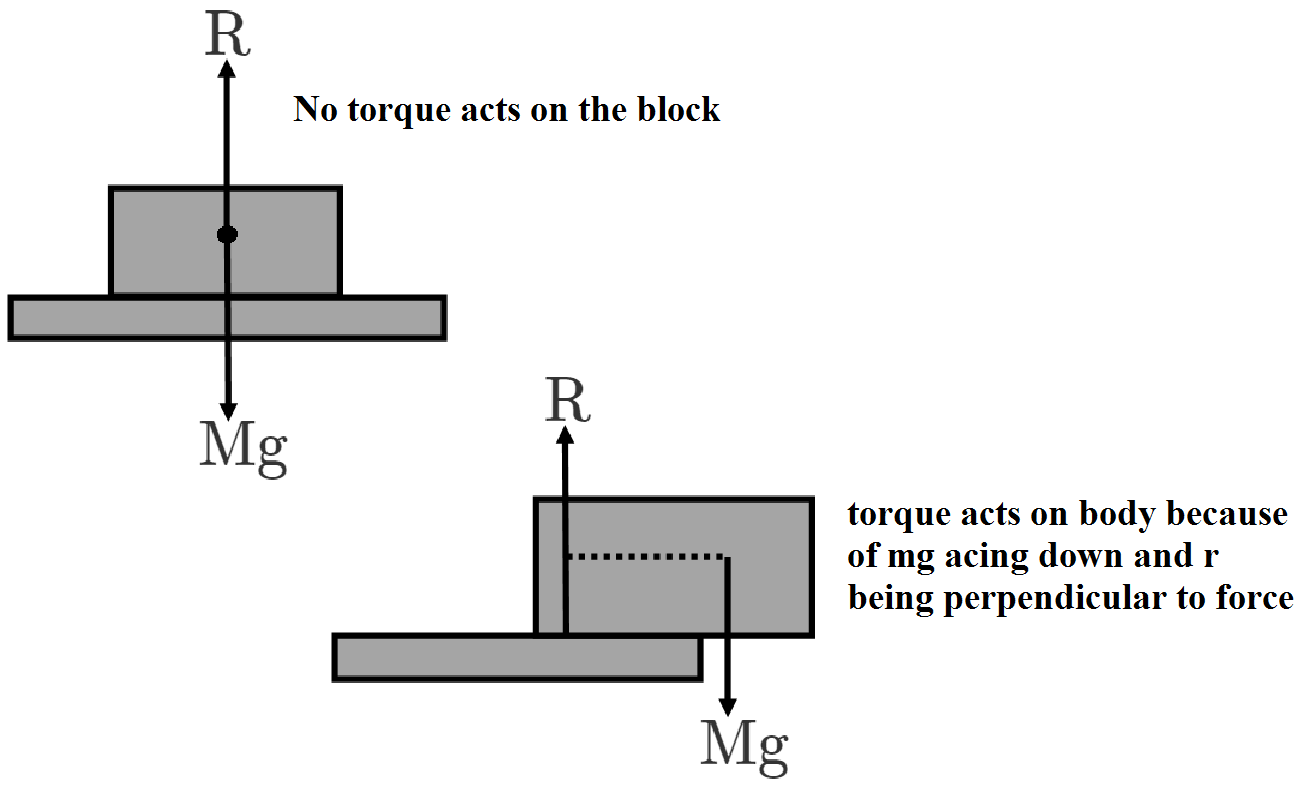
The centre of mass (CM) of a rectangular block lies in the middle of the block. When the block is projected less than half of its length (CM being over the table), no net force acts on it.
Thus, no net torque acts upon the body.But if the block is projected more than half of its length outside the table (CM being outside the table), gravitational force acts along the CM of the block. This force produces a moment along the edge of the table. This rotates the block, and as a result, it falls down.
View full question & answer
Question 51 Mark
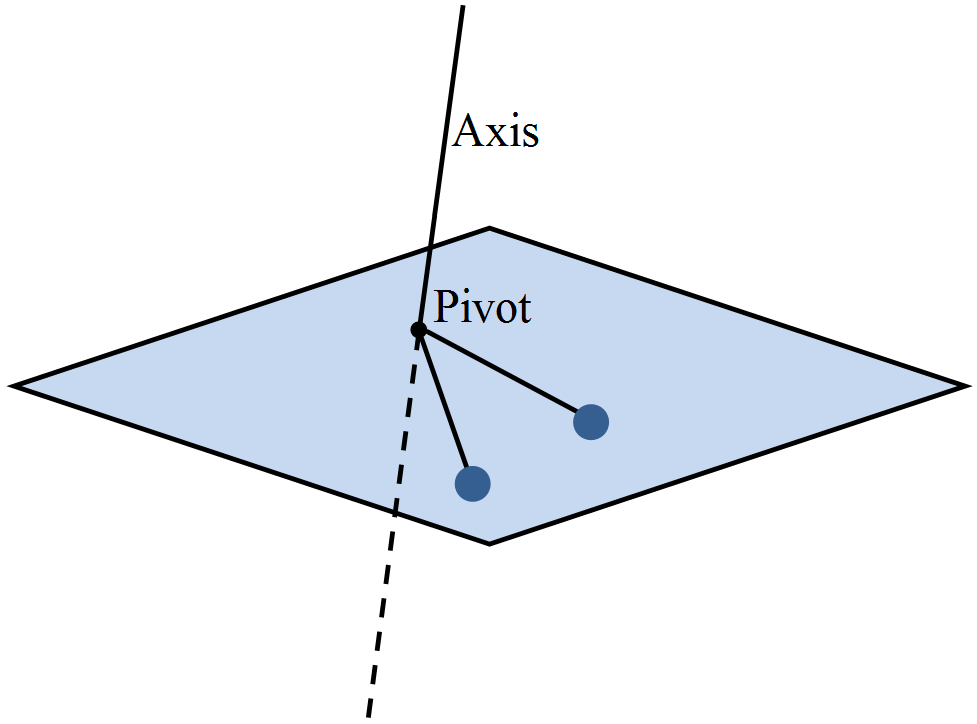
A simple pendulum is a point mass suspended by a light thread from a fixed point. The particle is displaced towards one side and then released. It makes small oscillations. Is the motion of such a simple pendulum a pure rotation? If yes, where is the axis of rotation?
Answer
Yes, it is an example of pure rotation.
The axis of rotation passes through the pivot of the pendulum, perpendicular to the plane containing the pendulum. 
View full question & answer
Question 61 Mark
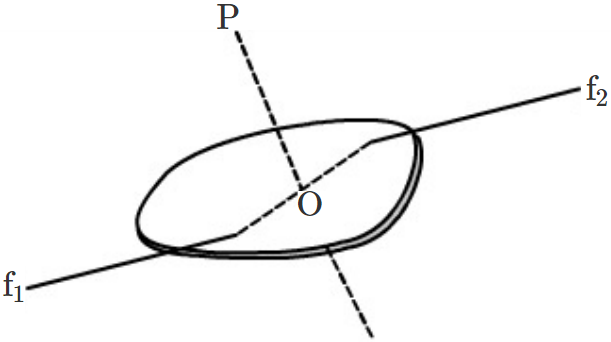
If the sum of all the forces acting on a body is zero, is it necessarily in equilibrium? If the sum of all the forces on a particle is zero, is it necessarily in equilibrium?
Answer
No, if the sum of all the forces acting on a body is zero, the body is not necessarily in equilibrium. To be in equilibrium, the sum of torque acting on the body must be zero too. In the above case, although the sum of the forces acting on the body is zero $\Big(\vec{\text{F}}_1+\Big(-\vec{\text{F}}_1\Big)=0\Big).$ Still, the body will rotate along $\overrightarrow{\text{OP}}.$ So, it won't remain in equilibrium.
View full question & answer
Question 71 Mark
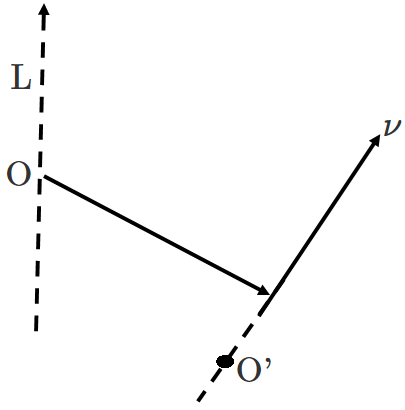
If the angular momentum of a body is found to be zero about a point, is it necessary that it will also be zero about a different point?
Answer
No, angular momentum is dependent on the position vector of the particle, angle between the radius vector and the linear velocity of the particle. So, there may be finite angular momentum along any different point even if it is zero at a particular point. If angular momentum is zero along O but finite along O.
View full question & answer
Question 81 Mark
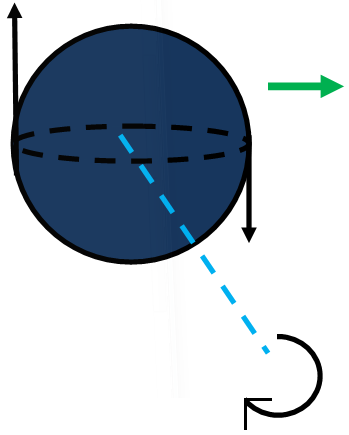
A sphere rolls on a horizontal surface. If there any point of the sphere which has a vertical velocity?
Answer
Some points on the equator of the sphere has got vertical velocity with respect to the direction of motion of the sphere.
View full question & answer
Question 91 Mark
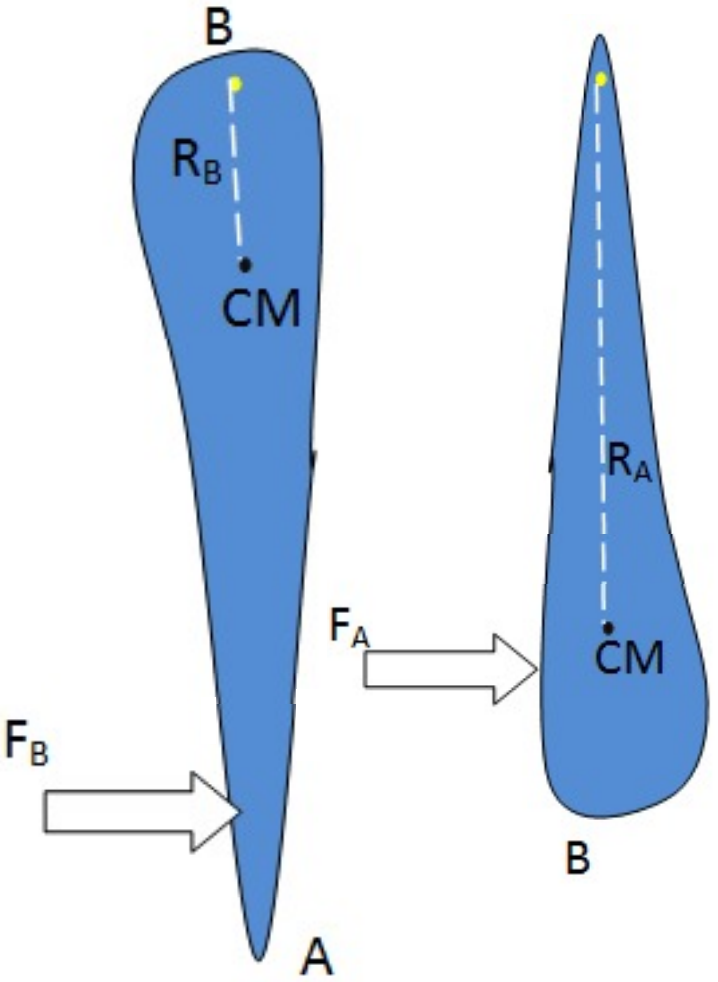
The density of a rod $AB$ continuously increases from $A$ to $B$. Is it easier to set it in rotation by clamping it at $A$ and applying a perpendicular force at $B$ or by clamping it at $B$ and applying the force at $A$?
Answer
It will require more force to set the bar into rotation by clamping at $A$ and then clamping at $B$.

Since the rod has mass density increasing towards $B,$ the Center of Mass $(CM)$ of the rod is near $B$.
If the rod is clamped along $A,$ the distance of $CM$ of the rod from the pivot will be greater when the rod is clamped along $B$.
Greater distance of $CM$ from the Center of rotation increases the moment of inertia of the rod and hence more torque will be necessary to rotate the bar about $A$.
Greater torque implies greater force will be necessary to rotate it.
$F_A =$ Force required to rotated the rod clamped at $A$.
$R_{A }=$ Distance of $CM$ from pivot $A$.
$M =$ Mass of the rod.
$F_{B }=$ Force required to rotate the rod clamped at $B$.
$R_{B }=$ Distance of $CM$ from pivot $B$.
We have $\ce{R_{A }> R_B}.$
We have to find the torque required to rotate rod clamped at $A$ to produce angular acceleration a.
$\ce{T_A = MR_A^2a = R_AF_A}$
$\Rightarrow \ce{F_A = MR_Aa}$
We have to find torque required to rotate rod clamped at $B$ to produce angular acceleration a.
$\ce{T_B = MR_B^2a = R_BF_B}$
$\Rightarrow \ce{F_B = MR_Ba}$
On comparing, since $\ce{R_{A }> R_{B, }}$ we get:
$\ce{F_{A }> F_B}$
View full question & answer
Question 101 Mark
A hollow sphere, a solid sphere, a disc and a ring all having same mass and radius are rolled down on an inclined plane. If no slipping takes place, which one will take the smallest time to cover a given length?
Answer
The body with the smallest moment of inertia will roll down taking the smallest time. Here, the solid sphere has the lowest moment of inertia among all the other bodies. So, it will roll down taking the least time.
View full question & answer
Question 111 Mark
In a rotating body, $\text{a}=\alpha\text{r}$ and $\text{v}=\omega\text{r}.$ Thus $\frac{\text{a}}{\alpha}=\frac{\text{v}}{\omega}.$ Can a co you use the theorems of ratio and proportion studied in algebra so as to write$\frac{\text{a}+\alpha}{\text{a}-\alpha}=\frac{\text{v}+\omega}{\text{v}-\omega}$
Answer
No, we cannot use componendo-dividendo theorem of proportion here. This is because $\alpha$ and a, and v and $\omega$ are dimensionally different. Therefore, ​$\text{v}+\omega$ and/ or $\alpha+\text{a}$ are not possible. 
View full question & answer