Questions

4 Marks Questions

Take a timed test

5 questions · self-marked practice — reveal the answer and mark yourself.

Question 14 Marks
A kid of mass $M$ stands at the edge of a platform of radius $R$ which can be freely rotated about its axis. The moment of inertia of the platform is $I.$ The system is at rest when a friend throws a ball of mass m and the kid catches it. If the velocity of the ball is $v$ horizontally along the tangent to the edge of the platform when it was caught by the kid, find the angular speed of the platform after the event.
Answer
A kid of mass $M$ stands at the edge of a platform of radius $R$ which has a moment of inertia $I.$
A ball of $m$ thrown to him and horizontal velocity of the ball $v$ when he catches it.
Therefore if we take the total bodies as a system Therefore $\text{mvR} = {I + (M + m)R^2}ω ($The moment of inertia of the kid and ball about the axis $= (M + m)R^2)$
$\Rightarrow\omega=\frac{\text{mvR}}{1+(\text{M}+\text{m})\text{R}^2}$
View full question & answer
Question 24 Marks
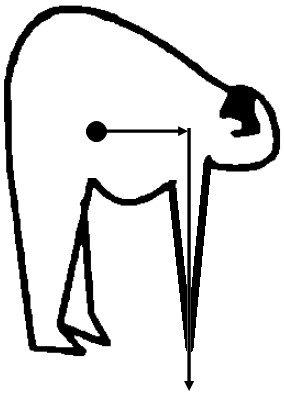
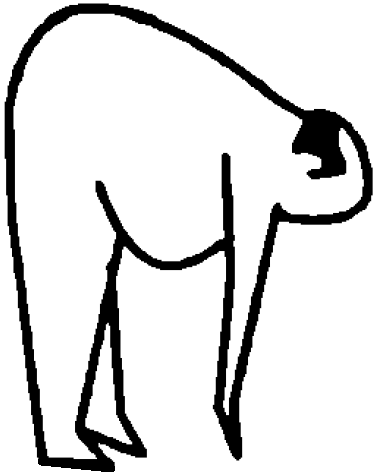
When a fat person tries to touch his toes, keeping the legs straight, he generally falls. Explain with reference to figure.
Answer
 When the man tries to touch his toe, he exerts force along the hand downwards. This force produces amoment along the Centre of Mass CM of the man as shown in the figure. This moment makes him rotateand, thus, he falls down after losing the balance.
View full question & answer
Question 34 Marks
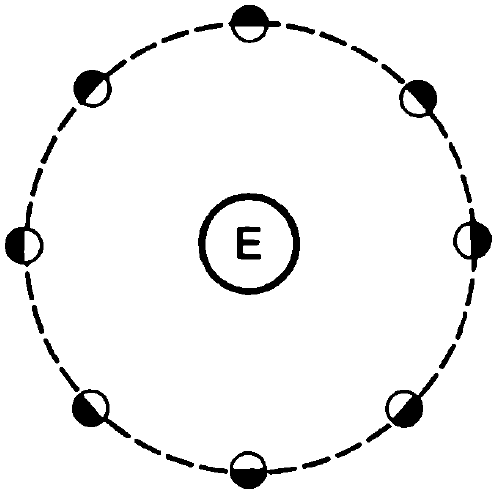
The moon rotates about the earth in such a way that only one hemisphere of the moon faces the earth. Can we ever see the ''other face'' of the moon from the earth? Can a person on the moon ever see all the faces of the earth?
Answer
No, we cannot see the other face of the Moon from the Earth.
Yes, a person on the Moon can see all the faces of the Earth.
Explanation:
Angular velocity of the Moon about its own axis of rotation is same as its angular velocity of revolution about the Earth. This means that its rotation time period equals its revolution time period. So, we can see only one face of the Moon from the Earth.
However, angular velocity of the Earth about its axis is not same as the angular velocity of Moon about the Earth. So, all the faces of the Earth is visible from the Moon.
View full question & answer
Question 44 Marks
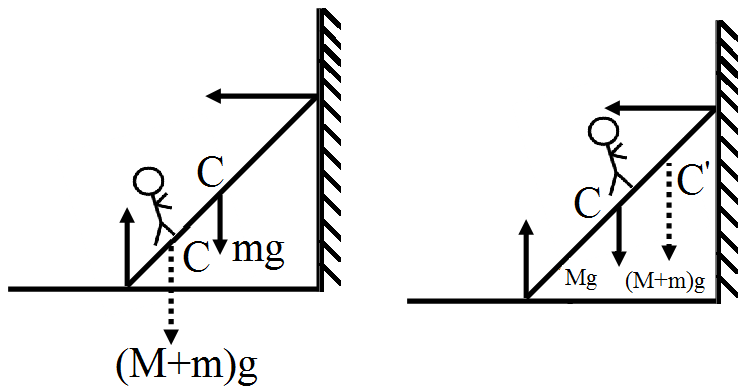
A ladder is resting with one end on a vertical wall and the other end on a horizontal floor. Is it more likely to slip when a man stands near the bottom or near the top?
Answer
The ladder is more likely to slide when the man stands near the top. This is because when the man stands near the top, it creates more torque compared to the torque caused by the weight of man near the bottom. When the man stands near the bottom, the Centre of Gravity of the ladder is shifted to C' from C. Now, the couple due to forces (m + M)g and N makes the ladder fall. We see that due to its shift from C to C', the moment arm of the couple decreases from r to r'; hence,
When the man stands near the top of the ladder, the Centre of Mass shifts from C to C'. This increases the moment arm of the couple and from r to r'. Increase in moment arm increases the couple and, thus, the ladder easily falls.
View full question & answer
Question 54 Marks
When tall buildings are constructed on earth, the duration of day-night slightly increases. Is it true?
Answer
Yes, because tall buildings have their CM much above the ground. It increases moment of inertia of the Earth. As the Earth’s rotation does not involve torque, its angular momentum is constant. Thus, an increase in MI leads to lower angular velocity of the Earth about its axis of rotation. This means length of night and day will increase. However, the increase is very small. 
View full question & answer