Questions

2 Marks Questions

Take a timed test

20 questions · self-marked practice — reveal the answer and mark yourself.

Question 12 Marks
A boy is standing on a platform which is free to rotate about its axis. The boy holds an open umbrella in his hand. The axis of the umbrella coincides with that of the platform. The moment of inertia of "the platform plus the boy system" is $3.0 \times 10^{-3} \mathrm{~kg}-\mathrm{m}^2$ and that of the umbrella is $2.0 \times 10^3 \mathrm{~kg}-\mathrm{m}^2$. The boy starts spinning the umbrella about the axis at an angular speed of $2.0 \mathrm{rev} / \mathrm{s}$ with respect to himself. Find the angular velocity imparted to the platform.
Answer
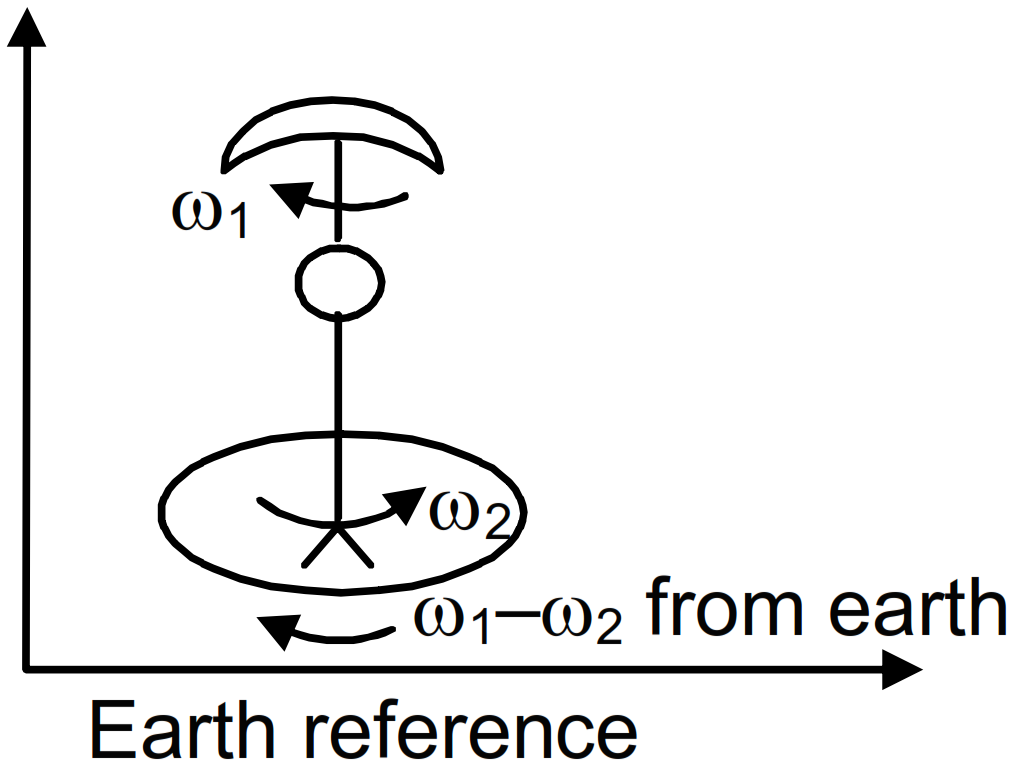
$\text{l}_1=2\times10^{-3}\text{Kg-m}^2$
$\text{l}_2=3\times10^{-3}\text{Kg-m}^2$
$\omega_1=2\text{rad/s}$
From the earth reference the umbrella has a angular velocity $(\omega_1-\omega_2)$
And the angular velocity of the man will be $\omega_2$
Therefore $\text{l}_1(\omega_1-\omega_2)=\text{l}_2\omega_2$
$\Rightarrow2\times10^{-3}(2-\omega_2)=3\times10^{-3}\times\omega_2$
$\Rightarrow5\omega_2=4$
$\Rightarrow\omega_2=0.8\text{rad/s}.$
View full question & answer
Question 22 Marks
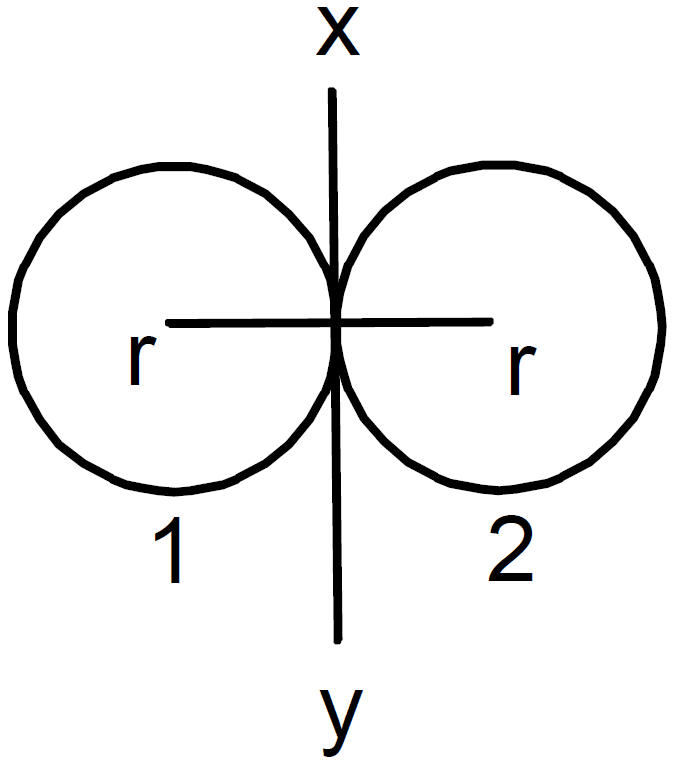
Find the moment of inertia of a pair of spheres, each having a mass m and radius r, kept in contact about the tangent passing through the point of contact.
Answer
The two bodies of mass m and radius r are moving along the common tangent. Therefore moment of inertia of the first body about XY tangent$=\text{mr}^2+\frac{2}5{}\text{mr}^2$
– Moment of inertia of the second body XY tangent $=\text{mr}^2+\frac{2}{5}\text{mr}^2=\frac{7}{5}\text{mr}^2$ Therefore, net moment of inertia $=\frac{7}5{}\text{mr}^2+\frac{7}{5}\text{mr}^2=\frac{14}{5}\text{mr}^2\text{units}$
View full question & answer
Question 32 Marks
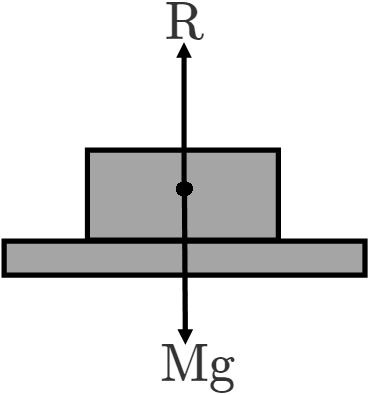
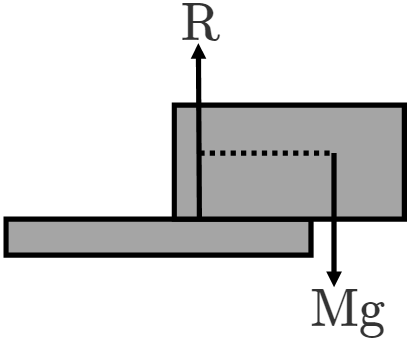
The torque of the weight of any body about any vertical axis is zero. Is it always correct?
Answer
No, its not always correct.
Figure 1
Explanation:
If the centre of mass of the body is not on the same vertical line as the normal reaction R of the body, a net torque acts on the body about its vertical axis. In fig. 1, R and CM lies in the same vertical line. Thus, there is no torque about any vertical axis

Figure 2
But in fig. 2, as R and CM do not lie along the same vertical line, there exists a torque about the vertical axis.
View full question & answer
Question 42 Marks
A wheel is making revolutions about its axis with uniform angular acceleration. Starting from rest, it reaches 100rev/sec in 4 seconds. Find the angular acceleration. Find the angle rotated during these four seconds.
Answer
$\omega_0=0;\ \rho=100\text{rev/s};\ \omega=2\pi;\ \rho=200\pi\text{rad/s}$$\Rightarrow\omega=\omega_0=\alpha\text{t}$
$\Rightarrow\omega=\alpha\text{t}$
$\Rightarrow\alpha=\Big(\frac{200\pi}{4}\Big)=50\pi\text{rad/s}^2$ or $25\text{rev/s}^2$
$\therefore\theta=\omega_0\text{t}+\frac{1}2{}\alpha\text{t}^2=8\times50\pi$
$=400\pi\text{rad}$
$\therefore\alpha=50\pi\text{rad/s}^2$ or $25\text{rev/s}^2$
$\theta=400\pi\text{rad}$
View full question & answer
Question 52 Marks
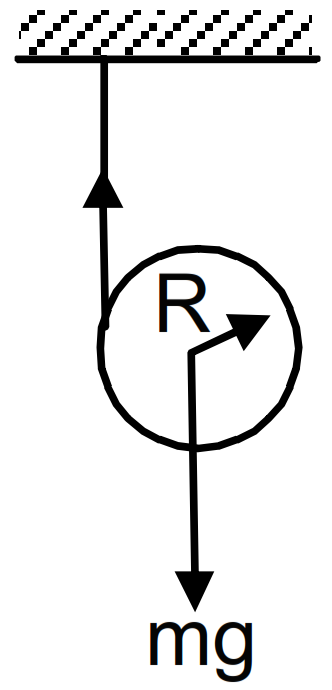
A string is wrapped over the edge of a uniform disc and the free end is fixed with the ceiling. The disc moves down, unwinding the string. Find the downward acceleration of the disc.
Answer

Let the radius of the disc = R
Therefore according to the question & figure
Mg - T = ma ...(1)
& the torque about the centre
$=\text{T}\times\text{R}=\text{l}\times\alpha$
$\Rightarrow\text{TR}=\Big(\frac{1}{2}\Big)\text{mR}^2\times\frac{\text{a}}{\text{R}}$
$\Rightarrow\text{T}=\Big(\frac{1}{2}\Big)\text{ma}$
Putting this value in the equation (1) we get
$\Rightarrow\text{mg}-\Big(\frac{1}{2}\Big)\text{ma}=\text{ma}$
$\Rightarrow\text{mg}=\frac{3}{2}\text{ma}$
$\Rightarrow\text{a}=\frac{\text{2g}}{3}$
View full question & answer
Question 62 Marks
Because of the friction between the water in oceans with the earth's surface, the rotational kinetic energy of the earth is continuously decreasing. If the earth's angular speed decreases by 0.0016rad/ day in 100 years, find the average torque of the friction on the earth. Radius of the earth is 6400km and its mass is $6.0 × 10^{24}$kg.
Answer
The earth’s angular speed decreases by 0.0016rad/ day in 100 years. Therefore the torque produced by the ocean water in decreasing earth's angular velocity$\tau=\text{I}\alpha$
$=\frac{2}{5}\text{mr}^2\times\frac{(\omega-\omega_0)}{\text{t}}$
$=\frac{2}{6}\times6\times10^{24}\times64^2\times10^{10}\times\Big(\frac{0.0016}{26400^2\times100\times365}\Big)$ (1 year = 365 days= 365 × 56400 sec)
$=5.678\times10^{20}\text{N-m}$
View full question & answer
Question 72 Marks
A boy is seated in a revolving chair revolving at an angular speed of 120 revolutions per minute. Two heavy balls form part of the revolving system and the boy can pull the balls closer to himself or may push them apart. If by pulling the balls closer, the boy decreases the moment of inertia of the system from $6 \mathrm{~kg}-\mathrm{m}^2$ to $2 \mathrm{~kg}-\mathrm{m}^2$, what will be the new angular speed?
Answer
$\omega=120\text{rpm}=120\times\Big(\frac{2\pi}{60}\Big)=4\pi\text{rad/s}$$\text{l}_1=6\text{kg-m}^2,\ \text{l}_2=2\text{Kg-m}^2$
Since two balls are inside the system
Therefore, total external torque = 0
Therefore $\text{l}_1\omega_1=\text{l}_2\omega_2$
$\Rightarrow6\times4\pi=2\omega_2$
$\Rightarrow\omega_2=12\pi\text{rad/s}$
$=6\text{rev/s}$
$=360\text{rev/}\ \text{minute}.$
View full question & answer
Question 82 Marks
A body rotates about a fixed axis with an angular acceleration of one radian/ second/ second. Through what angle does it rotate during the time in which its angular velocity increases from 5rad/s to 15rad/s.
Answer
$\alpha=1\text{rad/s}^2,\ \omega_0=5\text{rad/s};\ \omega=15\text{rad/s}$$\therefore\text{w}=\text{w}_0+\alpha\text{t}$
$\Rightarrow\text{t}=\frac{(\omega-\omega_0)}{\alpha}=\frac{(15-5)}{1}=10\text{sec}$
Also, $\theta=\omega_0\text{t}+\frac{1}{2}\alpha\text{t}^2$
$=5\times10+\frac{1}{2}\times1\times100=100\text{rad}$
View full question & answer
Question 92 Marks
A sphere of mass m rolls on a plane surface. Find its kinetic energy at an instant when its centre moves with speed v.
Answer

A sphere having mass m rolls on a plane surface. Let its radius R. Its centre moves with a velocity v.
Therefore Kinetic energy $=\Big(\frac{1}{2}\Big)\text{l}\omega^2+\Big(\frac{1}{2}\Big)\text{mv}^2$
$=\frac{1}{2}\times\frac{2}{5}\text{mR}^2\times\frac{\text{v}^2}{\text{R}^2}+\frac{1}{2}\text{mv}^2$
$=\frac{2}{10}\text{mv}^2+\frac{1}{2}\text{mv}^2$
$=\frac{2+5}{10}\text{mv}^2=\frac{7}{10}\text{mv}^2$
View full question & answer
Question 102 Marks
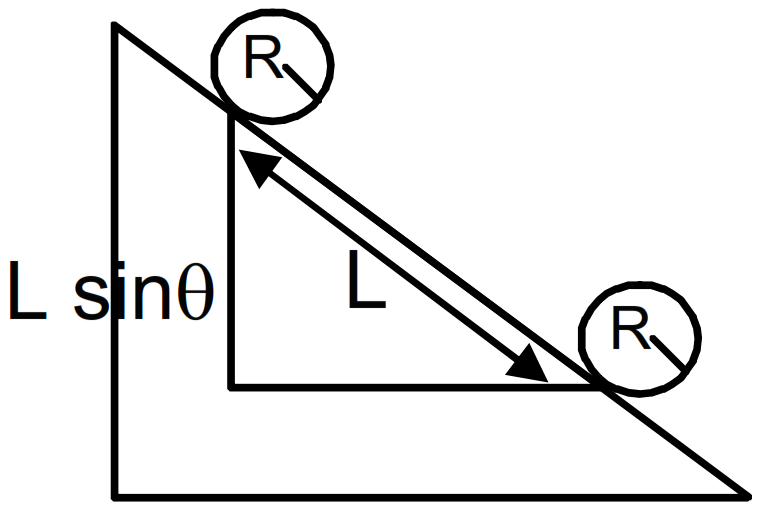
A sphere starts rolling down an incline of inclination $\theta.$ Find the speed of its centre when it has covered a distance l.
Answer

A sphere is rolling in inclined plane with inclination $\theta.$
Therefore according to the principle
$\text{Mgl}\sin\theta=\Big(\frac{1}{2}\Big)\text{l}\omega^2+\Big(\frac{1}{2}\Big)\text{mv}^2$
$\Rightarrow\text{Mgl}\sin\theta=\Big(\frac{1}{5}\Big)\text{mv}^2+\Big(\frac{1}{2}\Big)\text{mv}^2$
$\text{Gl}\sin\theta=\frac{7}{10}\omega^2$
$\Rightarrow\text{v}=\sqrt{\frac{10}{7}\text{gl}\sin\theta}$
View full question & answer
Question 112 Marks
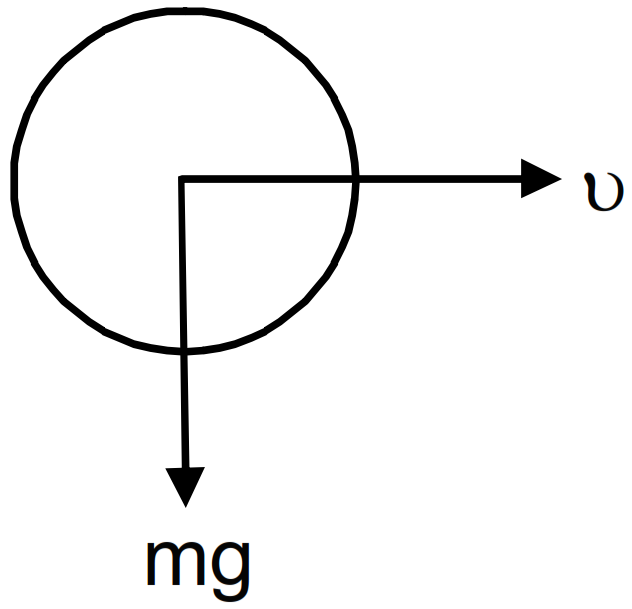
Suppose the platform of the previous problem is brought to rest with the ball in the hand of the kid standing on the rim. The kid throws the ball horizontally to his friend in a direction tangential to the rim with a speed v as seen by his friend. Find the angular velocity with which the platform will start rotating.
Answer
Initial angular momentum = Final angular momentum (The total external torque = 0) Initial angular momentum = mvR (m = Mass of the ball, v = Velocity of the ball, R = Radius of platform) Therefore angular momentum $=\text{l}\omega+\text{MR}^2\omega$ Therefore $\text{mVR}=\text{l}\omega+\text{MR}^2\omega$$\Rightarrow\omega=\frac{\text{mVR}}{(1+\text{MR}^2)}$
View full question & answer
Question 122 Marks
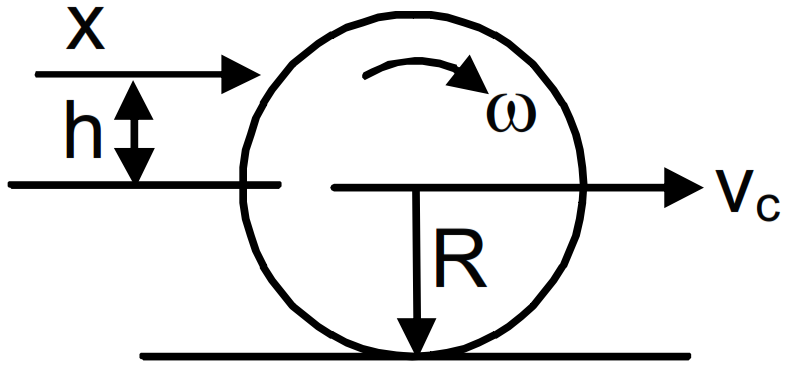
A thin spherical shell of radius R lying on a rough horizontal surface is hit sharply and horizontally by a cue. Where should it be hit so that the shell does not slip on the surface?
Answer

Let the cue strikes at a height ‘h’ above the centre, for pure rolling, $\text{V}_{\text{c}}=\text{R}_{\omega}$
Applying law of conservation of angular momentum at a point A,
$\text{mv}_{\text{c}}\text{h}-\ell\omega=0$
$\text{mv}_{\text{c}}\text{h}=\frac{2}{3}\text{mR}^2\times\Big(\frac{\text{v}_{\text{c}}}{\text{R}}\Big)$
$\text{h}=\frac{2\text{R}}{3}$
View full question & answer
Question 132 Marks
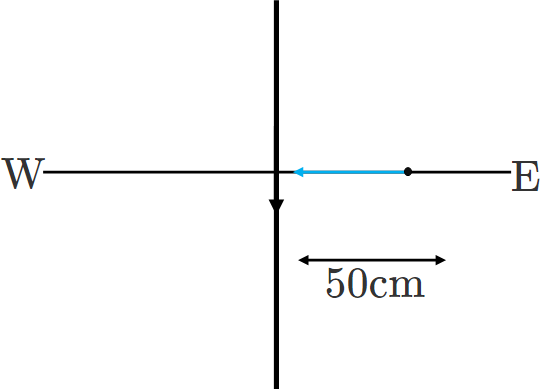
A heavy particle of mass m falls freely near the earth's surface. What is the torque acting on this particle about a point 50cm east to the line of motion? Does this torque produce any angular acceleration in the particle?
Answer
We know that:$\overrightarrow{\text{r}}=\overrightarrow{\text{r}}\times\overrightarrow{\text{F}}$
Given:$\overrightarrow{\text{r}}=-0.5\hat{\text{i}}\text{m}$
$\overrightarrow{\text{F}}=-\text{mg}\hat{\text{j}}$
The torque becomes:$\overrightarrow{\text{r}}=0.5\big(-\hat{\text{i}}\big)\times\text{mg}\big(-\hat{\text{j}}\big)$
$\overrightarrow{\text{r}}=0.5\text{mg}\hat{\text{k}}$ $\big[\because\hat{\text{i}}\times\hat{\text{j}}=\hat{\text{k}}\big]$
No, there will be no angular acceleration on the particle due to the torque.Angular acceleration is given by $\alpha=\frac{\text{T}}{\text{I}}.$ As the particle here moves in a straight line, the centre of rotation lies at a distance infinity $(\text{r}=\infty);$ so, moment of inertia $\big(\text{I}=\text{mr}^2\big)$ of the particle is infinity.$\therefore\alpha=0$
View full question & answer
Question 142 Marks
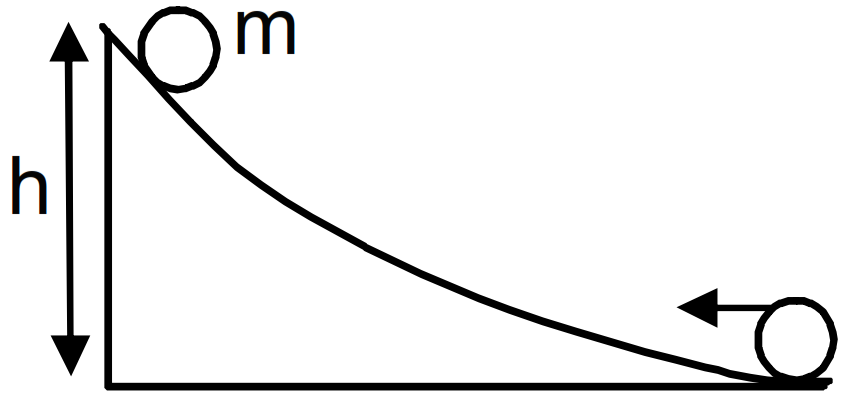
A small disc is set rolling with a speed v on the horizontal part of the track of the previous problem from right to left. To what height will it climb up the curved part?
Answer

A disc is set rolling with a velocity V from right to left. Let it has attained a height h.
Therefore $\Big(\frac{1}{2}\Big)\text{mV}^2+\Big(\frac{1}{2}\Big)\text{l}\omega^2=\text{mgh}$
$\Rightarrow\Big(\frac{1}{2}\Big)\text{mV} ^2+\Big(\frac{1}{2}\Big)\times\Big(\frac{1}{2}\Big)\text{mR}^2\omega^2=\text{mgh}$
$\Rightarrow\Big(\frac{1}{2}\Big)\text{V}^2+\frac{1}{4}\text{V}^2=\text{gh}$
$\Rightarrow\Big(\frac{3}{4}\Big)\text{V}^2=\text{gh}$
$\Rightarrow\text{h}=\frac{3}{4}\times\frac{\text{V}^2}{\text{g}}$
View full question & answer
Question 152 Marks
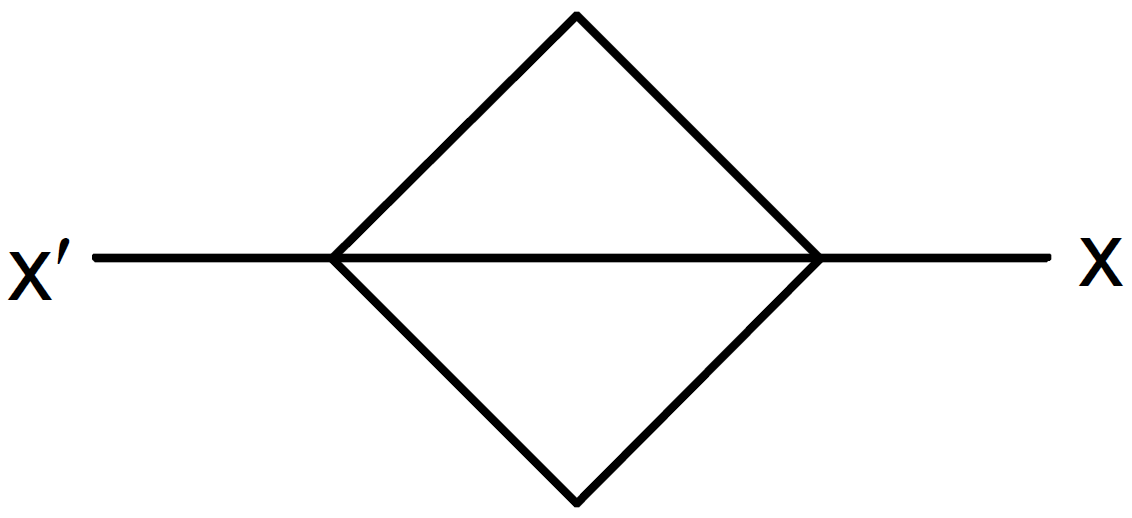
Calculate the torque on the square plate of the previous problem if it rotates about a diagonal with the same angular acceleration.
Answer

Moment of inertial of a square plate about its diagonal is $\frac{\text{ma}^2}{12}$ (m = mass of the square plate)
a = edges of the square
Therefore torque produced $=\Big(\frac{\text{ma}^2}{12}\Big)\times\alpha$
$=\Big\{\frac{120\times10^{-3}\times5^2\times10^{-4}}{12}\Big\}\times0.2$
$=0.5\times10^{-5}\text{N-m}$
View full question & answer
Question 162 Marks
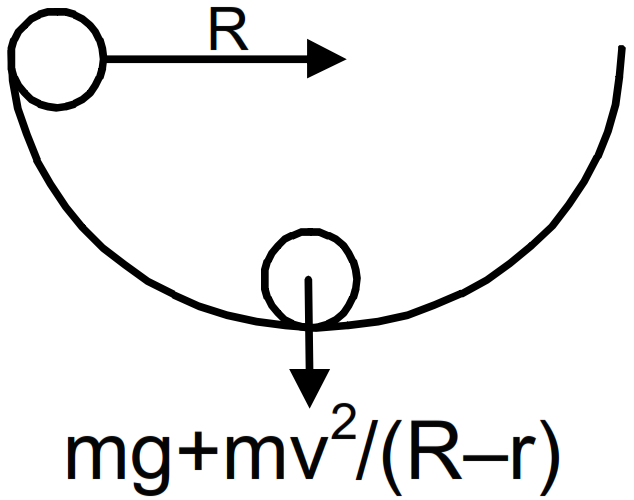
A solid sphere of mass m is released from rest from the rim of a hemispherical cup so that it rolls along the surface. If the rim of the hemisphere is kept horizontal, find the normal force exerted by the cup on the ball when the ball reaches the bottom of the cup.
Answer

Total normal force $=\text{mg}+\frac{\text{mv}^2}{\text{R}-\text{r}}$
$\Rightarrow\text{mg}(\text{R}-\text{r})=\Big(\frac{1}{2}\Big)\text{l}\omega^2+\Big(\frac{1}{2}\Big)\text{mv}^2$
$\Rightarrow\text{mg}(\text{R}-\text{r})=\frac{1}{2}\times\frac{2}{5}\text{mv}^2+\Big(\frac{1}{2}\Big)\text{mv}^2$
$\Rightarrow\frac{7}{10}\text{mv}^2=\text{mg}(\text{R}-\text{r})$
$\Rightarrow\text{v}^2=\frac{10}{7}\text{g}(\text{R}-\text{r})$
Therefore total normal force
$=\text{mg}+\frac{\text{mg}+\text{m}\Big(\frac{10}{7}\Big)\text{g}(\text{R}-\text{r})}{\text{R}-\text{r}}$
$=\text{mg}+\text{mg}\Big(\frac{10}{7}\Big)$
$=\frac{17}{7}\text{mg}$
View full question & answer
Question 172 Marks
If the resultant torque of all the forces acting on a body is zero about a point, is it necessary that it will be zero about any other point?
Answer
No, it is not necessary that the torque about any other point be zero if it is zero about one point.
Let $\overrightarrow{\text{F}}$be the resultant force due to all the forces acting on the plane of the body.
Therefore, torque due to force $\overrightarrow{\text{F}}$ at any point will be the resultant torque.
Now, we see that the torque due to $\overrightarrow{\text{F}}$ at point Q will be zero because Q lies on the line of support of the force F but the torque due to force $\overrightarrow{\text{F}}$ will not be zero along the point P.
View full question & answer
Question 182 Marks
The torque of a force $\overrightarrow{\text{F}}$ about a point is defined as $\overrightarrow{\text{r}}=\overrightarrow{\text{r}}\times\overrightarrow{\text{F}}.$ Suppose $\overrightarrow{\text{r}}, \overrightarrow{\text{F}}$and $\overrightarrow{\text{r}}$ are all nonzero. Is $\text{r}\times\overrightarrow{\text{r}}\Bigg|\Bigg|\overrightarrow{\text{F}}$ always true? Is it ever true?
Answer
No, $\overrightarrow{\text{r}}\times\overrightarrow{\text{r}}\Bigg|\Bigg|\overrightarrow{\text{r}}$ is not true. In fact, it is never true. This is because:$\overrightarrow{\text{r}}\times\overrightarrow{\text{r}}$
$=\overrightarrow{\text{r}}\times\Big(\overrightarrow{\text{r}}\times\overrightarrow{\text{F}}\Big)$
Applying vector triple product, we get:$\overrightarrow{\text{r}}\times\Big(\overrightarrow{\text{r}}\times\overrightarrow{\text{F}}\Big)$
$=\Big(\overrightarrow{\text{r}}.\overrightarrow{\text{F}}\Big)\overrightarrow{\text{r}}-\Big(\overrightarrow{\text{r}}.\overrightarrow{\text{r}}\Big)\overrightarrow{\text{F}}$
$\because\overrightarrow{\text{r}}.\overrightarrow{\text{r}}=\text{r}^2$
$=\Big(\overrightarrow{\text{r}}.\overrightarrow{\text{F}}\Big)\overrightarrow{\text{r}}-\text{r}^2\overrightarrow{\text{F}}$
If $\overrightarrow{\text{r}}.\overrightarrow{\text{F}}=0;$ that is, $\overrightarrow{\text{r}}\perp\overrightarrow{\text{F}},$ then:$\overrightarrow{\text{r}}\times\overrightarrow{\text{r}}=-\text{r}^2.\overrightarrow{\text{F}}$
We know that $r^2$ is never negative and $\overrightarrow{\text{r}}\times\overrightarrow{\text{r}}=-\text{r}^2.\overrightarrow{\text{F}}$ This implies that both vectors may be antiparallel to each other but not parallel.
View full question & answer
Question 192 Marks
A disc rotates about its axis with a constant angular acceleration of $4rad/s^2$. Find the radial and tangential accelerations of a particle at a distance of 1cm from the axis at the end of the first second after the disc starts rotating.
Answer
$\text{t}=1\text{sec},\ \text{r}=1\text{cm}=0.01\text{m}$$\alpha=4\text{rad/s}^2$
Therefore $\omega=\alpha\text{t}=4\text{rad/s}$
Therefore radial acceleration,
$\text{A}_{\text{n}}=\omega^2\text{r}=0.16\text{m/s}^2=16\text{cm/s}^2$
Therefore tangential acceleration,
$\text{a}_{\text{r}}=0.04\text{m/s}^2=4\text{cm/s}^2.$
View full question & answer
Question 202 Marks
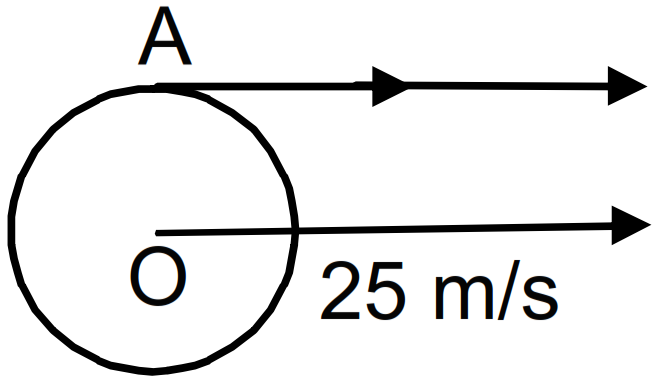
A cylinder rolls on a horizontal plane surface. If the speed of the centre is 25m/s, what is the speed of the highest point?
Answer
A cylinder rolls in a horizontal plane having centre velocity 25m/s.

At its age the velocity is due to its rotation as well as due to its leniar motion & this two velocities are same and acts in the same direction (v = rω)
Therefore Net velocity at A = 25m/s + 25m/s = 50m/s
View full question & answer