Questions

3 Marks Question

Take a timed test

22 questions · self-marked practice — reveal the answer and mark yourself.

Question 13 Marks
There are energy bands in a solid. Do we have really continuous energy variation in a band or do we have very closely spaced but still discrete energy levels?
Answer
A solid consists of a combination of closely spaced energy levels. These energy levels are discrete but they have very small energy gap between two consecutive levels so they are referred as band. However, the energy levels in the band are discrete.
View full question & answer
Question 23 Marks
In a photodiode, the conductivity increases when the material is exposed to light. It is found that the conductivity changes only if the wavelength is less than 620nm. What is the band gap?
Answer
Conductivity of any material increases when the number of free charge carriers in the material increases. When a photo diode is exposed to light, additional electron hole pairs are created in the diode; thus, its conductivity increases. So to change the conductivity of a photo diode, the minimum energy of the incident radiation should be equal to the band gap of the material.
In other words,
Band gap = Energy of the incident radiation
$\Rightarrow\text{E}=\frac{\text{hc}}{\lambda}$
$\Rightarrow\text{E}=\frac{1242\text{eV}-\text{nm}}{620\text{nm}}=2.0\text{eV}$
View full question & answer
Question 33 Marks
Show that $\text{AB} + \overline{\text{AB}}$ is always 1.
Answer
Given,
$\text{X}=\text{AB} + \overline{\text{AB}}$
Let,
$\text{AB}=\text{y}$
$\therefore\text{X}=\text{y} + \overline{\text{y}}$
$\text{For y} = 0,$
$\text{X}=0+1$
$=1$
$\text{For y} = 1,$
$\text{X}=1+0$
$=1$
thus, X = 1 for all values of y = AB.
View full question & answer
Question 43 Marks
When the base current in a transistor is changed from $30\mu\text{A}$ to $80\mu\text{A},$ the collector current is changed from 1.0mA to 3.5mA. Find the current gain $\beta.$
Answer
$\delta\text{I}_\text{b}=80\mu\text{A}-30\mu\text{A}=50\mu\text{A}=50\times10^{-6}\text{A}$
$\delta\text{I}_\text{c}=3.5\text{mA}-1\text{mA}$ $=-2.5\text{mA}=2.5\times10^{-3}\text{A}$
$\beta=\Big(\frac{\delta\text{I}_\text{c}}{\delta\text{I}_\text{b}}\Big)\text{V}_\text{ce}$ = constant
$\Rightarrow\frac{2.5\times10^{-3}}{50\times10^{-6}}=\frac{2500}{50}=50$
Current gain = 50.
View full question & answer
Question 53 Marks
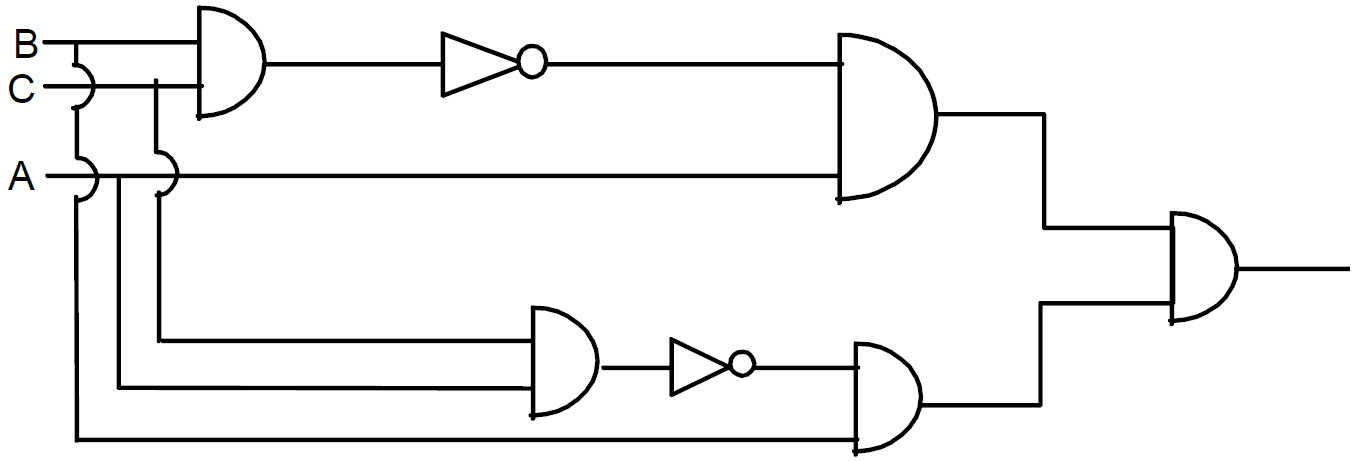
Design a logical circuit using AND, OR and NOT gates to evaluate $\text{A}\overline{\text{BC}}+\text{B}\overline{\text{CA}}.$
Answer
$\text{X}=\text{A}\overline{\text{BC}}+\text{B}\overline{\text{CA}}$ $=\text{A}\Big(\overline{\text{B}}+\overline{\text{C}}\Big)+\text{B}\Big(\overline{\text{C}}+\overline{\text{A}}\Big)$ $=\text{A}\overline{\text{B}}+\text{A}\overline{\text{C}}+\text{B}\overline{\text{C}}+\text{B}\overline{\text{A}}$ $=\text{A}\overline{\text{B}}+\overline{\text{C}}\Big(\text{A}+\text{B}\Big)+\text{B}\overline{\text{A}}$
View full question & answer
Question 63 Marks
The band gap for silicon is 1.1eV.
  1. Find the ratio of the band gap to kT for silicon at room temperature 300K.
  2. At what temperature does this ratio become one tenth of the value at 300K?
(Silicon will not retain its structure at these high temperatures.)
Answer
Bandgap $=1.1\text{eV},\text{T}=300\text{K}$
  1. Ratio $=\frac{1.1}{\text{KT}}=\frac{1.1}{8.62\times10^{-5}\times3\times10^2}=42.53=43$
  2. $4.253'=\frac{1.1}{8.62\times10^{-5}\times\text{T}}$ or $\text{T}=\frac{1.1\times10^5}{4.253\times8.62}=3000.47\text{K}.$
View full question & answer
Question 73 Marks
In a $p-n$ junction, the depletion region is $400\ nm$ wide and an electric field of $5 \times 10^5\ V/m$ exists in it.
  1. Find the height of the potential barrier.
  2. What should be the minimum kinetic energy of a conduction electron which can diffuse from the $n-$side to the $p-$side?
Answer
Let,
Depletion region width, $\text{d}=400\text{nm}=4\times10^{-7}\text{m}$
Electric field, $\text{E}=5\times10^5\text{Vm}$
Let the potential barrier be $V.$
The relation between the potential and the electric field is given by $V = Ed$
$\Rightarrow\text{V}=\text{E}\times\text{d}=5\times\text{d}$
$\Rightarrow\text{V}=5\times10^5\times4\times10^{-7}=0.2\text{V}$
To find: Kinetic energy required
Energy of any electron accelerated through a potential of $V = eV$
Also, the minimum energy of the electron should be equal to the band gap of the material.
$\therefore$ Potential barrier $\times\ e = 0.2eV (e =$ Charge of the electron$).$
View full question & answer
Question 83 Marks
The drift current in a reverse-biased p-n junction increases in magnitude if the temperatu,re of the junction is increased. Explain this on the basis of creation of hole-electron pairs.
Answer
When the temperature of a reverse-biassed p‒n junction is increased, the breaking of bonds takes place because of the increase in the thermal energy of the charge carriers. Drift current is due to the flow of the minority carriers across the junction. So, when a p‒n junction is reverse biassed, the applied voltage supports the flow of minority charge carriers across the junction. Thus, the drift current increases with increase in temperature in a reverse biassed p‒n junction.
View full question & answer
Question 93 Marks
The potential barrier existing across an unbiased $p-n.$ junction is $0·2$ volt. What minimum kinetic energy a hole should have to diffuse from the $p-$side to the $n-$side if,
  1. The junction is unbiased.
  2. The junction is forwardbiased at $0.1$ volt.
  3. The junction is reverse-biased at $0.1$ volt$?$
Answer
Potential barrier $= 0.2$ Volt
  1. $K.E. = ($Potential difference$) \times e = 0.2eV ($in unbiased cond$^n)$
  2. In forward biasing
$KE + Ve = 0.2e$
$\Rightarrow KE = 0.2e - 0.1e = 0.1e.$
  1. In reverse biasing
$KE - Ve = 0.2e$
$\Rightarrow KE = 0.2e + 0.1e = 0.3e.$
View full question & answer
Question 103 Marks
In a p-n junction, a potential barrier of 250meV exists across the junction. A hole with a kinetic energy of 300meV approaches the junction. Find the kinetic energy of the hole when it crosses the junction if the hole approached the junction.
  1. From the p-side.
  2. From the n-side.
Answer
Potential barrier ‘d’ = 250meV
Initial KE of hole = 300meV
We know: KE of the hole decreases when the junction is forward biased and increases when reverse blased in the given ‘Pn’ diode.
So,
  1. Final KE = (300 - 250)meV = 50meV.
  2. Initial KE = (300 + 250)meV = 550meV.
View full question & answer
Question 113 Marks
Estimate the proportion of boron impurity whieh will increase the conductivity of a pure silicon sample by a factor of $100.$ Assume that each boron atom creates a hole and the concentration of holes in pure silicon at the same temperature is $7 \times 10^{15}$ holes per cubic metre. Density of silicon is $5 \times 10^{21}$ atoms per cubic metre.
Answer
Total no.of charge carriers initially $=2\times7\times10^{15}=14\times10^{15}$ Cubic meter.
Finally the total no.of charge carriers $=14\times10^{17}\text{m}^3$
We know,
The product of the concentrations of holes and conduction electrons remains, almost the same.
Let $x$ be the no.of holes.
So, $\big(7\times10^{15}\big)\times\big(7\times10^{15}\big)=\text{x}\times\big(14\times10^{17}-\text{x}\big)$
$\Rightarrow14\text{x}\times10^{17}-\text{x}^2=79\times10^{30}$
$\Rightarrow\text{x}^2-14\text{x}\times10^{17}-49\times10^{30}=0$
$\text{x}=\frac{14\times10^{17}\pm14^2\times\sqrt{10^{34}+4\times49\times10^{30}}}{2}$ 
$=14.00035\times10^{17}.$
$=$ Increased in no. of holes or the no.of atoms of Boron added.
$\Rightarrow 1$ atom of Boron is added per $\frac{5\times10^{28}}{1386.035\times10^{15}}$ 
$=3.607\times10^{-3}\times10^{13}=3.607\times10^{10}.$
View full question & answer
Question 123 Marks
We have valence electrons and conduction electrons in a semiconductor. Do we also have 'valence holes' and 'conduction holes'?
Answer
Holes do not exist in reality. They exist only virtually. When an electron jumps from the valence band to the conduction band, a vacancy is created at the place from where the electron had jumped. This vacancy is called a hole. So, a valence or conduction hole is a virtual concept only.
View full question & answer
Question 133 Marks
In a pure semiconductor, the number of conduction electrons is $6 \times 10^{19}$ per cubic metre. How many holes are there in a sample of size $1\ cm \times 1\ cm \times 1mm$?
Answer
In a pure semiconductor, the no. of conduction electrons $=$ no. of holes
Given volume $=1\text{cm}\times1\text{cm}\times1\text{mm}$
$=1\times10^{-2}\times1\times10^{-2}\times1\times10^{-3}$
$=10^{-7}\text{m}^3$
No.of electrons $=6\times10^{19}\times10^{-7}$
$=6\times10^{12}$
Hence no.of holes $=6\times10^{12}$
View full question & answer
Question 143 Marks
The conductivity of a pure semiconductor is roughly proportional to $\text{T}^\frac{3}{2}\text{e}^{\frac{-\Delta\text{E}}{2\text{kT}}}$ where $\Delta\text{E}$ is the band gap. The band gap for germanium is 0.74eV at 4K and 0.67eV at 300K. By what factor does the conductivity of pure germanium increase as the temperature is raised from 4K to 300K?
Answer
$\sigma=\text{T}^\frac{3}{2}\text{e}^\frac{-\Delta\text{E}}{2\text{KT}}\text{ at }4^\circ\text{K}$
$\sigma=4^\frac{3}{2}=\text{e}^{\frac{-0.67}{{2\times8.62\times10^{-5}\times4}}}=8\times\text{e}^{-1073.08}$
$\text{At } 300\text{K},$
$\sigma=300^\frac{3}{2}\text{ e}^{\frac{-0.67}{{2\times8.62\times10^{-5}\times300}}}=\frac{3\times1730}{8}\text{e}^{-12.95}$
$\text{Ratio}=\frac{8\times\text{e}^{-1073.08}}{\Big[\frac{3\times1730}{8}\Big]\times\text{e}^{-12.95}}=\frac{64}{3\times1730}\text{e}^{-1060.13}$
View full question & answer
Question 153 Marks
The band gap between the valence and the conduction bands in zinc oxide (ZnO) is 3.2eV. Suppose an electron in the conduction band combines with a hole in the valence band and the excess energy is released in the form of electromagnetic radiation. Find the maximum wavelength that can be emitted in this process.
Answer
Given:
Band gap = 3.2eV
As the electron in the conduction band combines with the hole in the valence band, the minimum energy band gap (because maximum energy is released) through which the electron has to jump will be equal to the band gap of the material.
This implies that the maximum energy released in this process will be equal to the band gap of the material.
Here,
$\text{E}=3.2\text{eV}$
Thus,
$\Rightarrow3.2\text{eV}=\frac{1242\text{eV}-\text{nm}}{\lambda}$
$\Rightarrow\lambda=388.1\text{nm}$
View full question & answer
Question 163 Marks
The product of the hole concentration and the conduction electron concentration turns out to be independent of the amount of any impurity doped. The concentration of conduction electrons in germanium is $6 \times 10^{19}$ per cubic metre. When some phosphorus impurity is doped into a germanium sample, the concentration of conduction electrons increases to $2 \times 10^{23}$ per cubic metre. Find the concentration of the holes in the doped germanium.
Answer
$($No. of holes$)\ ($No.of conduction electrons$) =$ constant.
At first:
No. of conduction electrons $= 6 \times 10^{19}$
No. of holes $= 6 \times 10^{19}$
After doping
No. of conduction electrons $= 2 \times 10^{23}$
No. of holes $= x.$
$\big(6\times10^{19}\big)\big(6\times10^{19}\big)=(2\times10^{23}\big)\text{x}$
$\Rightarrow\frac{6\times6\times10^{19+19}}{2\times10^{23}}=\text{x}$
$\Rightarrow\text{x}=18\times10^{15}=1.8\times10^{16}.$
View full question & answer
Question 173 Marks
An ideal diode should pass a current freely in one direction and should stop it completely in the opposite direction. Which is closer to ideal-vacuum diode or a p-n junction diode?
Answer
It should be an ideal vacuum diode. When a p-n junction diode is reverse biassed then a small current called reverse current flows across the diode. As the the p‒n junction diode allows some current in reverse biassed condition also so the given diode cannot be a p-n junction diode.
View full question & answer
Question 183 Marks
A semiconducting material has a band gap of 1eV. Acceptor impurities are doped into it which create acceptor levels 1meV above the valence band. Assume that the transition from one energy level to the other is almost forbidden if kT is less than $\frac{1}{50}$ of the energy gap. Also, if kT is more than twice the gap, the upper levels have maximum population. The temperature of the semiconductor is increased from 0K. The concentration of the holes increases with temperature and after a certain temperature it becomes approximately constant. As the temperature is further increased, the hole concentration again starts increasing at a certain temperature. Find the order of the temperature range in which the hole concentration remains approximately constant.
Answer
Given band gap = 1eV
Net band gap after doping $=\big(1-10^{-3}\big)\text{eV}=0.999\text{eV}$
According to the question, $\text{KT}_1=\frac{0.999}{50}$
$\Rightarrow\text{T}_1=231.78=231.8$
For the maximum limit $\text{KT}_2=2\times0.999$
$\Rightarrow\text{T}_2=\frac{2\times1\times10^{-3}}{8.62\times10^{-5}}=\frac{2}{8.62}\times10^2=23.2.$
Temperature range is (23.2 - 231.8).
View full question & answer
Question 193 Marks
Calculate the number of states per cubic metre of sodium in $3s$ band. The density of sodium is $1013\ kg/ m^3$. How many of them are empty?
Answer
$\text{f}=1013\text{kg/ m}^3,\text{V}=1\text{m}^3$
$\text{m}=\text{fV}=1013\times1=1013\text{kg}$
No.of atoms $=\frac{1013\times10^3\times6\times10^{23}}{23}=264.26\times10^{26}$
  1. Total no.of states $=2\text{N}=2\times264.26\times10^{26}$
$=528.52=5.3\times10^{28}\times10^{26}$
  1. Total no. of unoccupied states $=2.65\times10^{26}.$
View full question & answer
Question 203 Marks
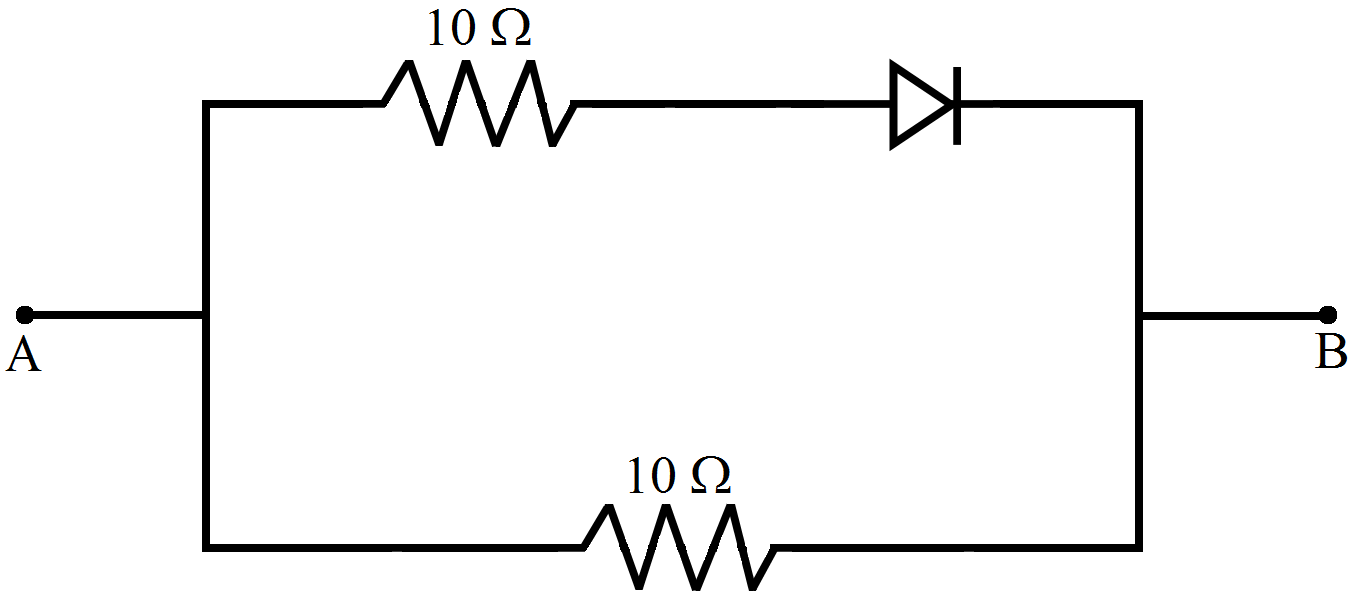
Find the equivalent resistance of the network shown in figure. between the points $A$ and $B$.
Answer

Let the potentials at $A$ and $B$ be $V_A$ and $V_B$ respectively.
  1. If $V_A > V_B$
Then current flows from $A$ to $B$ and the diode is in forward biased.
Eq. Resistance $=\frac{10}{2}=5\Omega.$
  1. If $V_A < V_B$
Then current flows from $B$ to $A$ and the diode is reverse biased.
Hence Eq.Resistance $=10\Omega.$
View full question & answer
Question 213 Marks
Let AE denote the energy gap between the valence band and the conduction band. The population of conduction electrons (and of the holes) is roughly proportional to $\text{e}^{\frac{-\Delta\text{E}}{2\text{kT}}}.$ Find the ratio of the concentration of condu.ction electrons in diamond to that in silicon at room temperature 300K. $\Delta\text{E}$ for silicon is 1.1eV and for diamond is 6.0eV. How many conduction electrons are likely to be in one cubic metre of diamond?
Answer
Given, $\text{n}=\text{e}^{\frac{-\Delta\text{E}}{2\text{KT}}},\Delta\text{E}=\text{Diamon}\rightarrow6\text{eV};\Delta\text{E}\ \text{Si}\rightarrow1.1\text{eV}$ Now, $\text{n}_1=\text{e}^{\frac{-\Delta\text{E}_1}{2\text{KT}}}=\text{e}^{\frac{-6}{{2\times300\times8.62\times10^{-5}}}}$$\text{n}_2=\text{e}^{\frac{-\Delta\text{E}_2}{2\text{KT}}}=\text{e}^{\frac{-1.1}{{2\times300\times8.62\times10^{-5}}}}$
$\frac{\text{n}_1}{\text{n}_2}=\frac{4.14772\times10^{-51}}{5.7978\times10^{-10}}=7.15\times10^{-42}$ Due to more $\Delta\text{E},$ the conduction electrons per cubic metre in diamond is almost zero.
View full question & answer
Question 223 Marks
Indium antimonide has a band gap of 0.23eV between the valence and the conduction band. Find the temperature at which kT equals the band gap.
Answer
$\text{E} = 0.23\text{eV, K} = 1.38 \times 10^{-23}$
$\text{KT}=\text{E}$
$\Rightarrow 1.38 \times 10^{-23} \times \text{T} = 0.23 \times 1.6 \times 10^{-19}$
$\Rightarrow\text{T}=\frac{0.23\times1.6\times10^{-19}}{1.38\times10^{-23}}=\frac{0.23\times1.6\times10^4}{1.38}$
$=0.2676\times10^4=2670$
View full question & answer