Question
We have valence electrons and conduction electrons in a semiconductor. Do we also have 'valence holes' and 'conduction holes'?

Answer

Holes do not exist in reality. They exist only virtually. When an electron jumps from the valence band to the conduction band, a vacancy is created at the place from where the electron had jumped. This vacancy is called a hole. So, a valence or conduction hole is a virtual concept only.

Need a full question paper?

Generate a complete, print-ready paper with questions like this in minutes — across 16+ boards, with answer keys.
Start Generating Free

Similar questions

A horizontal overhead power line carries a current of 90 A in east to west direction. What is the magnitude and direction of the magnetic field due to the current 1.5 m below the line?
In an experiment on photoelectric effect following observation were recorded :
(i) Wavelength of incident light $ =1.98\times10^{-7}m, $
(ii) cut-off potential = 2.5 V. Calculate maximum kinetic energy of photoelectrons and work function of the metal.
Write and explain the super position principle (of waves).
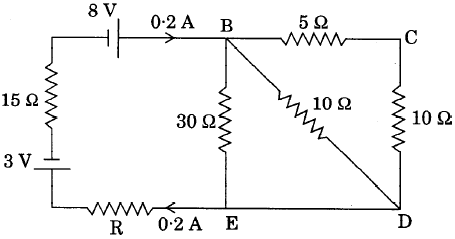
Calculate the value of the resistance $R$ in the circuit shown in the figure so that the current in the circuit is $0.2A$. What would be the potential difference between points Band $E?$
Estimate the number of electrons in $100g$ of water. How much is the total negative charge on these electrons?
  1. Write the process of $\beta$ decay. How can radioactive nuclei emit $\beta$-particles even though they do not contain them? Why do all electrons emitted during $\beta$-decay not have the same energy? 
  2. A heavy nucleus splits into two lighter nuclei. Which one of the two - parent nucleus or the daughter nuclei has more binding energy per nucleon?
Two particles of masses $m_1$ and $m_2$ are joined by a light rigid rod of length $r.$ The system rotates at an angular speed co about an axis through the centre of mass of the system and perpendicular to the rod. Show that the angular momentum of the system is $\text{L}=\mu\text{r}^2\omega$ where $\mu$ is the reduced mass of the system defined as $\mu=\frac{\text{m}_1\text{m}_2}{\text{m}_1+\text{m}_2}.$
A $3.0 \ cm$ wire carrying a current of $10 A$ is placed inside a solenoid perpendicular to its axis. The magnetic field inside the solenoid is given to be $0.27 T.$ What is the magnetic force on the wire?
A person riding a car moving at 72km/h sounds a whistle emitting a wave of frequency 1250Hz. What frequency will be heard by another person standing on the road.
  1. In front of the car.
  2. Behind the car? Speed of sound in air = 340m/s.
A proton is projected with a velocity of $3 \times 10^6 ms^{-1}$ perpendicular to a uniform magnetic field of $0.6T$. Find the acceleration of the proton.