Questions

4 Marks Questions

Take a timed test

8 questions · self-marked practice — reveal the answer and mark yourself.

Question 14 Marks
Two submarines are approaching each other in a calm sea. The first submarine travels at a speed of $36\ km/h$ and the other at $54\ km/h$ relative to the water. The first submarine sends a sound signal $($sound waves in water are also called sonar$)$ at a frequency of $2000\ Hz.$
  1. At what frequency is this signal received by the second submarine?
  2. The signal is reflected from the second submarine. At what frequency is this signal received by the first submarine. Take the speed of the sound wave in water to be $1500\ m/s.$
Answer
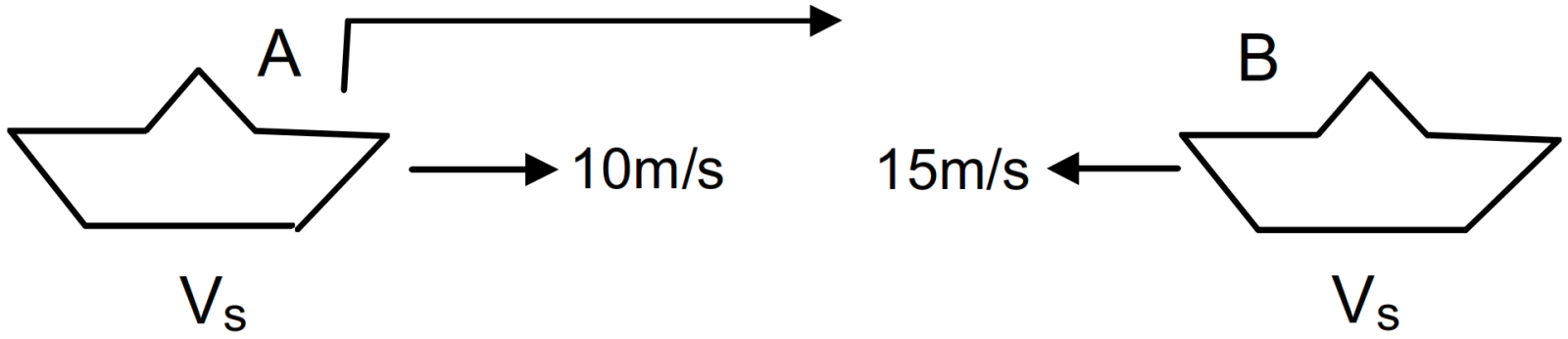
  1. According to the questions, $v = 1500\ m/s, f = 2000\ Hz, v_s = 10m/s, v_o = 15\ m/s$
  2. So, the apparent frequency heard by the submarine $B,$
    $=\Big(\frac{1500+15}{1500-10}\Big)\times2000=2034\text{ Hz}.$
  3. Apparent frequency received by submarine $A,$
  4. $=\Big(\frac{1500+10}{1500-15}\Big)\times2034=2068\text{ Hz}.$
View full question & answer
Question 24 Marks
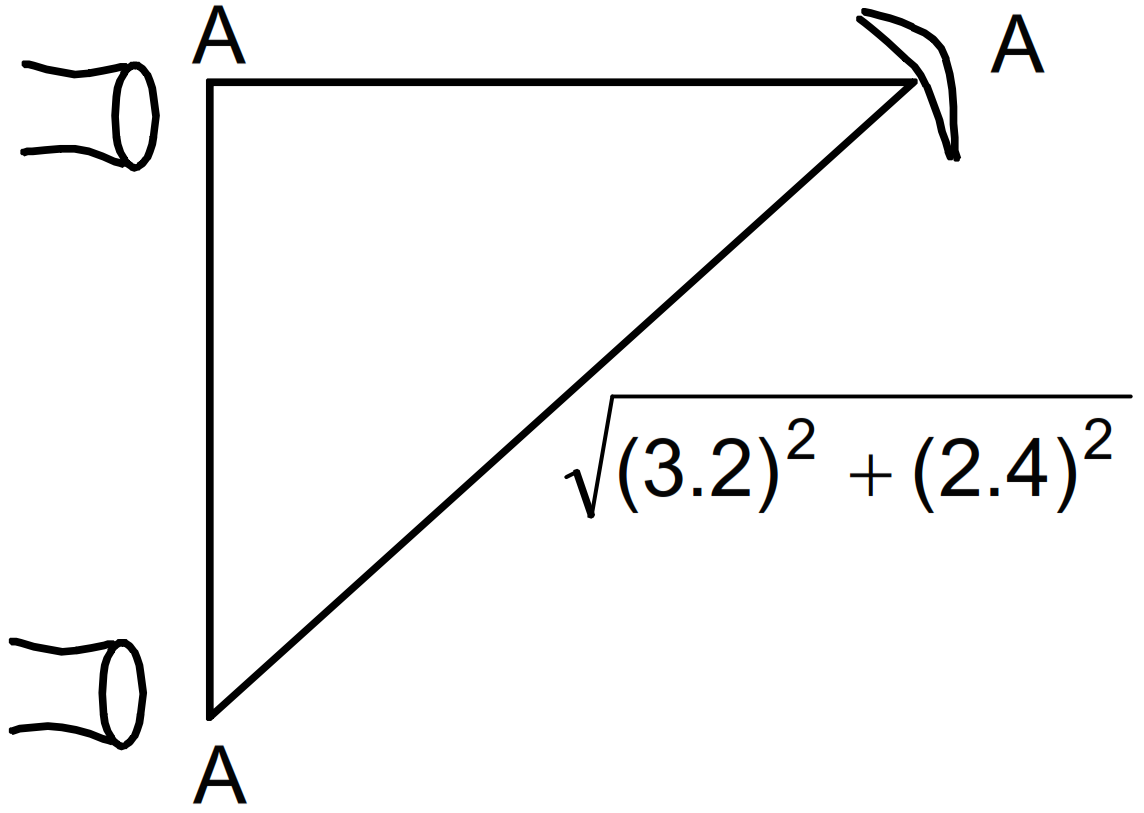
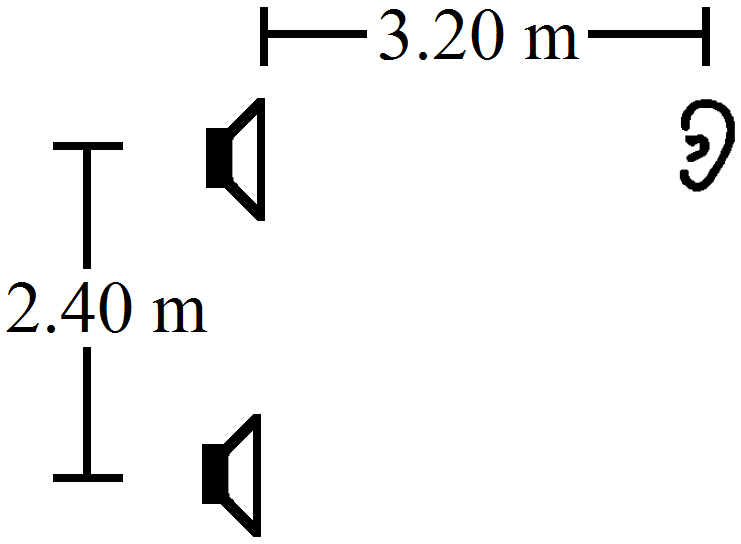
Two stereo speakers are separated by a distance of 2.40m. A person stands at a distance of 3.20m directly in front of one of the speakers as shown in figure, Find the frequencies in the audible range (20-2000Hz) for which the listener will hear a minimum sound intensity. Speed of sound in air = 320m/s.
Answer

As shown in the figure the path differences $2.4=\triangle\text{x}=\sqrt{(3.2)^2+(2.4)^2}-3.2$
Again, the wavelength of the either sound waves $=\frac{320}{\rho}$
We know, destructive interference will be occur
If $\triangle\text{x}=\frac{(2\text{n}+1)\lambda}{2}$
$\Rightarrow \sqrt{(3.2)^2+(2.4)^2-(3.2)}=\frac{(2\text{n}+1)}{2}\frac{320}{\rho}$
Solving we get
$\Rightarrow\text{V}=\frac{(2\text{n}+1)400}{2}=200(2\text{n}+1)$
Where $\text{n}=1,2,3,\ \dots49.$ (audible region)
View full question & answer
Question 34 Marks
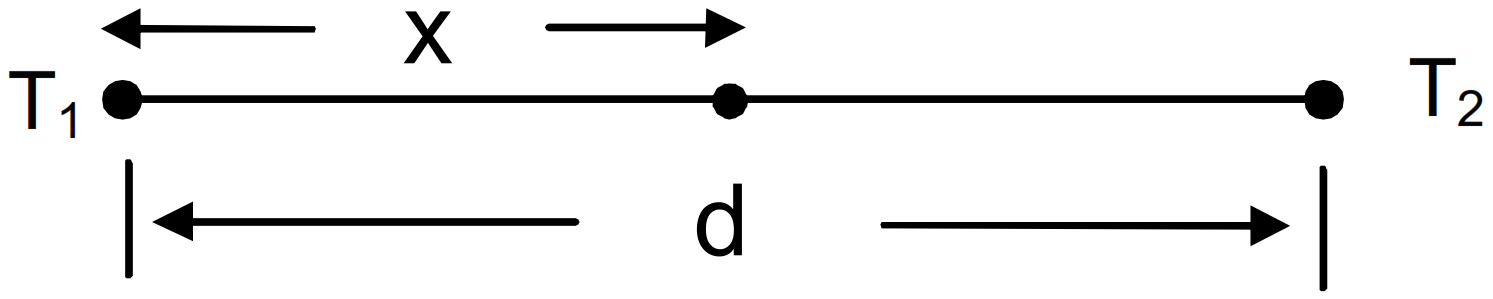
The absolute temperature of air in a region linearly increases from $T_1$ to $T_2$ in a space of width d. Find the time taken by a sound wave to go through the region in terms of $T_1, T_2$, d and the speed v of sound at $273K$. Evaluate this time for $T_1 = 280K, T_2 = 310K, d = 33m$ and $v = 330\ m/s.$
Answer


The variation of temperature is given by
$\text{T}=\text{T}_1+\frac{(\text{T}_2-\text{T}_2)}{\text{d}}\text{x}\ \dots(1)$
We know that $\text{V}\propto\sqrt{\text{T}}$
$\Rightarrow\frac{\text{V}_\text{T}}{\text{V}}=\sqrt{\frac{\text{T}}{273}}$
$\Rightarrow\text{V}_\text{T}=\text{v}\sqrt{\frac{\text{T}}{273}}$
$\Rightarrow\text{dt}=\frac{\text{dx}}{\text{V}_\text{T}}=\frac{\text{du}}{\text{v}}\times\sqrt{\frac{273}{\text{T}}}$
$\Rightarrow\text{t}=\frac{273}{\text{V}}\int\limits_0^\text{d}\frac{\text{dx}}{\Big[\frac{\text{T}_1+(\text{T}_2-\text{T}_1)}{\text{dx}}\Big]^{\frac{1}{2}}}$
$=\frac{\sqrt{273}}{\text{V}}\times\frac{2\text{d}}{\text{T}_2-\text{T}_1}\bigg[\text{T}_1+\frac{\text{T}_2-\text{T}_1}{\text{d}}\text{x}\bigg]_0^\text{d}$
$=\Big(\frac{2\text{d}}{\text{V}}\Big)\Big(\frac{\sqrt{273}}{\text{T}_2-\text{T}_1}\Big)\times\sqrt{\text{T}}_2-\sqrt{\text{T}_1}$
$=\text{T}=\frac{2\text{d}}{\text{V}}\frac{\sqrt{273}}{\sqrt{\text{T}}_2+\sqrt{\text{T}_1}}$
Putting the given value we get
$=\frac{2\times33}{330}$
$=\frac{\sqrt{273}}{\sqrt{280}+\sqrt{310}}=96\text{ms}.$
View full question & answer
Question 44 Marks
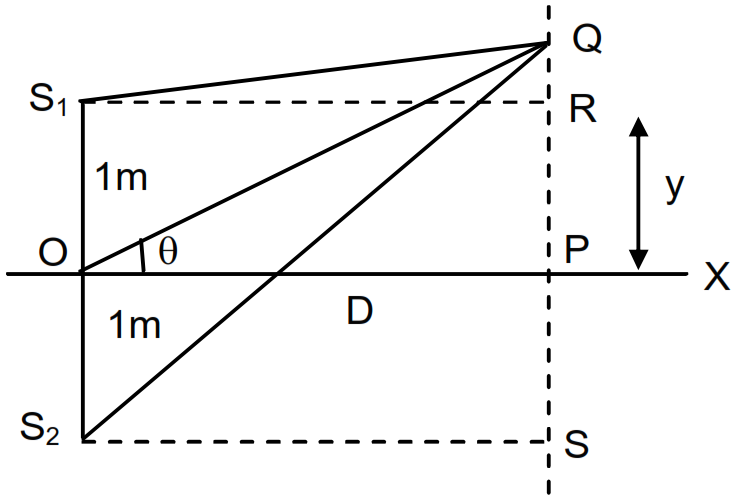
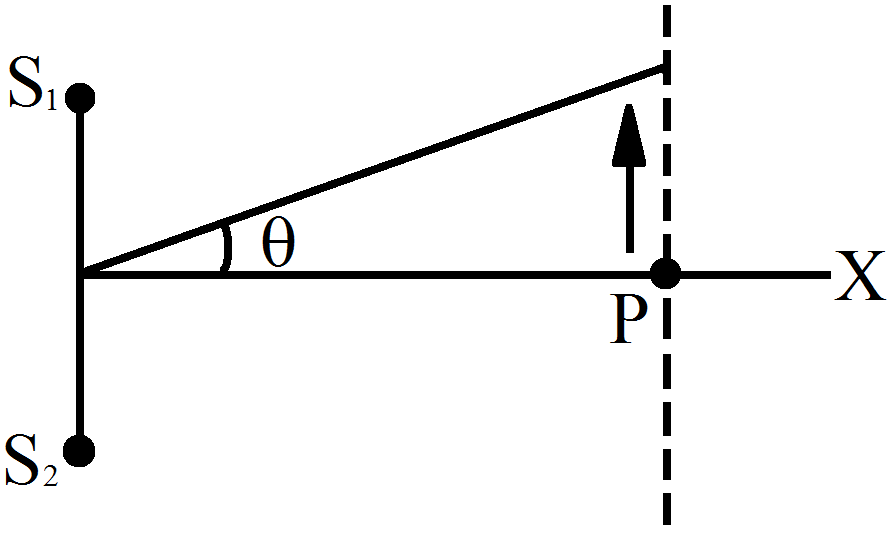
Two speakers $S_1$ and $S_2,$ driven by the same amplifier, are placed at $y = 1.0m$ and $y = -1.0m$ figure, The speakers vibrate in phase at $600\ Hz.$ A man stands at a point on the $X-$axis at a very large distance from the origin and starts moving parallel to the $Y-$axis. The speed of sound in air is 330m/s.
  1. At what angle $\theta$ will the intensity of sound drop to a minimum for the first time?
  2. At what angle will he hear a maximum of sound intensity for the first time?
  3. If he continues to walk along the line, how many more maxima can he hear?
Answer

Give, $\text{F}=600\text{ Hz},$ and $\text{v}=300\text{ m/s}$
$\Rightarrow\lambda=\frac{\text{v}}{\text{f}}=\frac{330}{600}=0.55\text{ mm}$
Let $\text{OP}=\text{D},\ \text{PQ}=\text{y}$
$\Rightarrow\theta=\frac{\text{y}}{\text{R}}\ \dots(1)$ Now path difference is given by,
$\text{x}=\text{S}_2\text{Q}-\text{S}_1\text{Q}=\frac{\text{yd}}{\text{D}}$
Where $d = 2m\Big[$The proof of $\text{x}=\frac{\text{yd}}{\text{D}}$ is discussed in interference of light waves$\Big]$
  1. For minimum intensity, $\text{x}=(2\text{n}+1)\Big(\frac{\lambda}{2}\Big)$
$\therefore\frac{\text{yd}}{\text{D}}=\frac{\lambda}{2}$ $\Big[$for minimum $\text{y},\text{x}=\frac{\lambda}{2}\Big]$
$\therefore\frac{\text{y}}{\text{D}}=\theta=\frac{\lambda}{2}=\frac{0.55}{4}=0.1375\times(57.1)^\circ=7.9^\circ$
  1. For minimum intensity, $\text{x}=2\text{n}\Big(\frac{\lambda}{2}\Big)$
$\frac{\text{yd}}{\text{D}}=\lambda$
$\Rightarrow\frac{\text{y}}{\text{D}}=\theta=\frac{\lambda}{\text{D}}=\frac{0.55}{2}=0.275\ \text{rad}$
$\therefore\theta=16^\circ$
  1. For more maxima,
$\frac{\text{yd}}{\text{D}}=2\lambda,3\lambda,4\lambda,\ \dots$
$\Rightarrow\frac{\text{y}}{\text{D}}=\theta=32^\circ,64^\circ,128^\circ$
But since, the maximum value of $\theta$ can be $90^\circ$ , he will hear two more maximum i.e. at $32^\circ$ and $64^\circ .$
View full question & answer
Question 54 Marks
At a prayer meeting, the disciples sing JAI-RAM JAI-RAM. The sound amplified by a loudspeaker comes back after reflection from a building at a distance of 80m from the meeting. What maximum time interval can be kept between one JAI-RAM and the next JAI-RAM so that the echo does not disturb a listener sitting in the meeting. Speed of sound in air is 320m/s.
Answer
Here given $\text{S}=80\text{m}\times2=160\text{m}$$\text{v}=320\text{m/s}$
So the maximum time interval will be$\text{t}=\frac{\text{s}}{\text{v}}$
$=\frac{160}{320}=0.5\ \text{seconds}.$
View full question & answer
Question 64 Marks
Find the change in the volume of $1.0$ litre kerosene when it is subjected to an extra pressure of $2.0 \times 10^5N/m^2$ from the following data. Density of kerosene $= 800\ kg/m^3$ and speed of sound in kerosene $= 1330m/s.$
Answer
We know that $\text{v}=\sqrt{\frac{\text{K}}{\rho}}$
Where $K =$ bulk modulus of elasticity
$\Rightarrow\text{K}=\text{v}^2\rho=(1330)^2\times800\text{N/m}^2$
We know $\text{K}=\Bigg(\frac{\frac{\text{F}}{\text{A}}}{\frac{\triangle\text{V}}{\text{V}}}\Bigg)$
$\Rightarrow\triangle\text{V}=\frac{\text{pressuress}}{\text{K}}$
$=\frac{2\times10^5}{1330\times1330\times800}$
So, $\triangle\text{V}=0.15\ \text{cm}^3$
View full question & answer
Question 74 Marks
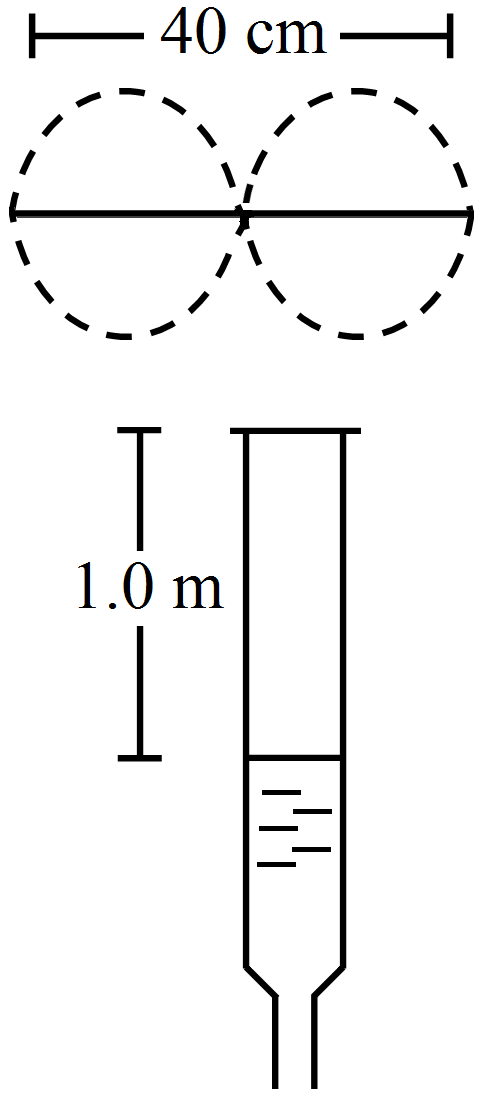
Consider the situation shown in figure. The wire which has a mass of $4.00g$ oscillates in its second harmonic and sets the air column in the tube into vibrations in its fundamental mode. Assuming that the speed of sound in air is $340m/s$, find the tension in the wire.
Answer
Let $n_0 =$ frequency of the turning fork, $T =$ tension of the string $L = 40\ cm = 0.4m, m = 4g = 4 \times 10^{-3}\ kg$
So, $\text{m}=\frac{\text{Mass}}{\text{Unit length}}=10^{-2}\text{Kg/m}$
$\text{n}_0=\frac{1}{2\text{l}}\sqrt{\frac{\text{T}}{\text{m}}}.$
So, $2^{nd}$​​​​​​​ harmonic $2n_0 =\Big(\frac{2}{2\text{l}}\Big)\sqrt{\frac{\text{T}}{\text{m}}}$
As it is unison with fundamental frequency of vibration in the air column
$\Rightarrow2\text{n}_0=\frac{340}{4\times1}=85\text{Hz}$
$\Rightarrow85=\frac{2}{2\times0.4}\sqrt{\frac{\text{T}}{14}}$
$\Rightarrow\text{T}=85^2\times(0.4)^2\times10^{-2}=11.6\ \text{Newton}.$
View full question & answer
Question 84 Marks
If you are walking on the moon, can you hear the sound of stones cracking behind you? Can you hear the sound of your own footsteps?
Answer
We cannot hear sound of stone cracking behind us because there is no air or any other material to propagate sound waves.
But we can hear our foot sep as sound of foot wil travel through our body and we will be able to hear it.
View full question & answer