Question types

Sound Waves question types

118 questions across 6 question groups — pick any mix to generate a Physics paper with step-by-step answer keys.

118
Questions
6
Question groups
5
Question types
Sample Questions

Sound Waves questions

One sample from each question group in this chapter. Select any group above to see the full set with answer keys.

A tuning fork of frequency 512Hz is vibrated with a sonometer wire and 6 beats per second are heard. The beat frequency reduces if the tension in the string is slightly increased. The original frequency of vibration of the string is:
  1. 506Hz
  2. 512Hz
  3. 518Hz
  4. 524Hz.
View full solution
Consider the following statements about sound passing through a gas.
  1. The pressure of the gas at a point oscillates in time.
  2. The position of a small layer of the gas oscillates in time.
  1. Both A and B are correct.
  2. A is correct but B is wrong.
  3. B is correct but A is wrong.
  4. Both A and B are wrong.
View full solution
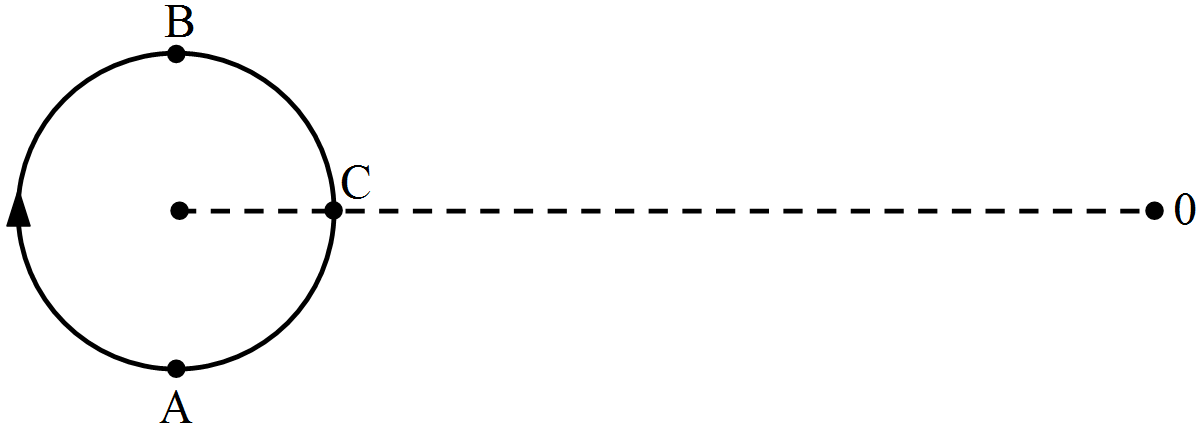
A small source of sound moves on a circle as shown$-$in figure and an observer is sitting at $0$. Let $v_1, v_2, v_3$ be the frequencies heard when the source is at $A, B$ and $C$ respectively.
  • $v_1 > v_2 > v_3$
  • B
    $v_1 = v_2 > v_3$
  • C
    $v_2 > v_3 > v_1$
  • D
    $v_1 > v_2 > v_2.$

Answer: A.

View full solution
The speed of sound in a medium depends on:
  1. The elastic property but not on the inertia property.
  2. The inertia property but not on the elastic property.
  3. The elastic property as well as the inertia property.
  4. Neither the elastic property nor the inertia property.
View full solution
Two sound waves move in the same direction in the same medium. The pressure amplitudes of the waves are equal but the wavelength of the first wave is double the second. Let the average power transmitted across a cross-section by the first wave be $P_1$ and that by the $1$ second wave be $P_2.$ Then,
  • $P_1 = P_2$
  • B
    $P_1 = 4P_2$
  • C
    $P_2 = 2P_1$
  • D
    $P_2 = 4P_1$

Answer: A.

View full solution
A Kundt's tube apparatus has a copper rod of length 1.0m clamped at 25cm from one of the ends. The tube contains air in which the speed of sound is 340m/s. The powder collects in heaps separated by a distance of 5.0cm. Find the speed of sound waves in copper.
View full solution
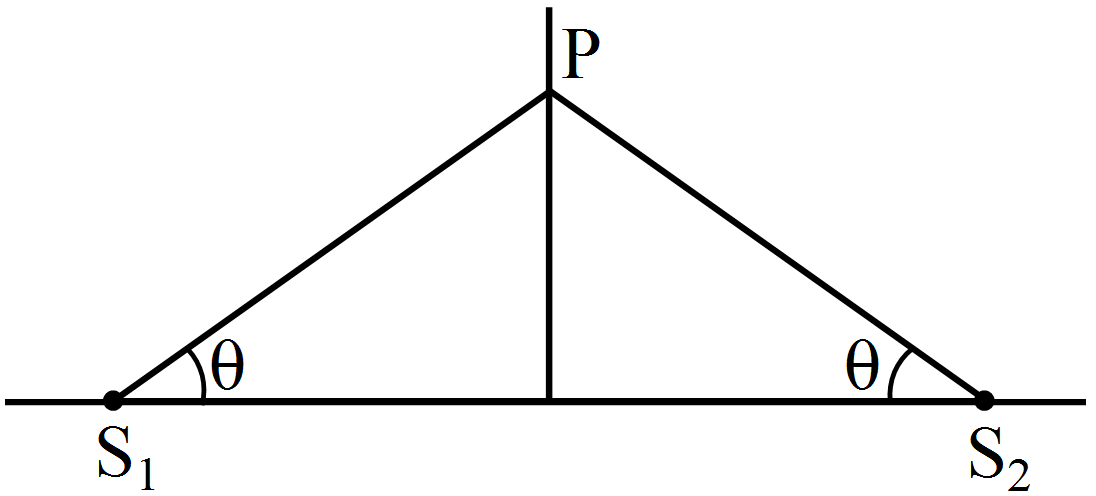
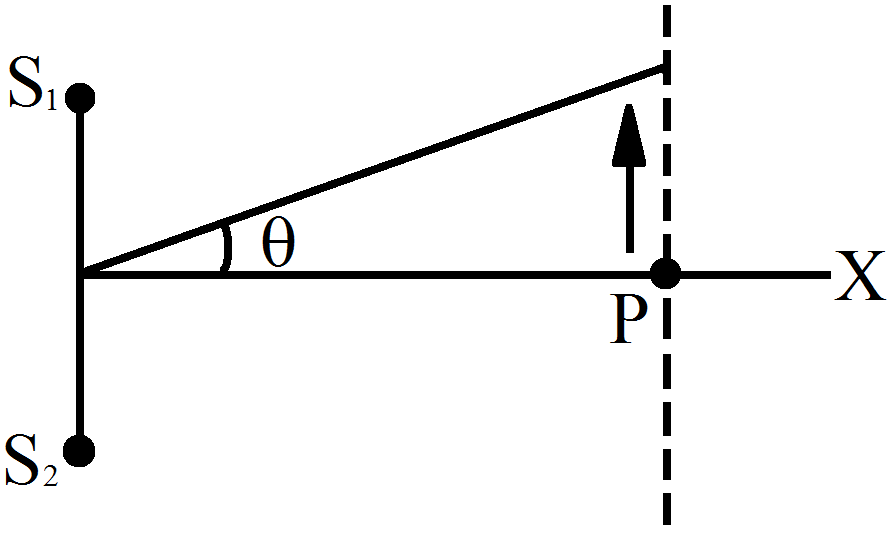
Two sources of sound $S_1$ and $S_2$ vibrate at same frequency and are in phase figure. The intensity of sound detected at a point $P$ as shown in the figure is $I_0.$
  1. If $0$ equals $45^\circ ,$ what will be the intensity of sound detected at this point if one of the sources is switched off?
  2. What will be the answer of the previous part if $= 60^\circ$ ?
View full solution
A small source of sound vibrating at frequency 500Hz is rotated in a circle of radius $\frac{100}{\pi}\text{cm}$ at a constant angular speed of 5.0 revolutions per second. A listener situates himself in the plane of the circle. Find the minimum and the maximum frequency of the sound observed. Speed of sound in air = 332m/s.
View full solution
Q 133 Marks Question3 Marks
Two sources of sound $, S_1$ and $S_2,$ emitting waves of equal wavelength $20.0\ cm,$ are placed with a separation of $20.0\ cm$ between them. A detector can be moved on a line parallel to $S_1 ,S_2,$ and at a distance of $20.0\ cm$ from it. Initially, the detector is equidistant from the two sources. Assuming that the waves emitted by the sources are in phase, find the minimum distance through which the detector should be shifted to detect a minimum of sound.
View full solution
Q 143 Marks Question3 Marks
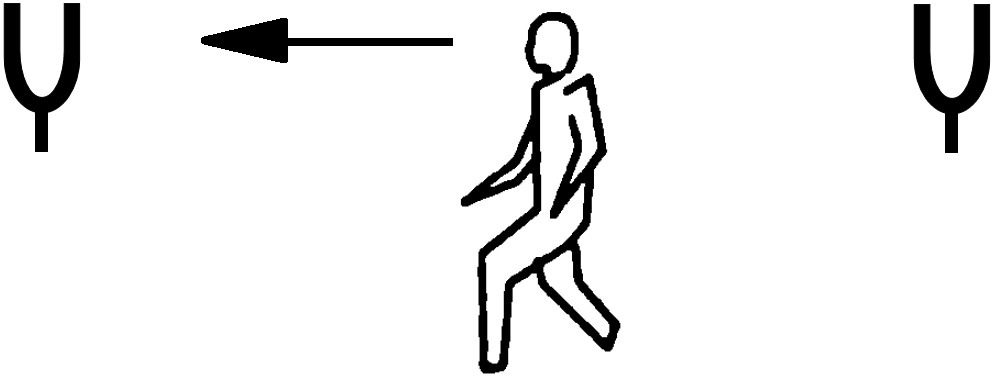
Two identical tuning forks vibrating at the same frequency $256\ Hz$ are kept fixed at some distance apart. $A$ listener runs between the forks at a speed of $3.0\ m/s$ so that he approaches one tuning fork and recedes from the other figure. Find the beat frequency observed by the listener. Speed of sound in air $= 332\ ms/s.$
View full solution
Q 153 Marks Question3 Marks
A person riding a car moving at 72km/h sounds a whistle emitting a wave of frequency 1250Hz. What frequency will be heard by another person standing on the road.
  1. In front of the car.
  2. Behind the car? Speed of sound in air = 340m/s.
View full solution
Q 163 Marks Question3 Marks
A car moves with a speed of $54\ km/h$ towards a cliff. The horn of the car emits sound of frequency $400\ Hz$ at a speed of $3.35m/s.$
  • A
    Find the wavelength of the sound emitted by the horn in front of the car.
  • B
    Find the wavelength of the wave reflected from the cliff.
  • C
    What frequency does a person sitting in the car hear for the reflected sound wave?
  • D
    How many beats does he hear in $10$ seconds between the sound coming directly from the horn and that coming after the reflection?
View full solution
Q 173 Marks Question3 Marks
In a Quincke's experiment, the sound intensity has a minimum value I at a particular position. As the sliding tube is pulled out by a distance of 16.5mm, the intensity increases to a maximum of 9I. Take the speed of sound in air to be 330m/s.
  1. Find the frequency of the sound source.
  2. Find the ratio of the amplitudes of the two waves arriving at the detector assuming that it does not change much between the positions of minimum intensity and maximum intensity.
View full solution
Two submarines are approaching each other in a calm sea. The first submarine travels at a speed of $36\ km/h$ and the other at $54\ km/h$ relative to the water. The first submarine sends a sound signal $($sound waves in water are also called sonar$)$ at a frequency of $2000\ Hz.$
  1. At what frequency is this signal received by the second submarine?
  2. The signal is reflected from the second submarine. At what frequency is this signal received by the first submarine. Take the speed of the sound wave in water to be $1500\ m/s.$
View full solution
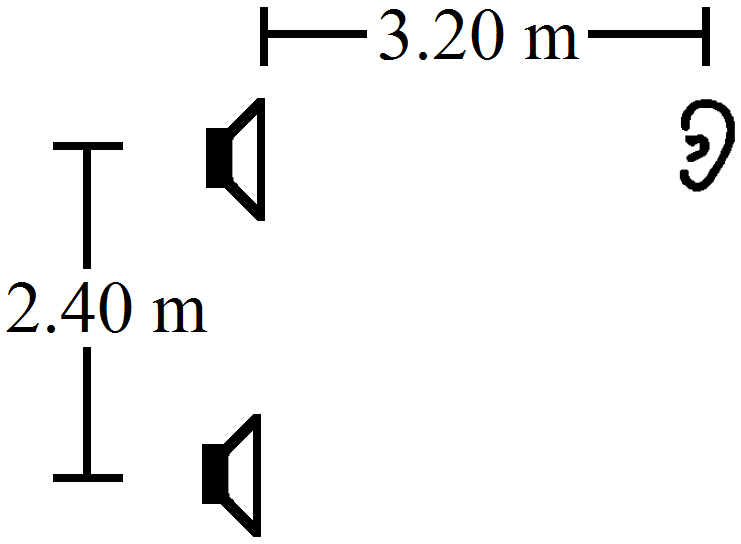
Two stereo speakers are separated by a distance of 2.40m. A person stands at a distance of 3.20m directly in front of one of the speakers as shown in figure, Find the frequencies in the audible range (20-2000Hz) for which the listener will hear a minimum sound intensity. Speed of sound in air = 320m/s.
View full solution
The absolute temperature of air in a region linearly increases from $T_1$ to $T_2$ in a space of width d. Find the time taken by a sound wave to go through the region in terms of $T_1, T_2$, d and the speed v of sound at $273K$. Evaluate this time for $T_1 = 280K, T_2 = 310K, d = 33m$ and $v = 330\ m/s.$
View full solution
Two speakers $S_1$ and $S_2,$ driven by the same amplifier, are placed at $y = 1.0m$ and $y = -1.0m$ figure, The speakers vibrate in phase at $600\ Hz.$ A man stands at a point on the $X-$axis at a very large distance from the origin and starts moving parallel to the $Y-$axis. The speed of sound in air is 330m/s.
  1. At what angle $\theta$ will the intensity of sound drop to a minimum for the first time?
  2. At what angle will he hear a maximum of sound intensity for the first time?
  3. If he continues to walk along the line, how many more maxima can he hear?
View full solution
At a prayer meeting, the disciples sing JAI-RAM JAI-RAM. The sound amplified by a loudspeaker comes back after reflection from a building at a distance of 80m from the meeting. What maximum time interval can be kept between one JAI-RAM and the next JAI-RAM so that the echo does not disturb a listener sitting in the meeting. Speed of sound in air is 320m/s.
View full solution
A $U-$tube having unequal arm$-$lengths has water in it. A tuning fork of frequency $440\ Hz$ can set up the air in the shorter arm in its fundamental mode of vibration and the same tuning fork can set up the air in the longer arm in its first overtone vibration. Find the length of the air columns. Neglect any end effect and assume that the speed of sound in air $= 330\ m/s.$
View full solution
A source of sound operates at $2.0kHz, 20W$ emitting sound uniformly in all directions. The speed of sound in air is $340\ m/s$ and the density of air is $1.2\ kg/m^3.$
  1. What is the intensity at a distance of 6.0m from the source?
  2. What will be the pressure amplitude at this point?
  3. What will be the displacement amplitude at this point ?
View full solution
A sound wave of frequency 100Hz is travelling in air. The speed of sound in air is 350m/s.
  1. By how much is the phase changed at a given point in 2.5ms?
  2. What is the phase difference at a given instant between two points separated by a distance of 10.0cm along the direction of propagation?
View full solution
A small source of sound oscillates in simple harmonic motion with an amplitude of $1.7\ cm.$ A detector is placed along the line of motion of the source. The source emits a sound of frequency $800Hz$  which travels at a speed of $340m/s.$ If the width of the frequency band detected by the detector is $8Hz,$ find the time period of the source.
View full solution
A sound source, fixed at the origin, is continuously emitting sound at a frequency of 660Hz. The sound travels in air at a speed of 330m/s. A listener is moving along the line x = 336m at a constant speed of 26m/s. Find the frequency of the sound as observed by the listener when he is:
  1. At y = - 140m.
  2. At y = 0.
  3. At y = 140m.
View full solution

Generate a Sound Waves paper free

Pick question groups from the list above, set marks and difficulty, and export a branded PDF with step-by-step answer keys. First 3 chapters free — no signup.

Download App