Questions

5 Marks Questions

Take a timed test

20 questions · self-marked practice — reveal the answer and mark yourself.

Question 15 Marks
A boy riding on his bike is going towards east at a speed. of $4\sqrt{2}\text{m/s}$ At a certain point he produces a sound pulse of frequency 1650Hz that travels in air at a speed of 334m/s. A second boy stands on the ground 45° south of east from him. Find the frequency of the pulse as received by the second boy.
Answer
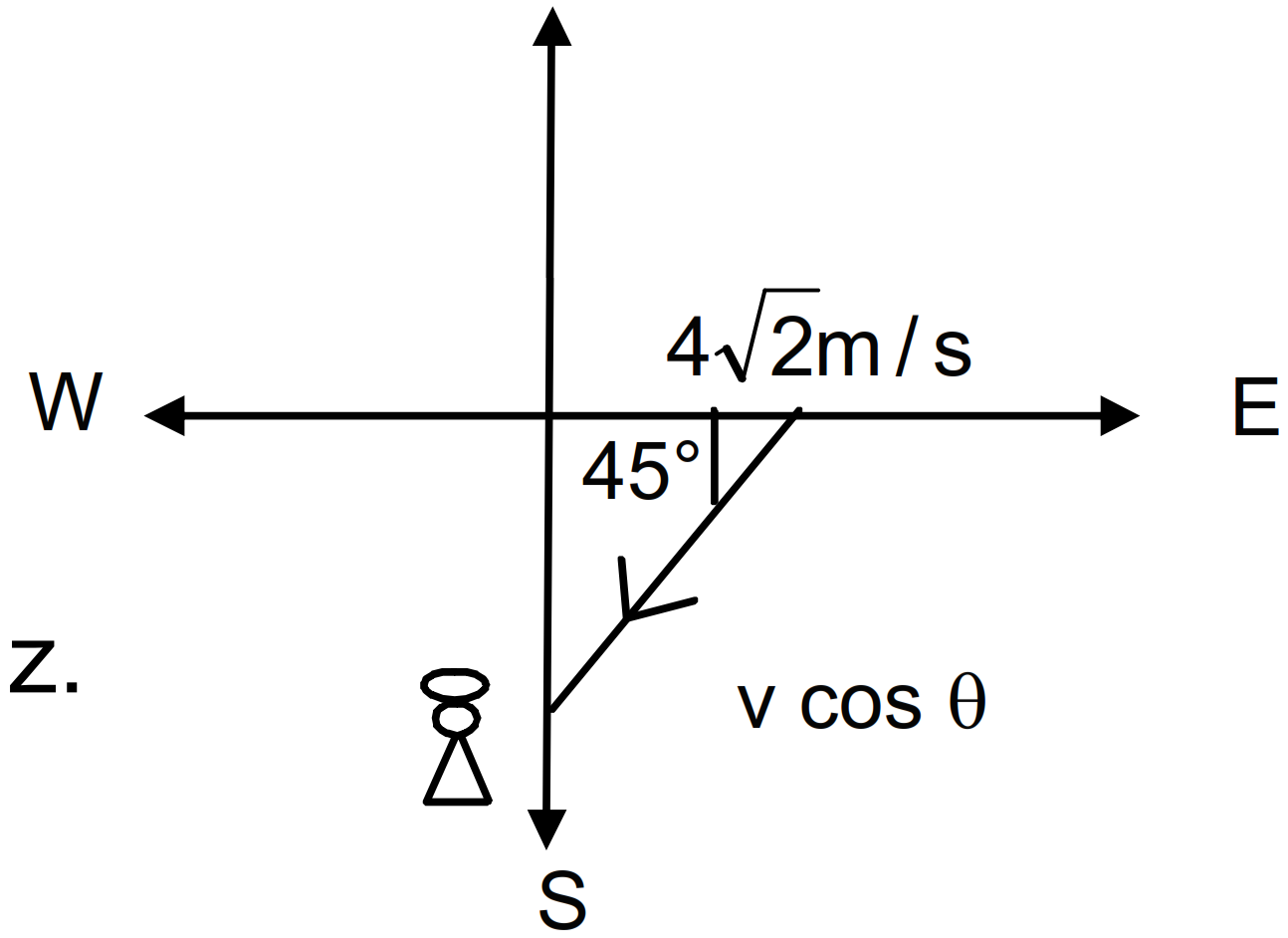

$\text{u}=334\text{m/s}, \text{v}_\text{b}=4\sqrt{2}\text{m/s},\ \text{v}_0=0$
So, $\text{v}_\text{s}=\text{V}_\text{b}\cos\theta=4\sqrt{2}\times\Big(\frac{1}{\sqrt{2}}\Big)=4\text{m/s}$
So, the apparent frequency $\text{f}'=\Big(\frac{\text{u}+0}{\text{u}-\text{v}_\text{b}\cos\theta}\Big)\text{f}=\Big(\frac{334}{334-4}\Big)\times1650=1670\text{Hz}.$
View full question & answer
Question 25 Marks
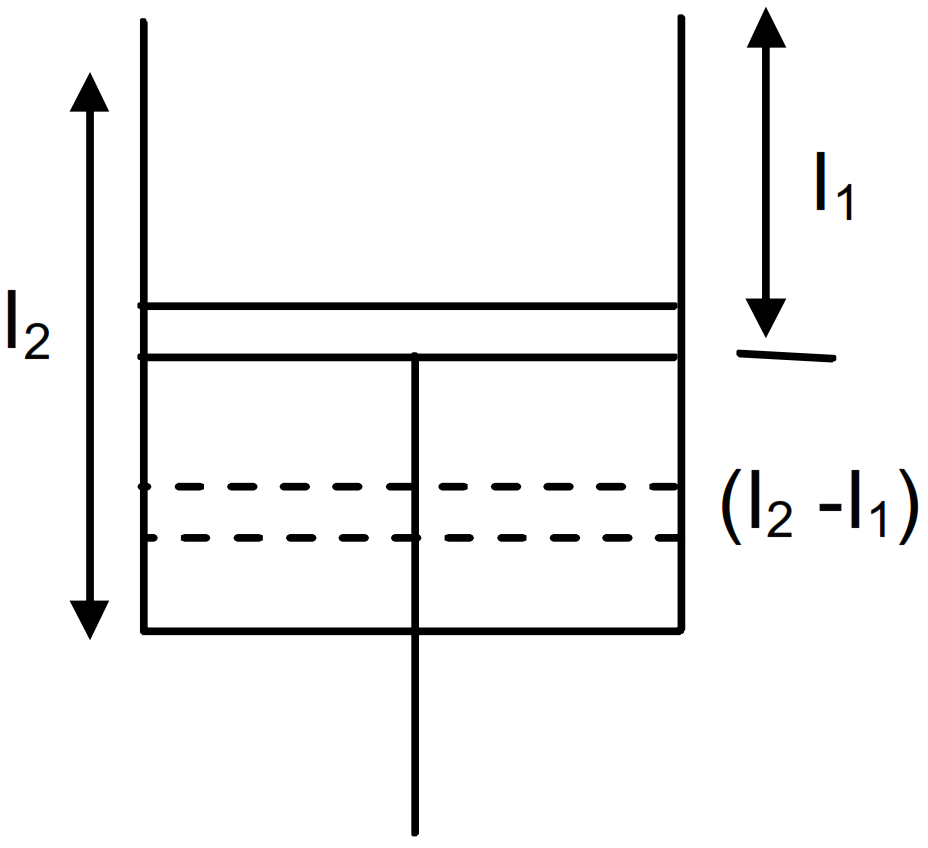
A piston is fitted in a cylindrical tube of small cross-section with the other end of the tube open. The tube resonates with a tuning fork of frequency 512Hz. The piston is gradually pulled out of the tube and it is found that a second resonance occurs when the piston is pulled out through a distance of 32.0cm. Calculate the speed of sound in the air of the tube.
Answer


Let, the piston resonates at length $l_1$ and $l_2$
Here, $\text{l}=32;\ \text{v}=?,\ \text{n}=512\text{Hz}$
Now $\Rightarrow512=\frac{\text{v}}{\lambda}$
$\Rightarrow\text{v}=512\times0.64=328\text{m/s}$
View full question & answer
Question 35 Marks
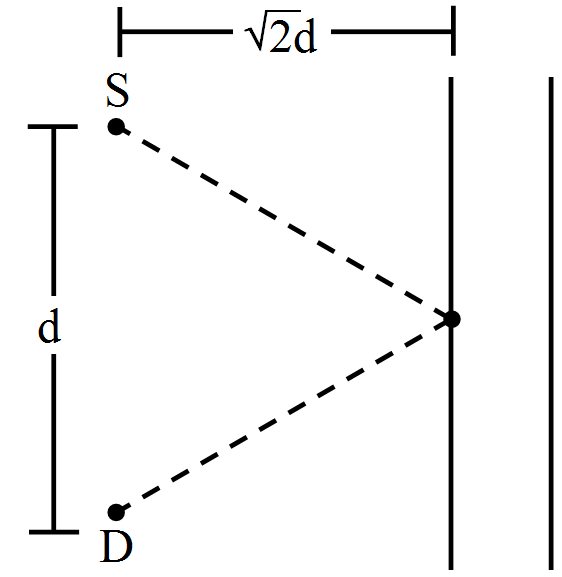
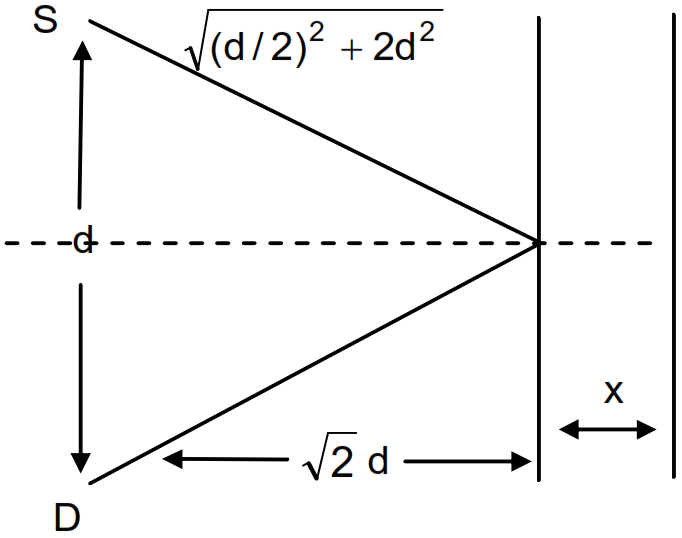
A source S and a detector D are placed at a distance d apart. A big cardboard is placed at a distance $\sqrt{2}\text{d}$ from the source and the detector as shown in figure, The source emits a wave of wavelength $=\frac{\text{d}}{2}$ which is received by the detector after reflection from the cardboard. It is found to be in phase with the direct wave received from the source. By what minimum distance should the cardboard be shifted away so that the reflected wave becomes out of phase with the direct wave?
Answer

Here given $\lambda=\frac{\text{d}}{2}$
Initial path difference is given by $2\sqrt{\Big(\frac{\text{d}}{2}\Big)^2+2\text{d}^2}-\text{d}$
If it is now shifted a distance x then path difference will be
$=2\sqrt{\Big(\frac{\text{d}}{2}\Big)^2}+\Big(\sqrt{2}\text{d}+\text{x}\Big)^2-\text{d}=\frac{\text{d}}{4}\Big(2\text{d}+\frac{\text{d}}{4}\Big)$
$\Rightarrow\Big(\frac{\text{d}}{2}\Big)^2+\Big(\sqrt{2}\text{d}+\text{x}\Big)^2=\frac{169\text{d}^2}{64}$
$\Rightarrow\frac{153}{64}\text{d}^2$
$\Rightarrow\sqrt{2}\text{d}+\text{x}=1.54\text{d}$
$\Rightarrow\text{x}=1.54\text{d}-1.414\text{d}$
$=0.13\text{d}.$
View full question & answer
Question 45 Marks
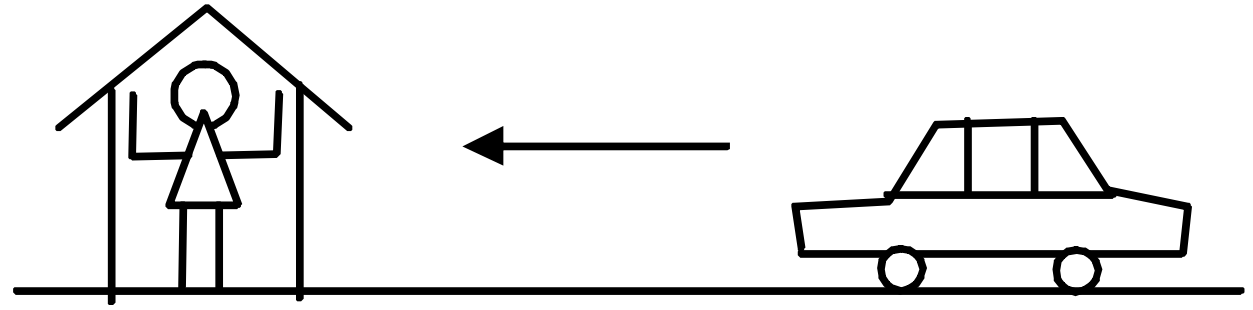
An operator sitting in his base camp sends a sound signal of frequency 400Hz. The signal is reflected back from a car moving towards him. The frequency of the reflected sound is found to be 410Hz. Find the speed of the car. Speed of sound in air = 324m/s.
Answer

$\text{f}=400\text{Hz},\ \text{u}=324\text{m/s}$
$\text{f}'=\frac{\text{u}-(-\text{v})}{\text{u}-(0)}\text{f}=\frac{324+\text{v}}{324}\times400\ \dots(1)$
for the reflected wave, $\text{f}'=410=\frac{\text{u}-0}{\text{u}-\text{v}}\text{f}'$
$\Rightarrow410=\frac{324}{324-\text{v}}\times\frac{324+\text{v}}{324}\times400$
$\Rightarrow810\text{v}=324\times10$
$\Rightarrow\text{v}=\frac{324\times10}{810}=4\text{m/s}.$
View full question & answer
Question 55 Marks
A tuning fork of unknown frequency makes 5 beats per second with another tuning fork which can cause a closed organ pipe of length 40cm to vibrate in its fundamental mode. The beat frequency decreases when the first tuning fork is slightly loaded with wax. Find its original frequency. The speed of sound in air is 320m/s.
Answer
Given length of the closed organ pipe, $\text{l}=40\text{cm}=40\times10^{-2}\text{m}$$\text{V}_\text{air}=320$
So, its frequency $\rho=\frac{\text{V}}{4\text{l}}=\frac{320}{4\times40\times10^{-2}}=200\ \text{Hertz}.$ As the tuning fork produces 5 beats with the closed pipe, its frequency must be 195Hz or 205Hz. Given that, as it is loaded its frequency decreases. So, the frequency of tuning fork = 205Hz.
View full question & answer
Question 65 Marks
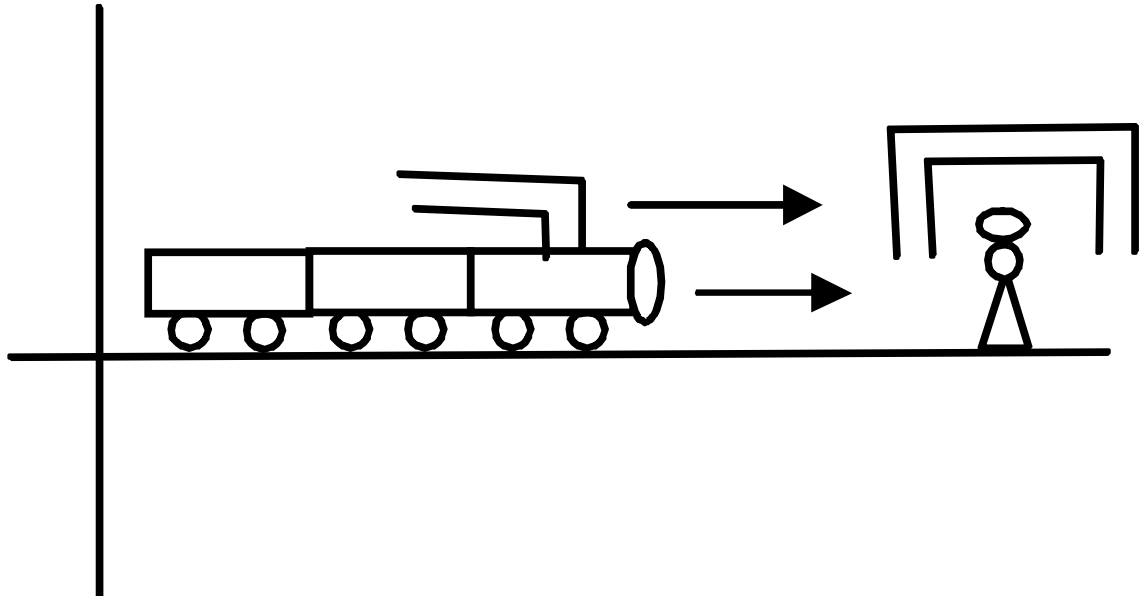
A train running at 108km/h towards east whistles at a dominant frequency of 500Hz. Speed of sound in air is 340m/s.
  1. What frequency will a passenger sitting near the open window hear?
  2. What frequency will a person standing near the track hear whom the train has just passed?
  3. A wind starts blowing towards east at a speed f 36km/h. Calculate the frequencies heard by the passenger in the train and by the person standing near the track.
Answer
  1. The frequency by the passenger sitting near the open window is 500Hz. The speed of sound in air V = 340m/ s.
Speed of the source u ₹ = 180km/ h
$=\frac{108000}{3600}\text{m}/\text{s}=30\text{m}/\text{s}.$
  1. After the train has passed the apparent frequency heard by a person standing near the track will be,
So, $\text{f}''=\Big(\frac{340+0}{340+30}\Big)\times500=459\text{Hz}$
  1. The person inside the source will listen the original frequency of the train.
Here, given $\text{V}_\text{m}=10\text{m/s}$
For the person standing near the track
Apparent frequency $=\frac{\text{u}+\text{V}_\text{m}+0}{\text{u}+\text{V}_\text{m}-(-\text{V}_\text{s})}\times500=458\text{Hz}.$
View full question & answer
Question 75 Marks
A source of sound emitting a 1200Hz note travelg along a straight line at a speed of 170m/s. A detector is placed at a distance of 200m from the line of motion of the source.
  1. Find the frequency of sound received by the detector at the instant when the source gets closest to it.
  2. Find the distance between the source and the detector at the instant it detects the frequency 1200Hz. Velocity of sound in air = 340m/s.
Answer
  1. Given that, f = 1200Hz, u = 170m/s, L = 200m, v = 340m/s
From Doppler’s equation (as in problem no.84)
$\text{f}'=\text{f}\Big(\frac{\text{v}^2}{\text{v}^2-\text{u}^2}\Big)=1200\times\frac{340^2}{340^2-170^2}=1600\text{Hz}.$
​​​​​​​
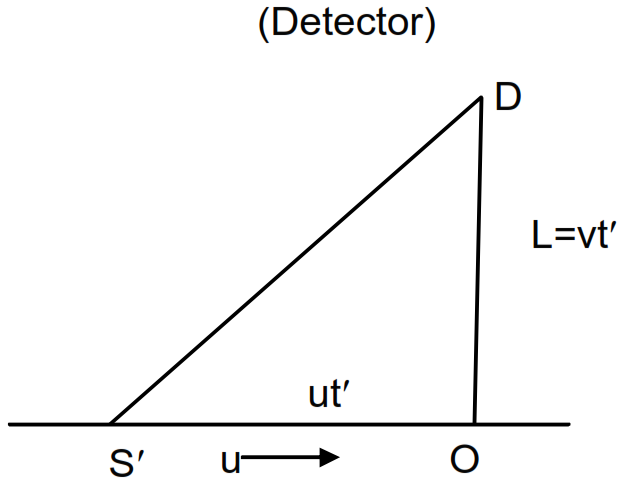
  1. v = velocity of sound, u = velocity of source let, t be the time taken by the sound to reach at D
$\text{DO}=\text{vt}'=\text{L},$ and $\text{S}'\text{O}=\text{ut}'$
$\text{t}'=\frac{\text{L}}{\text{V}}$
$\text{S}'\text{D}=\sqrt{\text{S}'\text{O}^2+\text{DO}^2}=\sqrt{\text{u}^2\frac{\text{L}^2}{\text{v}^2}+\text{L}^2}=\frac{\text{L}}{\text{v}}\sqrt{\text{u}^2+\text{v}^2}$
Putting the values in the above equation, we get
$\text{S}'\text{D}=\frac{220}{340}\sqrt{170^2+340^2}=223.6\text{m}.$
View full question & answer
Question 85 Marks
A U-tube having unequal arm-lengths has water in it. A tuning fork of frequency 440Hz can set up the air in the shorter arm in its fundamental mode of vibration and the same tuning fork can set up the air in the longer arm in its first overtone vibration. Find the length of the air columns. Neglect any end effect and assume that the speed of sound in air = 330m/s.
Answer
Given: Speed of sound in air $v = 330\ ms^{−1}$
Frequency of the tuning fork f = 440Hz For the shorter arm:
 Let the length of the shorter arm of the tube be $L_1$ Frequency of fundamental mode is given by
$\text{f}=\frac{\text{v}}{4\text{L}_1}$
On substituting the respective values, we get:$440=\frac{330}{4\text{L}_1}$
$\Rightarrow \text{L}_1=\frac{330}{440\times 4}=0.1875\text{m}$
$=18.8\text{cm}$
For the longer arm: Let the length of the longer arm of the tube be $L_2$ Frequency of the first overtone f = 440Hz Frequency of the first overtone is given by,
$\text{f}=\frac{3\text{v}}{4\text{L}_2}$
On substituting the respective values, we get,$\Rightarrow 440=\frac{3\times 330}{4\text{L}_2}$
$\Rightarrow \text{L}_2=\frac{3\times 330}{440\times4}=05.63\text{m}$
$=56.3\text{cm}$
View full question & answer
Question 95 Marks
Calculate the frequency of beats produced in air when two sources of sound are activated, one emitting a wavelength of 32cm and the other of 32.2cm. The speed of sound in air is 350m/s.
Answer
Group - I Given $\text{V}=350$$\lambda_1=32\text{cm}$
$=32\times10^{-2}\text{m}$
So, $\eta_1=\text{frequency}=1093\text{Hz}$ Group - II$\text{v}=350$
$\lambda_2=32.2\text{cm}$
$=32.2\times10^{-2}\text{m}$
$\eta_2=\frac{\text{V}}{\lambda}=\frac{350}{32.2\times10^{-2}}=1086.96\text{Hz}$
So beat frequency $=1093-1086=7\text{Hz}.$
View full question & answer
Question 105 Marks
A source of sound operates at 2.0kHz, 20W emitting sound uniformly in all directions. The speed of sound in air is 340m/s and the density of air is $1.2kg/m^3.$
  1. What is the intensity at a distance of 6.0m from the source?
  2. What will be the pressure amplitude at this point?
  3. What will be the displacement amplitude at this point ?
Answer
  1. Here given $\text{V}_\text{air}=340\text{m/s},\ \text{Power}=\frac{\text{E}}{\text{t}}=20\text{W}$
$\text{f}=2,000\text{Hz},\ \rho=1.2\text{kg/m}^3$
So, intensity $\text{I}=\frac{\text{E}}{\text{t}.\text{A}}$
$=\frac{20}{4\pi\text{r}^2}=\frac{20}{4\times\pi\times6^2}=44\text{mw/m}^2$ (because r = 6m)
  1. We know that $\text{I}=\frac{\text{P}_0^2}{2\rho\text{V}_\text{air}}$
$\Rightarrow\text{p}_0=\sqrt{1\times2\rho\text{V}_\text{air}}$
$=\sqrt{2\times1.2\times340\times44\times10^{-3}}$
$=6.0\text{N/m}^2.$
  1. We know that $\text{I}=2\pi^2\text{S}_0^2\text{v}^2\rho\text{v}$ where $S_0 =$ displacement amplitude
$\Rightarrow\text{S}_0=\sqrt{\frac{\text{I}}{\pi^2\rho^2\rho\text{V}_\text{air}}}$
Putting the value we get $\text{S}_\text{g}=1.2\times10^{-6}\text{m}.$
View full question & answer
Question 115 Marks
A sound wave of frequency 100Hz is travelling in air. The speed of sound in air is 350m/s.
  1. By how much is the phase changed at a given point in 2.5ms?
  2. What is the phase difference at a given instant between two points separated by a distance of 10.0cm along the direction of propagation?
Answer
  1. Here given $\text{n}=100,\ \text{v}=350\text{m/s}$
$\Rightarrow\lambda=\frac{\text{v}}{\text{n}}$

$=\frac{350}{100}=3.5\text{m}$

In 2.5ms, the distance travelled by the particle is given by

$\triangle\text{x}=350\times2.5\times10^{-3}$

So, phase difference

$\phi=\frac{2\pi}{\lambda}\times\triangle\text{x}\Rightarrow\frac{2\pi}{\Big(\frac{350}{100}\Big)}\times350\times2.5\times10^{-3}=\Big(\frac{\pi}{2}\Big).$
  1. In the second case, Given $\triangle\eta=10\text{cm}=10^{-1}\text{m}$
So, $\phi=\frac{2\pi}{\text{x}}\triangle\text{x}=\frac{2\pi\times10^{-1}}{\Big(\frac{350}{100}\Big)}=\frac{2\pi}{35}.$
View full question & answer
Question 125 Marks
Two audio speakers are kept some distance apart and are driven by the same amplifier system. A person is sitting at a place 6.0m from one of the speakers and 6.4m from the other. If the sound signal is continuously varied from 500Hz to 5000Hz, what are the frequencies for which there is a destructive interference at the place of the listener? Speed of sound in air = 320m/s.
Answer
The path difference of the two sound waves is given by$\triangle\text{L}=6.4-6.0=0.4\text{m}$
The wavelength of either wave = $\lambda=\frac{\text{V}}{\rho}=\frac{320}{\rho}(\text{m/s})$ For destructive interference $\triangle\text{L}=\frac{(2\text{n}+1)\lambda}{2}$ where n is an integers. Or $0.4\text{m}=\frac{2\text{n}+1}{2}\times\frac{320}{\rho}$$\Rightarrow\rho=\text{n}=\frac{320}{0.4}=800\frac{2\text{n}+1}{2}\text{Hz}=(2\text{n}+1)400\text{Hz}$
Thus the frequency within the specified range which cause destructive interference are 1200Hz, 2000Hz, 2800Hz, 3600Hz and 4400Hz.
View full question & answer
Question 135 Marks
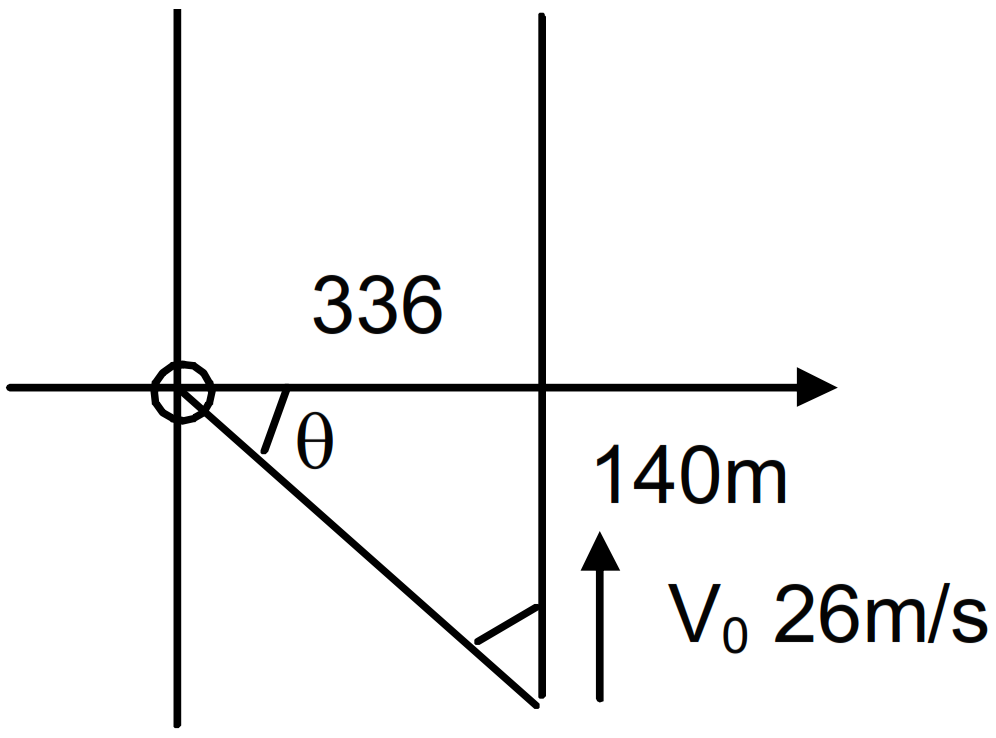
A sound source, fixed at the origin, is continuously emitting sound at a frequency of 660Hz. The sound travels in air at a speed of 330m/s. A listener is moving along the line x = 336m at a constant speed of 26m/s. Find the frequency of the sound as observed by the listener when he is:
  1. At y = - 140m.
  2. At y = 0.
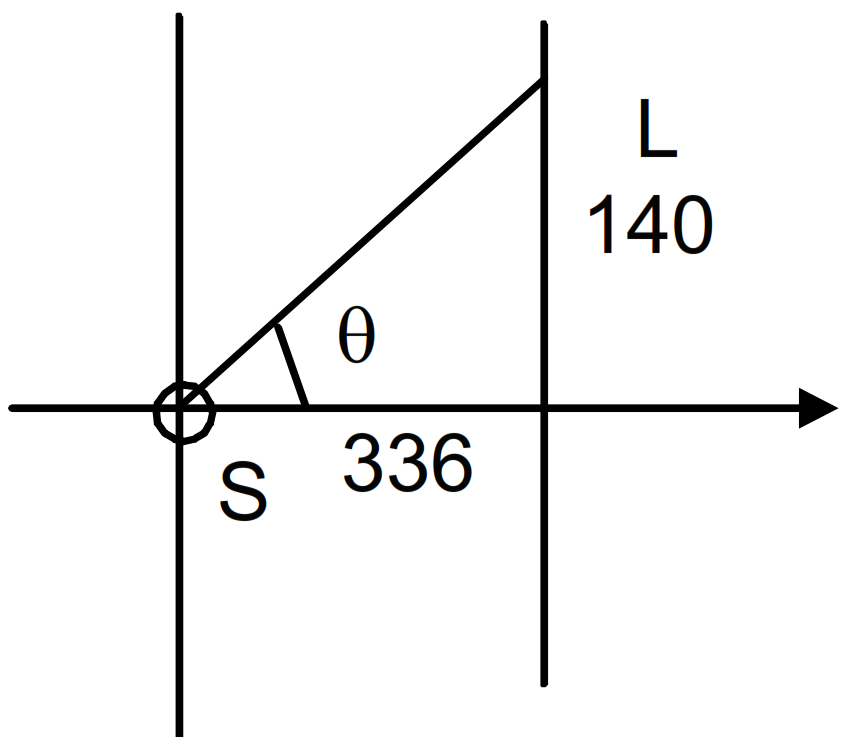
  3. At y = 140m.
Answer
$\text{u}=330\text{m/s},\ \text{v}_0=26\text{m/s}$
  1. Apparent frequency at, $\text{y}=-336$

$\text{m}=\Big(\frac{\text{v}}{\text{v}-\text{u}\sin\theta}\Big)\times\text{f}$
$=\Big(\frac{330}{330-26\sin23^\circ}\Big)\text{f}$
$\Big[$because, $\theta=\tan^{-1}\big(\frac{140}{336}\big)=23^\circ\Big]=680\text{Hz}.$
  1. At the point y = 0 the source and listener are on a x-axis so no apparent change in frequency is seen. So, $\text{f}=660\text{Hz}.$
  2. As shown in the figure $\theta=\tan^{-1}\Big(\frac{140}{336}\Big)=23^\circ$
​​​​​​​​​​​​​​
Here given, $=330\text{m/s};\ \text{v}=\text{V}\sin23^\circ=10.6\text{m/s}$
So, $\text{F}''=\frac{\text{u}}{\text{u}+\text{v}\sin23^\circ}\times660$
$=640\text{Hz}.$
View full question & answer
Question 145 Marks
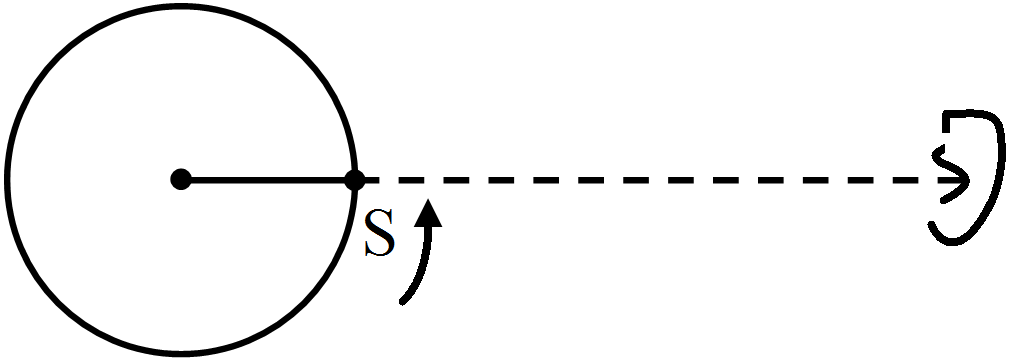
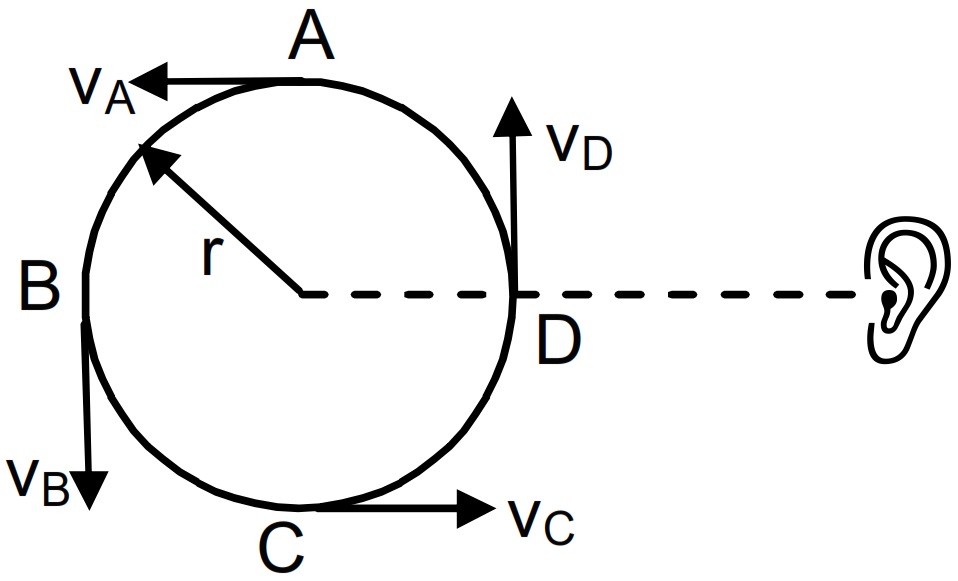
A small source of sound S of frequency 500Hz is attached to the end of a light string and is whirled in a vertical circle of radius 1.6m. The string just remains tight wher the source is at the highest point.
  1. An observer is located in the same vertical plane at a large distance and at the same height as the centre of the circle figure. The speed of sound in air = 330m/s and g = 10m/s 2. Find the maximum frequency heard by the observer.
  2. An observer is situated at a large distance vertically above the centre of the circle. Find the frequencies heard by the observer corresponding to the sound emitted by the source when it is at the same height as the centre.
Answer
Given that, r = 1.6m, f = 500Hz, u = 330m/s
  1. At A, velocity of the particle is given by,
$\text{v}_\text{A}=\sqrt{\text{rg}}=\sqrt{1.6\times10}=4\text{m/s}$
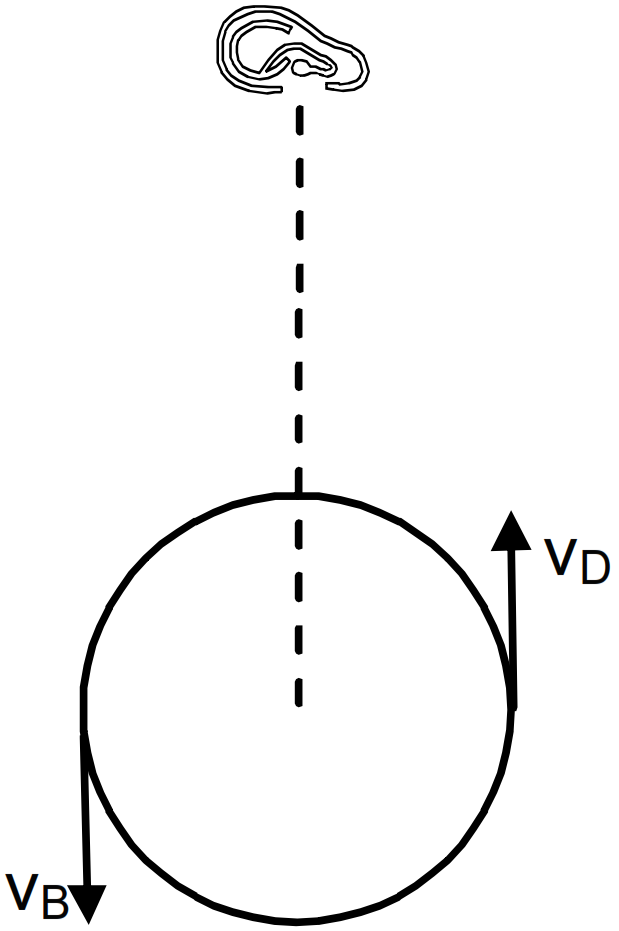
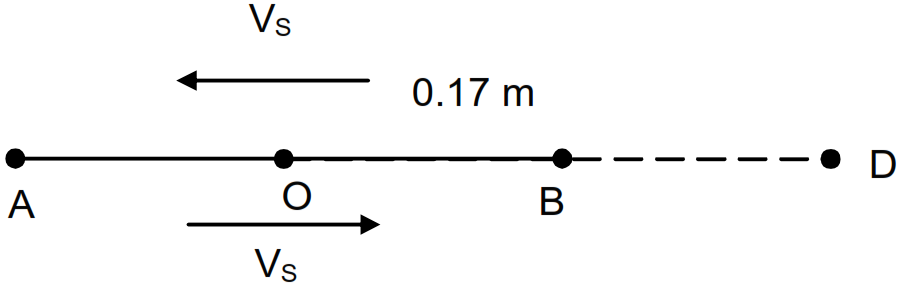
and at C, $\text{v}_\text{A}=\sqrt{\text{rg}}=\sqrt{1.6\times10}=4\text{m/s}$
So, maximum frequency at C,
$\text{f}'_\text{c}=\frac{\text{u}}{\text{u}-\text{v}_\text{s}}\text{f}=\frac{330}{330-8.9}\times500=513.85\text{Hz}.$
Similarly, maximum frequency at A is given by $\text{f}'_\text{A}=\frac{\text{u}}{\text{u}-(-\text{v}_\text{s})}\text{f}=\frac{330}{330+4}(500)=494\text{Hz}.$
  1. Velocity at $\text{B}=\sqrt{3\text{rg}}=\sqrt{3\times1.6\times10}=6.92\text{m/s}$

So, frequency at B is given by, $\text{f}'_\text{B}=\frac{\text{u}}{\text{u}+\text{v}_\text{s}}\times\text{f}=\frac{330}{330+6.92}\times500=490\text{Hz}$
and frequency at D is given by,
$\text{f}_\text{D}=\frac{\text{u}}{\text{u}-\text{v}_\text{s}}\times\text{f}$
$=\frac{330}{330-6.92}\times500$
$=511\text{Hz}$
View full question & answer
Question 155 Marks
A small source of sound oscillates in simple harmonic motion with an amplitude of 1.7cm. A detector is placed along the line of motion of the source. The source emits a sound of frequency 800Hz which travels at a speed of 340m/s. If the width of the frequency band detected by the detector is 8Hz, find the time period of the source.
Answer


Given that, $r = 0.17m, F = 800Hz, u = 340m/s$
Frequency band $= f_1 - f_2 = 6Hz$
Where $f_1$ and $f_2$ correspond to the maximum and minimum apparent frequencies (both will occur at the mean position because the velocity is maximum).
Now, $\text{f}_1\Big(\frac{340}{340+\text{v}_\text{s}}\Big)\text{f}$ and $\text{f}_2=\Big(\frac{340}{340+\text{v}_\text{s}}\Big)\text{f}$
$\therefore\text{f}_1-\text{f}_2=8$
$\Rightarrow340\text{f}\Big(\frac{1}{340-\text{v}_\text{s}}-\frac{1}{340+\text{v}_\text{s}}\Big)=8$
$\Rightarrow\frac{2\text{v}_\text{s}}{340^2-\text{v}_\text{s}^2}=\frac{8}{340\times800}$
$\Rightarrow340^2-\text{v}_\text{s}^2=68000\text{v}_\text{s}$
Solving for vs we get, $\text{v}_\text{s}=1.695\text{m/s}$
For SHM, $\text{v}_\text{s}=\text{r}\omega$
$\Rightarrow\omega=\Big(\frac{1.695}{0.17}\Big)=10$
So, $\text{T}=\frac{2\pi}{\omega}=\frac{\pi}{5}$
$=0.63\text{sec}.$
View full question & answer
Question 165 Marks
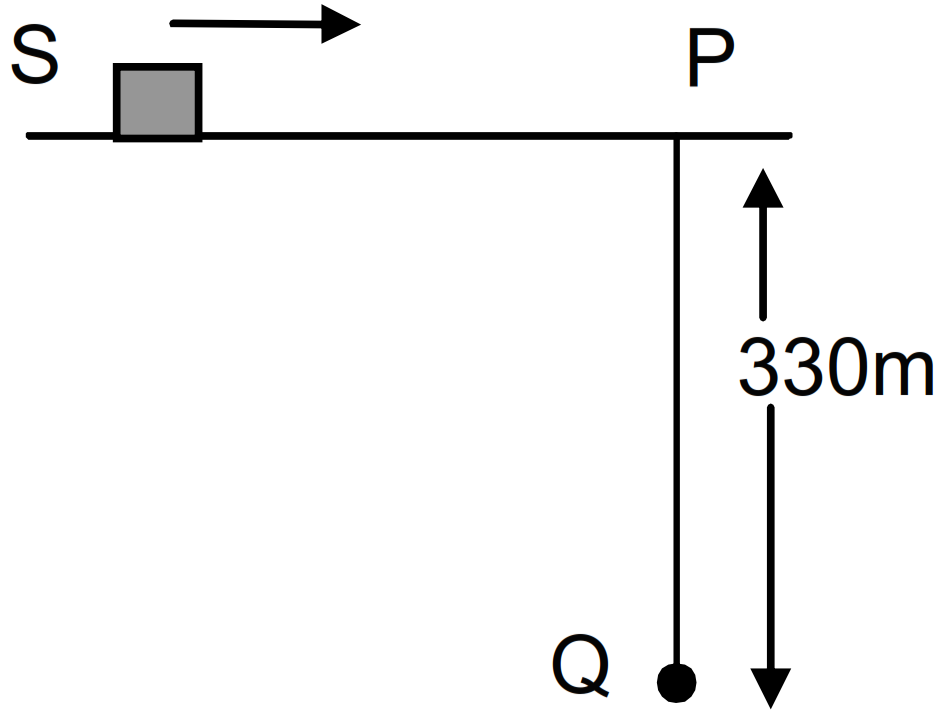
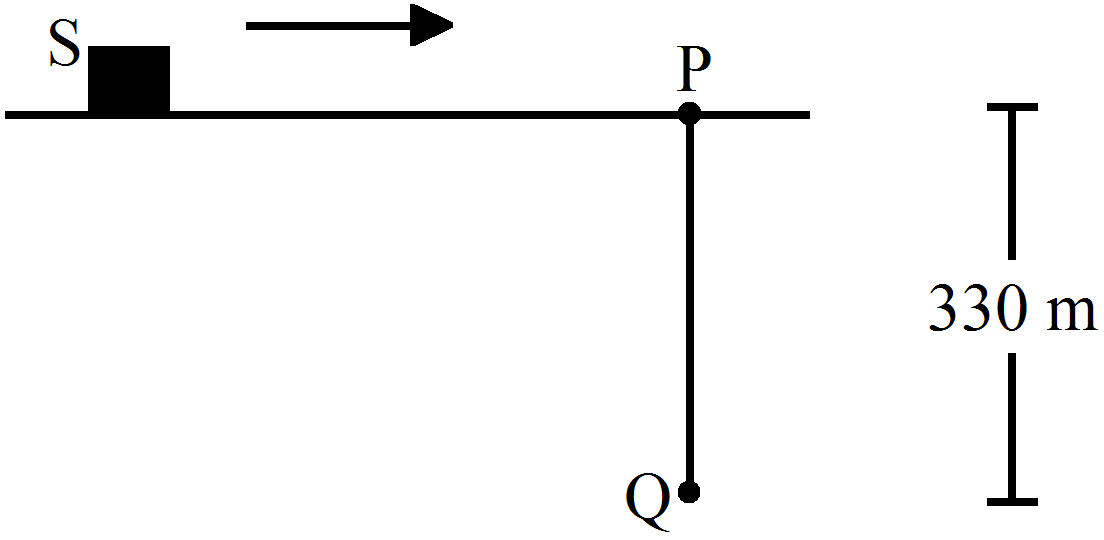
Figure, shows a source of sound moving along the X-axis at a speed of 22m/s continuously emitting a sound of frequency 2.0kHz which travels s in air at a speed of 330m/s. A listener Q stands on the Y-axis at a distance of 330 m from the origin. At t = 0, the source crosses the origin P.
  1. When does the sound emitted from the source at P reach the listener Q?
  2. What will be the frequency heard by the listener at this instant?
  3. Where will the source be at this instant?
Answer

$\text{f}=2\text{KHz}, \text{v}=330\text{m/s},\ \text{u}=22\text{m/s}$

At t = 0, the source crosses P
  1. Time taken to reach at Q is
$\text{t}=\frac{\text{S}}{\text{v}}=\frac{330}{330}=1\text{sec}$
  1. The frequency heard by the listner is
$\text{f}'=\text{f}\Big(\frac{\text{v}}{\text{v}-\text{u}\cos\theta}\Big)$
since, $\theta=90^\circ$
$\text{f}'=2\times\Big(\frac{\text{v}}{\text{u}}\Big)=2\text{KHz}.$
  1. After 1sec, the source is at 22m from P towards right.
View full question & answer
Question 175 Marks
A piano wire A vibrates at a fundamental frequency of 600Hz. A second identical wire B produces 6 beats per second with it when the tension in A is slightly increased. Find the ratio of the tension in A to the tension in B.
Answer
Here given $\text{n}_\text{B}=600=\frac{1}{2\text{l}}\sqrt{\frac{\text{TA}}{\text{m}}}$ As the tension increases frequency increases It is given that 6 beats are produces when tension in A is increases. So, $\text{n}_\text{a}\Rightarrow606=\frac{1}{2\text{l}}\sqrt{\frac{\text{T}_\text{B}}{\text{m}}}$$\Rightarrow\frac{\text{n}_\text{A}}{\text{n}_\text{B}}=\frac{600}{606}=\frac{\Big(\frac{1}{2\text{l}}\Big)\sqrt{\frac{\text{T}_\text{A}}{\text{m}}}}{\Big(\frac{1}{2\text{l}}\Big)\sqrt{\frac{\text{T}_\text{B}}{\text{m}}}}=\frac{\sqrt{\text{TB}}}{\sqrt{\text{TA}}}$
$\Rightarrow \frac{606}{600}=\frac{\sqrt{T_\text{A}}}{\sqrt{\text{T}_\text{B}}}$
$\Rightarrow\frac{\sqrt{\text{T}_\text{A}}}{\sqrt{\text{T}_\text{B}}}=\frac{606}{600}=1.01$
$\Rightarrow\frac{\text{T}_\text{A}}{\text{T}_\text{B}}=1.02$
View full question & answer
Question 185 Marks
A car moving at 108km/h finds another car in front of it going in the same direction at 72km/h. The first car sounds a horn that has a dominant frequency of 800Hz. What will be the apparent frequency heard by the driver in the front car? Speed of sound in air = 330m/s.
Answer


According to the questions velocity of car
$A = V_A = 108km/h = 30m/s$
$V_B = 72km/h = 20m/s, f = 800Hz$
So, the apparent frequency heard by the car B is given by,
$\text{f}'\Big(\frac{330-20}{330-30}\Big)\times800$
$\Rightarrow826.9=827\text{Hz}.$
View full question & answer
Question 195 Marks
A boy riding on a bicycle going at 12km/h towards a vertical wall whistles at his dog on the ground. If the frequency of the whistle is 1600Hz and the speed of sound in air is 330m/s, find
  1. The frequency of the whistle as received by the wall.
  2. The frequency of the reflected whistle as received by the boy.
Answer
To find out the apparent frequency received by the wall,
  1. $\text{V}_\text{s}=12\text{km/h}=\frac{10}{3}=\text{m/s}$
$\text{V}_0=0,\ \text{u}=330\text{m/s}$

So, the apparent frequency is given by $\text{f}'=\bigg(\frac{330}{\frac{330-10}{3}}\bigg)\times1600=1616\text{Hz}$
  1. The reflected sound from the wall whistles now act as a sources whose frequency is 1616Hz.
So, $\text{u}=330\text{m/s},\ \text{V}_\text{s}=0,\ \text{V}_0=\frac{10}{3}\text{m/s}$

So, the frequency by the man from the wall,

$\Rightarrow\text{f}''=\bigg(\frac{330+\frac{10}{3}}{330}\bigg)\times1616=1632\text{m/s}.$
View full question & answer
Question 205 Marks
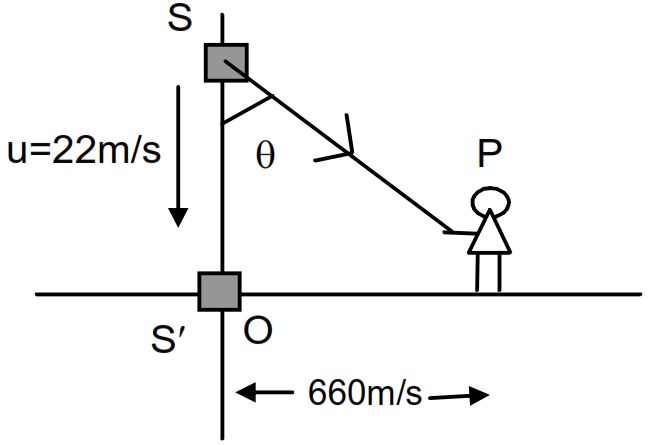
A source emitting sound at frequency 4000Hz, is moving along the Y-axis with a speed of 22m/s. A listener is situated on the ground at the position (660m, 0). Find the frequency of the sound received by the listener at the instant the source the origin. Speed of sound in air = 330m/s.
Answer
t = 4000Hz, u = 22m/s Let ‘t’ be the time taken by the source to reach at ‘O’. Since observer hears the sound at the instant it crosses the ‘O’, ‘t’ is also time taken to the sound to reach at P. $\therefore\text{OQ}=\text{ut}$ and $\text{QP}=\text{vt}$
$\cos\theta=\frac{\text{u}}{\text{v}}$
Velocity of the sound along QP is $(\text{u}\cos\theta).$$\text{f}'=\text{f}\Big(\frac{\text{v}-0}{\text{v}-\text{u}\cos\theta}\Big)=\text{f}\bigg(\frac{\text{v}}{\text{v}-\frac{\text{u}^2}{\text{v}}}\bigg)=\text{f}\Big(\frac{\text{v}^2}{\text{v}^2-\text{u}^2}\Big)$
Putting the values in the above equation, $\text{f}'=4000\times\frac{330^2}{330^2-22^2}=4017.8=4018\text{Hz}.$
View full question & answer