Question
Two audio speakers are kept some distance apart and are driven by the same amplifier system. A person is sitting at a place 6.0m from one of the speakers and 6.4m from the other. If the sound signal is continuously varied from 500Hz to 5000Hz, what are the frequencies for which there is a destructive interference at the place of the listener? Speed of sound in air = 320m/s.
Answer

The path difference of the two sound waves is given by$\triangle\text{L}=6.4-6.0=0.4\text{m}$
The wavelength of either wave = $\lambda=\frac{\text{V}}{\rho}=\frac{320}{\rho}(\text{m/s})$ For destructive interference $\triangle\text{L}=\frac{(2\text{n}+1)\lambda}{2}$ where n is an integers. Or $0.4\text{m}=\frac{2\text{n}+1}{2}\times\frac{320}{\rho}$$\Rightarrow\rho=\text{n}=\frac{320}{0.4}=800\frac{2\text{n}+1}{2}\text{Hz}=(2\text{n}+1)400\text{Hz}$
Thus the frequency within the specified range which cause destructive interference are 1200Hz, 2000Hz, 2800Hz, 3600Hz and 4400Hz.

Need a full question paper?

Generate a complete, print-ready paper with questions like this in minutes — across 16+ boards, with answer keys.

Start Generating Free

Similar questions

A servo voltage stabiliser restricts the voltage output to 220V ± 1%. If an electric bulb rated at 220V, 100W is connected to it, what will be the minimum and maximum power consumed by it?
Explain why elemental semiconductor cannot be used to make visible LEDs.
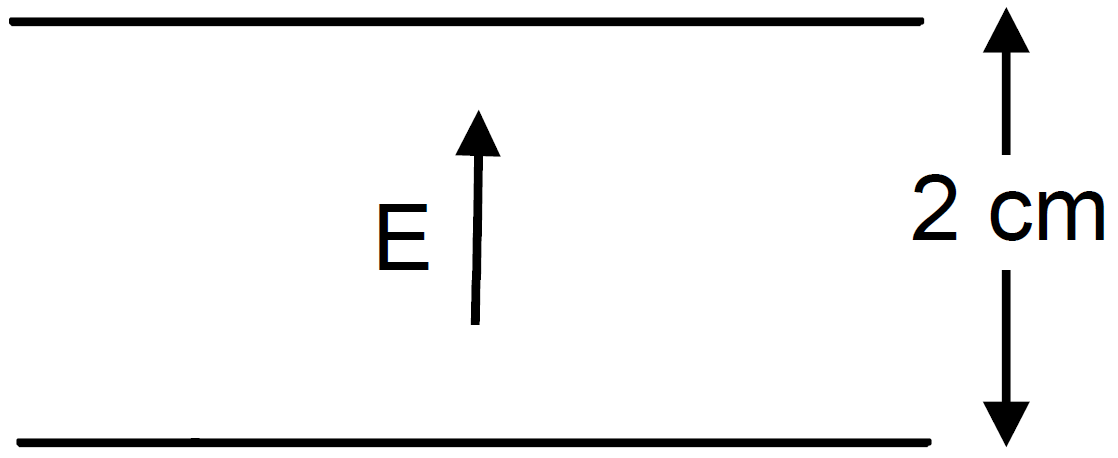
An electric field of magnitude $1000NC^{-1}$ is produced between two parallel plates having a separation of 2.0cm as shown in figure.
  1. What is the potential difference between the plates?
  2. With what minimum speed should an electron be projected from the lower plate in the direction of the field so that it may reach the upper plate?
  3. Suppose the electron is projected from the lower plate with the speed calculated in part (b). The direction of projection makes an angle of 60° with the field. Find the maximum height reached by the electron.
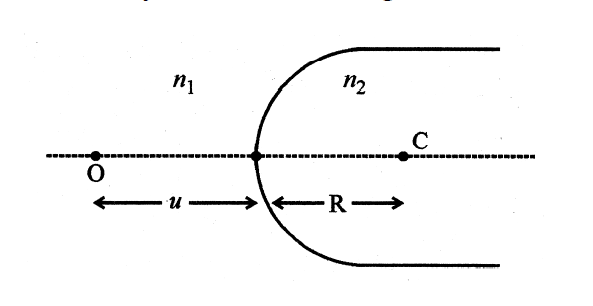
A point object 'O' is kept in a medium of refractive index $n_1$ in front of a convex spherical surface of radius of curvature R which separates the second medium of refractive index $n_2$ from the first one, as shown in the figure. Draw the ray diagram showing the image formation and deduce the relationship between the object distance and the image distance in terms of $n_1, n_2$ and R.
  1.  
  1. hen the image formed above acts as a virtual object for concave spherical, surface separating the medium $n_2$ from $n_1 (n_2> n_1),$ draw this ray diagram and write the similar (similar to (a) relation. Hence obtain the expression for the lens maker's formula.
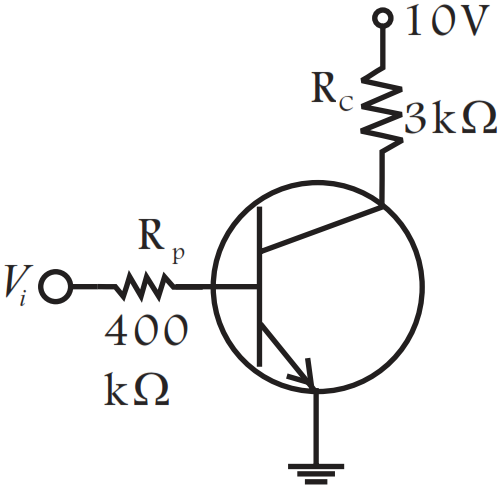
In the circuit shown in Fig., when the input voltage of the base resistance is $10V, V_{be$} is zero and Vce is also zero. Find the values of $I_b, I_c$ and $\beta.$
$i$. Using Huygens's construction of secondary wavelets explains how a diffraction pattern is obtained on a screen due to a narrow slit on which a monochromatic beam of light is incident normally.
$ii.$ Show that the angular width of first diffraction fringe is half that of the central fringe.
$iii.$ Explain why the maxima at $\theta=\left(n+\frac{1}{2}\right) \frac{\lambda}{a}$ a become weaker and weaker with increasing $n$.
A 20cm long conducting rod is set into pure translation with a uniform velocity of $10cm/s^{-1}$ perpendicular to its length. A uniform magnetic field of magnitude 0.10T exists in a direction perpendicular to the plane of motion.
  1. Find the average magnetic force on the free electrons of the rod.
  2. For what electric field inside the rod, the electric force on a free elctron will balance the magnetic force? How is this electric field created?
  3. Find the motional emf between the ends of the rod.
A copper wire of radius 0.1mm and resistance $1\text{k}\Omega$ is connected across a power supply of 20V.
(a) How many electrons are transferred per second between the supply and the wire at one end? (b) Write down the current density in the wire.
The inverse square law in electrostatics is $|\text{F}|=\frac{\text{e}^2}{(4\pi\in_0)\text{r}^2}$ for the force between an electron and a proton. The $\Big(\frac{1}{\text{r}}\Big)$ dependence of |F| can be understood in quantum theory as being due to the fact that the 'particle' of light (photon) is massless. If photons had a mass $m_p,$ force would be modified to $|\text{F}|=\frac{\text{e}^2}{(4\pi\in_0)\text{r}^2}\Big[\frac{1}{\text{r}^2}+\frac{\lambda}{\text{r}}\Big].\text{e}\times\text{p}(-\lambda\text{r})$ where $\lambda=\frac{\text{m}_\text{p}\text{c}}{\text{h}}$ and $\text{h}=\frac{\text{h}}{2\pi}$. Estimate the change in the ground state energy of a H-atom if $m_p$ were $10^{-6}$ times the mass of an electron.
Suppose the gravitational potential due to a small system is $\frac{\text{k}}{\text{r}^2}$ at a distance r from it. What will be the gravitational field? Can you think of any such system? What happens if there were negative masses?