Question 11 Mark
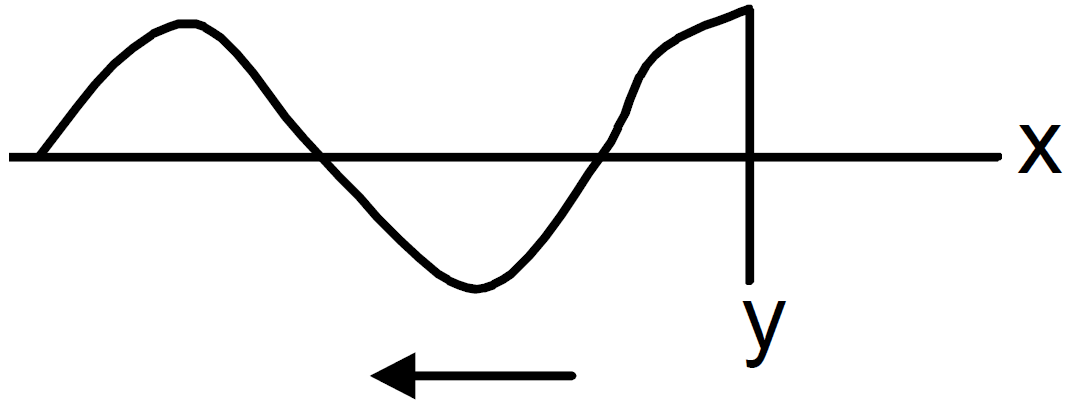
Show that the particle speed can never be equal to the wave speed in a sine wave if the amplitude is less than wavelength divided by $2\pi.$
Answer
View full question & answer→Equation of the wave is given by,$\text{y}=\text{A}\sin (\omega\text{t}-\text{kx})$
Where, A is the amplitude$\omega$ is the angular frequency
k is the wave number Velocity of wave, $\upsilon=\frac{\omega}{\text{k}}$ Velocity of particle, $\upsilon_\text{p}=-\frac{\text{dy}}{\text{dt}}=\text{A}\omega\cos(\omega\text{t}-\text{kx})$ Max velocity of particle, $\upsilon_{\text{p}_{\text{max}}}=\text{A}\omega$ As given$\text{A}<\frac{\lambda}{2\pi}$
$\upsilon_{\text{p}_{\text{max}}}=\frac{\lambda}{2\pi}$
$\upsilon_{\text{p}_{\text{max}}}<\frac{\omega}{\text{k}}$ $\Big[\therefore \frac{2\pi}{\lambda}=\text{k}\Big]$
Where, A is the amplitude$\omega$ is the angular frequency
k is the wave number Velocity of wave, $\upsilon=\frac{\omega}{\text{k}}$ Velocity of particle, $\upsilon_\text{p}=-\frac{\text{dy}}{\text{dt}}=\text{A}\omega\cos(\omega\text{t}-\text{kx})$ Max velocity of particle, $\upsilon_{\text{p}_{\text{max}}}=\text{A}\omega$ As given$\text{A}<\frac{\lambda}{2\pi}$
$\upsilon_{\text{p}_{\text{max}}}=\frac{\lambda}{2\pi}$
$\upsilon_{\text{p}_{\text{max}}}<\frac{\omega}{\text{k}}$ $\Big[\therefore \frac{2\pi}{\lambda}=\text{k}\Big]$