Question 14 Marks
Explain (/ Discuss) the variation in intensity of the light transmitted through two polaroids. And from that derive Malus' law.
Answer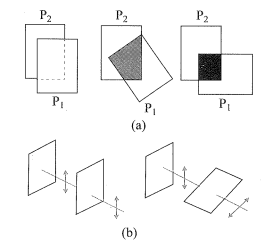
→The light emitted from an oridinary source (like a sodium lamp) is unpolarised.
→When such a light is passed through a polaroid sheet $P_1$, it is observed that its intensity is reduced by half. Rotating $P _{\text {, }}$ has no effect on the transmitted beam and transmitted intensity remains constant.
→Now, let an identical piece of polaroid $P _2$ be placed before $P _1$.
→As shown in Fig., initially $P_1$ and $P_2$ are arranged in such a way that their pass-axis are parallel to each other.
→In this case, the intensity of the transmitted light is the same.
→Now, if $P _1$ is rotated, there is variation seen in the light coming out of $P _2$.
→As shown in a position in the fig., the intensity transmitted through $P_2$ followed by $P_1$ is nearly zero.
→When $P _1$ is rotated by $90^{\circ}$, in one position for light coming from $P _2$, total intensity is absorbed by $P_1$. So, the intensity of light emerging from $P_1$ is zero.
→Suppose, the pass axis of $P _2$ makes an angle $\theta$ with the pass axis of $P_1$, then when the polarised beam passes through the polaroid $P _2$, the component $E \cos \theta$ (along the pass-axis of $P_2$ ) will pass through $P_2$. Thus, as we rotate the polaroid $P _1$ (or $P _2$ ), the intensity will vary as :
$I = I _0 \cos ^2 \theta$
where $I_0$ is the intensity of the polarized light after passing through $P _1$.
→This is known as Malus' law.
→The above discussion shows that the intensity coming out of a single polaroid is half of the incident intensity. By putting a second polaroid, the intensity can be further controlled from $50 \%$ to zero of the incident intensity by adjusting the angle between the pass axis of two polaroids.
View full question & answer→→The light emitted from an oridinary source (like a sodium lamp) is unpolarised.
→When such a light is passed through a polaroid sheet $P_1$, it is observed that its intensity is reduced by half. Rotating $P _{\text {, }}$ has no effect on the transmitted beam and transmitted intensity remains constant.
→Now, let an identical piece of polaroid $P _2$ be placed before $P _1$.
→As shown in Fig., initially $P_1$ and $P_2$ are arranged in such a way that their pass-axis are parallel to each other.
→In this case, the intensity of the transmitted light is the same.
→Now, if $P _1$ is rotated, there is variation seen in the light coming out of $P _2$.
→As shown in a position in the fig., the intensity transmitted through $P_2$ followed by $P_1$ is nearly zero.
→When $P _1$ is rotated by $90^{\circ}$, in one position for light coming from $P _2$, total intensity is absorbed by $P_1$. So, the intensity of light emerging from $P_1$ is zero.
→Suppose, the pass axis of $P _2$ makes an angle $\theta$ with the pass axis of $P_1$, then when the polarised beam passes through the polaroid $P _2$, the component $E \cos \theta$ (along the pass-axis of $P_2$ ) will pass through $P_2$. Thus, as we rotate the polaroid $P _1$ (or $P _2$ ), the intensity will vary as :
$I = I _0 \cos ^2 \theta$
where $I_0$ is the intensity of the polarized light after passing through $P _1$.
→This is known as Malus' law.
→The above discussion shows that the intensity coming out of a single polaroid is half of the incident intensity. By putting a second polaroid, the intensity can be further controlled from $50 \%$ to zero of the incident intensity by adjusting the angle between the pass axis of two polaroids.