Questions

3 Marks Question

Take a timed test

14 questions · self-marked practice — reveal the answer and mark yourself.

Question 13 Marks
Mark two points, $A$ and $B$ on a piece of paper and join them. Measure this length. Draw a line segment $CD$ that is: Half $AB.$
Answer
Mark two points, $A$ and $B$ on a piece of paper and join them as follows:
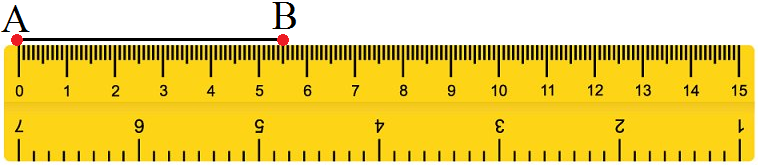
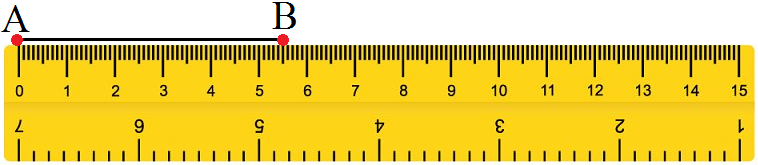
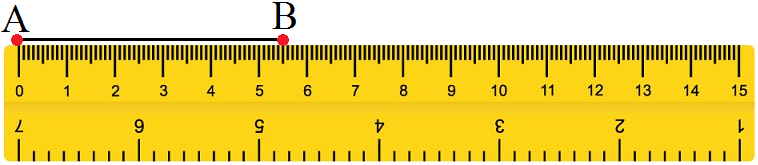
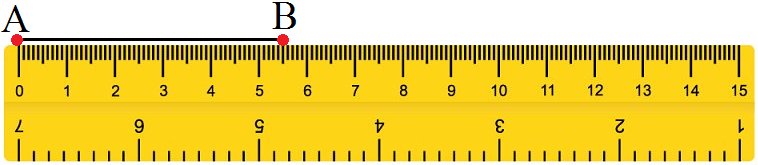
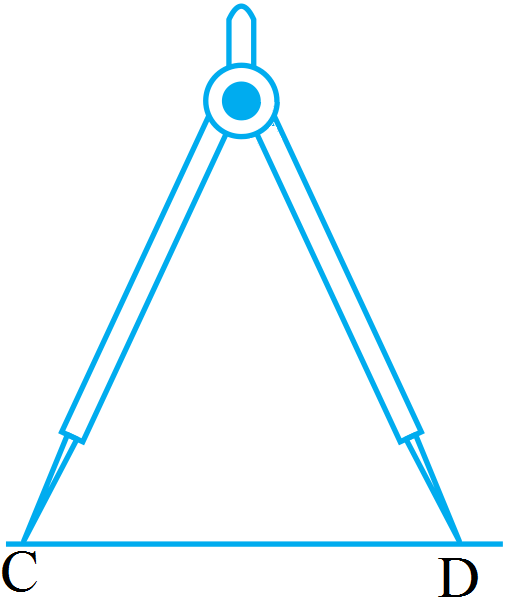
To measure the length of $AB$, place the ruler with its edge along $AB$, such that the zero mark of the \ cm side of the ruler coincides with point $A$, as shown in the figure. Now, read the mark on the ruler, which corresponds to the point $B$. The reading on the ruler at point $B$ is the length of the line segment $AB$. Here, $AB = 5.6\ cm$ To draw the line segment that is half $AB$, we draw a line/ and take a point $C$ on it. Now, using a ruler, we measure the line segment $AB$ and here, $AB = 5.6\ cm$ Half of $AB = 5.62 = 2.8\ cm$ Now, we take a divider and open it so much that its end of one hand is at $0$ and end of the another hand is at $2.8\ cm.$ Then, we lift the divider and place one end at $C$ and the other end on the line $l$ at point $D$.
View full question & answer
Question 23 Marks
Mark two points, $A$ and $B$ on a piece of paper and join them. Measure this length. Draw a line segment $CD$ that is: Twice $AB.$
Answer
Mark two points, $A$ and $B$ on a piece of paper and join them as follows:

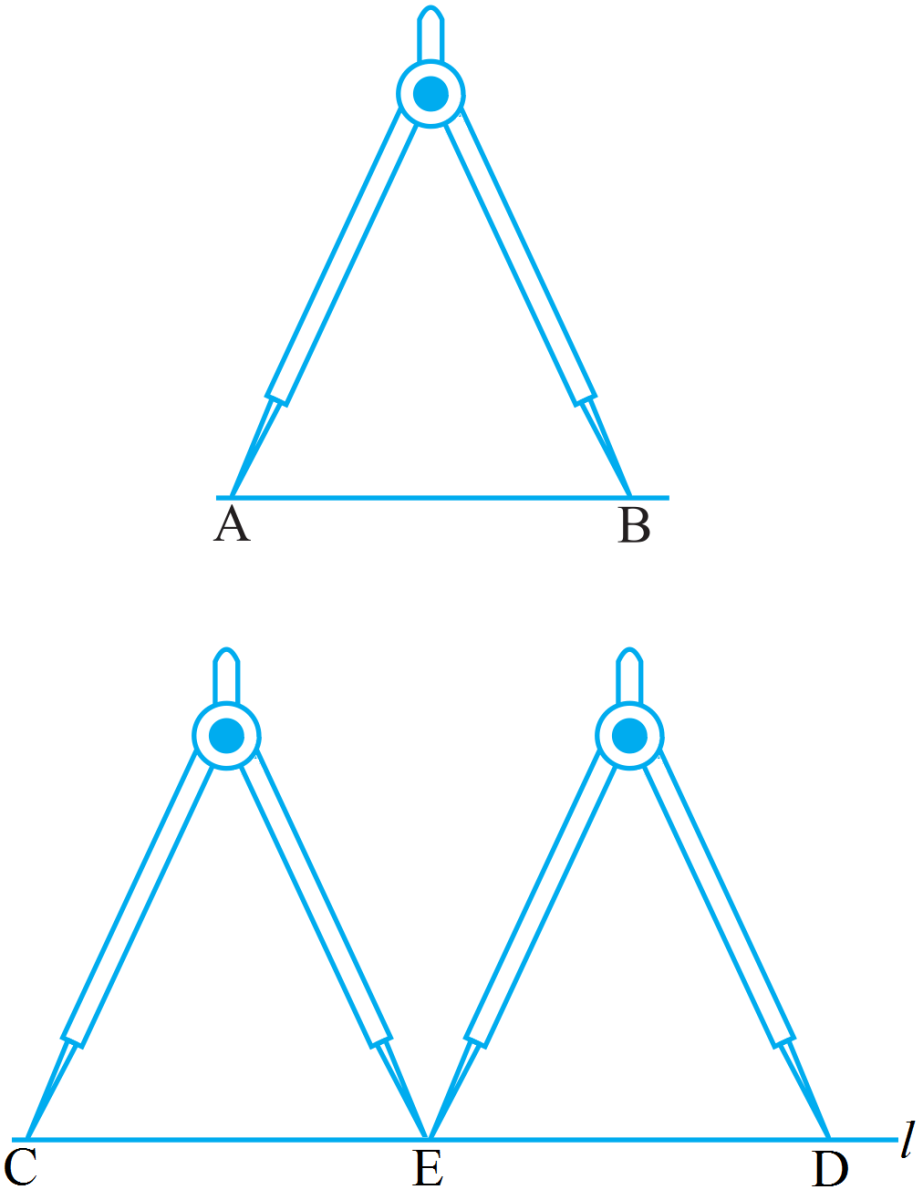
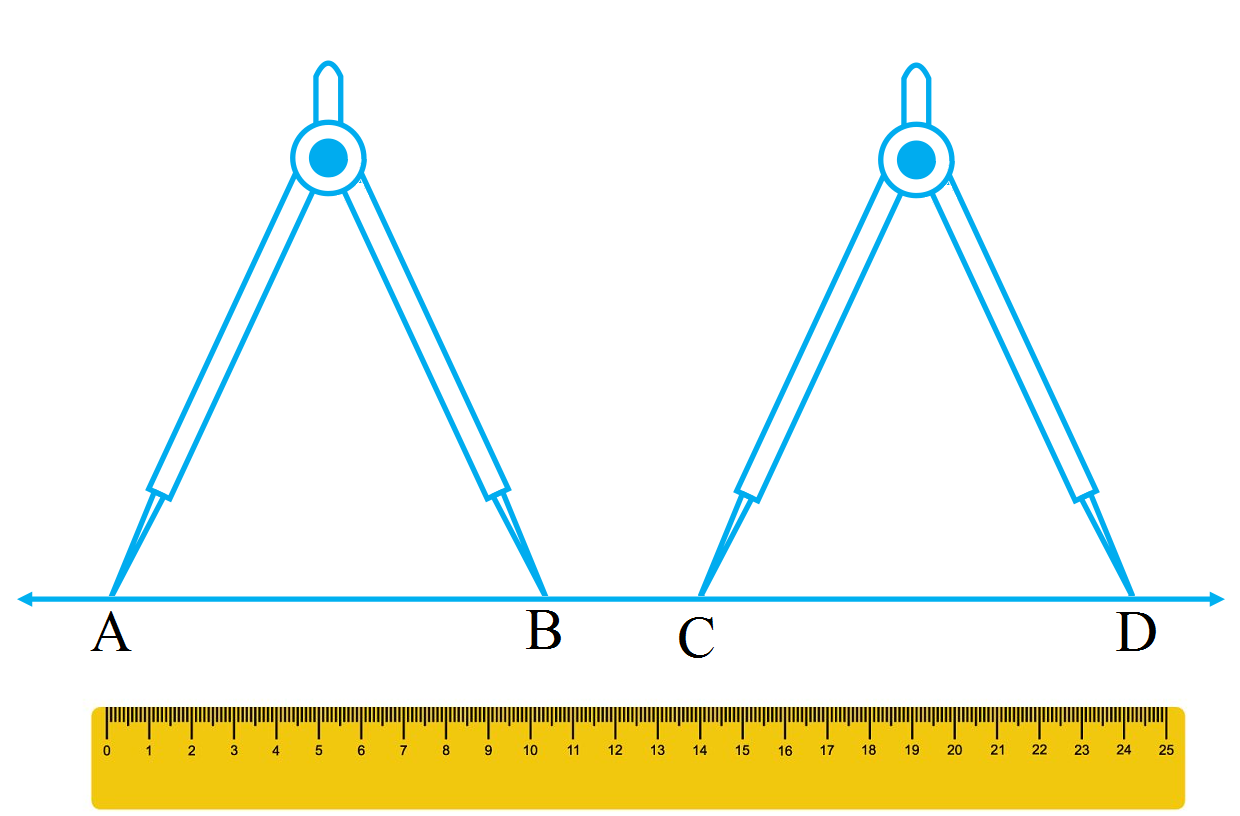
To measure the length of $AB$, place the ruler with its edge along $AB$, such that the zero mark of the \ cm side of the ruler coincides with point $A$, as shown in the figure. Now, read the mark on the ruler, which corresponds to the point $B$. The reading on the ruler at point $B$ is the length of the line segment $AB$. Here, $AB = 5.6\ cm$ To draw the line segment twice $AB$, draw a line/ and take a point $C$ on it. Now, take a divider and open it such that the end points of both its arms are at $A$ and $B$. Then, lift the divider and without disturbing its opening, place one end-point at $C$ and the other end-point on the line $1$, as shown in the figure. Lift the divider and place one end-point at $E$ and the other end-point on the line $1$, opposite $C$. Name this point $D.$
 
View full question & answer
Question 33 Marks
Construct the following angles using set-squares: $105^\circ $
Answer
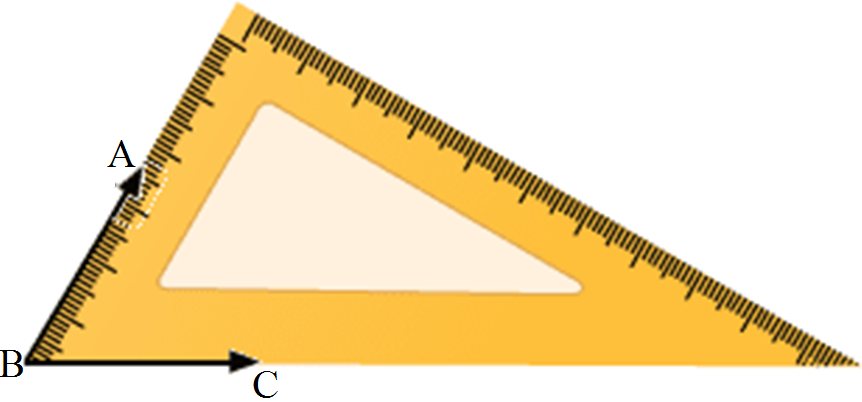
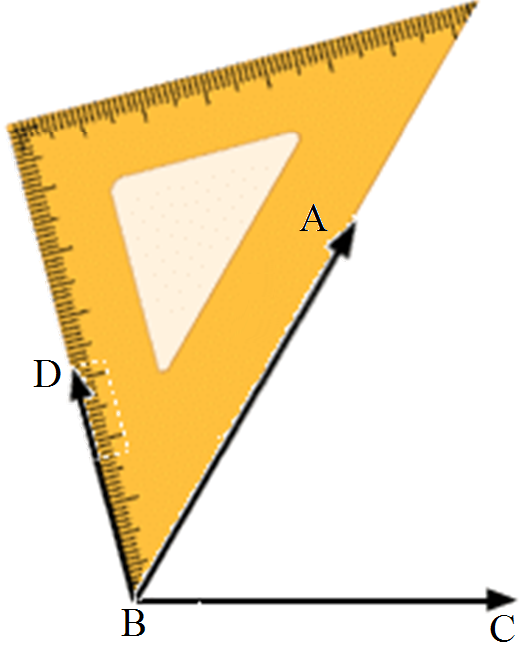
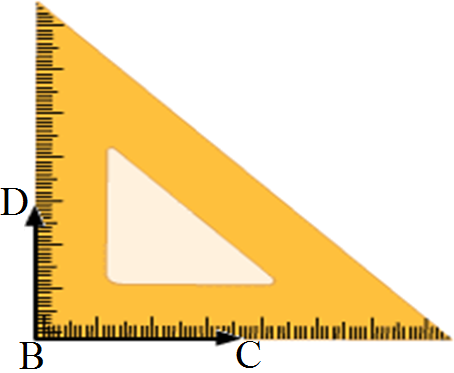
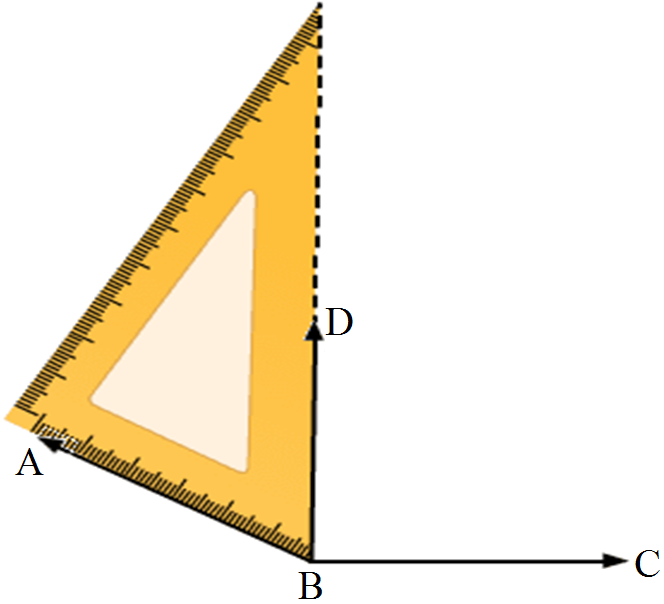
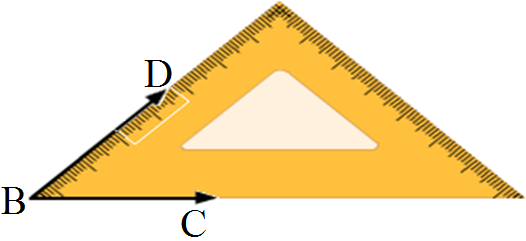
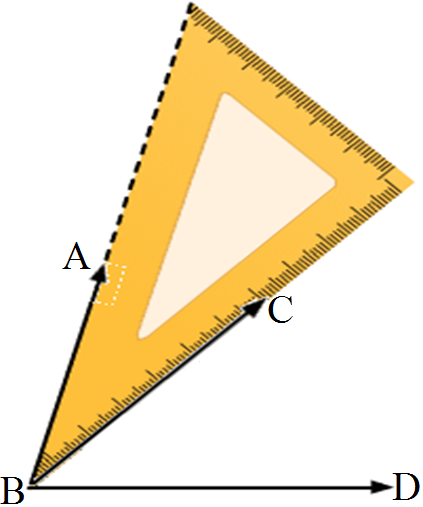
$105^\circ $ Place $30^\circ $ set-square and make an angle $60^\circ $ by drawing the rays $BA$ and $BC$ as shown in figure.
Now place the vertex of $45^\circ $ of the set –square on the ray $BA$ as shown in figure and draw the ray $BD$. The angle so formed is $105^\circ $ Therefore, $\angle\text{DBC}=150^{\circ}$​​​​​​​
View full question & answer
Question 43 Marks
Construct the following angles using set-squares: $105^\circ $
Answer
Place the vertex of $45^\circ $ of the set-square and make angle of $90^\circ $ by drawing the rays $BD$ and $BC$ as shown in the figure

Now, place the vertex of $30^\circ $ of the set-square on the ray $BS$ as shown in the figure and draw the ray $BA$ The angle so formed is $150^\circ $. Therefore, $\angle\text{ABC}=150^{\circ}$​​​​​​​
View full question & answer
Question 53 Marks
If $AB = 7.5\ cm$ and $CD = 2.5\ cm$, construct a segment whose length is equal to:
$AB - CD$
Answer
Given: $AB= 7.5\ cm$ and $CD = 2.5\ cm$ Draw $AB$ and $CD$
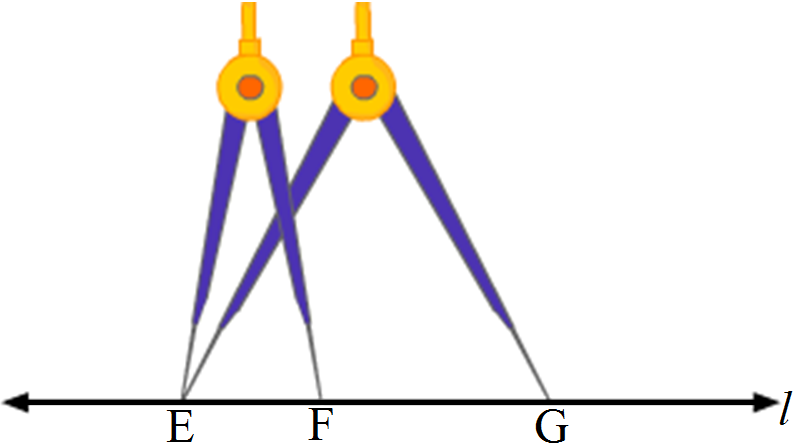
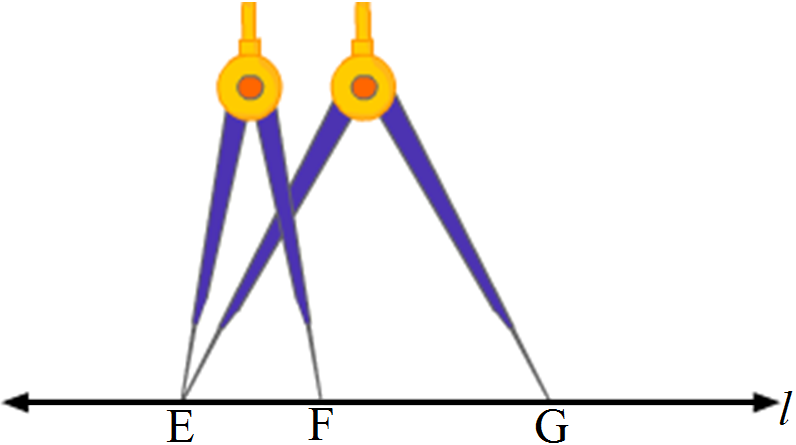
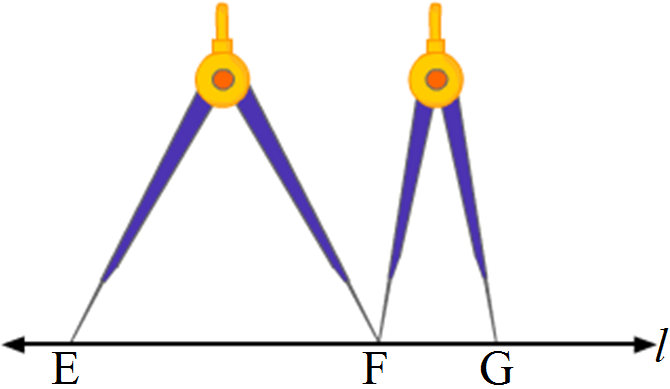
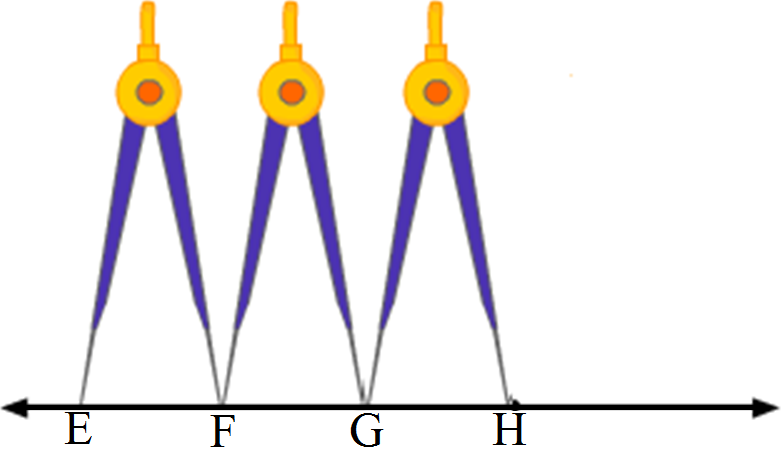
Now, take a divider and open it such that ends of both the arms are at $A$ and $B$. Then, we lift the divider and place its one end at $E$ and other end $(F)$ and on the line I as shown in figure. Now, reset the divider in such a way that the end of its one hand is at $C$ and the end of the other hand is at $D$. Then, we lift the divider and place its one end at $E$ and other end ( $G$ ) on the line I as shown in the figure. $F G$ is required line segment, whose length is equal to ( $A B-C D$ )​​​​​​​
View full question & answer
Question 63 Marks
If $AB = 7.5\ cm$ and $CD = 2.5\ cm$, construct a segment whose length is equal to: $2AB$
Answer
Given: $AB= 7.5\ cm$ and $CD = 2.5\ cm$ Draw $AB$ and $CD$
Draw a line l and take a point $E$ on it. Now a take a divider and open it such that the ends of both its arms are at $A$ and $B$. Then, we lift the divider and place its one end at $E$ and other end (say $F$) on the line l as shown in the figure. Again, lift the divider and place its one end $F$ and other end on the line $l$, opposite to $E$. Let this point be $G. EG$ is required line segment, whose length is equal to $2AB.$
View full question & answer
Question 73 Marks
Mark two points, $A$ and $B$ on a piece of paper and join them. Measure this length. Draw a line segment $CD$ that is: Collinear with $AB$ and is equal to it.
Answer
Mark two points, $A$ and $B$ on a piece of paper and join them as follows:

To measure the length of $AB$, place the ruler with its edge along $AB$, such that the zero mark of the  cm side of the ruler coincides with point $A$, as shown in the figure. Now, read the mark on the ruler, which corresponds to the point $B.$ The reading on the ruler at point $B$ is the length of the line segment $AB$. Here, $AB = 5.6\ cm$
View full question & answer
Question 83 Marks
The end-point $P$ of a line-segment $PQ$ is against $4\ cm$ mark and the end-point $Q$ is against the mark indicating $14.8\ cm$ on a ruler. What is the length of the segment $PQ?$
Answer


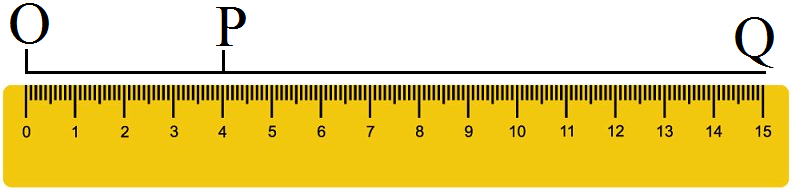
Extend the line segment $QP$ towards point zero of the ruler and take a point $0$ on the extended line $QP$ corresponding to point zero on the ruler.
From the figure, we can say:
$OP = 4\ cm$ and $OQ = 14.8\ cm$
Now, $PQ = OQ - OP$
$= (14.8 - 4)cm$
$= 10.8\ cm$
View full question & answer
Question 93 Marks
Given a line $BC$ and a point $A$ on it, construct a ray $AD$ using set squares so that $\angle\text{DAC}$ is: $150^\circ $
Answer
Draw a line $BC$ and take a point $A$ on it.
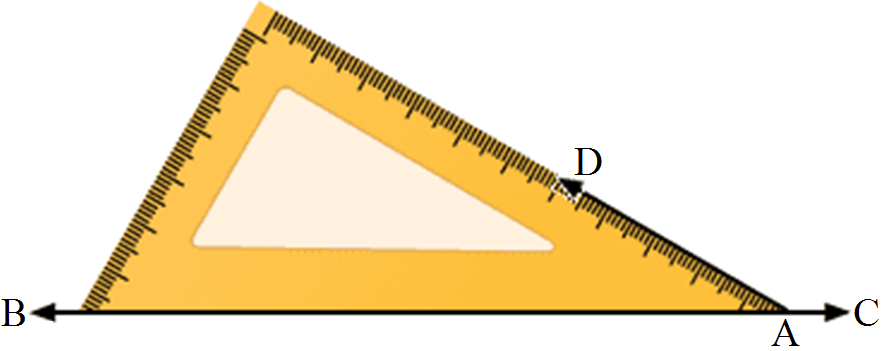
Place $30^\circ $ set-square on the line $BC$ such that its vertex of $30^\circ $ angle lies on point A and one edge coincides with the ray $AB$ as shown in the figure. Draw the ray $AD.$

Therefore, $\angle\text{DAB}=30^{\circ}$
We know that angle on one side of the straight line will always add to $180^\circ $
Therefore, $\angle\text{DAB}+\angle{\text{DAC}}=180^{\circ}$
Therefore, $\angle\text{DAC}=150^{\circ}$
View full question & answer
Question 103 Marks
What is the difference between line, a line segment and a ray?
Answer


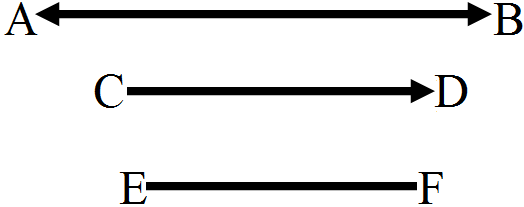
A line can be drawn to infinity in both the directions. $AB$ is a line.
A line segment has both ends fixed. $EF$ is a line segment. A ray has one end fixed and another end can be drawn to infinity. $CD$ is a ray.
View full question & answer
Question 113 Marks
Mark two points, $A$ and $B$ on a piece of paper and join them. Measure this length. Draw a line segment $CD$ that is: Three times $AB.$
Answer
Mark two points, $A$ and $B$ on a piece of paper and join them as follows:

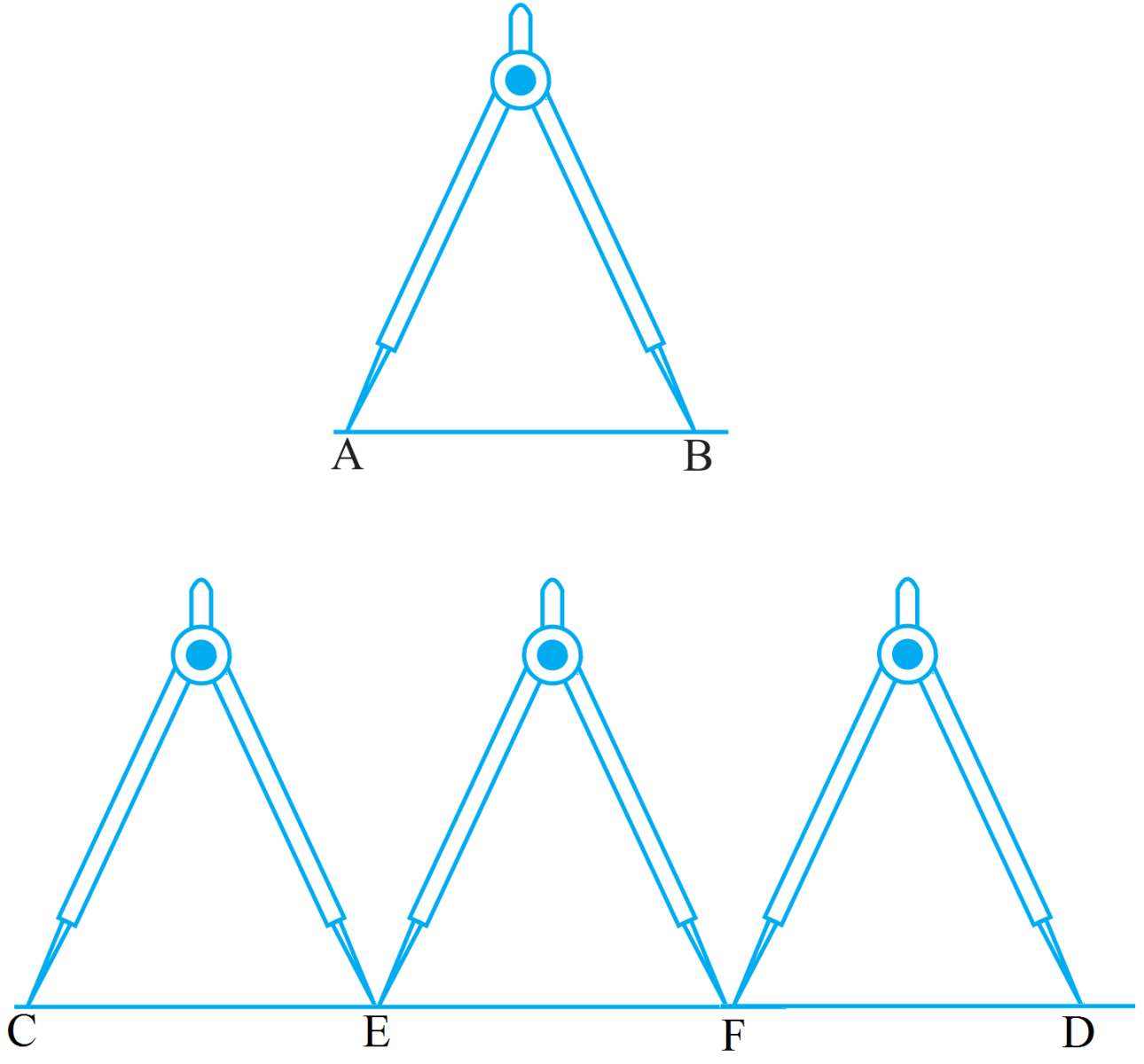
To measure the length of $AB$, place the ruler with its edge along $AB$, such that the zero mark of the \ cm side of the ruler coincides with point $A$, as shown in the figure. Now, read the mark on the ruler, which corresponds to the point $B$. The reading on the ruler at point $B$ is the length of the line segment $AB$. Here, $AB = 5.6\ cm$ To draw the line segment three times $A$, we draw a line  and take a point $C$ on it. Now take a divider and open it, such that the end-points of both its arms are at $A$ and $B.$ Then, we lift the divider and place one end-point at $C$ and the other end-point on the line $1,$ as shown in the figure. Let this point be $E$. Again, lift the divider and place one end-pint at $E$ and the other end-point on the line $1,$ opposite to $C.$ Let this point be $F$. Again, lift the divider and place one end-point at $F$ and the other end-point on the line $1,$ opposite to $C.$ Name this point $D.$
View full question & answer
Question 123 Marks
If $AB = 7.5\ cm$ and $CD = 2.5\ cm,$ construct a segment whose length is equal to: $AB + CD$
Answer
Given: $AB= 7.5\ cm$ and $CD = 2.5\ cm$ Draw $AB$ and $CD$
We draw a line $l$ and take a point $E$ on it. Now, take a divider and open it such that the ends of both its arms are $A$ and $B$. The, we lift the divider end $(F)$ on the line $l$, as shown in the figure. Now, reset the divider in such a way that the end of its one hand is at $C$ and the end of the other hand is at $D$. Then, we lift the divider and place its one end at $F$ and another end $(G)$ on the line l opposite to $E$ as shown in the figure. $EG$ is required line segment, whose length is equal to $(AB + CD)$
View full question & answer
Question 133 Marks
Construct the following angles using set-squares: $75^\circ $
Answer
Place $45^\circ $ set-square and make an angle of $45^\circ $ by drawing the rays $BD$ and $BC$ as shown in the figure.
Now place the vertex of $30^\circ $ of the set- square on the ray $BD$ as shown in the figure and draw the ray $BA$. The angle so formed is 75^\circ . Therefore, $\angle\text{ABC}=75^{\circ}$​​​​​​​

(Line $BD$ is hidden)
View full question & answer
Question 143 Marks
If $AB = 7.5\ cm$ and $CD = 2.5\ cm$, construct a segment whose length is equal to: $3CD$
Answer
Given: $AB= 7.5\ cm$ and $CD = 2.5\ cm$ Draw $AB$ and $CD$

Draw a line I and take a point $E$ on it. Now take a divider and open it such that the ends of both its arms are at $C$ and $D.$ Then, we lift the divider and place its end at $E$ on it and other end $(F)$ on the line $I$, as shown in the figure. Again, we lift the divider end $(G)$ on the I opposite to $C$. Again, lift the divider end $(G)$ on the line $I$ opposite to $C$. Again, lift the divider and place its one end at G and another end $( H )$ on the line $I$ , opposite to $E . EH$ is required line segment, whose length is equal to $3 C D$.
View full question & answer