Question 12 Marks
In the following numbers, replace $*$ by the smallest number to make it divisible by $9:$
$835*86$
Answer$835686$
Here, $8 + 3 + 5 + * + 8 + 6 = 30 + *$ should be a multiple of $9.$
To be divisible of $9,$ the least value of $*$ should be $6,$ i.e., $30 + 6 = 36$, which is a multiple of $9.$
$\therefore * = 6$
View full question & answer→Question 22 Marks
Test the divisibility of the following numbers by $6:$
$251780$
AnswerA number is divisible by $6$ if it is divisible by both $2$ and $3.$
Since $251780$ is not divisible by $3,$ it is not divisible by $6.$
Checking the divisibility by $3:$
The sum of the digits of the number, $2 + 5 + 1 + 7 + 8 + 0,$ is $23,$ which is not divisible by $3.$
So, the number is not divisible by $3.$
View full question & answer→Question 32 Marks
Test the divisibility of:
$12030624$ by $8$
Answer$12030624$ by $8$
$12030624$ is divisible by $8.$
It is because the number formed by its hundreds, tens and ones digits is $624,$ which is divisible by $8.$
View full question & answer→Question 42 Marks
Find the $HCF$ of the numbers in the following using the prime factorization method: $504, 980$
AnswerThe given numbers are $504$ and $980.$ We have:
$\begin{array}{c|c}2&504\\\hline2&252\\\hline2&126\\\hline3&63\\\hline3&21\\\hline7&7\\\hline&1\end{array}$
$\begin{array}{c|c}2&980\\\hline2&490\\\hline5&245\\\hline7&49\\\hline7&7\\\hline&1\end{array}$
$504=2\times2\times2\times3\times3\times7=2^3\times3^2\times7$
$980=2\times2\times5\times7\times7=2^2\times5\times7^2$
$\therefore HCF$ of the given numbers $= 2^2\times 7 = 28$
View full question & answer→Question 52 Marks
Give the prime factorization of the following number:
$1323$
AnswerWe will use the didvision method as shown below:
$\begin{array}{c|c}3&1323\\\hline3&441\\\hline3&147\\\hline7&49\\\hline7&7\\\hline&1\end{array}$
$\therefore1323=3\times3\times3\times7\times7\times1$
$=3^3\times7^2$
View full question & answer→Question 62 Marks
Give the prime factorization of the following number: $18$
AnswerWe will use the didvision method as shown below:
$\begin{array}{c|c}2&18\\\hline2&9\\\hline3&3\\\hline&1\end{array}$
$\therefore18=2\times3\times3$ $=2\times3^2$
View full question & answer→Question 72 Marks
Which of the following are prime numbers? $137$
AnswerA number between $100$ and $200$ is a prime number if it is not divisible by any prime number less than $15.$
Similarly, a number between $200$ and $300$ is a prime number if it is not divisible by any prime number less than $20. $
$137$ is a prime number, because it is not divisible by $2, 3, 5, 7$ and $11.$
View full question & answer→Question 82 Marks
The product of two numbers is $2560$ and their $LCM$ is $320.$ Find their $HCF.$
AnswerProduct of the two numbers $= 2560.$
$HCF = 320$
We know that,
$LCM \times HCF =$ Product of two numbers
$\therefore HCF =\frac{2560}{320}=8$
View full question & answer→Question 92 Marks
Test the divisibility of the following numbers by $7:$
$2345$
AnswerTo determine if a number is divisible by $7,$ double the last digit of the number and subtract it from the number formed by the remaining digits.
$2345$ is divisible by $7.$
We have $234 - 2 × 5 = 224,$ which is a multiple of $7.$
View full question & answer→Question 102 Marks
Which of the following are prime numbers? $331$
AnswerA number between $100$ and $200$ is a prime number if it is not divisible by any prime number less than $15.$
Similarly, a number between $200$ and $300$ is a prime number if it is not divisible by any prime number less than $20.$
$331$ is a prime number, because it is not divisible by $2, 3, 5, 7, 11, 13, 17$ and $19.$
View full question & answer→Question 112 Marks
In the following numbers, replace $*$ by the smallest number to make it divisible by $3: 8*711$
Answer$81711$ Here, $8 + * + 7 + 1 + 1 = 17 + *$ should be a multiple of $3.$
To be divisible by $3,$ the least value of $*$ should be $1, $
i.e., $17 + 1 = 18,$ which is a multiple of $3.$
$\therefore * = 1$
View full question & answer→Question 122 Marks
Find the $LCM$ of the numbers given below: $60, 75$
AnswerThe given numbers are $60$ and $75.$ We have:
$\begin{array}{c|c}3&60,75\\\hline5&20,25\\\hline5&4,5\\\hline2&4,5\\\hline2&2,1\\\hline&1,1\end{array}$
$\therefore LCM = 3 × 5 × 5 × 2 × 2$
$= 300$
View full question & answer→Question 132 Marks
Test the divisibility of the following numbers by $7: 6021$
AnswerTo determine if a number is divisible by $7,$
double the last digit of the number and subtract it from the number formed by the remaining digits.
$6021$ is divisible by $7.$ We have $602 - 2 \times 1 = 600,$ which is not a multiple of $7.$
View full question & answer→Question 142 Marks
Write all prime numbers between $50$ and $100.$
Answer$53, 59, 61, 67, 71, 73, 79, 83, 89, 97$ are the prime numbers between $50$ and $100.$
View full question & answer→Question 152 Marks
Which of the following are prime numbers? $161$
AnswerA number between $100$ and $200$ is a prime number if it is not divisible by any prime number less than $15.$ Similarly, a number between $200$ and $300$ is a prime number if it is not divisible by any prime number less than $20.$ $161$ is a not prime number, because it is divisible by $7.$
View full question & answer→Question 162 Marks
Show that the following pairs are co-primes: $59, 97$
AnswerThe given numbers are $59$ and $97.$
$59 = 59 \times 1 97 = 97 \times 1$
$\therefore HCF = 1 $
Since $59$ and $97$ does not have any common factor other than $1,$ the two numbers are co-primes.
View full question & answer→Question 172 Marks
Which of the following are prime numbers$?$
$397$
AnswerA number between $100$ and $200$ is a prime number if it is not divisible by any prime number less than $15.$
Similarly, a number between $200$ and $300$ is a prime number if it is not divisible by any prime number less than $20.$
$397$ is a prime number, because it is not divisible by $2, 3, 5, 7, 11, 13, 17$ and $19.$
View full question & answer→Question 182 Marks
Test the divisibility of the following numbers by $7: 14126$
AnswerTo determine if a number is divisible by $7,$
double the last digit of the number and subtract it from the number formed by the remaining digits.
$14126$ is divisible by $7.$
We have $1412 - 2 \times 6 = 1400,$
which is a multiple of $7.$
View full question & answer→Question 192 Marks
In the following numbers, replace $*$ by the smallest number to make it divisible by $3: 6*1054$
Answer$621054$ Here, $6 + * + 1 + 0 + 5 + 4 = 16 + *$ should be a multiple of $3.$ To be divisible by $3,$ the least value of $*$ should be $2,$ i.e., $16 + 2 = 18,$ which is a multiple of $3.$ $\therefore * = 2$
View full question & answer→Question 202 Marks
Test the divisibility of: $10001001$ by $3$
Answer$10001001$ by $3$
$10001001$ is divisible by $3.$ It is because the sum of its digits, $1 + 0 + 0 + 0 + 1 + 0 + 0 + 1,$ is $3,$ which is divisible by $3.$
View full question & answer→Question 212 Marks
In the following numbers, replace $*$ by the smallest number to make it divisible by $9:$
$6678*1$
Answer$667881$
Here, $6 + 6 + 7 + 8 + * + 1 = 28 + *$ should be a multiple of $9.$
To be divisible by $9,$ the least value of $* $ should be $8,$ i.e., $28 + 8 = 36,$ which is a multiple of $9.$
$\therefore * = 8$
View full question & answer→Question 222 Marks
What are composite numbers? Can a composite number be odd? If yes, write the smallest odd composite number.
AnswerCOMPOSITE NUMBERS: Numbers having more than two factors are known as composite numbers. Yes a composite number can odd. The smallest odd composite number is $9.$
View full question & answer→Question 232 Marks
Find the $LCM$ of the numbers given below: $42, 63$
AnswerThe given numbers are $42$ and $63.$ We have:
$\begin{array}{c|c}7&42,63\\\hline3&6,9\\\hline3&2,3\\\hline2&2,1\\\hline&1,1\end{array}$
$\therefore LCM = 7 × 3 × 3 × 2 × 1$
$= 126$
View full question & answer→Question 242 Marks
Test the divisibility of the following numbers by $11:$
$66311$
AnswerA number is divisible by $11$ if the difference of the sum of its digits at odd places and the sum of its digits at even places is either $0$ or a multiple of $11.$
$66311$ is not divisible by $11.$
Sum of the digits at odd places $= (1 + 3 + 6) = 10$
Sum of the digits at even places $= (1 + 6) = 7$
Difference of the two sums $= (10 - 7) = 3,$
which is not divisible by $11.$
View full question & answer→Question 252 Marks
Write seven consecutive composite numbers less than $100$ having no prime number between them.
AnswerSeven consecutive composite numbers less than $100$ having no prime number between them are $90, 91, 92, 93, 94, 95$ and $96.$
View full question & answer→Question 262 Marks
Give the prime factorization of the following number: $1035$
AnswerWe will use the didvision method as shown below:
$\begin{array}{c|c}3&1035\\\hline3&345\\\hline5&115\\\hline23&23\\\hline&1\end{array}$
$\therefore1035=3\times3\times5\times23$
$=3^2\times5\times23$
View full question & answer→Question 272 Marks
In the following numbers, replace * by the smallest number to make it divisible by $9:$
$2*135$
Answer$27135$
Here, $2 + * + 1 + 3 + 5 = 11 + *$ should be a multiple of $9.$
To be divisible by $9,$ the least value of $*$ should be $7,$ i.e., $11 + 7 = 18$, which is a multiple of $9.$
$\therefore * = 7$
View full question & answer→Question 282 Marks
Test the divisibility of the following numbers by $11:$
$137269$
AnswerA number is divisible by $11$ if the difference of the sum of its digits at odd places and the sum of its digits at even places is either $0$ or a multiple of $11.$
$137269$ is divisible by $11.$
Sum of the digits at odd places $= (9 + 2 + 3) = 14$
Sum of the digits at even places $= (6 + 7 + 1) = 14$
Difference of the two sums $= (14 - 14) = 0,$ which is a divisible by $11.$
View full question & answer→Question 292 Marks
Test the divisibility of the following numbers by $7: 826$
AnswerTo determine if a number is divisible by $7,$
double the last digit of the number and subtract it from the number formed by the remaining digits.
If their difference is a multiple of $7,$ the number is divisible by $7.$
$826$ is divisible by $7.$
We have$ 82 - 2 \times 6 = 70$, which is a multiple of $7.$
View full question & answer→Question 302 Marks
In the following numbers, replace $*$ by the smallest number to make it divisible by $3: 27*4$
Answer$2724$
Here, $2 + 7 + * + 4 = 13 + * $ should be a multiple of $3.$
To be divisible by $3,$ the least value of $*$ should be $2,$
i.e., $13 + 2 = 15,$ which is a multiple of $3.$
$\therefore * = 2$
View full question & answer→Question 312 Marks
Test the divisibility of: $1000001$ by $11$
Answer$10000001$ by $11$
$10000001$ is divisible by $11.$
Sum of digits at odd places $= (1 + 0 + 0 + 0) = 1$
Sum of digits at even places $= (0 + 0 + 0 + 1) = 1$
Difference of the two sums $= (1 - 1) = 0,$
which is divisible by $11.$
View full question & answer→Question 322 Marks
Test the divisibility of the following numbers by $8:$
$901674$
AnswerA number is divisible by $8$ if the number formed by the last three digits (digits in the hundreds, tens and units places) is divisible by $8.$
$901674$ is not divisible by $8.$
It is because the number formed by its hundreds, tens and ones digits, i.e., $674,$ is not divisible by $8.$
View full question & answer→Question 332 Marks
The $HCF$ of two numbers is $145$ and their $LCM$ is $2175.$ If one of the numbers is $725,$ find the other.
Answer$HCF = 145$
$LCM = 2175$
One of the numbers $= 725$
We know that,
$HCF \times LCF =$ Product of two numbers
$\therefore$ Other number $=\frac{145\times2175}{725}=435$
View full question & answer→Question 342 Marks
Find the $LCM$ of the numbers given below: $36, 60, 72$
AnswerThe given numbers are $36, 60$ and $72.$
We have:
$\begin{array}{c|c}2&36,60,72\\\hline2&18,30,36\\\hline3&9,15,18\\\hline3&3,5,6\\\hline5&1,5,2\\\hline2&1,1,2\\\hline&1,1,1\end{array}$
$\therefore LCM = 2 \times 2 \times 2 \times 3 \times 3 \times 5$
$= 360$
View full question & answer→Question 352 Marks
Give the prime factorization of the following number: $9317$
AnswerWe will use the didvision method as shown below: $\begin{array}{c|c}7&9317\\\hline11&1331\\\hline11&121\\\hline11&11\\\hline&1\end{array}$ $\therefore9317=7\times11\times11\times11$ $=7\times11^3$
View full question & answer→Question 362 Marks
Test the divisibility of the following numbers by $8:$
$36792$
AnswerA number is divisible by $8$ if the number formed by the last three digits (digits in the hundreds, tens and units places) is divisible by $8.$
$36792$ is divisible by $8.$
It is because the number formed by its hundreds, tens and ones digits, i.e., $792,$ is divisible by $8$
View full question & answer→Question 372 Marks
Test the divisibility of the following numbers by $8: 1790184$
AnswerA number is divisible by $8$ if the number formed by the last three digits (digits in the hundreds, tens and units places) is divisible by $8. 1790184$ is divisible by $8.$ It is because the number formed by its hundreds, tens and ones digits, i.e., $184,$ is divisible by $8.$
View full question & answer→Question 382 Marks
Find the $HCF$ of $:2$ and an even number.
Answer$2$ and $4$ are two prime numbers.
Now, $HCF$ of $2$ and $4$ is as follows:
$2 = 2 \times 1$
$4 = 2 \times 2 \times 1$
$\therefore HCF =2 \times 1 = 2$
View full question & answer→Question 392 Marks
Find the $HCF$ of the numbers in the following using the division method: $1965, 2096$
AnswerThe given numbers are $1965 $ and $2096.$ We have:
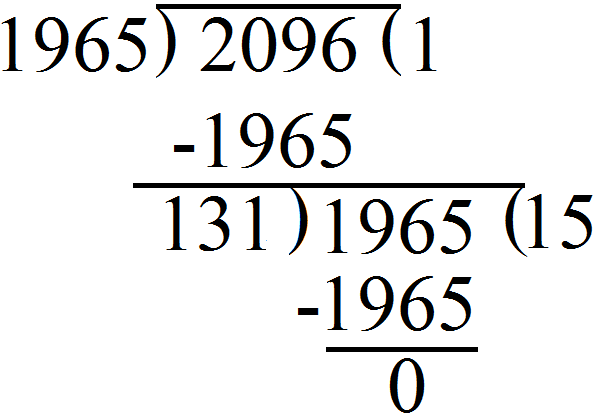
$\therefore$ The $HFC$ is $131.$ View full question & answer→Question 402 Marks
Which of the following are prime numbers? $217$
AnswerA number between $100$ and $200$ is a prime number if it is not divisible by any prime number less than $15.$
Similarly, a number between $200$ and $300$ is a prime number if it is not divisible by any prime number less than $20.$
$217$ is a not prime number, because it is divisible by $7.$
View full question & answer→Question 412 Marks
Find the $HCF$ of the numbers in the following using the division method: $2241, 2324$
AnswerThe given numbers are $2241$ and $2341.$ We have:
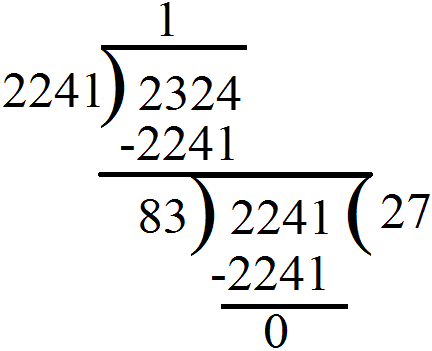
$\therefore$ The $HFC = 83.$ View full question & answer→Question 422 Marks
Test the divisibility of the following numbers by $8: 2138$
AnswerA number is divisible by $8$ if the number formed by the last three digits (digits in the hundreds, tens and units places) is divisible by $8.$
$2138$ is not divisible by $8.$ It is because the number formed by its hundreds, tens and ones digits, i.e., $138,$ is not divisible by $8.$
View full question & answer→Question 432 Marks
Test the divisibility of the following numbers by $11: 4334$
AnswerA number is divisible by $11$ if the difference of the sum of its digits at odd places and the sum of its digits at even places is either $0$ or a multiple of $11.$
$4334$ is divisible by $11.$
Sum of the digits at odd places $= (4 + 3) = 7$
Sum of the digits at even places $= (3 + 4) = 7$
Difference of the two sums $= (7 - 7) = 0,$
which is divisible by $11.$
View full question & answer→Question 442 Marks
Test the divisibility of the following numbers by $6: 872536$
AnswerA number is divisible by $6$ if it is divisible by both $2$ and $3.$
Since $872536$ is not divisible by $3,$ it is not divisible by $6$.
Checking the divisibility by $3:$ The sum of the digits of the number,
$8 + 7 + 2 + 5 + 3 + 6,$ is $31$, which is not divisible by $3.$
So, the number is not divisible by $3.$
View full question & answer→Question 452 Marks
Give the prime factorization of the following number:
$2907$
AnswerWe will use the didvision method as shown below:
$\begin{array}{c|c}3&2907\\\hline3&969\\\hline17&323\\\hline19&19\\\hline&1\end{array}$
$\therefore4641=3\times3\times17\times19$
$=3^2\times17\times19$
View full question & answer→Question 462 Marks
Test the divisibility of: $2134563$ by $9$
Answer$2134563$ by $9$
$2134563$ is not divisible by $9.$
It is because the sum of its digits,
$2 + 1 + 3 + 4 + 5 + 6 + 3,$ is $24,$
which is not divisible by $9.$
View full question & answer→Question 472 Marks
Which of the following are prime numbers$?$
$103$
AnswerA number between $100$ and $200$ is a prime number if it is not divisible by any prime number less than $15.$
Similarly, a number between $200$ and $300$ is a prime number if it is not divisible by any prime number less than $20.$
$103$ is a prime number, because it is not divisible by $2, 3, 5, 7, 11$ and $13.$
View full question & answer→Question 482 Marks
In the following numbers, replace $*$ by the smallest number to make it divisible by $3: 234*17$
Answer$234117$
Here, $2+ 3 +4 + * + 1 + 7 = 17 + *$ should be a multiple of $3.$
To be divisible by 3, the least value of $*$ should be $1,$
i.e., $17 + 1 = 18,$ which is a multiple of $3.$
$\therefore * = 1$
View full question & answer→Question 492 Marks
Give the prime factorization of the following number: $252$
AnswerWe will use the didvision method as shown below:
$\begin{array}{c|c}2&252\\\hline2&126\\\hline3&63\\\hline3&21\\\hline7&7\\\hline&1\end{array}$
$\therefore252=2\times2\times3\times3\times7\times1$
$=2^2\times3^2\times7\times1$
View full question & answer→Question 502 Marks
Give the prime factorization of the following number: $945$
AnswerWe will use the didvision method as shown below:
$\begin{array}{c|c}3&945\\\hline3&315\\\hline3&105\\\hline5&35\\\hline7&7\\\hline&1\end{array}$
$\therefore945=3\times3\times3\times5\times7\times1$
$=3^3\times5\times7$
View full question & answer→Question 512 Marks
Test the divisibility of: $10203574$ by $4$
Answer$10203574$ by $4$
$10203574$ is not divisible by $4.$ It is because the number formed by its tens and the ones digits is $74,$ which is not divisible by $4.$
View full question & answer→Question 522 Marks
Test the divisibility of the following numbers by $7: 117$
AnswerTo determine if a number is divisible by $7,$
double the last digit of the number and subtract it from the number formed by the remaining digits.
$117$ is not divisible by $7.$
We have $11 - 2 × 7 = -3,$ which is not a multiple of $7.$
View full question & answer→Question 532 Marks
In the following numbers, replace $*$ by the smallest number to make it divisible by $9: 65*5$
Answer$6525$
Here, $6 + 5 + * + 5 = 16 + * $ should be a multiple of $9.$
To be divisible by $9,$
the least value of $*$ should be $2,$
i.e., $16 + 2 = 18,$ which is a multiple of $9. $
$\therefore * = 2$
View full question & answer→Question 542 Marks
Test the divisibility of the following numbers by $11:$
$83721$
AnswerA number is divisible by $11$ if the difference of the sum of its digits at odd places and the sum of its digits at even places is either $0$ or a multiple of $11.$
$83721$ is divisible by $11.$
Sum of the digits at odd places $= (1 + 7 + 8) = 16$
Sum of the digits at even places $= (2 + 3) = 5$
Difference of the two sums $= (16 - 5) = 11,$ which is divisible by $11.$
View full question & answer→Question 552 Marks
Test the divisibility of the following numbers by $7: 25368$
AnswerTo determine if a number is divisible by $7,$ double the last digit of the number and subtract it from the number formed by the remaining digits. $25368$ is divisible by $7.$
We have $2536 - 2 × 8 = 2520,$ which is a multiple of $7.$
View full question & answer→Question 562 Marks
The $HCF$ of two number is $15$ and their product is $1650.$ Find their $LCM.$
Answer$HCF \times LCM =$ Products of the two numbers.
Product of the two numbers $= 1650$
$HCF = 15$ Required $LCM =\frac{1650}{15} = 110$
View full question & answer→Question 572 Marks
Find the $LCM$ of the numbers given below: $12, 18, 20$
AnswerThe given numbers are $12, 18$ and $20.$ We have:
$\begin{array}{c|c}2&12,18,20\\\hline2&6,9,10\\\hline3&3,9,5\\\hline3&1,3,5\\\hline5&1,1,5\\\hline&1,1,1\end{array}$
$\therefore LCM = 2 \times 2 \times 3 \times 3 \times 5$
$= 180$
View full question & answer→Question 582 Marks
Give the prime factorization of the following number: $1224$
AnswerWe will use the didvision method as shown below:
$\begin{array}{c|c}2&1224\\\hline2&612\\\hline2&306\\\hline3&153\\\hline3&51\\\hline17&17\\\hline&1\end{array}$
$\therefore1224=2\times2\times2\times3\times3\times17$
$=2^3\times3^2\times17$
View full question & answer→Question 592 Marks
Test the divisibility of the following numbers by $8: 9364$
AnswerA number is divisible by $8$ if the number formed by the last three digits (digits in the hundreds, tens and units places) is divisible by $8.$
$9364$ is not divisible by $8.$ It is because the number formed by its hundreds, tens and ones digits, i.e., $364,$ is not divisible by $8.$
View full question & answer→Question 602 Marks
In the following numbers, replace $*$ by the smallest number to make it divisible by $9:$
$6702*$
Answer$67023$
Here, $6 + * + 7 + 0 + 2 = 15 + *$ should be a multiple of $9.$
To be divisible by $9, $the least value of $*$ should be $3,$ i.e., $15 + 3 = 18,$ which is a multiple of $9.$
$\therefore * = 3$
View full question & answer→Question 612 Marks
Test the divisibility of the following numbers by $11: 901351$
AnswerA number is divisible by $11$ if the difference of the sum of its digits at odd places and the sum of its digits at even places is either $0$ or a multiple of $11.$
$901351$ is divisible by $11.$
Sum of the digits at odd places $= (0 + 3 + 1) = 4$
Sum of the digits at even places $= (9 + 1 + 5) = 15$
Difference of the two sums $= (4 - 15) = -11,$
which is divisible by $11.$
View full question & answer→Question 622 Marks
Give the prime factorization of the following number: $1197$
AnswerWe will use the didvision method as shown below:
$\begin{array}{c|c}3&1197\\\hline3&399\\\hline7&113\\\hline19&19\\\hline&1\end{array}$
$\therefore1197=3\times3\times7\times19$
$=3^2\times7\times19$
View full question & answer→Question 632 Marks
Give the prime factorization of the following number:
$136$
AnswerWe will use the didvision method as shown below:
$\begin{array}{c|c}2&136\\\hline2&68\\\hline2&34\\\hline17&17\\\hline&1\end{array}$
$\therefore136=2\times2\times2\times17$
$=2^3\times17$
View full question & answer→Question 642 Marks
Give the prime factorization of the following number:
$48$
AnswerWe will use the didvision method as shown below:
$\begin{array}{c|c}2&48\\\hline2&24\\\hline2&12\\\hline2&6\\\hline3&3\\\hline&1\end{array}$
$\therefore48=2\times2\times2\times2\times3$
$=2^4\times3$
View full question & answer→Question 652 Marks
Find the $HCF$ of the numbers in the following using the prime factorization method: $170, 238$
AnswerThe given numbers are $170$ and $238.$
We have:
$\begin{array}{c|c}2&170\\\hline5&85\\\hline17&17\\\hline&1\end{array}$
$\begin{array}{c|c}2&238\\\hline7&119\\\hline17&17\\\hline&1\end{array}$
$170=2\times5\times17$
$238=2\times7\times17$
$\therefore HCF$ of the given numbers $= 2 \times 17 = 34$
View full question & answer→Question 662 Marks
Test the divisibility of the following numbers by $6: 71232$
AnswerA number is divisible by $6$ if it is divisible by both $2$ and $3.$
Since $71232$ is divisible by both $2$ and $3,$ it is divisible by $6.$
Checking the divisibility by $2:$ Since the number has $2$ in its units place, it is divisible by $2.$
Checking the divisibility by $3:$ The sum of the digits of the number,
$7 + 1 + 2 + 3 + 2,$ is $15,$ which is divisible by $3.$
So, the number is divisible by $3.$
View full question & answer→Question 672 Marks
Find the $HCF$ of the numbers in the following using the prime factorization method: $84, 98$
AnswerThe given numbers are $84$ and $98.$ We have:
$\begin{array}{c|c}2&84\\\hline2&42\\\hline3&21\\\hline7&7\\\hline&1\end{array}$
$\begin{array}{c|c}2&98\\\hline7&49\\\hline7&7\\\hline&1\end{array}$
$84=2\times2\times3\times7=2^2\times3\times7$
$98=2\times7\times7=2\times7^2$
$\therefore HCF$ of the given numbers $= 2 × 7 = 14$
View full question & answer→Question 682 Marks
Test the divisibility of the following numbers by $6: 934706$
AnswerA number is divisible by $6$ if it is divisible by both $2$ and $3.$
Since $934706$ is not divisible by $3,$ it is not divisible by $6.$
Checking the divisibility by $3:$ Since the sum of the digits of the number, $9 + 3 + 4 + 7 + 0 + 6,$ is $29,$
which is not divisible by $3.$
So, the number is not divisible by $3.$
View full question & answer→Question 692 Marks
Test the divisibility of $67529124$ by $8.$
Answer$67529124A$ number is divisible by $8$ if the number formed by the hundreds, tens and ones digits is divisible by $8.$
Since the digits at the hundred’s, ten’s and unit places are $124,$ which is not divisible by $8, 67529124$ is not divisible by $8.$
View full question & answer→Question 702 Marks
Give the prime factorization of the following number: $56$
AnswerWe will use the didvision method as shown below:
$\begin{array}{c|c}2&56\\\hline2&28\\\hline2&14\\\hline&7\end{array}$
$\therefore56=2\times2\times2\times7$
$=2^3\times7$
View full question & answer→Question 712 Marks
Test the divisibility of the following numbers by $8: 136976$
AnswerA number is divisible by $8$ if the number formed by the last three digits (digits in the hundreds, tens and units places) is divisible by $8.$
$136976$ is divisible by $8.$
It is because the number formed by its hundreds,
tens and ones digits, i.e., $976,$ is divisible by $8.$
View full question & answer→Question 722 Marks
In the following numbers, replace $*$ by the smallest number to make it divisible by $3: 62*35$
Answer$62235$ Here, $6 + 2 + * + 3 + 5 = 16 + *$ should be a multiple of $3.$
To be divisible by $3,$ the least value of $*$ should be $2,$ i.e., $16 + 2 = 18,$ which is a multiple of $3.$
$\therefore * = 2$
View full question & answer→Question 732 Marks
Test the divisibility of the following numbers by $6: 2070$
AnswerA number is divisible by $6$ if it is divisible by both $2$ and $3.$ Since $2070$ is divisible by $2$ and $3,$ it is divisible by $6.$ Checking the divisibility by $2:$ Since the number $2070$ has $0$ in its units place, it is divisible by $2.$ Checking the divisibility by $3:$ The sum of the digits of $2070, 2 + 0 + 7 + 0,$ is $9,$ which is divisible by $3.$ So, it is divisible by $3.$
View full question & answer→Question 742 Marks
Test the divisibility of the following numbers by $6:$
$46523$
AnswerA number is divisible by $6$ if it is divisible by both $2$ and $3.$
Since $46523$ is not divisible by $2,$ it is not divisible by $6.$
Checking the divisibility by $2:$ Since the number $46523$ has $3$ in its units place, it is not divisible by $2.$
View full question & answer→Question 752 Marks
In the following numbers, replace $*$ by the smallest number to make it divisible by $3: 53*46$
Answer53046$$ Here, $5 + 3 + * + 4 + 6 = 18 + *$ should be a multiple of $3.$ As $18$ is divisible by $3,$ the least value of $*$ should be $0$, i.e., $18 + 0 = 18.$
$\therefore * = 0$
View full question & answer→Question 762 Marks
Can two numbers have $12$ as their $HCF$ and $512$ as their $LCM?$ Justify your answer.
AnswerNo, they cannot have $512$ as their $LCM.$ We know that the $HCF$ is one of the factors of the $LCM.$ Here, $3,$ which is a factor of $12,$ is not a factor of $512.$
View full question & answer→Question 772 Marks
Test the divisibility of the following numbers by $11: 8790322$
AnswerA number is divisible by $11$ if the difference of the sum of its digits at odd places and the sum of its digits at even places is either $0$ or a multiple of $11.$
$8790322$ is not divisible by $11.$
Sum of the digits at odd places $= (2 + 3 + 9 + 8) = 22.$
Sum of the digits at even places $= (2 + 0 + 7) = 9$
Difference of the two sums $= (22 - 9) = 13,$
which is not divisible by $11.$
View full question & answer→Question 782 Marks
Test the divisibility of: $19083625$ by $11$
Answer$19083625$ by $11$
$19083625$ is divisible by $11. $
Sum of digits at odd places $= (5 + 6 + 8 + 9) = 28$
Sum of digits at even places $= (2 + 3 + 0 + 1) = 6$
Difference of the two sums $= (28 - 6) = 22,$
which is divisible by $11.$
View full question & answer→Question 792 Marks
Give the prime factorization of the following number: $637$
AnswerWe will use the didvision method as shown below:
$\begin{array}{c|c}7&637\\\hline7&91\\\hline13&13\\\hline&1\end{array}$
$\therefore637=7\times7\times13$
$=7^2\times13$
View full question & answer→Question 802 Marks
Find the $HCF$ of:Two consecutive numbers.
Answer$4$ and $5$ are two consecutive numbers.
Now, $HCF$ of $4$ and $5$ is as follows:
$4 = 2 \times 2 \times 1 = 2^2\times 1$
$5 = 5 \times 1$
$\therefore HCF = 1$
View full question & answer→Question 812 Marks
Give the prime factorization of the following number:
$90$
AnswerWe will use the didvision method as shown below:
$\begin{array}{c|c}2&90\\\hline3&45\\\hline3&15\\\hline5&5\\\hline&1\end{array}$
$\therefore90=2\times3\times3\times5$
$=2\times3^2\times5$
View full question & answer→Question 822 Marks
Give the prime factorization of the following number: $4641$
AnswerWe will use the didvision method as shown below:
$\begin{array}{c|c}3&4641\\\hline7&1547\\\hline13&221\\\hline17&17\\\hline&1\end{array}$
$\therefore4641=3\times7\times13\times17$
View full question & answer→Question 832 Marks
The product of two numbers is $2160$ and their $HCF$ is $12.$ Find their $LCM.$
AnswerProduct of the two numbers $= 2160.$
$HCF = 12$
We know that,
$LCM \times HCF =$ Product of two numbers
$\therefore LCM =\frac{2160}{12}$
$=180$
View full question & answer→Question 842 Marks
What are co-primes? Give examples of five pairs of five pairs of co-primes. Are co-primes always primes? If no, illustrate your answer by an example.
AnswerCO-PRIMES: Two numbers are said to be co-primes if they do not have a common factor other than $1.$ No, co-primes are not be always primes. For example $6, 7 $ are co-primes, while 6 is not a prime number.
View full question & answer→Question 852 Marks
Give the prime factorization of the following number: $420$
AnswerWe will use the didvision method as shown below:
$\begin{array}{c|c}2&420\\\hline2&210\\\hline3&105\\\hline7&35\\\hline5&5\\\hline&1\end{array}$
$\therefore420=2\times2\times3\times7\times5\times1$
$=2^2\times3\times7\times5$
View full question & answer→Question 862 Marks
Which of the following are prime numbers$?$
$277$
AnswerA number between $100$ and $200$ is a prime number if it is not divisible by any prime number less than $15.$
Similarly, a number between $200$ and $300$ is a prime number if it is not divisible by any prime number less than $20.$
$277$ is a prime number, because it is not divisible by $2, 3, 5, 7, 11, 13, 17$ and $19.$
View full question & answer→Question 872 Marks
Give the prime factorization of the following number: $12$
AnswerWe use the didvision method as shown below:
$\begin{array}{c|c}2&12\\\hline2&6\\\hline3&3\\\hline&1\end{array}$
$\therefore12=2\times2\times3$
$=2^2\times3$
View full question & answer→Question 882 Marks
What are twin primes? Write all the pairs of twin primes between $50$ and $100.$
AnswerTWIN PRIMES: Two consecutive odd prime numbers are known as twin primes. $(59, 61), (71, 73)$ are the pairs of twin primes between $50$ and $100.$
View full question & answer→Question 892 Marks
Give the prime factorization of the following number: $4335$
AnswerWe will use the didvision method as shown below:
$\begin{array}{c|c}3&4335\\\hline5&1445\\\hline17&289\\\hline17&17\\\hline&1\end{array}$
$\therefore4641=3\times5\times17\times17$
$=3\times5\times17^2$
View full question & answer→Question 902 Marks
Which of the following are prime numbers? $179$
AnswerA number between $100$ and $200$ is a prime number if it is not divisible by any prime number less than $15.$
Similarly, a number between $200$ and $300$ is a prime number if it is not divisible by any prime number less than $20.$
$179$ is a prime number, because it is not divisible by $2, 3, 5, 7, 11$ and $13.$
View full question & answer→Question 912 Marks
What are Prime Numbers? Give ten examples.
AnswerEach of the numbers which have exactly two factors, namely, $1$ and itself, is called a Prime Number.
Example- The numbers $2, 3, 5, 7, 11, 13, 17, 19, 23, 29,$ etc. are all prime number.
View full question & answer→Question 922 Marks
In the following numbers, replace $*$ by the smallest number to make it divisible by $9: 91*67$
Answer$91467$ Here, $9 + 1 * + 6 + 7 = 23 + *$ should be a multiple of $9.$
To be divisible by $9,$
the least value of $*$ should be $4,$
i.e., $23 + 4 = 27,$
which is a multiple of $9.$
$\therefore * = 4$
View full question & answer→Question 932 Marks
Find the $HCF$ of:Two prime numbers.
Answer$2$ and $3$ are two prime numbers.
Now, $HCF$ of $2$ and $3$ is as follows:
$2 = 2 \times 1$
$3 = 3 \times 1$
$\therefore HCF = 1$
View full question & answer→Question 942 Marks
Find the $HCF$ of the numbers in the following using the prime factorization method: $272, 425$
AnswerThe given numbers are $272$ and $425.$
We have:
$\begin{array}{c|c}2&272\\\hline2&136\\\hline2&68\\\hline2&34\\\hline17&17\\\hline&1\end{array}$
$\begin{array}{c|c}5&425\\\hline5&85\\\hline17&17\\\hline&1\end{array}$
Now, $272=2\times2\times2\times2\times17$
$425=5\times5\times17$
$\therefore$ The required $HCF$ is $17.$
View full question & answer→Question 952 Marks
Find the $HCF$ of:Two co-primes.
Answer$2$ and $3$ are two prime numbers. Now, $HCF$ of $2$ and $3$ is as follows: $2 = 2 \times 1 3 = 3 \times 1$
$\therefore HCF = 1$
View full question & answer→Question 962 Marks
The $HCF$ and $LCM$ of two numbers are $131$ and $8253$ respectively. If one of the numbers is $917$, find the other.
Answer$HCF = 131$ $LCM = 8253$
One of the numbers $= 917$
We know that,
$HCF \times LCF =$ Product of two numbers
Other number $=\frac{8253\times131}{917}$
$\therefore$ The other number is $1179.$
View full question & answer→