MCQ 11 Mark
Which of the following shows the maximum rise in temperature$?$
- A
$23^\circ$ to $32^\circ$
- ✓
$-10^\circ $ to $+1^\circ $
- C
$-18^\circ $ to $-11^\circ $
- D
$-5^\circ $ to $+5^\circ $
AnswerCorrect option: B. $-10^\circ $ to $+1^\circ $
$a.\ 32^\circ -23^\circ = 9^\circ $
$b.\ 1^\circ -(-10^\circ ) = 1^\circ +10^\circ = 11^\circ $
$c.\ 11^\circ -(-18^\circ ) = 11^\circ + 18^\circ = 7^\circ $
$d.\ 5^\circ -(-5 ) = 5^\circ +5^\circ = 10^\circ $
Therefore, the maximum rise is shown by option bis $11$ degrees.
View full question & answer→MCQ 21 Mark
$-7 - (-8) =$
AnswerGiven that We have to find the value of given expression
$- 7 - (-8)$
we know that $(−) \times (−) = +$
and $(+) \times (−)=−$
$= -7 + 8$
$= 1$
So option $C$ is correct
View full question & answer→MCQ 31 Mark
Mark the correct aftemative of the following The successor of $-79$ is:
Answer If a is an integer, then its successor is $a + 1.$ So
Successor of $-79 = -79 + 1$
$= -(79 - 1)$
$= -78$
Hence, the correct option is $(b).$
View full question & answer→MCQ 41 Mark
How many $INR\ 1$ coins make $INR\ 10$ ______________.
Answer$10 × 1 = 10$
$\therefore 10\ INR\ 1$ coins make $INR\ 10.$
View full question & answer→MCQ 51 Mark
The largest number that divides $64$ and $72$ and leave the remainders $12$ and $7$ respectively, is:
AnswerSubtract $12$ and $7$ from $64$ and $72$ respectively.
$64 - 12 = 52$
$72 - 7 = 65$
The required number is the $HCF$ of $52$ and $65.$
Now,
$52 = 4 \times 13$
$65 = 5 \times 13$
$\therefore HCF\ 52$ and $65 = 13$
Therefore, the largest number that divides $64$ and $72$ and leave the remainder $12$ and $7$ respectively, is $13.$
Hence, the correct option is $(b)$.
View full question & answer→MCQ 61 Mark
The sum of four consecutive integers is $46$ then the four integers are
- A
$11, 12, 13, 14$
- ✓
$10, 11, 12, 13$
- C
$6, 7, 8, 9$
- D
$20, 21, 22, 23$
AnswerCorrect option: B. $10, 11, 12, 13$
$x + (x + 1) + (x + 2) + (x + 3) = 46$
$= 4x + 6 = 46$
$= 4x = 40$
$= x = 10$
the integers are $x_1 = 10,$ $x_2 = 11, x_3 = 12, x_4 = 13$
correct option is $B.$
View full question & answer→MCQ 71 Mark
On the number line, the integer $5$ is located:
- A
To the left of $0.$
- ✓
To the right of $0.$
- C
To the left of $1.$
- D
To the left of $-2.$
AnswerCorrect option: B. To the right of $0.$
We know that, all the positive integers lie on the right of $0.$
So, integer $5$ is also located to the right of $0.$
View full question & answer→MCQ 81 Mark
Subtract $-134$ from the sum of $38$ and $-87$
AnswerSum $: 38 - 87 = - 49$
Now, $-49 - (-134) = -49 + 134 = 85$
View full question & answer→MCQ 91 Mark
The additive inverse of a negative integer:
AnswerAdditive inverse of an integer is obtained by changing the sign of the integer.
Therefore, the additive inverse of a negative integer is always positive.
Let a nagative integer be $-5.$ Then, additive inverse of $-5 = -(-5) = 5.$
View full question & answer→MCQ 101 Mark
Mark against the correct answer in the following:
The sum of two integers is $-25.$ If one of them is $30$ then the other is
AnswerLet $x$ be the other integer
$x + 30 = -25$
$x = -25 - 30$
$x = -55$
View full question & answer→MCQ 111 Mark
$86 + (-28) + 12 + (-34)$ is equal to:
Answer$86 + (-28) + 12 + (-34) = 86 + (-28) - (34 - 12)$
$= 86 + (-28) - 22$
$= (86 - 28) - (34 - 12)$
$= 58 - 22$
$= 36$
Hence, the correct option is $(c).$
View full question & answer→MCQ 121 Mark
The successor of the predecessor of $-50$ is:
AnswerFor predecessor, we subtract $1$ from the given integer and for successor, we add $1$ to the given integer.
The predecessor of $-50 = -50 -1 = -51$ and the successor of $-51 = -51 + 1 = -50.$
View full question & answer→MCQ 131 Mark
Encircle the odd one of the following
- A
$(−9) \times 5 \times 6 \times (−3)$
- B
$9 \times (−5) \times 6 \times (−3)$
- ✓
$(−9) \times (−5) \times (−6) \times 3$
- D
$9 \times (−5) \times (−6) \times 3$
AnswerCorrect option: C. $(−9) \times (−5) \times (−6) \times 3$
$a.\ (−9) \times 5 \times 6 \times (−3) = 810$
$b.\ 9 \times (−5) \times 6 \times (−3) = 810$
$c.\ (−9) \times (−5) \times (−6) \times 3 = −810$
$d.\ 9 \times (−5) \times (−6) \times 3 = 810$
By the above calculation, we can see that option $c$ gives $- 810$ while other options give $810.$ Thus, optionc is different from all others.
View full question & answer→MCQ 141 Mark
Every integer less than $0$ has the sign.
AnswerOption $B$ is right.
Every integer less than $0$ has the negative sign.
View full question & answer→MCQ 151 Mark
$(-36) + (+12) =$
Answer$(-36) + (+12) = -36 + 12 = -24$
View full question & answer→MCQ 161 Mark
How much $5$ is less than $- 2$ is .
AnswerNow, $5$ is less than $-2 $ is $- 2 - 5 = -7$
View full question & answer→MCQ 171 Mark
The sum of two integers is $-35.$ If one of them is $40,$ then the other is:
AnswerSum of integers $= -35$
One of the numbers $= 40$
Other number $= (-35) - (40)$
$= -35 - 40$
$= -(35 + 40)$
$= -75$
Therefore, the other number is $-75$
Hence, the correct option is $(b).$
View full question & answer→MCQ 181 Mark
Absolute value of $-58$ is:
AnswerAbsolute value describes the distance of a number on the number line from $0$ without considering which direction from zero the number lies.
The absolute value of a number is never negative. Absolute value makes numbers positive.
Absolute value of $-58$ is $|-58| = 58$
View full question & answer→MCQ 191 Mark
Smallest negative number is
AnswerWe know that we cannot define a largest positive number, similarly the smallest negative number cannot be defined. Hence, option $D$ is correct.
View full question & answer→MCQ 201 Mark
Find the next term in the following sequence. $2, 3, 11, 38, 102,?$
AnswerThe sequence is $+ 1^3, + 2^3, + 3^3, + 4^3,+ 5^3.2 + 1$
$= 3, 3 + 8 = 11, 11 + 27$
$= 38, 38 + 64$
$= 102, 102 + 125 = 227$
View full question & answer→MCQ 211 Mark
The smallest positive integer is
Answersmallest positive integer in the given options is obviously $1...$since zero is not considered as positive or negative integer..
View full question & answer→MCQ 221 Mark
Fathers age is three times the sum of ages of histwo children. After five years his age will be twicethe sum of ages of two children. The age of thefather is.
MCQ 231 Mark
Sum of two integers is $+62.$ If one of the integer is $-48,$ then the other is
- A
$+ 14$
- B
$-14$
- C
$-110$
- ✓
$+ 110$
AnswerCorrect option: D. $+ 110$
Let the other integer be $xx.$ One of the integer is given that is $-48$Also, it is given that the sum of the two integers is $+62.$ Therefore, we have:
$x + (−48) = + 62$
$\Rightarrow x - 48 - 62$
$\Rightarrow x = 62 + 48$
$\Rightarrow x = 110$
Hence, the other integer is $+110.$
View full question & answer→MCQ 241 Mark
Fathers age is three times the sum of ages of histwo children. After five years his age will be twicethe sum of ages of two children. The age of thefather is
AnswerLet the age of the sons be $x$ and $y.$
Given that Father $8217;s$ age is three times the age of his two children.
Therefore, the present age of the father is $3 (x + y)$
Now, it is also given, after $5$ years, his age will be twice the sum of the ages of his children.
Therefore, after $55$ years age of the father will be $3 (x + y) + 5$ and age of the children will be $x + 5$ and $y + 5.$
$3 (x + y) + 5 = 2(x + 5 + y + 5)$
$3x + 3y + 5 = 2x + 10 + 2y + 10$
$3x + 3y + 5 = 2x + 2y + 20$
$3x - 2x + 3y - 2y = 20–5$
$x + y = 15$
Now the age of father was $3(x + y) + 3 (15) = 45 ($Putting the value of $x + y)$
Thus the age of the father is $45$
View full question & answer→MCQ 251 Mark
Which of the following statement is true?
- A
$-7 > -5$
- ✓
$-7 < -5$
- C
$(-7) + (-5) > 0$
- D
$(-7) - (-5) > 0$
AnswerCorrect option: B. $-7 < -5$
On the number line, $-7$ is to the left of $-5,$ so $-7 < -5.$
Hence, the correct option is $(b).$
View full question & answer→MCQ 261 Mark
Evaluate: $+ 5 - 6 = ? + 5 − 6 =?$
AnswerWrite given integers in addition expression and we get:
$(+5) + (-6)$
Subtract smaller integer $5$ from bigger integer $6$ as follows: $6 − 5 = 1$
Since, the bigger integer $-6$ is a negative integer, so the result should also be negative that is $-1$
Hence, $+ 5 - 6 = -1$
View full question & answer→MCQ 271 Mark
$|-|-7| - 3|$ is equal to:
Answer$|-|-7| - 3| = |-7 - 3| (\because |-7| = 7)$
$= |-10|$
$= 10 (\because |-10| = 10)$
Hence, the correct option is $(c).$
View full question & answer→MCQ 281 Mark
Which of the following is an example of integer
- ✓
$-5$
- B
$\frac{5}{2}$
- C
$1.4$
- D
$\frac{-7}{2}$
Answer$-5$ is an integer number.
View full question & answer→MCQ 291 Mark
Sum of $X$ and $Y$ is $-2.$ If $X = 43,$ the $Y$ is:
Answer$X + Y = -2X - 43 + Y$
$= -2 $
$\Rightarrow Y = -2 - 43$
$= -45$
View full question & answer→MCQ 301 Mark
$(-12) \times (-9) - 6 \times (-8)$ is equal to:
Answer$(-12) \times (-9) - 6 \times (-8) = (12 \times 9) - 6 \times (-8)$
$= 108 - 6 \times (-8)$
$= 108 + 6 \times 8$
$= 108 + 48$
$= 156$
Hence, the correct option is $(a).$
View full question & answer→MCQ 311 Mark
The least integer lying between $-10$ and $-15$ is:
AnswerThe integers lying between $-10$ and $-15$ are $-11, -12, -13$ and $-14.$
The least integer among these is $-14. [$because with negative sign, greater number is smaller$]$
View full question & answer→MCQ 321 Mark
In which of the following pairs of integers, the first integer is not on the left of the other integer on the number line?
- A
$(-1, 10)$
- ✓
$(-3, -5)$
- C
$(-5, -3)$
- D
$(-6, 0)$
AnswerCorrect option: B. $(-3, -5)$
Firstly, draw a number line and mark all the given pairs of integers on it.

Clearly, we observe that $-3$ is on the right of $-5.$
View full question & answer→MCQ 331 Mark
Consider the five numbers:
$0.5,0,-6,-2/7,\sqrt{5}.$
Choose the correct options -
- ✓
- B
There are four rational numbers.
- C
There is only one irrational number.
- D
Answer$0,-6$, are integers. $0.5,0,-6,-\frac{2}{7},$ are rational number
$\sqrt{5}$ is an irrational number. All are real numbers.
View full question & answer→MCQ 341 Mark
Which of the following are the examples of negative numbers$?$
Answer In our daily systems, we take zero or ground level as the reference point. If a number is less than $0,$ it will
be negative and if greater, positive. If a level is below the ground level, it is said to be negative.
View full question & answer→MCQ 351 Mark
Smallest negative number:
AnswerSmallest negative number does not exist. because numbers are endless.
View full question & answer→MCQ 361 Mark
Mark against the correct answer in the following:
The successor of $-18$ is:
AnswerIn succession, we move from the left to right of the number line.
View full question & answer→MCQ 371 Mark
The smallest positive integer is:
AnswerSmallest positive integer in the given options is obviously $1$ since zero is not considered as positive or
negative integer.
View full question & answer→MCQ 381 Mark
Find the missing term in the given sequence. $4, 9, 29, ?, 599, 35994,9,29, ? ,599, 3599$
AnswerThe sequence is $\times 2 + 1, \times 3 + 2, \times 4 + 3, \times 5 + 4, \times 6 +$
$4 \times 2 + 1 = 9, 9 \times 3 + 2 = 29, 29 \times 4 + 3 = 119, 119 \times 5 + 4 = 599,$
$599 \times 6 +5 = 359$
Hence the correct answer is option $D$
View full question & answer→MCQ 391 Mark
$(+13)-(+12)$ is equal to
View full question & answer→MCQ 401 Mark
Which of the following pairs of integers have $5$ as a difference$?$
- A
$10, 5$
- B
$-10, -5$
- C
$15, 20$
- ✓
both $(a)$ and $(b)$
AnswerCorrect option: D. both $(a)$ and $(b)$
$a.\ 10 - 5 = 5$
$b.\ (-5) - (-10) = -5 + 10 = 5$
$c.\ 15 - (-20) = 15 + 20 = 35$
Hence, the correct option is $(d).$
View full question & answer→MCQ 411 Mark
Subtract the following algebraic expressions.
$- 4g$ from $-10g$
Answer$-10g - (-4g)$
$= −10g + 4g$
$= g(-10+4)$
$= -g\times 6$
$= -6g$
View full question & answer→MCQ 421 Mark
Opposite of earning $Rs. 100$
- A
$+ Rs. 100$
- B
Profit of $Rs. 100$
- ✓
Spending $Rs. 100$
- D
AnswerCorrect option: C. Spending $Rs. 100$
Earning of $Rs. 100$ means we got $Rs. 100.$
Therefore, opposite of earning is spending means we give $Rs.100$
Option $C$ is correct.
View full question & answer→MCQ 431 Mark
The integer $‘5$ units to the right of $0$ on the number line’ is:
AnswerFirstly, draw a number line and mark some points at equal distance on it. Mark a point as zero on it. On moving $5$ units to the right of $0$, we reach on $+5.$
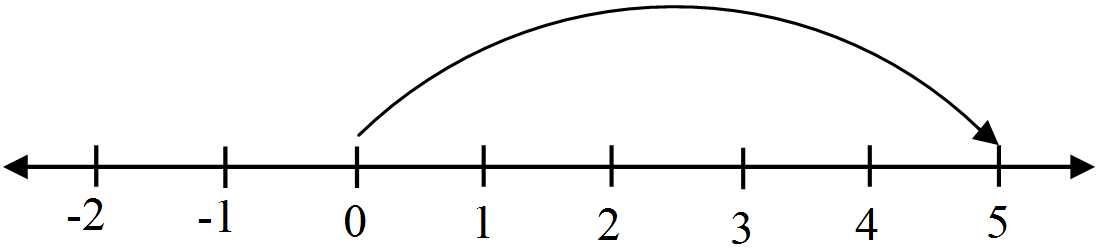
Hence, point $4$ represents $+5.$
Note: All the positive integers lie to the right of $0$ and the negative integers to the left of $0$ on the number line. View full question & answer→MCQ 441 Mark
$-123 - 456 - 890 =$
- A
$-100$
- B
$100$
- ✓
$-1469$
- D
$1469$
AnswerCorrect option: C. $-1469$
Given that We have to find the value of given expression
$-123 - 456 - 890$
we know that $(-) \times (-) = +$
and $= -(+) \times (-) = -$
$-123 - 456 - 890$
$= -579 - 890$
$= -1469$
So option $C$ is correct
View full question & answer→MCQ 451 Mark
The sum of two integers is $− 23.$ If one of them is $18$, then the other is:
AnswerSum of integers $= -23$
One of the numbers $= 18$
Other number $= (-23) - (18)$
$= -23 - 18$
$= -(23 + 18)$
$= -41$
Therefore, the other number is $− 41.$
Hence, the correct option is $(d).$
View full question & answer→MCQ 461 Mark
Mark $(\checkmark)$ against the correct answer in the following:
The predecessor of $-99$ is:
AnswerCorrect option: B. $-100$
The predecessor of a number lies to the left of the number.
$-100$ lies to the left of $-99.$
Hence, $-100$ is a predecessor of $-99.$
View full question & answer→MCQ 471 Mark
$−123+23+45=$
AnswerGiven that We have to find the value of given expression
$-123+23+45$
we know that $= +(−)×(−)=+$
and $= (+)×(−)=−$
$-123+23+45$
$=-100+45$
$=−55$
option $C$ is correct
View full question & answer→MCQ 481 Mark
Which of the following numbers is/are composite
- ✓
$1111.........1(91\ \mbox{digits})$
- B
$1111.........1(61 \ \mbox{digits})$
- C
$1111.........1(175\ \mbox{digits})$
- D
$1111.........1(105\ \mbox{digits})$
AnswerCorrect option: A. $1111.........1(91\ \mbox{digits})$
$1111.........1(91\ \mbox{digits})$
View full question & answer→MCQ 491 Mark
The statement "When an integer is added to itself, the sum is greater than the integer" is:
- A
- B
- ✓
True only when the integer is positive.
- D
True for non-negative integers.
AnswerCorrect option: C. True only when the integer is positive.
Suppose we take two integers one positive $(+1)$ and other negative $-1.$
On adding $1$ to itself, we get $1 + 1 = 2.$
Here, the sum is greater than the integer $(+1).$
Again, adding $-1$ to itself, we get $-1 + (-1) = -1 -1 = -2$
Here, the sum is less than the integer $-1.$
Hence, the given statement is true only when the integer is positive.
View full question & answer→MCQ 501 Mark
Mark the correct aftemative of the following:
The predecessor of $-99$ is:
AnswerCorrect option: B. $-100$
If a is an integer, then its predecessor is a$ - 1.$
So Predecessor of $-99 =-99 - 1$
$= -(99 + 1)$
$= -100$
Hence, the correct option is $(b).$
View full question & answer→MCQ 511 Mark
Difference of sums of $998$ and $-486$ from $290$ and $732$
- A
$-510$
- ✓
$+510$
- C
$-1022$
- D
$+512$
AnswerCorrect option: B. $+510$
$998 + (-486) = + 512$
$290 + 732 = 1022$
$1022 - 512 = + 510$
View full question & answer→MCQ 521 Mark
In which of the following pairs of integers, the first integer is not on the left of the other integer on the number line?
- A
$(-1, 10)$
- ✓
$(-3, -5)$
- C
$(-5, -3)$
- D
$(-6, 0)$
AnswerCorrect option: B. $(-3, -5)$
On observing all the options by using a number line, we get that there is only one pair $(-3, -5)$ in which the first integer is not on the left of the other integer.
View full question & answer→MCQ 531 Mark
The inequality $2^n> n$ is true for
AnswerFor $n = 0,$ we have $2^\circ0$ $= 1$ which is $>0$
$= 2$ which is $> 1^1$ For $n = 1$, we have $2$
which is $>−1$ $\frac{1}{2}$ $(- 1) =$ For $n = -1,$ we have $2$
Hence, $2^n> n$ for all integers
View full question & answer→MCQ 541 Mark
Sum of the greatest $8$ digit number and the smallest $9$ digit number is:
- A
$19999999$
- ✓
$199999999$
- C
$999999999$
- D
$10000999$
AnswerCorrect option: B. $199999999$
Greatest $- 8$ digit no $99999999$
Smallest $- 9$ digit no $+ 100000000$
$199999999$
View full question & answer→MCQ 551 Mark
Mark $(\checkmark)$ against the correct answer in the following:
Additive inverse of $-23$ is:
- A
$\frac{-1}{23}$
- B
$\frac{1}{23}$
- ✓
$23$
- D
$-23$
AnswerAdditive inverse of a number added to the number gives $0.$
$-23 + 23 = 0$
Hence, $23$ is the additive inverse of $-23.$
View full question & answer→MCQ 561 Mark
Mark the correct aftemative of the following:
The additive identity element in the set of integers is:
AnswerIf a is an integer, then $a + 0 = 0 + a = a$
Here, $0$ is the additive identity element in the set of integers.
Hence, the correct option is $(c).$
View full question & answer→MCQ 571 Mark
Find the next term in the following sequence. $2, 3, 11, 38, 102,?$ $2, 3, 11, 38, 102,?$
AnswerThe sequence is$ +1^3 ,$$+2^3$$+3^3$ $+4^3,$ $5^3 2.$
$+1 = 3, 3 + 8 = 11, 11 + 27 = 38,$
$38 + 64 = 102, 102 + 125 = 22$
Hence the correct answer is option $C.$
View full question & answer→MCQ 581 Mark
Mark $(\checkmark)$ against the correct answer in the following:
When $34$ is subtracted from $-36$, we get:
View full question & answer→MCQ 591 Mark
$(+48) + (-53)=$
Answer$(+48) + (-53) = 53 − 48 = −5$
View full question & answer→MCQ 601 Mark
The successor of lowest positive integer is
AnswerSince the Lowest positive integer is $1$. Successor of lowest positive integer will be $2$ as $2$ is the next positive integer number after $1$.
View full question & answer→MCQ 611 Mark
Mark against the correct answer in the following: $36 ÷ (-9) = ?$
Answer$36\div(-9)$
$=\frac{36}{-9}$
$= \frac{36}{9}\times(−1)$
$= -1 \times 4$
$= -4$
View full question & answer→MCQ 621 Mark
The greatest integer lying between $-10$ and $-15$ is:
AnswerThe integers lying between $-10$ and $-15$ are$-11, -12, -13$ and $-14.$
The greatest integer among these is $-11.$
with negative sign, smaller number is greater.
View full question & answer→MCQ 631 Mark
Mark against the correct answer in the following:
On subtracting $-9$ from $-6$, we get:
AnswerWe have:$-6 - (-9)$
$= -6 + 9$
$= 3$
View full question & answer→MCQ 641 Mark
$(-2) \times (-3) \times 6 \times (-1)$ is equal to:
Answer$(-2) \times (-3) \times 6 \times (-1) = (2 \times 3) \times 6 \times (-1)$
$= 6 \times 6 \times (-1)$
$= 36 \times (-1)$
$= -(36 \times 1)$
$= -36$
Hence, the correct option is $(b).$
View full question & answer→MCQ 651 Mark
Mark $(\checkmark)$ against the correct answer in the following:
If $(−13 + 6)\ \Box−25−(−9)$, then the correct symbol in the place holder is:
AnswerHere,$L.H.S. = (-13 + 6)$
$= -7$
$R.H.S. = -25 - (-9)$
$= -25 + 9$
$= -16$
$-7 > -16$
$L.H.S. > R.H.S.$
View full question & answer→MCQ 661 Mark
Mark against the correct answer in the following:
$(-9) \times 6 + (-9) \times 4 = ?$
Answer$(-9) \times 6 + (-9) \times 4$
Using distributive law:$(-9) \times (6 + 4)$
$= (-9) \times (10)$
$= -90$
View full question & answer→MCQ 671 Mark
Find the product of $(−20) \times (−2) \times (−5) \times 7$
- A
$-100$
- B
$-1200$
- ✓
$-1400$
- D
$1400$
AnswerCorrect option: C. $-1400$
$(-20) \times (-2) \times (-5) (-35)$
$\Rightarrow 40 \times (−35) [ (-) (-) = (+), (-) \times (+) = (-) ]$
$\Rightarrow -1400$
View full question & answer→MCQ 681 Mark
$6$ more than $− 7$ is:
Answer$6$ more than $-7 = (-7) + 6$
$= -( 7 - 6)$
$= -1$
Hence, the correct option is $(b).$
View full question & answer→MCQ 691 Mark
Mark the correct aftemative of the following:
If an integer a is greater than $7$, then $|7 - a| =$
- ✓
$7 - a$
- B
$a - 7$
- C
$7 + a$
- D
$-7 - a$
AnswerCorrect option: A. $7 - a$
If x is negative integer, then $|x| = -x$
Here, a is greater than $7$, so $7$ - a is negative.
Therefore, $|7 - a| = -(7 - a) = -7 + a = a - 7$
Hence, the correct option is $(a).$
View full question & answer→MCQ 701 Mark
Mark $(\checkmark)$ against the correct answer in the following:
The successor of $-89$ is:
AnswerThe successor of $-89$ is $-88$. The successor of a number lies towards its right on a number line.
$88$ lies to the right of $-89.$
View full question & answer→MCQ 711 Mark
Every integer less than $0$ has the sign:
AnswerEvery integer less than $0$ has the negative $(-)$ sign.
Note: An integer is positive, if it is greater than zero and negative, if it is less than zero.
View full question & answer→MCQ 721 Mark
The value of $12+|-6 |$ is
Answer$12 + ∣−6 ∣$
$= 12 + 6$
$= 18$
View full question & answer→MCQ 731 Mark
$-101 - 200 =$
AnswerGiven that We have to find the value of given expression
$-101 - 200$
we know that $(-) × (-) = +$
$and (+) × (-) = -$
$-101 - 200$
$= -301$
So option $C$ is correct
View full question & answer→MCQ 741 Mark
Mark the correct aftemative of the following:
If $\Delta$ is an operation on integers such that $\text{a }\Delta\text{ b}=\text{a}-\text{b}-2$, for all integers a, b. Then, $7\ \Delta\ (-4)=$
AnswerHere, the operation $\Delta$ is defined as $\text{a }\Delta\text{ b}=\text{a}-\text{b}-2$.
$7\ \Delta\ (-4)=7-(-4)-2$
$=7+4-2$
$=11-2=9$
Hence, the correct option is $(c).$
View full question & answer→MCQ 751 Mark
Temperature decreased by $20^\circ $. This event is represented as:
AnswerTemperature is decreased by $20$.
From the reference level, increase in temperature = +ve and decrease in temperature = −ve.
$\Rightarrow $ Temperature is represented as $−20.$
View full question & answer→MCQ 761 Mark
Mark $(\checkmark)$ against the correct answer in the following:
$? + (−8) = 12$
Answer$x + (-8) = 12$
$\Rightarrow x - 8 = 12$
$\Rightarrow x = 12 + 8$
$\Rightarrow x = 20$
View full question & answer→MCQ 771 Mark
Number of integers lying between $-1$ and $1$ is:
AnswerThe integers lying between $-1$ and $1$ is $0$, so there is only one integer.
View full question & answer→MCQ 781 Mark
$(+42) + (-64) =$
Answer$(+42) + (-64) = - 22$
View full question & answer→MCQ 791 Mark
$9 + ∣ -4$ ∣ is equal to
AnswerNow, $9 + | -4| = 9 + 4 = 13.$
View full question & answer→MCQ 801 Mark
Mark against the correct answer in the following:
The sum of two integers is $-13$. If one of them is $8$ then the other is:
AnswerLet $x$ be the other integer$x + 8 = -13$
$x = -13 - 8$
$x = -21$
View full question & answer→MCQ 811 Mark
$− 123 −(−23) =$
- A
$146$
- B
$-146$
- C
$100$
- ✓
$-100$
AnswerCorrect option: D. $-100$
Given that We have to find the value of given expression
$-123 - (-23)$
we know that $(−) × (−) = +$
and $(+) × (−) = −$
$= - 123 + 23$
$= - 100$
So option $D$ is correct
View full question & answer→MCQ 821 Mark
The greatest negative integer
Answer$-1$ is greatest negative integer.
View full question & answer→MCQ 831 Mark
$0$ is greater than every______integer.
Answer$0$ is grater than every negativenegative integer.
View full question & answer→MCQ 841 Mark
$0$ is greater than every...........integer.
Answer$0$ is grater than every negativenegative integer.
View full question & answer→MCQ 851 Mark
Mark the correct aftemative of the following:
Which of the following pairs of integers have $9$ as difference?
- A
$19, 10$
- B
$-19, -10$
- C
$19, -10$
- ✓
$(a)$ and $(b)$ both
AnswerCorrect option: D. $(a)$ and $(b)$ both
$1.\ 19 - 10 = 9$
$2.\ -10 - (-19) = -10 + 19 = 19 - 10 = 9$
$3.\ 19 - (-10) = 19 + 10 = 29$
Thus, $(a)$ and $(b)$ both are correct.
Hence, the correct option is $(d).$
View full question & answer→MCQ 861 Mark
The smallest integer value of x for which\displaystyle $\frac{7}{\text{x}}$ is an integer is
AnswerThe smallest integer value of $x$ would be $-7$ because if we divide $7$ by $-7$ will get $-1$ which is a integer number.
View full question & answer→MCQ 871 Mark
The predecessor of the integer $-1$ is:
AnswerWe know that, one less than a given number, gives a predecessor. Predecessor of the integer $-1 = -1 -1 = -2$ Hence, predecessor of the integer $-1$ is $-2.$
View full question & answer→MCQ 881 Mark
Rajanikant had loss of $Rs.238.$This is represented by
- A
$+238%$
- B
$-238%$
- C
$+238$
- ✓
$-238$
AnswerCorrect option: D. $-238$
The positive integers are represented as by the sign $(+)$ in front of the each n′ integer. The set of positive integers may be denoted by $Z^+.$ Positive integers are:
$Z^+$ $= 1, 2, 3, 4, 5,.....$
The negative integers are the collection of real numbers with negative sign $(−)$ in front of the standard numerals and are always less than zero. The set of negative integers is represented by $Z^−.$ Negative integers are written as:
$Z^−$ $= {...., -5, -4, -3, -2, -1}$
Moreover, profit represents the positive sign $(+)$ and loss represents the negative sign $(−).$
Hence, the statement Rajanikant had loss of $Rs. 238.$ represents the negative sign that is $-238.$
View full question & answer→MCQ 891 Mark
A number which is a factor of every number is ____ .
Answer$11$ is the smallest factor of a multiple and the greatest factor of a multiple is the multiple itself.
So, $11$ is a factor of every multiple.
Option $B$ is the correct answer.
View full question & answer→MCQ 901 Mark
Opposite of profit of $Rs. 250$
- A
$+Rs. 250$
- ✓
Loss of $Rs. 250$
- C
$+250$
- D
AnswerCorrect option: B. Loss of $Rs. 250$
Positive numbers are located above $0$ and negative numbers are located below $0$ on a vertical number line.
View full question & answer→MCQ 911 Mark
$5$ less than $-2$ is:
AnswerHere, $5$ less than $-2 = (-2) - (5) = -2 - 5 = -7.$
Hence, the correct option is $(c).$
View full question & answer→MCQ 921 Mark
If the sum of two integers is $- 26$ and one of them is $-14$, then the other integer is.
Answer$a, b$ be $2$ Integersa $+ b = - 26a + b=−26 .......$ given $a - 14 = -26 ..........$ given $b = - 14a = -26 + 14a = − 12$
View full question & answer→MCQ 931 Mark
Opposite of rise in temperature by\displaystyle $5^\circ C$
AnswerCorrect option: C. fall in temperature by $5^\circ C$
The opposite of rise is fall. So, opposite of rise in temperature by $5^\circ C$ is fall in temperature by $5^\circ C$
View full question & answer→MCQ 941 Mark
Opposite of profit of $Rs. 250$
- A
$+ Rs. 250$
- ✓
Loss of $Rs. 250$
- C
$+ 250$
- D
AnswerCorrect option: B. Loss of $Rs. 250$
Positive numbers are located above $0$ and negative numbers are located below $0$ on a vertical number line.
View full question & answer→MCQ 951 Mark
Mark the correct aftemative of the following:
The additive inverse of $17$ is:
- ✓
$-17$
- B
$17$
- C
$\frac{1}{17}$
- D
$-\frac{1}{17}$
AnswerIf a is an integer, then its additive inverse is $- a.$
So, additive inverse of $17 = -17$
Hence, the correct option is $(a).$
View full question & answer→MCQ 961 Mark
What should be added to $18$ to get $- 34?$
AnswerLet the number be $x$.Then according to the problem we get, $x + 18 = -34$ or, $x = -34 -18$ or, $x = -52.$
View full question & answer→MCQ 971 Mark
$........ + (-28) = 0$
Answerobviously $+28-28=0$
View full question & answer→MCQ 981 Mark
Encircle the odd one of the following
- A
$(−1, −2)$
- B
$(−5, +2)$
- C
$(−4, +1)$
- ✓
$(−9, +7)$
AnswerCorrect option: D. $(−9, +7)$
Option $(d)$ is correct.
$(a) - 1 - 2 = -3$
$(b) - 5 + 2 = -3$
$(c) - 4 + 1 = -3$
$(d) - 9 + 7 = -2$
By the above calculation, we can see that option d gives $-2$ while other options give $-3$. Thus, option dis different from all others.
View full question & answer→MCQ 991 Mark
Mark the correct aftemative of the following:
What should be added to $18$ to get $-34?$
AnswerThe required number is $(-34) - 18$
Now,
$(-34) - 18 = -(34 + 18)$
$= -52$
Hence, the correct option is $(b).$
View full question & answer→MCQ 1001 Mark
Mark against the correct answer in the following:
$(-7) + (-9) + 12 + (-16) = ?$
Answer$(-7) + (-9) + 12 + (-16)$
$= -7 - 9 + 12 - 16$
$= -20$
View full question & answer→MCQ 1011 Mark
$-34-(-56) - (-67) = ?$
AnswerGiven that We have to find the value of given expression $-34-(-56) - (-67)$
we know that $(−) \times (−) = +$
$=-32+5+67$
$=32+67$
$= 89$
So option $C$ is correct
View full question & answer→MCQ 1021 Mark
Temperature at the foot of a mountain is $+5^\circ C$. It fell down by $10^\circ C$ at the top of the mountain. The temperature recorded on the top is
- A
$+15^\circ C$
- B
$-15^\circ C$
- C
$+5^\circ C$
- ✓
$-5^\circ C$
AnswerCorrect option: D. $-5^\circ C$
$−5^\circ C$
$+5^\circ C +(-10^\circ C) = -5^\circ C$
View full question & answer→MCQ 1031 Mark
Mark against the correct answer in the following:
$2$ less than $-7$ is:
Answer$2$ less than $-7$ means the following:$= -7 - 2$
$= -9$
View full question & answer→MCQ 1041 Mark
Mark against the correct answer in the following:
On subtracting $-8$ from $0$, we get:
Answer$0 - (-8)$
$= 0 + 8$
$= 8$
View full question & answer→MCQ 1051 Mark
Mark $(\checkmark)$ against the correct answer in the following:
The integer which is $5$ more that $(-7)$ is:
Answer$5$ more than $(-7)$ means $5$ added to $(-7)$
$5 + (-7)$
$= 5 - 7$
$= -2$
View full question & answer→MCQ 1061 Mark
$(-16) + 14 - (-13)$ is equal to:
Answer$(-16) + 14 - (-13) = (-16) + 14 + 13$ (Additive inverse of $-13$ is $13)$
$= (-16) + 27$
$= 27 - 16$
$= 11$
Hence, the correct option is $(c).$
View full question & answer→MCQ 1071 Mark
If $-\frac{1}{\text{x}}$ is an integer, what are the possible values of $x?$
AnswerCorrect option: C. $\pm1$
the possible values of $x$ is $\pm1$
View full question & answer→MCQ 1081 Mark
Mark the correct aftemative of the following:
The integer $8$ more than $-12$ is:
AnswerThe integer $8$ more than $− 12$ is $(− 12) + 8$
Now,
$(-12) + 8 = -(12 - 8)$
$= -4$
Hence, the correct option is $(b).$
View full question & answer→MCQ 1091 Mark
If $x$ and $y$ are negative, then which of the following statements is/are always true?
I. $x + y$ is positive $II. xy$ is positive $III. x y$ is positive.
- A
$I$ only
- ✓
$II$ only
- C
$III$ only
- D
$I$ and $III$ only
AnswerCorrect option: B. $II$ only
As negative quantity multiplied by negative quantity yeild a positive quantity.
So option $2$ is correct.There is some sign is missing in option $3.$
View full question & answer→MCQ 1101 Mark
$(-5) + 6 = ?$
- A
$(-1)$
- ✓
$11$
- C
$11$
- D
$(-11)$
AnswerIn the given equation $5$ and $6$ are added $= -5 + 6 = 11$
View full question & answer→MCQ 1111 Mark
$(-46) + (+15)=$
AnswerOne negative and one positive number are added by doing subtraction of digits and keeping the bigger addend sign to the result.
$(-46) + (+15) = 46 - 15 = -31$
View full question & answer→MCQ 1121 Mark
Subtract $- 28$ from $- 12$
Answer$-12 - (-28) = (-12) + (+28) =+16$
View full question & answer→MCQ 1131 Mark
Mark against the correct answer in the following:
The predecessor of $-16$ is:
AnswerTo find the predecessor of a number, we move from the right to the left of a number line.
View full question & answer→MCQ 1141 Mark
A number which is a factor of every number is ____.
Answer$1$ is the smallest factor of a multiple and the greatest factor of a multiple is the multiple it self. So, $1$ is a
factor of every multiple.
View full question & answer→MCQ 1151 Mark
Subtract $- 30$ from $- 10$
Answer$-10 - (-30) = (-10) + (+30) = (+20)$
View full question & answer→MCQ 1161 Mark
Mark $(\checkmark)$ against the correct answer in the following:
What should be added to $16$ to get $(-31)?$
AnswerLet the number to be added to $16$ be $x$
$x + 16 = (-31)$
$\Rightarrow x = (-31) - 16$
$\Rightarrow x = -47$
View full question & answer→MCQ 1171 Mark
$9 + |-4|$ is equal to:
AnswerHere, $|-4| = 4$
Therefore, $9 + |-4| = 9 + 4 = 13$
Hence, the correct option is $(c).$
View full question & answer→MCQ 1181 Mark
Mark against the correct answer in the following:
$6 - (-4) = ?$
Answer$6 - (-4)$
$= 6 + 4$
$= 10$
View full question & answer→MCQ 1191 Mark
The successor of lowest positive integer is:
AnswerSince the Lowest positive integer is $1$. Successor of lowest positive integer will be $2$ as $2$ is the next positive integer number after $1.$
View full question & answer→MCQ 1201 Mark
Mark against the correct answer in the following:
The sum of two integers is $20$. If one of them is $-5$ then the other is:
AnswerLet x be the other integer$x + (-5) = 20$
$x - 5 = 20$
$x = 25$
View full question & answer→MCQ 1211 Mark
Evaluate $34 + 67 - 104$
AnswerGiven that We have to find the value of given expression$34 + 67 - 104$
$= (34 + 67) - 104$
$= 101 - 104$
View full question & answer→MCQ 1221 Mark
Addend $+$ Addend $=..........$
Answer$-$ Is used for difference× is used for product $\div$ is used for quotient and+Is used for the sum of $2$ numbers
Any of the numbers that are added together.
Example: In $8 + 3 = 11$, the $8$ and the $3$ are addends.
So the given sign being $+$ the correct answer is option $C.$
View full question & answer→MCQ 1231 Mark
The sum of four consecutive integers is $46$ then the four integers are:
- A
$11, 12, 13, 14$
- ✓
$10, 11, 12, 13$
- C
$6, 7, 8, 9$
- D
$20, 21, 22, 23$
AnswerCorrect option: B. $10, 11, 12, 13$
$10, 11, 12, 13$
View full question & answer→MCQ 1241 Mark
If $x$ is greater than $2,$ then $|2 - x| =$
- A
$2 - x$
- ✓
$x - 2$
- C
$2 + x$
- D
$-x - 2$
AnswerCorrect option: B. $x - 2$
If a is negative integer, then $|a| = -a.$
Here, $x$ is greater than $2$. So, $2 - x$ is negative.
Therefore, $|2 - x| = -(2 - x) = -2 + x = x - 2.$
Hence, the correct option is $(b).$
View full question & answer→MCQ 1251 Mark
Which of the following shows the maximum rise in temperature?
- A
$0^\circ C$ to $10^\circ C.$
- ✓
$-4^\circ C$ to $8^\circ C.$
- C
$-15^\circ C$ to $-8^\circ C.$
- D
$-7^\circ C$ to $0^\circ C.$
AnswerCorrect option: B. $-4^\circ C$ to $8^\circ C.$
We know that, the maximum rise in the temperature is equal to the maximum value of difference of two temperatures.
$a.\ $Difference of $0^\circ C to 10^\circ C = 10^\circ C - 0^\circ C = +10^\circ C.$
$b.\ $Difference of $-4^\circ C to 8^\circ C = 8^\circ C - (-4^\circ C) = 8^\circ C + 4^\circ C = +12^\circ C$ [maximum]
$c.\ $Difference of $-15^\circ C to -8^\circ C = -8^\circ C - (-15^\circ C) = -8^\circ C + 15^\circ C = +7^\circ C.$
$d.\ $Difference of $-7^\circ C to 0^\circ C = 0^\circ C - (-7^\circ C) = 0^\circ C + 7^\circ C = +7^\circ C$ Hence, the option $(b)$ shows the maximum rise in temperature.
View full question & answer→MCQ 1261 Mark
Arya climbed 10 steps up. Position of Arya can be represented by:
AnswerArya climbed $10$ steps up. Ground being the reference level, upwards direction $= +$ve and downwards direction $= −ve.$
$\Rightarrow $ Position of Arya is $+10$
View full question & answer→MCQ 1271 Mark
If nn is a positive integer not a multiple of $3$, then $1+\omega^\text{n}+\omega^{2\text{n}}=$
Answer$1+\omega^\text{n}+\omega^{2\text{n}}$ If n is not a multiple of $31+\omega^\text{n}+\omega^{2\text{n}}=0$
$\because\omega^3=1$ and according to cube-root unity.
$1+\omega^2+\omega=0$
View full question & answer→MCQ 1281 Mark
Difference of $23$ and $17.081$ is _____
- A
$0.5919$
- B
$59.19$
- C
$591.9$
- ✓
$5.919$
AnswerCorrect option: D. $5.919$
To subtract a whole number from a decimal we extend the whole number to the decimal points of the decimal number.
In our question,$23.000-17.081= 5.919$
So option $D$ is the correct answer.
View full question & answer→MCQ 1291 Mark
The simplified form of the expression $[15 − \{12 − (7 − \overline{6 − 2)}\}]$ will be
- ✓
$6$
- B
$3 + 3$
- C
$8$
- D
$2 \times 4$
Answer$[15 − \{12 − (7 − \overline{6 − 2)}\}]$
$=[15−{12−(7−4)}]$
$=[15−{12−(7−4)}]$
$= 15-9$
$=6$
Option $A$ is correct.
View full question & answer→MCQ 1301 Mark
$-67 - (-76) =$
AnswerGiven that We have to find the value of given expression
$- 67 - (-76)$
we know that $= + (−) × (−) = +$
and $= - (+) × (−) = −$
$= - 67 + 76=$
$=9$
So option $D$ is correct
View full question & answer→MCQ 1311 Mark
Mark against the correct answer in the following:
$-12 - (-5) = ?$
Answer$-12 - (-5)$
$= -12 + 5$
$= -7$
View full question & answer→MCQ 1321 Mark
Mark against the correct answer in the following:
$8 + (-8) = ?$
Answer$8 + (-8)$
$= 8 - 8$
$= 0$
View full question & answer→MCQ 1331 Mark
Number of whole numbers lying between $-5$ and $5$ is:
AnswerThe integers lying between $-5$ and $5$ are $-4, -3, -2, -1, 0, 1, 2, 3$ and $4.$ Whole numbers are $0, 1, 2, 3$ and $4.$
The number of whole numbers $= 5$ [whole numbers are the group of numbers that consist of the numbers i.e.$ 0, 1, 2, 3, 4, 5,…]$
View full question & answer→MCQ 1341 Mark
Mark against the correct answer in the following:
$49 + (-27) = ?$
Answer$49 + (-27)$
$= 49 - 27$
$= 22$
View full question & answer→MCQ 1351 Mark
On subtracting $− 7$ from $− 14$, we get:
AnswerRequired number $= -14 - (-7)$
$= -14 + 7$
$= -(14 - 7)$
$= -7$
Hence, the correct option is $(b).$
View full question & answer→MCQ 1361 Mark
The predecessor of $-14$ is:
AnswerIf a is an integer, then its predecessor is a $- 1.$
So predecessor $-14 = -14 - 1 = -15$
Hence, the correct option is $(a).$
View full question & answer→MCQ 1371 Mark
The successor of $-22$ is:
AnswerIf a is an integer, then its successor is $a + 1.$
So, successor of $-22 = -22 + 1 = -(22 - 1) = -21$
Hence, the correct option is $(b).$
View full question & answer→MCQ 1381 Mark
Mark against the correct answer in the following:
$(-6) \times 9 = ?$
AnswerWe have:$(-6) \times 9$
$= -(6 \times 9)$
$= -54$
View full question & answer→MCQ 1391 Mark
Opposite of earning $Rs. 100$
- A
$+Rs. 100$
- B
Profit of $Rs. 100$
- ✓
Spending $Rs. 100$
- D
AnswerCorrect option: C. Spending $Rs. 100$
Earning of $Rs. 100$ means we got $Rs. 100.$
Therefore, opposite of earning is spending means we give $Rs. 100$
View full question & answer→MCQ 1401 Mark
Addition of one negative and one positive integer is:
- A
- B
- ✓
Same as the sign of larger number
- D
Same as the sign of smaller number
AnswerCorrect option: C. Same as the sign of larger number
If the magnitude of positive number is greater than the negative number then there will be some positive remainder after adding the negative number.Hence,it will be the sign of a large number.
View full question & answer→MCQ 1411 Mark
On subtracting $-5$ from $0$, we get:
AnswerHere, $0 - (-5) = 0 + 5 = 5$
Therefore, on subtracting $-5$ from $0$, we get $5$
Hence, the correct option is $(b).$
View full question & answer→MCQ 1421 Mark
Opposite of profit of $Rs. 250.$
- A
Loss of $Rs. 150$
- ✓
Loss of $Rs. 250$
- C
Profit of $Rs. 100$
- D
AnswerCorrect option: B. Loss of $Rs. 250$
Loss of $Rs. 250.$
View full question & answer→MCQ 1431 Mark
Solve:$(-46) + (+15) =$
AnswerOne negative and one positive number are added by doing subtraction of digits and keeping the bigger addend sign to the result
$(-46) + (+15) = 46 - 15 = -31$
Bigger addend is $46$ with -− sign
$\therefore $ - sign is given for the result
View full question & answer→MCQ 1441 Mark
Opposite of rise in temperature by $5^\circ $
AnswerCorrect option: C. Fall in temperature by $5^\circ $
Opposite of rise in temperature by $5^\circ $ is fallin temperature by $5^\circ $
View full question & answer→MCQ 1451 Mark
In the first half of a trivia game, Mark scored $200$ points. Then, during the second half, he scored $-100$ points. What was his final score?
- ✓
$100$
- B
$300$
- C
$-100$
- D
$-200$
AnswerAt the end of the first half of the game he has $200$ pointsThe points he scored in the second half$=-100$ pointsNumber of points left with Mark at the end of the game$=200 + (-100) = 100$point
View full question & answer→MCQ 1461 Mark
Prove that the system of equations
$\begin{cases}\text{x}^{2} + 6\text{y}^{2}-\text{z}^{2} & \text{amp};\\6\text{x}^{2} + \text{y}^{2} - \text{t}^{2} & \text{amp}\end{cases}$
has no positive integer solutions.
- ✓
It has no positive integer solutions.
- B
It has positive integer solution.
- C
The equations do not have any solutions.
- D
The equations has negative integer solution.
AnswerCorrect option: A. It has no positive integer solutions.
we can assume that $\operatorname{gcd}( x , y , z , t )=1$.
Adding up the equations yields $7\left( x ^2+ y ^2\right)= z ^2+ t ^2$.
The square residues modulo $7$ are $0,1,2$, and $4 .$
It is not difficult to see that the only pair of residues which add up to o modulo $7$ is $(o, o)$, hence $z$ and $t$ are divisible by $7$ .
Setting $z=7 z_1$ and $t=7 t_1$ yields $7\left( x ^2+ y ^2\right)=49\left( z _1^2+ t _1^2\right)$ or $x ^2+ y ^2=7\left( z _1^2+ t _1^2\right)$
It follows that $x$ and $y$ are also divisible by $7 .$
Contradicting the fact that $\operatorname{gcd}( x , y , z , t )=1$.
View full question & answer→MCQ 1471 Mark
If $x$ is a negative integer, then
- ✓
$x + |x| = 0$
- B
$x - |x| = 0$
- C
$x + |x| = 2x$
- D
$x -|x| = -2x$
AnswerCorrect option: A. $x + |x| = 0$
If $x$ is negative integer, then $|x| = -x. So$
$x + |x| = x - x = 0$
$x - |x| = x - (-x) = x + x = 2x$
Hence, the correct option is $(a).$
View full question & answer→MCQ 1481 Mark
Which of the following is not an integer?
- ✓
$2 ÷ 7$
- B
$2-0$
- C
$-5 \times 9$
- D
$-13+17$
AnswerCorrect option: A. $2 ÷ 7$
$2\div7 =\frac{7}{2}$ which is a rational number
View full question & answer→MCQ 1491 Mark
Which of the following is an example of integer.
- ✓
$-5$
- B
$\dfrac{5}{2}$
- C
$1.4$
- D
$\dfrac{-7}{2}$
Answer$−5$ is an integer number.
View full question & answer→MCQ 1501 Mark
Mark the correct aftemative of the following:
When $47$ is subtracted from $-23$, we get?
Answer$(-23) - (47) = -23 - 47$
$= -(23 + 47)$
$= -70$
Thus, when $47$ is subtracted from $-23$, we get $-70.$
Hence, the correct option is $(d).$
View full question & answer→MCQ 1511 Mark
Fill in the blank:
How many $INR\ 1$ coins make $INR\ 10$ ______________
Answer$10 \times 1 = 10$
$\therefore \ 10 \ INR \ 1$ coins make $INR \ 10.$
View full question & answer→MCQ 1521 Mark
Mark against the correct answer in the following:
$(-42) + (-35) = ?$
Answer$(-42) + (-35)$
$= -42 - 35$
$= -77$
View full question & answer→MCQ 1531 Mark
Mark against the correct answer in the following:
$4$ more than $-5$ is:
Answer$4$ more than $-5$ means the following:
$= -5 + 4$
$= -1$
View full question & answer→MCQ 1541 Mark
The sum of the integers from $11$ to $100$ which are not divisible by $3$ or $5$ is
- A
$2489$
- B
$4735$
- C
$2317$
- ✓
$2632$
AnswerCorrect option: D. $2632$
$2632$
View full question & answer→MCQ 1551 Mark
Mark against the correct answer in the following:
$(-37) + 6 = ?$
Answer$(-37) + 6$
$= -37 + 6$
$= -31$
View full question & answer→MCQ 1561 Mark
$(-35) + (-32)$ is equal to:
Answer$(-35) + (-32) = -(35 + 32) = -67$
$$Hence, the correct option is $(b).$
View full question & answer→MCQ 1571 Mark
Rushabh walked $3$ units west. the position of Rushabh is:
- A
$+3$
- ✓
$−3$
- C
$3$ units South
- D
$0$
AnswerWest direction is denoted towards left. Rushabh walked $3$ units left. His positions co-ordinate on number line $= -3$
View full question & answer→MCQ 1581 Mark
If $\displaystyle-\frac{1}{\text{x}}$ is an integer, what are the possible values of $x?$
AnswerCorrect option: C. $\pm1$
The possible values of $x$ is $\pm1$
View full question & answer→MCQ 1591 Mark
If the sum of two integers is $-26$ and one of them is $14$, then the other integer is:
AnswerSum of two integers $= -26$
One of the two numbers $= 14$
$\therefore$ second number $= -26 - 14$
$= -(26 + 14)$
$= -40$
Hence, the correct option is $(c).$
View full question & answer→MCQ 1601 Mark
Evaluate $34 + 67 - 104$
AnswerGiven that We have to find the value of given expression $34 + 67 - 104$
$= (34 + 67) - 104$
$= 101 - 104$
$= -3$
View full question & answer→MCQ 1611 Mark
Mark against the correct answer in the following:
$5 - (-8) = ?$
Answer$5 - (-8)$
$= 5 + 8$
$= 13$
View full question & answer→MCQ 1621 Mark
Amulya and Amar visited two places $A$ and $B$ respectively in Kashmir and recorded the minimum temperatures on a particular day as$ -4^\circ C$ at $A$ and $–1^\circ C$ at $B$. Which of the following statement is true?
AnswerCorrect option: A. $A$ is cooler than $B.$
We know that, if the temperature decreases, the cooling increases.
Given, minimum temperature on a particular at $A = -4^\circ C$ and minimum temperature on a particular at $B = -1^\circ C$ We know that, $-4^\circ C < -1^\circ C.$
So, $A$ is cooler than $6.$
Hence, option $(a)$ is true.
View full question & answer→MCQ 1631 Mark
Encircle the odd one of the following
- A
$(-3,3)$
- B
$(-5,5)$
- ✓
$(-6,1)$
- D
$(-8,8)$
AnswerCorrect option: C. $(-6,1)$
Option $(c)$ is correct.
$(a) -3 + 3 = 0$
$(b) -5 + 5 = 0$
$(c) -6 + 1 = -5$
$(d) -8 + 8 = 0$
By the above calculation, we can see that option c gives $-5$ while other options give $0$. Thus, option cis different from all others.
View full question & answer→MCQ 1641 Mark
Compare $-28$ and $-32$
AnswerWhile comparing negative numbers smaller is greater, greater is smaller
$-28 > -32$
View full question & answer→MCQ 1651 Mark
When a negative integer is subtracted from another negative integer, the sign of the result:
- A
- B
- C
- ✓
Depends on the numerical value of the integers.
AnswerCorrect option: D. Depends on the numerical value of the integers.
Suppose we take two negative integers $-2$ and $-3.$
We subtract $(-3)$ from $(-2)$ and give a minus sign to get the result. i.e $-2 -(-3) = -2 + 3 = 1.$
Again, we subtract $(-2)$ from $-3$ and give a plus sign to get the result. i.e $-3 - (-2) = -3 + 2 = -1.$
So, the sign of the result depends on the numerical value of the integers..
View full question & answer→MCQ 1661 Mark
Greater $8 -$ digit number using four digits is:
- A
$900, 000, 787$
- B
$900, 000, 987$
- C
$999, 998, 876$
- ✓
$999, 999, 876$
AnswerCorrect option: D. $999, 999, 876$
Greatest eight digit using $4$ digits only then we will choose largest number $6, 7, 8, 9,$
So greatest one $99, 999, 876.$
View full question & answer→MCQ 1671 Mark
$138 − 234 =?$
AnswerWrite given integers in addition expression and we get:
$(+138) + (-234)$
Subtract smaller integer $138138$ from bigger integer $234$ as follows: $234 - 138 = 96$
Since, the bigger integer $234$ is a negative integer, so the result should also be negative that is $-96$
Hence, $138 - 234 = - 96$
View full question & answer→MCQ 1681 Mark
Mark against the correct answer in the following:
$(-6) + 4 - (-3) = ?$
Answer$(-6) + 4 - (-3)$
$= -6 + 4 + 3$
$= -6 + 7$
$= 1$
View full question & answer→MCQ 1691 Mark
Smallest negative number is:
AnswerWe know that we cannot define a largest positive number, similarly the smallest negative number cannot be defined.
View full question & answer→MCQ 1701 Mark
Integer used to represent a withdrawal of $Rs. 200$ is
- A
depositing $Rs. 200$
- B
$+ Rs. 200$
- ✓
$- Rs. 200$
- D
$- 200$
AnswerCorrect option: C. $- Rs. 200$
Withdrawal of $Rs. 200$ means amount $200$ is subtracted from our account.
i.e $Rs. -200$
Option C is correct.
View full question & answer→MCQ 1711 Mark
Which situation is best represented by the integer $-12?$
- A
The length of curtains is increased by $12$ inches
- ✓
The price of petrol is reduced by $Rs. 12$
- C
The size of picture is enlarged by $12$ percent
- D
The temperature rises by $12^\circ C$
AnswerCorrect option: B. The price of petrol is reduced by $Rs. 12$
Let increase in the petrol be represented by $+$ and decrease in the petrol be represented by $−$.Situation in option $(a), (c), (d)$ represents $+12$ SItuation in option $(b)$ represents $−12$Answer $B$
View full question & answer→MCQ 1721 Mark
Encircle the odd one of the following:
- A
$(-3, 3)$
- B
$(-5, 5)$
- ✓
$(-6, 1)$
- D
$(-8, 8)$
AnswerCorrect option: C. $(-6, 1)$
$-3 + 3 = 0$
$-5 + 5 = 0$
$-6 + 1 = -5$
$-8 + 8 = 0$
By the above calculation, we can see that option $c$ gives $-5$ while other options give $0$. Thus,
option cis different from all others.
View full question & answer→MCQ 1731 Mark
$(+48) + (-53) =$
Answer$(+48) + (-53)$
$= 53 - 48$
$= -5$
View full question & answer→MCQ 1741 Mark
If $x$ is a positive integer, then
- A
$x + |x| = 0$
- ✓
$x - |x| = 0$
- C
$x + |x| = -2x$
- D
$x = -|x|$
AnswerCorrect option: B. $x - |x| = 0$
If $x$ is positive integer, then $|x| = x.$ So,$ x + |x| = x + x = 2x$ and $x - |x| = x - x = 0.$
Hence, the correct option is $(b).$
View full question & answer→MCQ 1751 Mark
Integer used to represent a withdrawal of $Rs. 200$ is:
- A
Depositing $Rs. 200$
- B
$+Rs. 200$
- ✓
$-Rs. 200$
- D
$-200$
AnswerCorrect option: C. $-Rs. 200$
Withdrawal of $Rs. 200$ means amount $200$ is subtracted from our account.
View full question & answer→MCQ 1761 Mark
The integer with negative sign $(-)$ is always less than:
AnswerWe know that, negative integer is always less than $0.$
View full question & answer→MCQ 1771 Mark
An integer with positive sign $(+)$ is always greater than:
AnswerWe know that, positive integer is always greater than $0.$
View full question & answer→MCQ 1781 Mark
Mark against the correct answer in the following:
$7 + |-3| = ?$
Answer$7 + |-3|$
$= 7 + (+3) $(The absolute value of $-3$ is $3.)$
$= 7 + 3$
$= 10$
View full question & answer→MCQ 1791 Mark
If $m, n$ are the positive integers $(n > 1)$ such that $m^n$ $= 121$ then value of $(m-1)^n+1$is
AnswerCorrect option: C. $1000$
We know that $11^2 = 121$ So $m =11$ and $n=2n=2$ so,
$(m- 1)^n+1$ $=(11- 1)^2+1$$< br >< br >$ $= 10^3$ $< br >< br >$ $=1000$
Answer $(C) 1000$
View full question & answer→MCQ 1801 Mark
Which of the following is not an integer?
- ✓
$\frac{2}{7}$
- B
$2 − 0$
- C
$-5 \times 9$
- D
$-13 + 17$
AnswerCorrect option: A. $\frac{2}{7}$
$\frac{2}{7}$ = $\frac{2}{7}$ which is a rational number.
View full question & answer→MCQ 1811 Mark
Absolute value of $-58$ is:
AnswerAbsolute value describes the distance of a number on the number line from $00$ without considering which
direction from zero the number lies.
The absolute value of a number is never negative. Absolute value makes numbers positive.
View full question & answer→MCQ 1821 Mark
$(-29) + 5$ is equal to:
Answer$(-29) + 5 = -(29 - 5) = -24$
Thus, the correct option is $(d).$ View full question & answer→MCQ 1831 Mark
Temperature at the foot of a mountainis $+5^\circ C.$ It fell down by $10^\circ C$ at the top of the mountain. The temperature recorded on the top is
- A
$+15^\circ C$
- B
$-15^\circ C$
- C
$+5^\circ C$
- ✓
$-5^\circ C$
AnswerCorrect option: D. $-5^\circ C$
$-5^\circ C$
View full question & answer→MCQ 1841 Mark
$(+48) + (-53) =$
Answer$(+48) + (-53) = 53 - 48 = -5$
View full question & answer→MCQ 1851 Mark
Mark against the correct answer in the following:
$2$ less than $-3$ is:
Answer$2$ less than $-3$ means the following:$= -3 - 2$
$= -5$
View full question & answer→MCQ 1861 Mark
Mark against the correct answer in the following:
On subtracting $8$ from $-4$, we get:
View full question & answer→MCQ 1871 Mark
Let $n$ be an integer number. Prove that the equation has infinitely $x^2 + y^2 = n + z^2$ many integer solutions.
- ✓
$z = x − 1$
- B
$z = x + 1$
- C
$z = x × 1$
- D
$z = x /1$
AnswerCorrect option: A. $z = x − 1$
The equation is equivalent to $(x - z) (x + z) + y^2= n.$ If we set $x - z =$ then we obtain $2x - 1 + y^2 = n$ and $\text{x} = \frac{\text{n + 1 - y}^2}{2}$ . Now, it suffices tso take $y = n + m,$ where m is an odd integer to insure that $x$ is an integer as well. Indeed, if $m = 1$ kt $1$ then,
$\frac{\text{n + 1 - y}^2}{2} = \frac{\text{n+1-(n+2k+1)}^2}{2}=-\frac{\text{n (n + 1)}}{2}\\-2\text{nk}-2\text{nk}^2-2\text{k,}$
it is also an integer number. obviously an integer. Since $z = x - 1 z = x - 1$
View full question & answer→MCQ 1881 Mark
Mark against the correct answer in the following:
On subtracting $-5$ from $10$, we get:
AnswerWe have:$10 - (-5)$
$= 10 + 5$
$= 15$
View full question & answer→MCQ 1891 Mark
The greatest negative integer
Answer$-1$ is greatest negative integer.
View full question & answer→MCQ 1901 Mark
If the product of two integers is $72$ and one of them is $− 9$, then the other integers is:
AnswerProduct of integers $= 72$
One of the two integers $= -9$
So, the other integer is $\frac{72}{(-9)}=-8$
Hence, the option is $(a).$
View full question & answer→MCQ 1911 Mark
Mark against the correct answer in the following:
The additive inverse of $-5$ is:
AnswerIf we add the additive inverse of a number to the number, we get $0.$
$-5 + 5 = 0$
View full question & answer→MCQ 1921 Mark
Find:- $16 + 22 - 16 + 22$
AnswerWrite given integers in addition expression and we get:
$(+22) + (-16)$
Subtract smaller integer $16$ from bigger integer $22$ as follows: $22− 16 = 6$
Since, the bigger integer $22$ is a positive integer, so the result should also be positive that is $+6$ or $6.$
Hence, $-16 + 22 = 6$
View full question & answer→MCQ 1931 Mark
$2 – (- 1) – (- 2)$
View full question & answer→MCQ 1941 Mark
$2 – (- 1) – 2 – (- 3) =$
View full question & answer→MCQ 1951 Mark
$? – 4 = – 2$
View full question & answer→MCQ 1961 Mark
$? – 5 = – 5$
View full question & answer→MCQ 1971 Mark
$(- 1) + ? = – 2$
View full question & answer→MCQ 1981 Mark
$9 + (- 9) = ?$
View full question & answer→MCQ 1991 Mark
$10 + ? = 0$
AnswerCorrect option: B. $– 10$
View full question & answer→MCQ 2001 Mark
$(- 1) + ? = 0$
View full question & answer→MCQ 2011 Mark
$(- 1) – (- 2) = ?$
- A
$50600, 8500, 7235, 4000$
- ✓
$50600, 8500, 4000, 7200$
- C
$50600, 7235, 8500, 4000$
- D
$50600, 7235, 4000, 8500$
AnswerCorrect option: B. $50600, 8500, 4000, 7200$
View full question & answer→MCQ 2021 Mark
$(-2) – (- 1) = ?$
- ✓
$7500, 2000, 525, 132$
- B
$132, 525, 2000, 7500$
- C
$132, 525, 7500, 2000$
- D
$7500, 2000, 132, 525$
AnswerCorrect option: A. $7500, 2000, 525, 132$
View full question & answer→MCQ 2031 Mark
$(- 1) + (+ 1 ) = ?$
View full question & answer→MCQ 2041 Mark
$(- 1) + (- 1) = ?$
View full question & answer→MCQ 2051 Mark
$(- 4) + (+ 3) = ?$
View full question & answer→MCQ 2061 Mark
$(- 2) + (+ 3) = ?$
View full question & answer→MCQ 2071 Mark
$(- 1) + ( – 2) = ?$
View full question & answer→MCQ 2081 Mark
$(+ 1) + (+ 2) = ?$
View full question & answer→MCQ 2091 Mark
Which of the following statements, is true?
- ✓
Greatest negative integer is $– 1.$
- B
$– 10$ is to the right of $– 8$ on a number line.
- C
$– 50$ is to the left of $– 100$ on a number line.
- D
$– 11$ is larger than $– 10.$
AnswerCorrect option: A. Greatest negative integer is $– 1.$
View full question & answer→MCQ 2101 Mark
Which of the following statements, is false?
- A
Zero is neither a negative integer nor a positive integer.
- B
Zero is less than every positive integer.
- C
Zero is larger than every negative integer.
- ✓
Farther a number from zero on the left, larger is its value.
AnswerCorrect option: D. Farther a number from zero on the left, larger is its value.
View full question & answer→MCQ 2111 Mark
Which of the following statements is true?
- ✓
Every positive integer is larger than every negative integer.
- B
Zero is greater than every positive integer.
- C
Zero is smaller than every negative integer.
- D
Farther a number from zero to the right, smaller is its value.
AnswerCorrect option: A. Every positive integer is larger than every negative integer.
View full question & answer→MCQ 2121 Mark
Which of the following is false?
- ✓
$– 1 < – 2$
- B
$79 < 89$
- C
$– 1 < 1$
- D
$1 > 0.$
AnswerCorrect option: A. $– 1 < – 2$
View full question & answer→MCQ 2131 Mark
Which of the following is true?
- A
$0 < – 8$
- ✓
$0 > – 8$
- C
$4 < – 4$
- D
$0 > 6.$
AnswerCorrect option: B. $0 > – 8$
View full question & answer→MCQ 2141 Mark
An integer between $– 3$ and $– 1$ is
View full question & answer→MCQ 2151 Mark
The preceding number of the number $6$ is
View full question & answer→MCQ 2161 Mark
The preceding number of the number $2$ is
View full question & answer→MCQ 2171 Mark
The preceding number of the number $0$ is
View full question & answer→MCQ 2181 Mark
The preceding number of the number $1$ is
View full question & answer→MCQ 2191 Mark
The succeeding number of the number $9$ is
View full question & answer→MCQ 2201 Mark
The succeeding number of the number $– 4$ is
View full question & answer→MCQ 2211 Mark
The succeeding number of the number $– 1$ is
View full question & answer→MCQ 2221 Mark
The succeeding number of the number $0$ is
View full question & answer→