Question types

Body Movement question types

357 questions across 9 question groups — pick any mix to generate a Science paper with step-by-step answer keys.

357
Questions
9
Question groups
5
Question types
Sample Questions

Body Movement questions

One sample from each question group in this chapter. Select any group above to see the full set with answer keys.

Direction: Match Column$-I$ with Column$-II$ and select the correct answer using the codes given below the column.
S.No.
Column - $I$
 
Column - $II$
$A.$
Upper jaw
$(p)$
Has an outer skeleton.
$B.$
Ribs
$(q)$
Has a streamlined body.
$C.$
Fish
$(r)$
Is an immovable joint.
$D.$
Cockroach
$(s)$
Protect the heart.
  • A
    $A - (p), B - (q), C - (r), D - (s)$
  • $A - (r), B - (s), C - (q), D - (p)$
  • C
    $A - (q), B - (s), C - (r), D - (p)$
  • D
    $A - (s), B - (r), C - (q), D - (p)$

Answer: B.

View full solution
Direction: The questions in this segment consists of two statements, one labelled as 'assertion $A'$ and the other labelled as 'reason $R'$. You are to examine these two statements carefully and decide if the assertion $A$ and reason $R$ are individually true and if so, whether the reason is a correct explanation of the assertion. Select your answers to these items using odes given below.
Assertion (A): Shoulder is the region where fore limb or arm joins the body.
Reason (R): The two bones at the shoulder are called shoulder bones.
  • A
    Both $A$ and $R$ are true and $R$ is the correct explanation of $A$
  • Both $A$ and $R$ are true but $R$ is not the correct explanation of $A$
  • C
    $A$ is true but $R$ is false
  • D
    $A$ is false but $R$ is true

Answer: B.

View full solution
Direction: The questions in this segment consists of two statements, one labelled as 'assertion $A$' and the other labelled as 'reason $R'$. You are to examine these two statements carefully and decide if the assertion $A$ and reason $R$ are individually true and if so, whether the reason is a correct explanation of the assertion. Select your answers to these items using odes given below.
Assertion (A): Earthworm has muscles that help to extend or shorten body.
Reason (R): Muscles can only pull and not push.
  • A
    Both $A$ and $R$ are true and $R$ is the correct explanation of $A$
  • Both $A$ and $R$ are true but $R$ is not the correct explanation of $A$
  • C
    $A$ is true but $R$ is false
  • D
    $A$ is false but $R$ is true

Answer: B.

View full solution
Direction: The questions in this segment consists of two statements, one labelled as 'assertion $A'$ and the other labelled as 'reason R'. You are to examine these two statements carefully and decide if the assertion $A$ and reason $R$ are individually true and if so, whether the reason is a correct explanation of the assertion. Select your answers to these items using odes given below.
Assertion (A): Cartilage covers the ends of bones.
Reason (R): Cartilage acts as a shock absorber and reduces friction between bones.
  • Both $A$ and $R$ are true and $R$ is the correct explanation of $A$
  • B
    Both $A$ and $R$ are true but $R$ is not the correct explanation of $A$
  • C
    $A$ is true but $R$ is false
  • D
    $A$ is false but $R$ is true

Answer: A.

View full solution
Direction: The questions in this segment consists of two statements, one labelled as 'assertion $A$' and the other labelled as 'reason $R'$. You are to examine these two statements carefully and decide if the assertion $A$ and reason $R$ are individually true and if so, whether the reason is a correct explanation of the assertion. Select your answers to these items using odes given below.
Assertion (A): Snails move with the help of muscular foot.
Reason (R): The outer skeleton of a snail is called the shell.
  • A
    Both $A$ and $R$ are true and $R$ is the correct explanation of $A$
  • Both $A$ and $R$ are true but $R$ is not the correct explanation of $A$
  • C
    $A$ is true but $R$ is false
  • D
    $A$ is false but $R$ is true

Answer: B.

View full solution
Direction: The questions in this segment consists of two statements, one labelled as 'assertion $A'$ and the other labelled as 'reason $R$'. You are to examine these two tatements carefully and decide if the assertion$ A$ and reason $R$ are individually true and if so, whether the reason is a correct explanation of the assertion. Select your answers to these items using odes given below.
Assertion (A): The elbow joint is a hinge joint.
Reason (R): Hinge joint allows movement in one plane only.
  • A
    Both $A$ and $R$ are true and $R$ is the correct explanation of $A$
  • Both $A$ and $R$ are true but $R$ is not the correct explanation of $A$
  • C
    $A$ is true but $R$ is false
  • D
    $A$ is false but $R$ is true

Answer: B.

View full solution
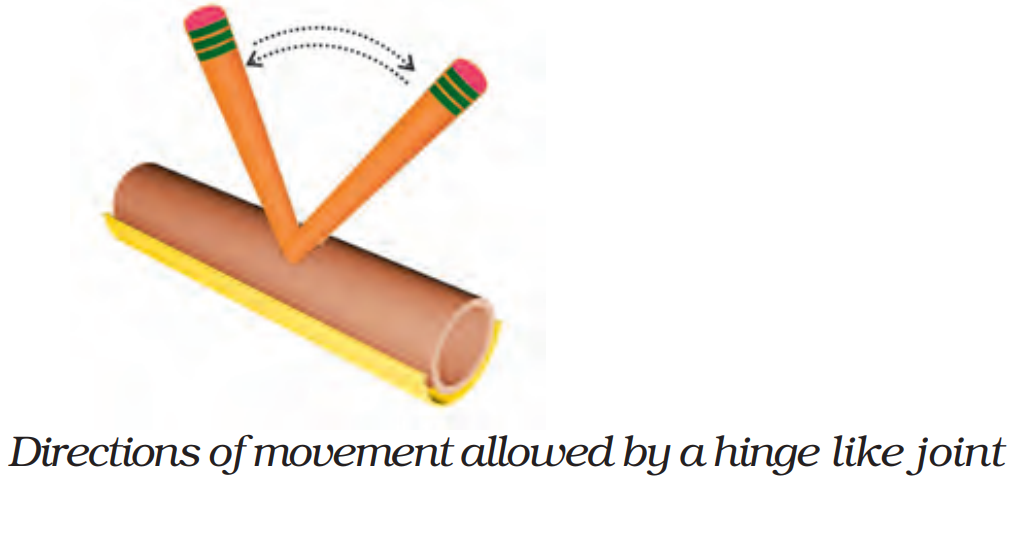
Activity.Let us look at the kind of movement allowed by a hinge. Make a cylinder with cardboard or thick chart paper, as shown in figure. Attach a small pencil to the cylinder by piercing the cylinder at the centre, as shown. Make a hollow half cylinder from cardboard such that the rolled up cylinder cati fit inside it easily. The hollow half cylinder with the rolled up cylinder sitting inside it, allows movement like a hinge. Try to move the rolled up cylinder. How does it move?

How is this movement different from what we saw with our constructed ball and socket joint?
View full solution
Given below is a list of different types of movements in animals.
Running, jumping, walking, slithering, crawling, flying, swimming, creeping.
Write the types of movements seen in each animal.
  1. Duck.
  2. Horse.
  3. Kangaroo.
  4. Snail.
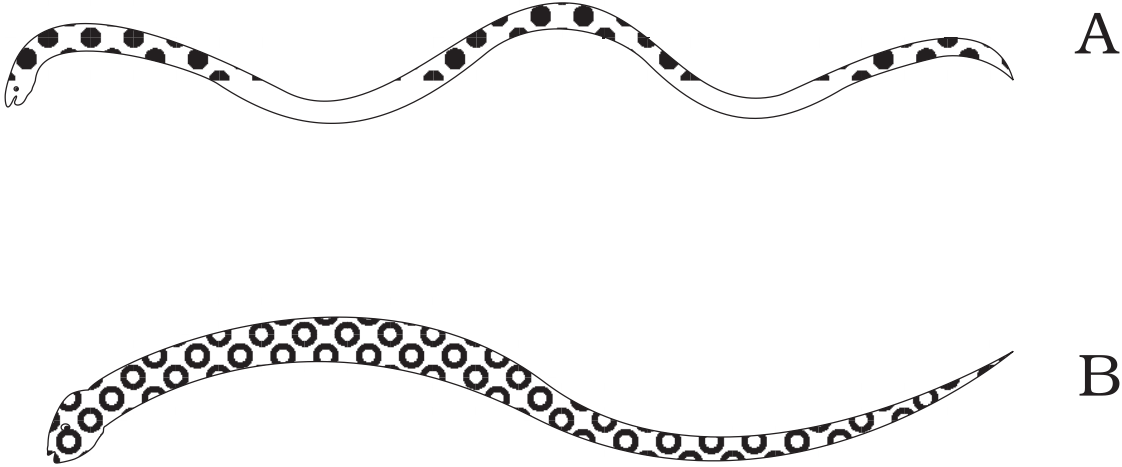
  5. Snake.
  6. Fish.
  7. Human beings.
  8. Cockroach.
View full solution
Match the name of the animals given in Column $I$ with its body parts used for movement given in Column $II.$
Serial Number
Column $I$
Serial Number
Coulmn $II$
$A.$
Humanbeing
$i.$
Fins
$B.$
Cow
$ii.$
Wings
$C.$
Snake
$iii.$
Legs
$D.$
Eagle
$iv.$
Whole Body
$E.$
Fish
$v.$
Limbs
View full solution
Match the items in Column $I$ with one or more items of Column $II$.
S.No
Column $I$
 
Column $II$
$(i)$
Upper jaw
$(i)$
Have fins on the body.
$(ii)$
Fishes
$(ii)$
Has an outer skeleton.
$(iii)$
Ribs
$(iii)$
Can fly in the air.
$(iv)$
Snail
$(iv)$
Is an immovable joint.
$(v)$
Cockroach
$(v)$
Protect the heart.
 
-
$(vi)$
Shows very slow movement.
 
-
$(vii)$
Have a streamlined body.
View full solution
The table describes the body shape of four animals.
Animal Shape of the body
Animal $P$ Large body with pillar-shaped legs
Animal $Q$ Slim body tapered at both ends
Animal $R$ Round body with large claws
Animal $S$ Star-shaped body with tiny legs
$9.$ Which animal is likely to swim the fastest in water?
$A.$ Animal $P$
$B.$ Animal $Q$
$C.$ Animal $R$
$D.$ Animal $S$
$10.$Which of these statements is true about yoga?
Circle $‘Yes’$ or $‘No’$ to mark your responses.
Is the statement true about yoga? $Yes$ or $No$
Yoga helps to make the backbone lexible. $Yes/No$
Yoga helps adults grow taller. $Yes/No$
Yoga helps in treating breathing problems. $Yes/No$
View full solution

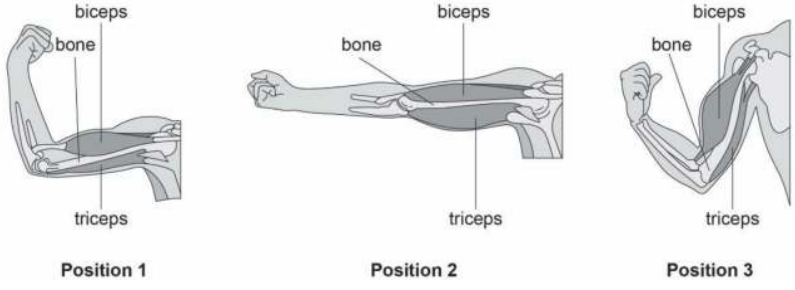
Image
$7.$ In which position are the biceps most contracted?
$8.$ Which of these statements is true?
$A.$ The largest muscles of the human body are located in the arms.
$B.$ Bending of arms is controlled by muscles only.
$C.$ The muscles located in the arm have a ixed shape.
$D.$ Bending of arms involves the contraction and relaxation of a pair of muscles.
View full solution
Cartilages are human body parts that are attached to the skeleton.
They are not as hard as bones but have a deinite shape.
Cartilages can bend easily but they break when hit badly.
$6.$ Which of these human body parts is made of cartilages?
  • A
     Nail
  • B
    Hair
  •  Nose
  • D
    Eyelid

Answer: C.

View full solution
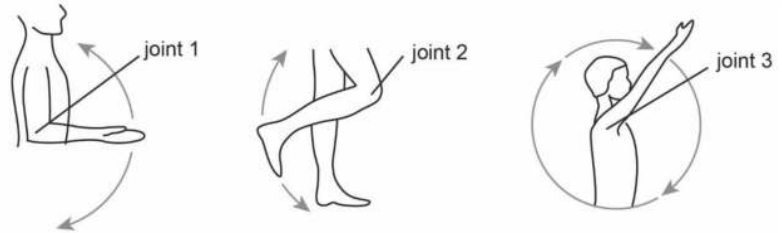
Joints are the locations in the human body where two bones are connected.
The picture shows three types of joints.
The arrows show the movement of the bones in each joint.Image
$3.$ In which joint can the pair of bones move in all directions?
$4.$ Which two joints shown in the picture are of the same type?
Mention the name for that type of joint.
$5.$ Some bone joints are ixed and the bones at those joints cannot move.
Which of these are ixed joints?
$A.$ Joints in the toe
$B.$ Joints in the neck
$C.$ Joints in the wrist
$D.$ Joints in the skull

 
View full solution
The table shows how different animals move.
Animal How does the animal move?
Frog Hop
Mouse Falk
Dragonly Fly
Earthworm Crawl
$1.$Which animal uses all of its body parts to move?
$A.$ Frog
$B.$ Mouse
$C.$ Dragonly
$D.$ Earthworm
$2.$What helps a frog hop?
$A.$ Strong leg muscles
$B.$ Short body length
$C.$ Two pairs of legs
$D.$ Absence of a tail
View full solution

Generate a Body Movement paper free

Pick question groups from the list above, set marks and difficulty, and export a branded PDF with step-by-step answer keys. First 3 chapters free — no signup.

Download App