Question types

Fibre to Fabric question types

418 questions across 9 question groups — pick any mix to generate a Science paper with step-by-step answer keys.

418
Questions
9
Question groups
5
Question types
Sample Questions

Fibre to Fabric questions

One sample from each question group in this chapter. Select any group above to see the full set with answer keys.

Lint is:
  • A
    A thread that is obtained by spinning fibres.
  • B
    An electrically operated device used for spinning.
  • The fibrous material that is left after removing seed from cotton bolls.
  • D
    The fruits of cotton plant.

Answer: C.

View full solution
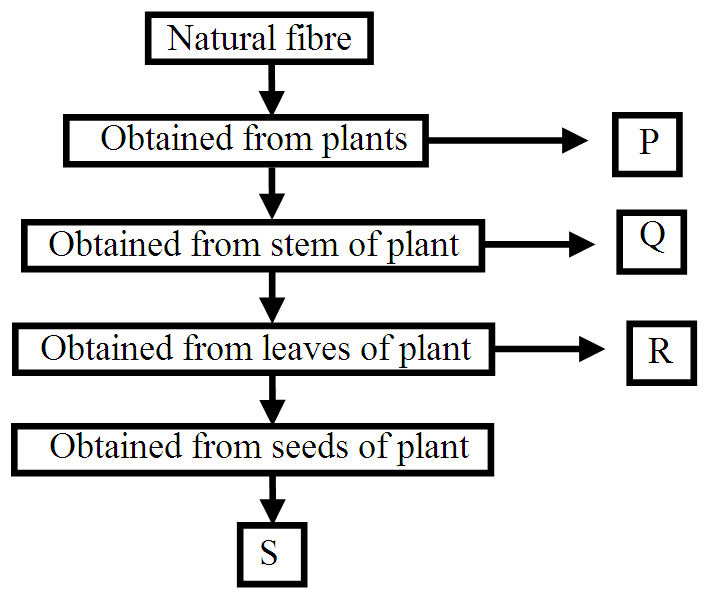
Refer to the given flow chart and select the incorrect option regarding $P, Q, R$ and $S.$
  • A
    $P$ is a protein fibre whereas $Q, R$ and $S$ are cellulosic fibres.
  • B
    Retting is involved in processing of $Q$ whereas ginning is involved in processing of $S.$
  • C
    $P$ could be wool, $Q$ could be jute, $R$ could be sisal and $S$ could be cotton.
  • Fabrics made from $P$ and $S$ are excellent winter clothing's whereas fabrics made from $Q$ and $R$ form excellent summer clothing's.

Answer: D.

View full solution
Directions: The questions in this segment consists of two statements, one labelled as? Assertion $A?$ and the other labelled as? Reason $R?$ You are to examine these two statements carefully and decide if the assertion A and mason $R$ are individually true and if so, whether the reason is a correct explanation of the assertion. Select your answers to these items using codes given below.
Assertion (A): Cotton is comfortable to wear in hot, humid weather.
Reason (R): Cotton absorbs sweat.
  • Both $A$ and $R$ are true and $R$ is the correct explanation of $A$
  • B
    Both $A$ and $R$ are true but $R$ is not the correct explanation of $A$
  • C
    $A$ is true but $R$ is false
  • D
    $A$ is false but $R$ is true

Answer: A.

View full solution
Directions: The questions in this segment consists of two statements, one labelled as "assertion $A"$ and the other labelled as "reason $R"$. You are to examine these two statements carefully and decide if the assertion $A$ and reason $R$ are individually true and if so, whether the reason is a correct explanation of the as section. Select your answers to these items using codes given below.
Assertion (A): Jute can be effective substitute of plastic bags.
Reason (R): Jute is $100\%$ bio-degradable and recyclable.
  • Both $A$ and $R$ are true and $R$ is the correct explanation of $A$
  • B
    Both $A$ and $R$ are true but $R$ is not the correct explanation of $A$
  • C
    $A$ is true but $R$ is false
  • D
    $A$ is false but $R$ is true

Answer: A.

View full solution
Directions: The questions in this segment consists of two statements, one labelled as? Assertion $A?$ and the other labelled as? Reason $R?$ You are to examine these two statements carefully and decide if the assertion $A$ and mason $R$ are individually true and if so, whether the reason is a correct explanation of the assertion. Select your answers to these items using codes given below.
Assertion (A): The fruits of the cotton plant are about the size of a lemon.
Reason (R): Cotton plants are generally grown at places having black soil and warm climate.
  • A
    Both $A$ and $R$ are true and $R$ is the correct explanation of $A$
  • Both $A$ and $R$ are true but $R$ is not the correct explanation of $A$
  • C
    $A$ is true but $R$ is false
  • D
    $A$ is false but $R$ is true

Answer: B.

View full solution
Directions: The questions in this segment consists of two statements, one labelled as "assertion $A"$ and the other labelled as "reason $R"$. You are to examine these two statements carefully and decide if the assertion $A$ and reason $R$ are individually true and if so, whether the reason is a correct explanation of the as section. Select your answers to these items using codes given below.
Assertion (A): In India jute is mainly grown in West Bengal, Bihar and Assam.
Reason (R): The jute plant is normally harvested when it is at flowering stage.
  • A
    Both $A$ and $R$ are true and $R$ is the correct explanation of $A$
  • Both $A$ and $R$ are true but $R$ is not the correct explanation of $A$
  • C
    $A$ is true but $R$ is false
  • D
    $A$ is false but $R$ is true

Answer: B.

View full solution
Match the articles given in Column $I$ with the articles of Column $II$.
 
$COLUMN\ I$
 
$COLUMN\ II$
$a$
Sweater
$i$
Cotton
$b$
Cotton bolls
$ii$
Wool
$c$
Dhoti
$iii$
Ginning
$d$
Gunny bags
$iv$
Jute
View full solution
He pours one spoon of dye on each fabric.
He then washes the fabrics with the same detergent.
Atul has four different fabrics.
The table shows what he inds after the wash.
Silk Acrylic Nylon Cotton
Light stain No stain No stain Light stain
$10.$ Which question can be answered through Atul’s activity?
  • A
     Which detergent best removes stains?
  •  Which type of fabric best retains dye?
  • C
     Which is the best dye to colour fabrics?
  • D
     Which fabric is most comfortable to wear in summers?

Answer: B.

View full solution
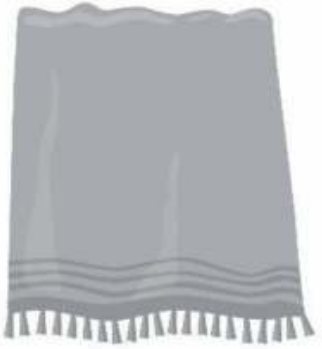
The picture shows a piece of fabric.
Image
Four friends discuss ways to ind out if the fabric is made of natural or synthetic ibres.
The table lists their suggestions.
Friend Suggestion
Tina Colour the fabric and check how well it retains colour
Amit Burn the fabric and check if it melts or burns
Sania Soak the fabric in water and check if it absorbs water
Mahesh Tear the fabric and check how strong the fabric is
$8.$Who made the correct suggestion?
  • A
    Tina
  • Amit
  • C
    Mahesh
  • D
    Sania

Answer: B.

View full solution
Rohan wants to ind out which type of fabric best absorbs water.
He soaks four different types of fabrics in water for $15$ minutes.
He places each fabric on a sieve and allows the water to drain.
He then measured the mass of the wet fabrics.
Fabric type Mass of the wet fabric
Cotton $120\ g$
Silk $100\ g$
Polyester $85\ g$
Wool $110\ g$
$6.$What extra information does Rohan need to ind out which fabric best absorbs water?
$A.$ The time each fabric took to dry completely
$B.$ The mass of each fabric before soaking in water
$C.$ The amount of water in which the fabrics were soaked
$D.$ The temperature of the water in which the fabrics were soaked
$7.$What does Rohan need to keep the same for all the four fabrics?
Circle $‘Yes’$ or $‘No’$ for each row
Should this be kept same for all the four fabrics? $Yes$ or $No$
The colour of the fabrics $Yes/No$
The size of the fabrics $Yes/No$
The thickness of the fabrics $Yes/No$
View full solution
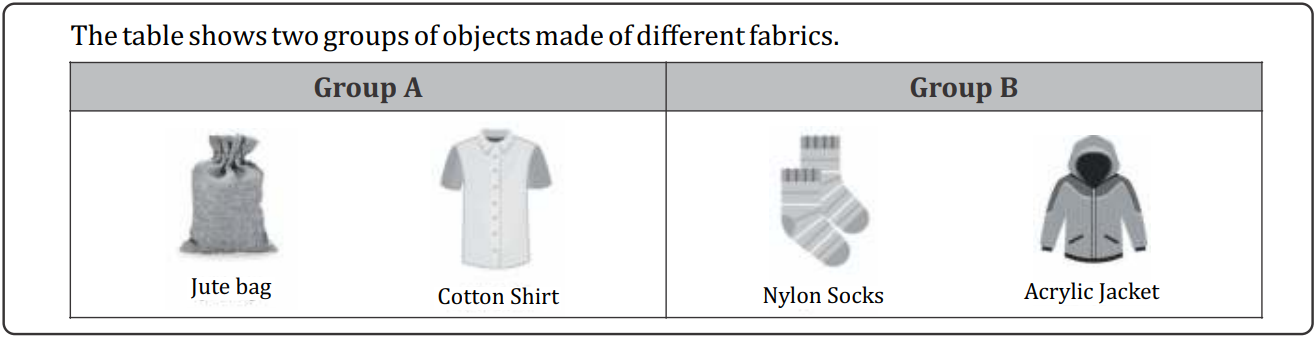
Image
$3.$Which feature was used to group the fabrics?
$A.$ Shiny/Dull
$B.$ Rough/Smooth
$C.$ Natural/Synthetic
$D.$ Animal ibre/Plant ibre
$4.$What is the correct sequence for making cotton shirt from cotton balls?
$A.$ Fabric spun into fibres $\rightarrow $Fibres woven into yarn
$B.$ Fibres spun into yarn $\rightarrow $Yarn woven into fabric
$C.$ Yarn woven into fabric $\rightarrow $ Fabric spun into fibres
$D.$ Yarn knitted into fibres$ \rightarrow $ Fibres woven into fabric
$5.$Which part of a cotton plant is used to obtain cotton balls?
$A.$ Fruit
$B.$ Stem
$D.$ Leaves
$C.$ Flowers
View full solution
Fill in the blanks to complete the life story of cotton fibre.
My parents, cotton plants were grown in _____________ soil and _____________ climate. The plants bore fruits called _____________ I, the cotton fibre was separated from seeds in the cotton bolls by the process of _____________ Other cotton fibres and myself were made into yarn by the process of _____________ The yarn was _____________ to give beautiful colours and then _____________ to get cotton fabric.
View full solution

Generate a Fibre to Fabric paper free

Pick question groups from the list above, set marks and difficulty, and export a branded PDF with step-by-step answer keys. First 3 chapters free — no signup.

Download App