- ✓North-south directions
- BEast-west directions
- CUpside down
- DAny direction by chance
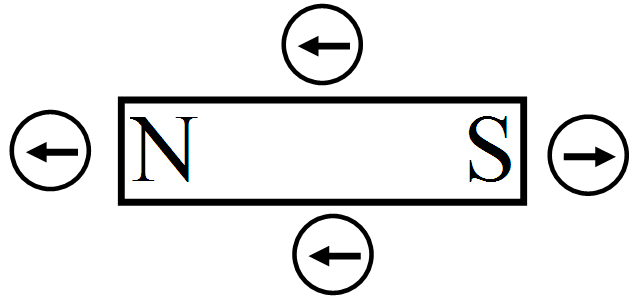
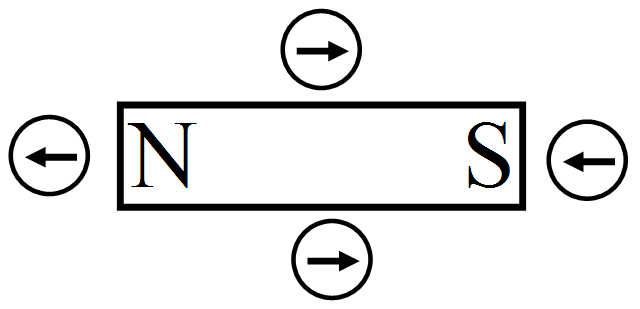
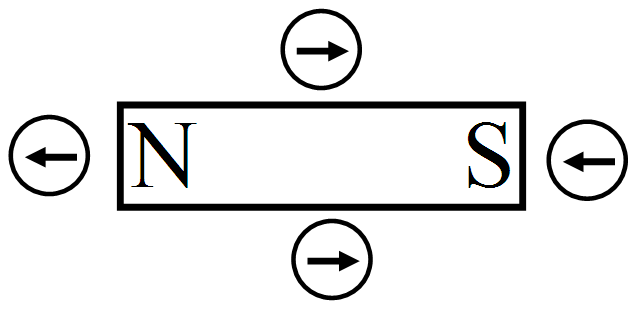
A bar magnet always rests in $N-S$ directions when suspended freely.
161 questions · auto-graded multiple-choice test.
A bar magnet always rests in $N-S$ directions when suspended freely.
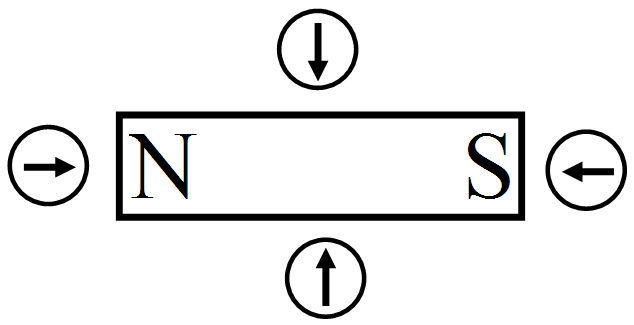


North pole (South pole) can be identified only if we have another magnet having its poles marked as North pole and South pole because only then we can see the attraction and repulsion between $N-S$ (i.e. opposite) poles and $N-N$ (i.e. similar) poles, respectively.
The needle of a compass is a magnet.
The earth too is a magnet as the needle tends to align itself to the earth's north pole.
The magnetic field of the earth can cause the needle to point in the north direction.
Magnetic field intensity is maximum at the poles of a bar magnet.
A torch does not contain a magnet in it.


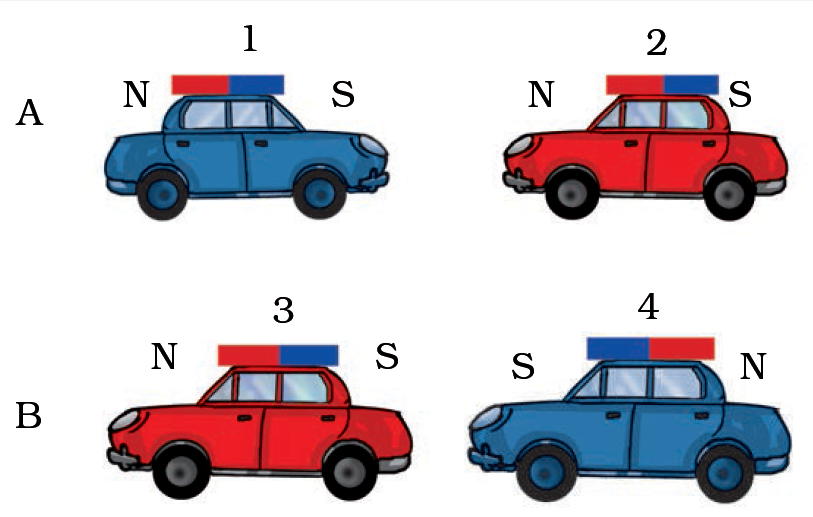
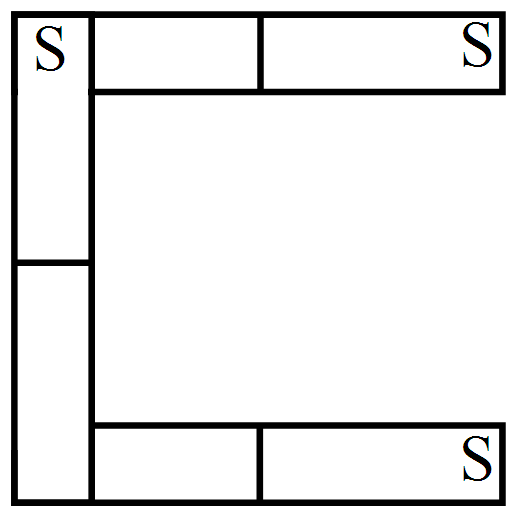
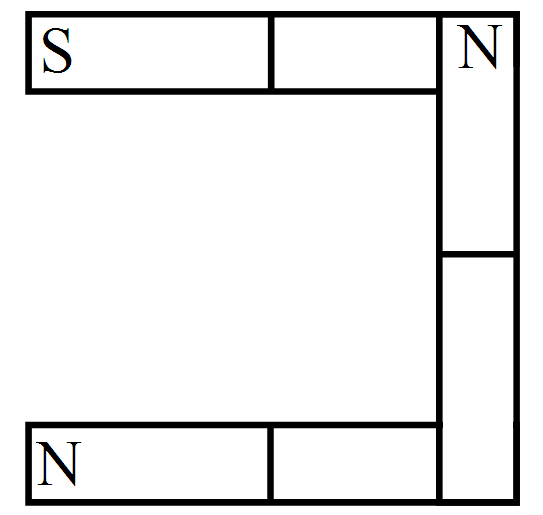
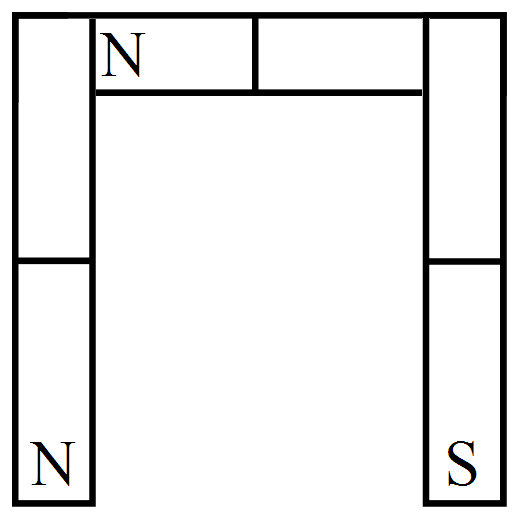
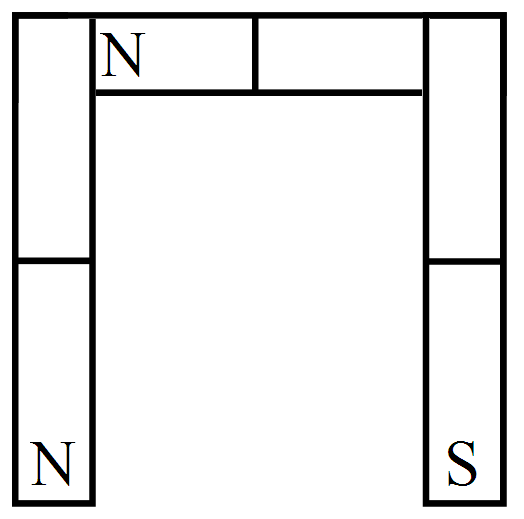
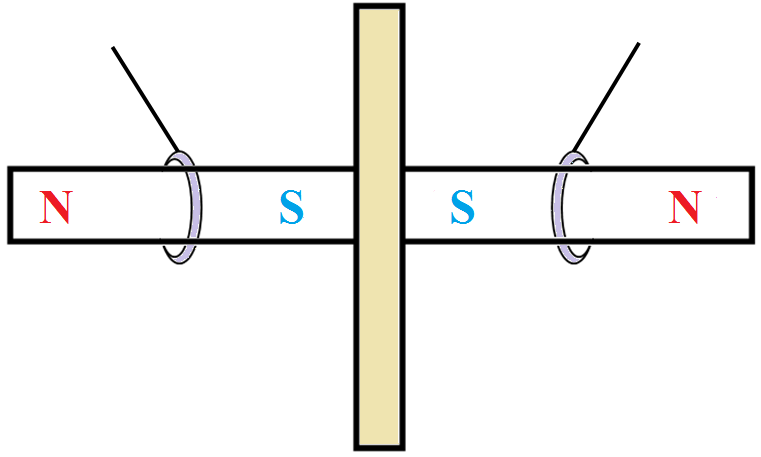
In $A,$ cars $1$ and $2$ will come closer to each other because North and South poles (i.e. opposite poles) attract each other while in $S,$ cars $3$ and $4$ will move away from each other because South poles (i.e. similar poles) repel each others.
Unlike poles attract and like poles repel each other.
There are two most important properties of magnets are:


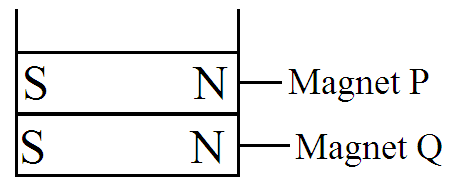
Since like poles repel each other, magnet $P$ will repel magnet $Q.$

$P$ and $S$ are the poles of the magnet and the magnetic force is strongest at these ends. So, they will attract the maximum number of pins.
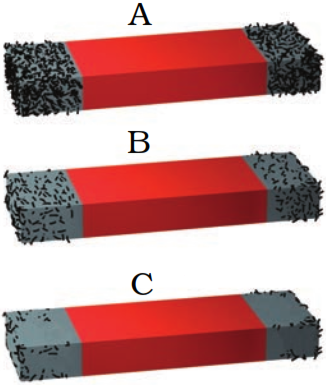
As we can see from the diagram that amount of iron filings in $A$ is greater than $B$ and $C$ and in $8,$ it is greater than $C.$ So, the strength of magnets will be according to the amount of iron filings sticking to them only.
Gold is a non-magnetic metal.
Hence, it cannot be attracted by a magnet.
Bar magnet is attracted by a horseshoe magnet.
Horseshoe magnet or bar magnet attract $U-$shaped magnet or any other kinds of magnet.
Remember, one thing that every magnet attracts other magnet.

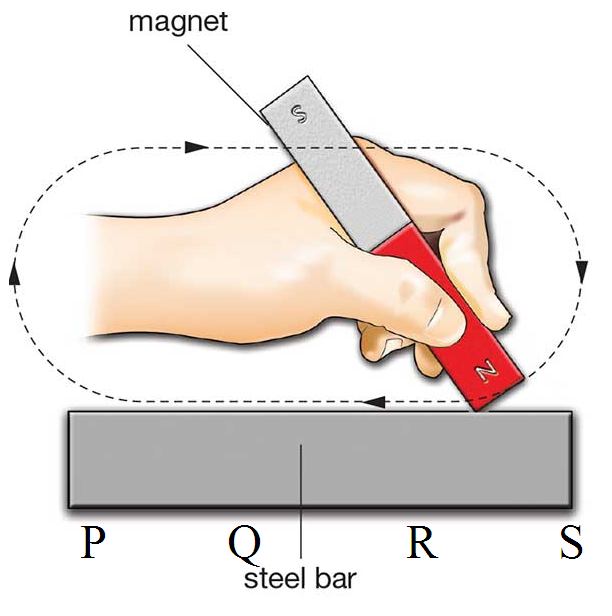
$Q$ becomes the North pole and $R,$ where the rubbing magnet is lifted becomes the South pole.
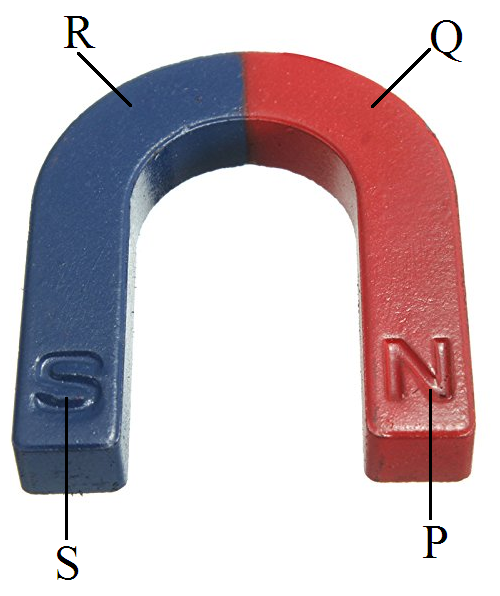
Magnet has two poles, North pole and South pole.
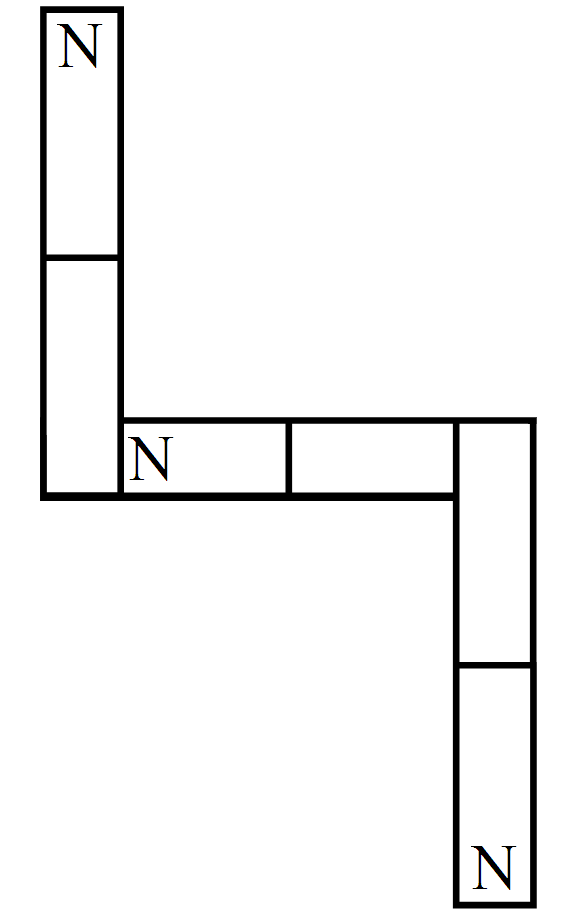
Poles $1, 3$ and $5$ are like poles, so they will not attract each other. Similarly poles $2, 4$ and $6$ are like poles. Only unlike poles are attracted by each other.
We know that there are two most important properties of magnets are:
Unlike poles attract and like poles repel each other.
A bar magnet always rests in $N-S$ directions when suspended freely.
A nickel coin and an iron nail are magnetic.
A brass screw is not magnetic in nature.
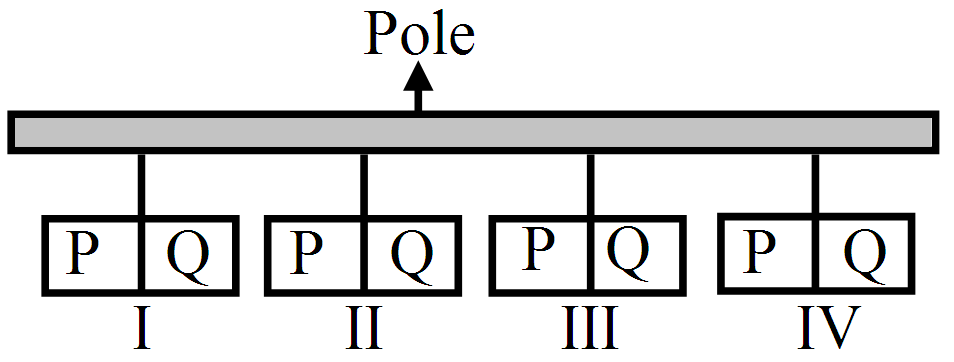
|
Bar
|
Part $P$
|
Part $Q$
|
|
$I$
|
Pushed
|
Pulled
|
|
$II$
|
Nothing happened
|
Nothing happened
|
|
$III$
|
Pulled
|
Pushed
|
|
$IV$
|
Pulled
|
Pulled
|
|
Bar $I$
|
Bar $II$
|
Bar $III$
|
Bar $IV$
|
|
Magnet
|
Stainless steel Bar
|
Magnet
|
Iron bar
|
|
Bar $I$
|
Bar $II$
|
Bar $III$
|
Bar $IV$
|
|
Magnet
|
Iron bar
|
Magnet
|
Glass bar
|
|
Bar $I$
|
Bar $II$
|
Bar $III$
|
Bar $IV$
|
|
Magnet
|
Iron bar
|
Magnet
|
|
|
Bar $I$
|
Bar $II$
|
Bar $III$
|
Bar $IV$
|
|
Magnet
|
Iron bar
|
Glass bar
|
Stainless steel Bar
|
|
Bar $I$
|
Bar $II$
|
Bar $III$
|
Bar $IV$
|
|
Magnet
|
Stainless steel Bar
|
Magnet
|
Iron bar
|
|
Bar $I$
|
Bar $II$
|
Bar $III$
|
Bar $IV$
|
|
Magnet
|
Stainless steel Bar
|
Magnet
|
Iron bar
|
|
Object
|
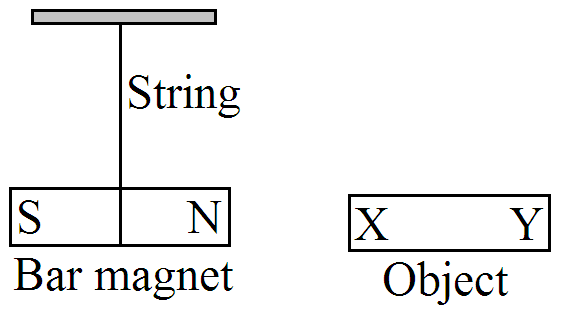
End $X$ brought near to $N$ pole
|
End $Y$ brought near to $N$ pole
|
|
$P$
|
$N$ pole repelled.
|
$N$ pole attracted.
|
|
$Q$
|
$N$ pole attracted.
|
$N$ pole repelled.
|
|
$R$
|
$N$ pole remains stationary.
|
$N$ pole remains stationary.
|

Like poles of magnets repel each other.


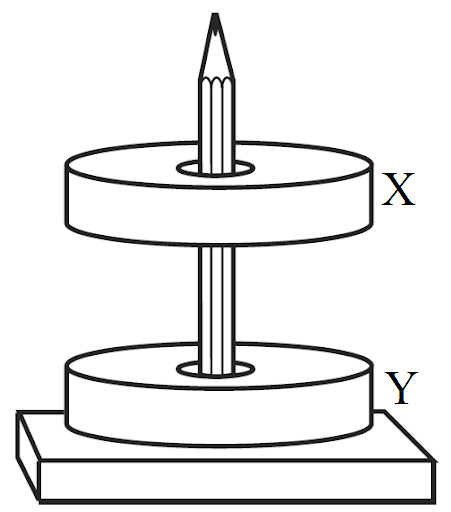
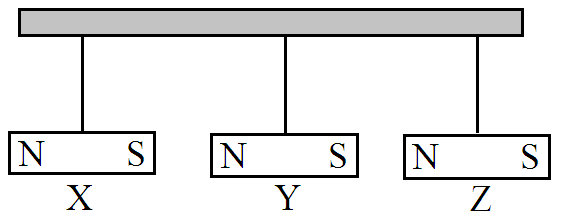
Magnet $Y$ will get attracted towards magnet $X$ and repelled by magnet $-Z.$