Question types

Fun with Magnets question types

332 questions across 9 question groups — pick any mix to generate a Science paper with step-by-step answer keys.

332
Questions
9
Question groups
5
Question types
Sample Questions

Fun with Magnets questions

One sample from each question group in this chapter. Select any group above to see the full set with answer keys.

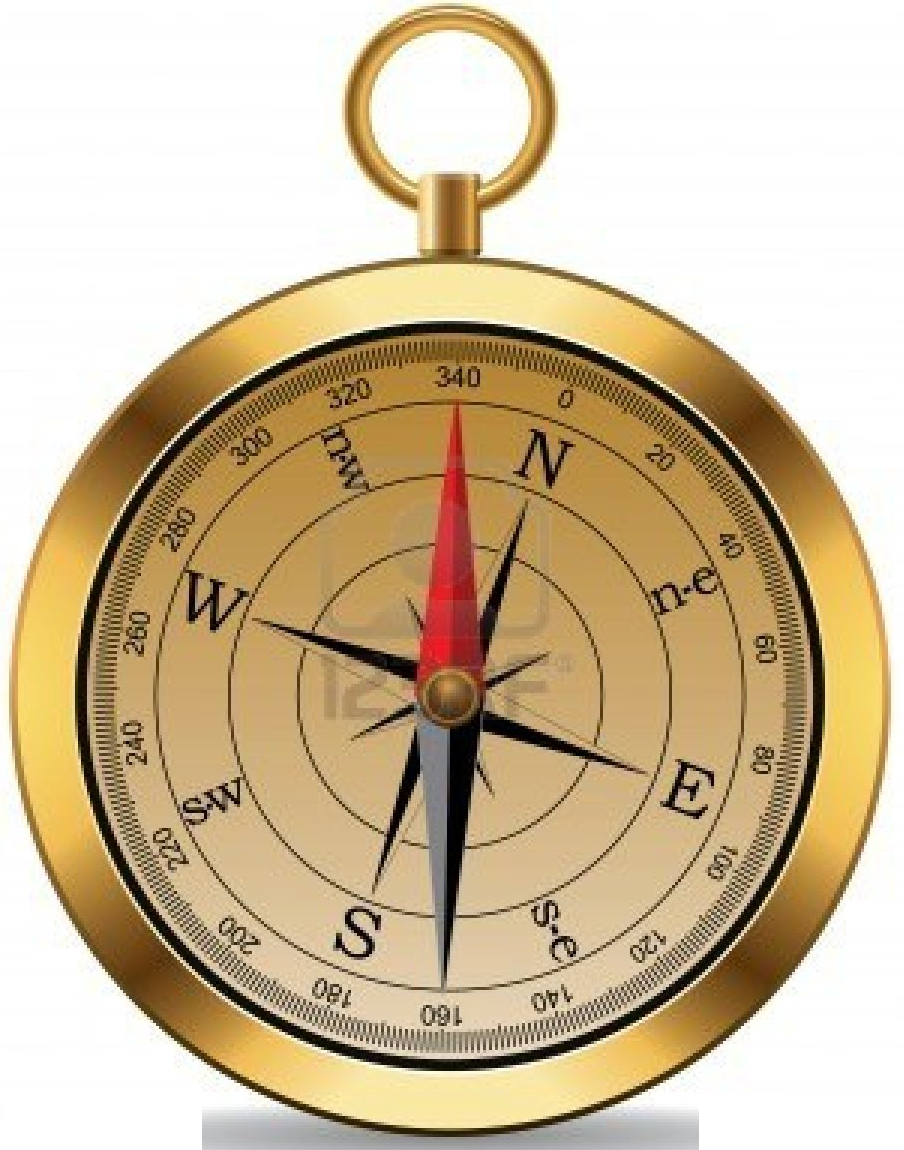
Arpita is standing in the middle of a cross road with a compass. The red portion of the compass needle is pointing towards her. She wants to go towards east then she should turn:
  • A
    Right and then go straight.
  • Left and then go straight.
  • C
    Right and then go left.
  • D
    Left and then go right.

Answer: B.

View full solution
A How is a compass useful to us?
  • A
    In finding the altitude of a place.
  • B
    In finding only the north of a place.
  • In finding all the directions of a place.
  • D
    In making artificial magnets.

Answer: C.

View full solution
Nikhilesh has a small piece of metal and a thread. He wants to find whether the metal is a magnet or not. Which of these things would he need?
  • A
    A piece of magnetic substance.
  • B
    A magnet or a compass.
  • C
    A piece of non-magnetic substance.
  • He does not require anything more.

Answer: D.

View full solution
Assertion – the process of making magnet from iron are artificial method Reason – There are different shapes of magnet like bar magnet, horsehoe magnet cylindrical or ball ended magnet. 
  • Assertion and reason both are correct statement and reason is correct explanation for assertion. 
  • B
    Assertion and reason both are correct statement and reason is not correct explanation for assertion. 
  • C
    Assertion is correct statement but reason is wrong statement. 
  • D
    Assertion is wrong statement but reason is correct statement.

Answer: A.

View full solution
Assertion – Opposite pole of two magnets attract each other where as similar pole repel one another. Reason – A freely suspended magnet always aligns in n-s direction.
  • A
    Assertion and reason both are correct statement and reason is correct explanation for assertion. 
  • Assertion and reason both are correct statement and reason is not correct explanation for assertion. 
  • C
    Assertion is correct statement but reason is wrong statement. 
  • D
    Assertion is wrong statement but reason is correct statement.

Answer: B.

View full solution
Assertion – There are two poles of bar magnet only. Reason – The magnet have north and south pole.
  • A
    Assertion and reason both are correct statement and reason is correct explanation for assertion.
  • B
    Assertion and reason both are correct statement and reason is not correct explanation for assertion.
  • C
    Assertion is correct statement but reason is wrong statement.
  • Assertion is wrong statement but reason is correct statement.

Answer: D.

View full solution
Assertion – Magnet attracts materials like iron, nickel, cobalt are called magnetic materials. Reason – Materials that are not attracted to words magnet are called
  • A
    Assertion and reason both are correct statement and reason is correct explanation for assertion.
  • Assertion and reason both are correct statement and reason is not correct explanation for assertion.
  • C
    Assertion is correct statement but reason is wrong statement.
  • D
    Assertion is wrong statement but reason is correct statement.

Answer: B.

View full solution
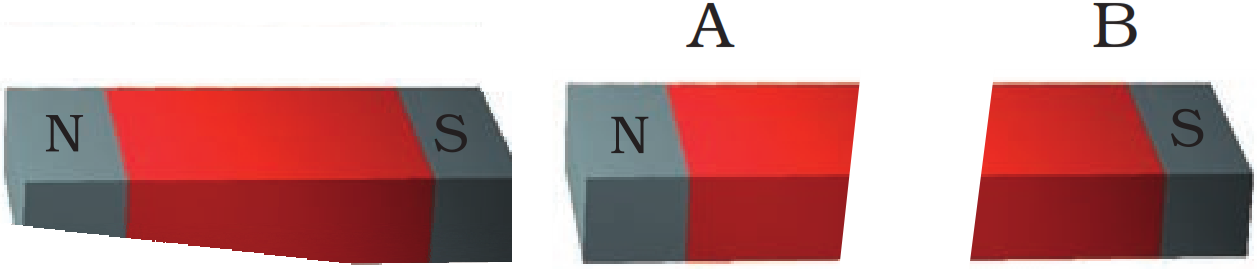
A bar magnet is cut into two pieces $A$ and $B$, from the middle, as shown in Fig.

Will the two pieces act as individual magnets? Mark the poles of these two pieces. Suggest an activity to verify your answer.
View full solution
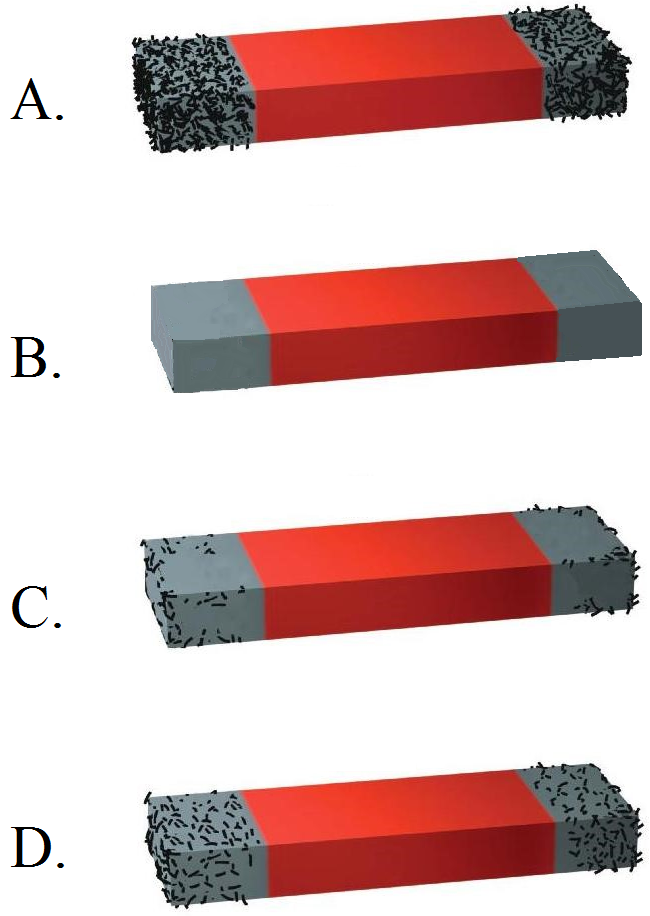
Four identical iron bars were dipped in a heap of iron filings one by one. The figures given below show the amount of iron filings sticking to each of them.
  1. Which of the iron bars is likely to be the strongest magnet?
  2. Which of the iron bars is not a magnet? Justify your answer.
View full solution
Boojho kept a magnet close to an ordinary iron bar. He observed that the iron bar attracts a pin as shown in Fig.

What inference could he draw from this observation? Explain.
View full solution
Match Column $I$ with Column $II$ (One option of $A$ can match with more than one option of $B$)
  $COLUMN\ I$   $COLUMN\ II$
$(a)$ Magnet attracts $(i)$ resis along a particular direction
$(b)$ Magnet can be repelled $(ii)$ iron
$(c)$ Magnet if suspended freely $(iii)$ by another magnet
$(d)$ Poles of the magnet can be identified by $(iv)$ iron filing
View full solution


Fig. shows a magnetic campass. What will happen to the position of its needle if you bring a bar magnet near it? Draw a diagram to show the effect on the needle on bringing the bar magnet near it. Also draw the diagram to show the effect when the other end of the bar magnet is brought near it.
View full solution
Column $I$ shows different positions in which one pole of a magnet is placed near that of the other. Column $II$ indicates the resulting action between them for each situation. Fill in the blanks.
Column $I$
Column $II$
$N-N$
_________
_________$-N$
noitcarttA
$N-S$
_________
$S-$_________
noitslupeR
View full solution

Generate a Fun with Magnets paper free

Pick question groups from the list above, set marks and difficulty, and export a branded PDF with step-by-step answer keys. First 3 chapters free — no signup.

Download App