Question types

Garbage In, Garbage Out question types

310 questions across 9 question groups — pick any mix to generate a Science paper with step-by-step answer keys.

310
Questions
9
Question groups
5
Question types
Sample Questions

Garbage In, Garbage Out questions

One sample from each question group in this chapter. Select any group above to see the full set with answer keys.

Which of the set of items not good for making compost?
  • A
    Plastic paper, tin foil, wrappers
  • B
    Broken plastic toys, polythene bags, pieces of clothes
  • Egg shells, vegetable and fruit peels and tea leaves
  • D
    Aluminium wrappers, plastic bags and dry leaves

Answer: C.

View full solution
DIRECTIONS: The questions in this segment consists of two statements, one labelled as? Assertion $A?$ and the other labelled as? Reason $R?$. You are to examine these two statements carefully and decide if the assertion $A$ and reason $R$ are individually true and if so, whether the reason is a correct explanation of the assertion. Select your answers to these items using codes given below.
Assertion (A): We develop some compost making areas near the landfill.
Reason (R): It is done to utilize some of the useful components of garbage.
  • Both $A$ and $R$ are true and $R$ is the correct explanation of $A$
  • B
    Both $A$ and $R$ are true but $R$ is not the correct explanation of $A$
  • C
    $A$ is true but $R$ is false
  • D
    $A$ is false but $R$ is true

Answer: A.

View full solution
DIRECTIONS: The questions in this segment consists of two statements, one labelled as? Assertion $A?$ and the other labelled as? Reason $R?$. You are to examine these two statements carefully and decide if the assertion $A$ and reason $R$ are individually true and if so, whether the reason is a correct explanation of the assertion. Select your answers to these items using codes given below.
Assertion (A): After a landfill site is completely filled with garbage it is converted into a park.
Reason (R): At a landfill site that has been converted into a park, no building is allowed to be constructed for next 50 years.
  • A
    Both $A$ and $R$ are true and $R$ is the correct explanation of $A$
  • B
    Both $A$ and $R$ are true but $R$ is not the correct explanation of $A$
  • $A$ is true but $R$ is false
  • D
    $A$ is false but $R$ is true

Answer: C.

View full solution
DIRECTIONS: The questions in this segment consists of two statements, one labelled as? Assertion $A?$ and the other labelled as? Reason $R?$. You are to examine these two statements carefully and decide if the assertion $A$ and reason $R$ are individually true and if so, whether the reason is a correct explanation of the assertion. Select your answers to these items using codes given below.
Assertion (A): You are advised never to bum the dry leaves.
Reason (R): They produce harmful gases when burnt.
  • Both $A$ and $R$ are true and $R$ is the correct explanation of $A$
  • B
    Both $A$ and $R$ are true but $R$ is not the correct explanation of $A$
  • C
    $A$ is true but $R$ is false
  • D
    $A$ is false but $R$ is true

Answer: A.

View full solution
DIRECTIONS: The questions in this segment consists of two statements, one labelled as? Assertion $A?$ and the other labelled as? Reason $R?$. You are to examine these two statements carefully and decide if the assertion $A$ and reason $R$ are individually true and if so, whether the reason is a correct explanation of the assertion. Select your answers to these items using codes given below.
Assertion (A): Garbage contains plastics, metal containers and other wrapping materials.
Reason (R): Useful and non-useful components are separated out from the garbage at landfill site after spreading the garbage over landfill site.
  • A
    Both $A$ and $R$ are true and $R$ is the correct explanation of $A$
  • B
    Both $A$ and $R$ are true but $R$ is not the correct explanation of $A$
  • $A$ is true but $R$ is false
  • D
    $A$ is false but $R$ is true

Answer: C.

View full solution
DIRECTIONS: The questions in this segment consists of two statements, one labelled as? Assertion $A?$ and the other labelled as? Reason $R?$. You are to examine these two statements carefully and decide if the assertion $A$ and reason $R$ are individually true and if so, whether the reason is a correct explanation of the assertion. Select your answers to these items using codes given below.
Assertion (A): Vermicomposting is done with the help of blue worms.
Reason (R): We can recycle paper to get useful products.
  • A
    Both $A$ and $R$ are true and $R$ is the correct explanation of $A$
  • B
    Both $A$ and $R$ are true but $R$ is not the correct explanation of $A$
  • C
    $A$ is true but $R$ is false
  • $A$ is false but $R$ is true

Answer: D.

View full solution
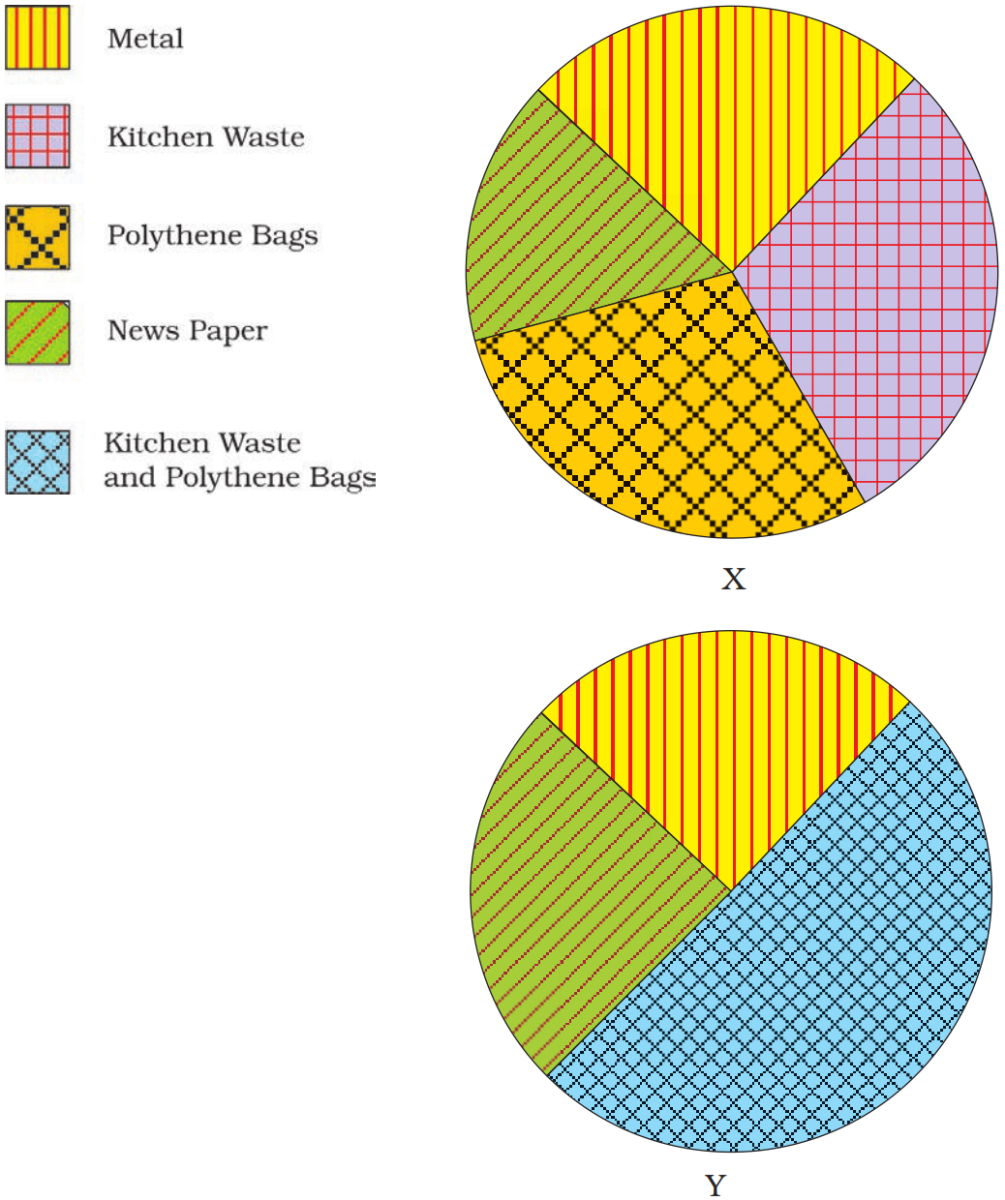
The pie charts $A$ and $B$ shown in Fig. are based on waste segregation method adopted by two families $X$ and $Y$ respectively.

Which of the two families $X$ or $Y$ do you think is more environmentally conscious and why?
View full solution
Beera, a farmer would clear his field everyday, and burn dry leaves fallen on the ground. After sometime he found that those living in huts near his field were suffering from cough and breathing problems.
  1. Can you explain why?
  2. Also suggest an environment friendly way to dispose the dry leaves.
View full solution
Beautiful hand crafted articles like boxes and toys are made of paper pulp in our country. Can you explain how paper pulp which is made from paper can be used to make hard boxes and other articles?
View full solution
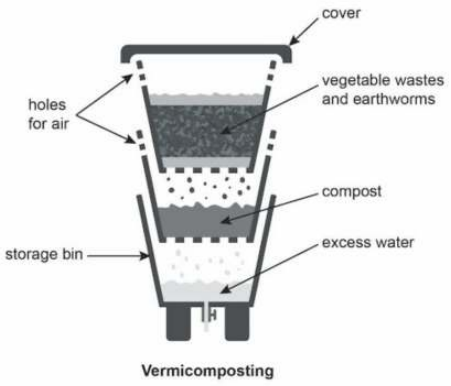
Vermicomposting is a process of recycling degradable waste.
Earthworms breakdown the waste into compost that can be use as manure.
The diagram shows the details of the process.
Image
$8.$ Which of these statements is true about vermicomposting?
$A.$ It breaks down waste naturally.
$B.$ It produces harmful substances.
$C.$ It requires the presence of light.
$D.$ It takes place in the absence of oxygen
$9.$ Why does vermicomposting require moist condition and moderate temperatures?
__________________________________________________________________________________________________________________________________________________________
$10.$ Which of these is true for the excess water obtained from vermicomposting?
$A.$ It contains earthworms.
$B.$ It is rich in mineral nutrients.
$C.$ It contains vegetable waste.
$D.$ It does not contain microorganisms.
View full solution
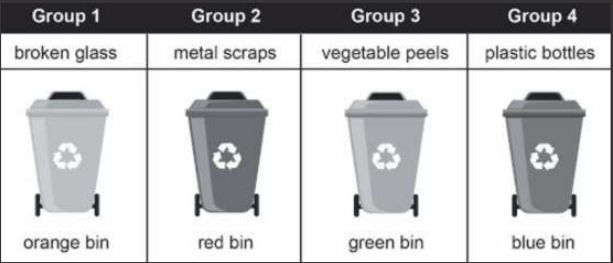
The table shows different bins used to collect different types of wastes
.Image
$1.$ The waste from which bin is suitable for composting?
$A.$ Orange
$B.$ Red
$C.$ Green
$D.$ Blue
$2.$ A children’s park has only green and blue bins.
In which bin should empty juice cans be dumped? Explain your answer.
$3.$ Why should we recycle materials?
Circle $‘Yes’ $ or $‘No’$ for the correct response.
Why do we recycle materials? $Yes$ or $No$
To save natural resources $Yes/No$
To make products stronger $Yes/No$
To create beautiful products $Yes/No$
$4.$ Why is burning of crop residue harmful?
$5.$ WWhich of these is an example of reducing waste at home?
Circle $‘Yes’$ or $‘No’ $ for the correct response.
Will this reduce waste? $Yes$ or $No$
Buying use-and-throw pens $Yes/No$
Using old cloth to make grocery bags $Yes/No$
Reusing cookie jars to store sugar $Yes/No$
$6.$ Why should plastic waste not be dumped in landills?
$A.$ It has a low melting point.
$B.$ It does not degrade over time.
$C.$ It reacts with some vegetable wastes.
$D.$ It produces harmful gases on burning.
$7.$ Should plastic waste be dumped in water bodies? Explain your answer.
View full solution

Generate a Garbage In, Garbage Out paper free

Pick question groups from the list above, set marks and difficulty, and export a branded PDF with step-by-step answer keys. First 3 chapters free — no signup.

Download App