Question 13 Marks
What must be added to $x^4+2 x^3-2 x^2+x-1$, so that the resulting polynomial is exactly divisible by $x^2+2 x-3$?
Answer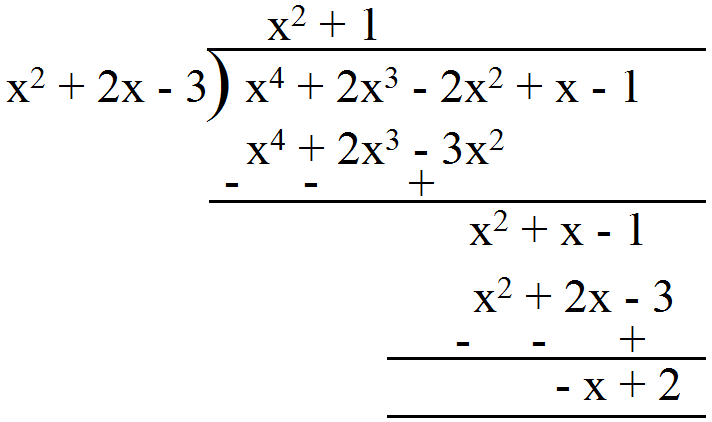
Thus, $(x - 2)$ should be added to $\left(x^4+2 x^3-2 x^2+x-1\right)$
to make the resulting polynomial exactly divisible by $\left(x^2+2 x-3\right)$ View full question & answer→Question 23 Marks
Divide $3 y^4-3 y^3-4 y^2-4 y$ by $y^2-2 y$
View full question & answer→Question 33 Marks
Find whether, or not the first polynomial is a factor of the second: $\frac{3\text{z}^2-13\text{z}+4}{4-\text{z}}$
Answer$\frac{3\text{z}^2-13\text{z}+4}{4-\text{z}}$
$=\frac{3\text{z}(\text{z}-4)-1(\text{z}-4)}{4-\text{z}}$
$=\frac{(\text{z}-4)(3\text{z}-1)}{4-\text{z}}$
$=\frac{(4-\text{z})(1-3\text{z})}{4-\text{z}}$
$=1-3\text{z}$
Therefore, remainder $= 0$
$(4 - z)$ is a factor of the factor of $3z^2 - 13z + 4$
View full question & answer→Question 43 Marks
Divide $14 x^3-5 x^2+9 x-1$ by $2 x-1$and find the quotient and remainder.
Answer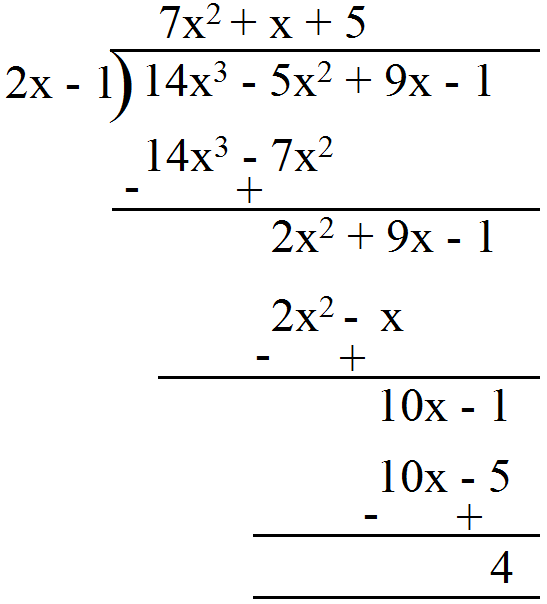
Quotient = $7 x^2+x+5$
Remainder $= 4$ View full question & answer→Question 53 Marks
Divide $-\text{x}^6+2\text{x}^4+4\text{x}^3+2\text{x}^2\text{ by }\sqrt{2}\text{x}^2.$
Answer$\frac{-\text{x}^6+2\text{x}^4+4\text{x}^3+2\text{x}^2}{\sqrt{2}\text{x}^2}$
$=\frac{-\text{x}^6}{\sqrt{2}\text{x}^2}+\frac{2\text{x}^4}{\sqrt{2}\text{x}^2}+\frac{4\text{x}^3}{\sqrt{2}\text{x}^2}+\frac{2\text{x}^2}{\sqrt{2}\text{x}^2}$
$=\frac{-1}{\sqrt{2}}\text{x}^{(6-2)}+\sqrt{2}\text{x}^{(4-2)}+2\sqrt{2}\text{x}^{(3-2)}+\sqrt{2}\text{x}^{(2-2)}$
$=\frac{-1}{\sqrt{2}}\text{x}^4+\sqrt{2}\text{x}^2+2\sqrt{2}\text{x}+\sqrt{2}$
View full question & answer→Question 63 Marks
Divide
$2 y^5+10 y^4+6 y^3+y^2+y^2+5 y+3$ by $2 y^3+1$
View full question & answer→Question 73 Marks
Divide $\left(a^2+2 a b+b^2\right)-\left(a^2+2 a c+c^2\right)$ by $(2 a+b+c)$
Answer$\frac{\big(\text{a}^2+2\text{ab}+\text{b}^2\big)-\big(\text{a}^2+2\text{ac}+\text{c}^2\big)}{2\text{a}+\text{b}+\text{c}}$
$=\frac{(\text{a}+\text{b}^2-(\text{a}+\text{c})^2}{2\text{a}+\text{b}+\text{c}}$
$=\frac{(\text{a}+\text{b}+\text{a}+\text{c})(\text{a}+\text{b}-\text{a}-\text{c})}{2\text{a}+\text{b}+\text{c}}$
$=\frac{(2\text{a}+\text{b}+\text{c})(\text{b}-\text{c})}{2\text{a}+\text{b}+\text{c}}=\text{b}-\text{c}$
View full question & answer→Question 83 Marks
Divide $6 x^3-x^2-10 x-3$ by $2 x-3$ and find the quotient and remainder.
Answer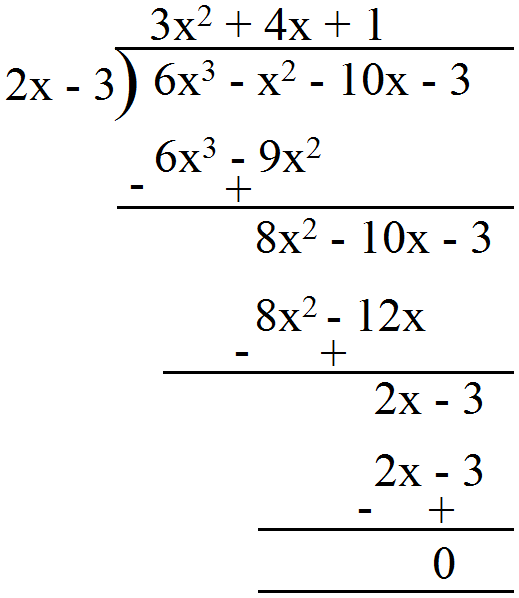
Quotient = $3 x^2+4 x+1$
Remainder $= 0$ View full question & answer→Question 93 Marks
Using division of polynomials, state whether.
$2 y-5$ is a factor $4 y^4-10 y^2+30 y-15$
Answer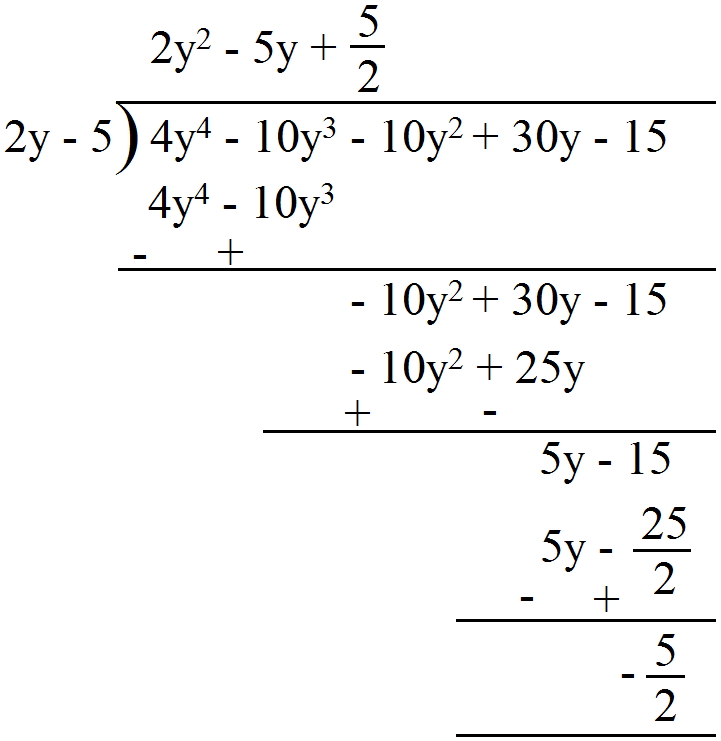
$\because$ The ramainder in room zero. $2 y-5$ in not a factor of $4 y^4-10 y^3-10 y^2-30 y-15$. View full question & answer→Question 103 Marks
Divide $30 x^4+11 x^3-82 x^2-12 x+48$ by $3 x^2+2 x-4$ and find the quotient and remainder.
Answer
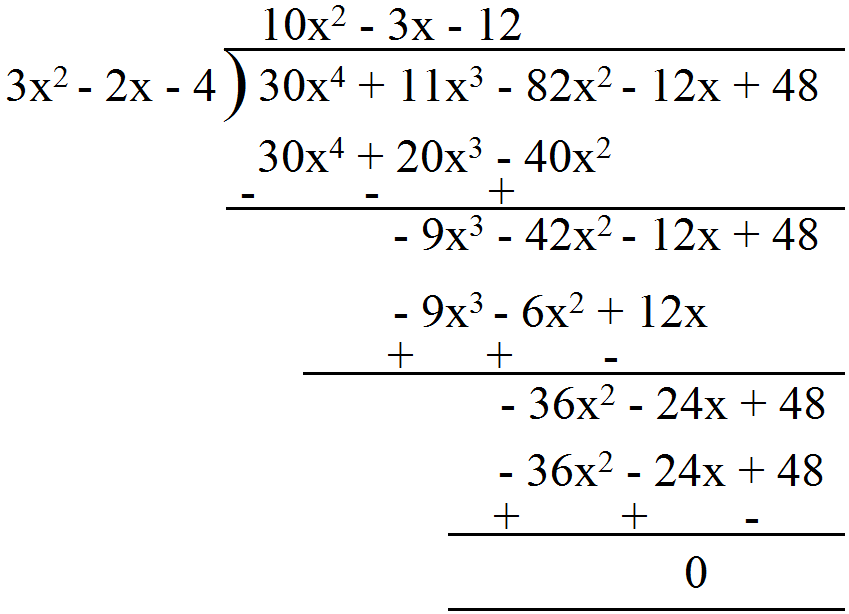
Quotient = $10 x^2-3 x-12$
Remainder $= 0$ View full question & answer→Question 113 Marks
Divide the first polynomial by the second polynomial in the following. Also write the quotient and remainder: $\frac{10\text{x}^2-7\text{x}+8}{5\text{x}-3}$
Answer$\frac{10\text{x}^2-7\text{x}+8}{5\text{x}-3}$ $\frac{2\text{x}(5\text{x}-3)-\frac{1}{5}(5\text{x}-3)+\frac{47}{5}}{5\text{x}-3}$ $=\frac{(5\text{x}-3)\Big(2\text{x}-\frac{1}{5}\Big)(5\text{x}-3)+\frac{47}{5}}{5\text{x}-3}$ $=\Big(2\text{x}-\frac{1}{5}\Big)+\frac{\frac{47}{5}}{5\text{x}-3}$ Therefore, quotient $=\Big(2\text{x}-\frac{1}{5} \Big)$ and remainder $=\frac{47}{5}$
View full question & answer→Question 123 Marks
Find whether, or not the first polynomial is a factor of the second: $\frac{4\text{x}^4+12\text{x}^2+15}{4\text{x}^2-5}$
Answer$\frac{4\text{x}^4+12\text{x}^2+15}{4\text{x}^2-5}$
$=\frac{\text{x}^2\big(4\text{x}^2-5\big)+3\big(4\text{x}^2-5\big)+30}{4\text{x}^2-5}$
$=\Big(\text{x}^2+3\Big)+\frac{30}{4\text{x}^2-5}$
Therefore, $\left(4 x^2-5\right)$ is not a factor of $4 x^4+7 x^2+15$
View full question & answer→Question 133 Marks
Divide $\Big(\frac{1}{4}\text{x}^2-\frac{1}{2}\text{x}-12\Big)$ by $\Big(\frac{1}{2}\text{x}-4\Big)$
Answer$\frac{\frac{1}{4}\text{x}^2-\frac{1}{2}\text{x}-12}{\frac{1}{2}\text{x}-4}$
$=\frac{\frac{1}{2}\text{x}\Big(\frac{1}{2}\text{x}-4\Big)+3}{\frac{1}{2}\text{x}-4}$
$=\frac{\Big(\frac{1}{2}\text{x}+3\Big)\Big(\frac{1}{2}\text{x}-4\Big)}{\frac{1}{2}\text{x}-4}=\Big(\frac{1}{2}\text{x}+3\Big)$
View full question & answer→Question 143 Marks
Divide $acx^2+ (bc + ad) x + bd$ by $(ax + b)$
Answer$\frac{\text{acx}^2+(\text{bc}+\text{ad})\text{x}+\text{bd}}{\text{ax}+\text{b}}$
$=\frac{\text{acx}^2+\text{bcx}+\text{adx}+\text{bd}}{\text{ax}+\text{b}}$
$=\frac{\text{cx}(\text{ax}+\text{b})+\text{d}(\text{ax}+\text{b})}{\text{ax}+\text{b}}$
$=\frac{(\text{ax}+\text{b})(\text{cx}+\text{d)}}{\text{ax}+\text{b}}=\text{cx}+\text{d}$
View full question & answer→Question 153 Marks
Verify the division algorithm i.e., Dividend $=$ Divisor $\times $ Quotient $+$ Remainder, in the following. Also write the quotient and remainder.
Dividend: $14 x^2+13 x-15$
Divisor: $7x - 4$
Answer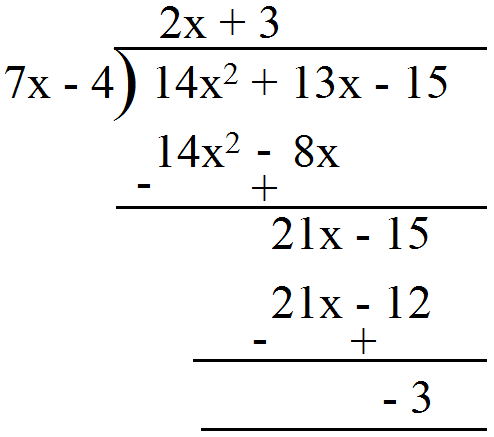
Quotient $= 2x + 3$
Remainder $= -3$
Divisor $= 7x - 4$
Divisor $\times $ Quotient $+$ Remainder $= (7x - 4)(2x + 3) - 3$
$14 x^2+21 x-8 x-12-3$
$=14 x^2+13 x-15$
= Dividend
Thus,
Divisor $\times $ Quotient + Remainder = Dividend
Hence verified. View full question & answer→Question 163 Marks
Using division of polynomials, state whether.
$3 y^2+5$ is a factor of $6 y^5+15 y^4+16 y^3+10 y-35$
Answer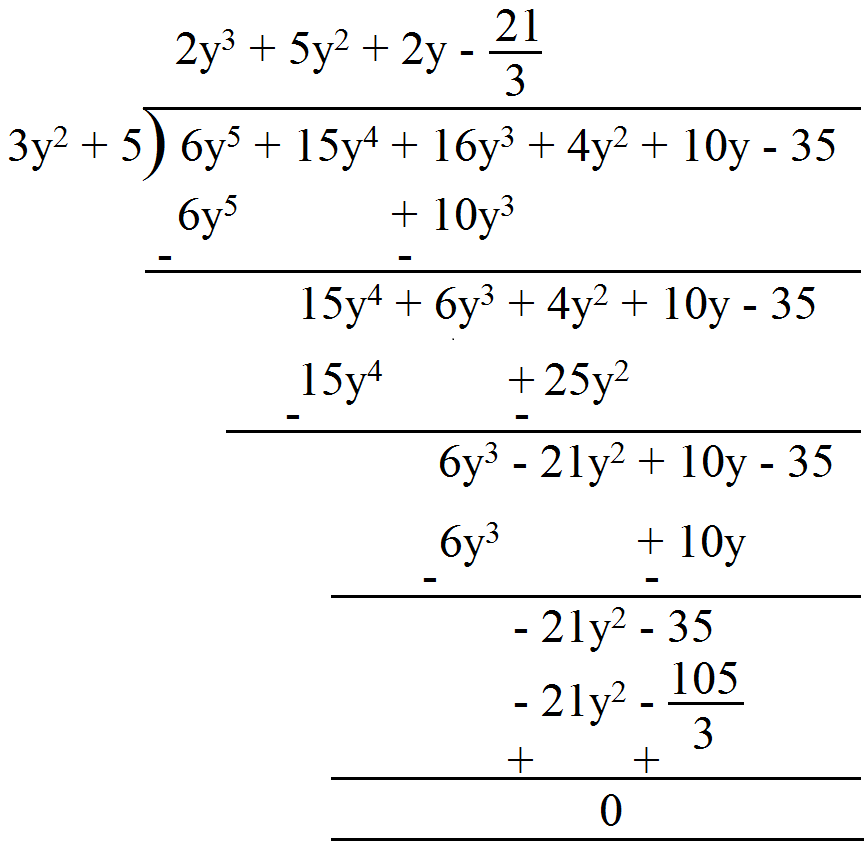
Remainder is zero. Therefore, $3 y^2+5$ is a factor of $6 y^5+15 y^4+16 y^3+4 y^2+10 y-35$. View full question & answer→Question 173 Marks
Divide $9 x^4-4 x^2+4$ by $3 x^2-4 x+2$ and find the quotient and remainder.
Answer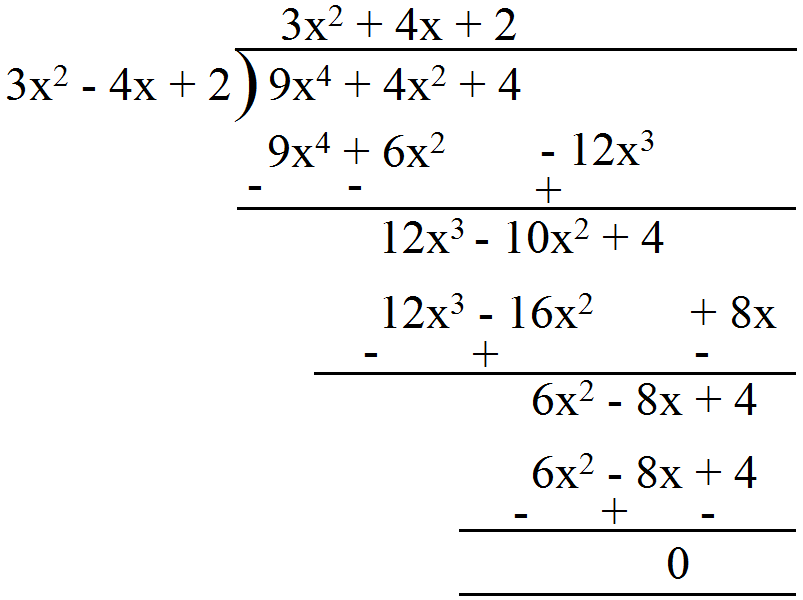
$\therefore$ Quotient = $3 x^2+4 x+2$ and remainder $= 0.$ View full question & answer→Question 183 Marks
Divide $x^4-2 x^3+2 x^2+2 x^2+x+4$ by $x^2+x+1$.
View full question & answer→Question 193 Marks
Divide $\sqrt{3}\text{a}^4+2\sqrt{3}\text{a}^3+3\text{a}^2-6\text{a}\text{ by } 3\text{a}.$
Answer$\frac{\sqrt{3}\text{a}^4+2\sqrt{3}\text{a}^3+3\text{a}^2-6\text{a}}{3\text{a}}$
$=\frac{\sqrt{3}\text{a}^4}{3\text{a}}+\frac{2\sqrt{3}\text{a}^2}{3\text{a}}+\frac{3\text{a}^2}{3\text{a}}-\frac{6\text{a}}{3\text{a}}$
$=\frac{1}{\sqrt{3}}\text{a}^{(4-1)}+\frac{2}{\sqrt{3}}\text{a}^{(3-1)}+\text{a}^{(2-1)}-2$
$=\frac{1}{\sqrt{3}}\text{a}^3+\frac{2}{\sqrt{3}}\text{a}^2+\text{a}-2$
View full question & answer→Question 203 Marks
Find the value of a, if $x + 2$ is a factor of $4 x^4+2 x^3-3 x^2+8 x+5 a$.
AnswerWe have to find the value of a if $(x+2)$ is a factor of $\left(4 x^4+2 x^3-3 x^2+8 x+5 a\right)$.
Substituting $x=-2$ in $4 x^4+2 x^3-3 x^2+8 x+5 a$, we get,
$4(-2)^4+2(-2)^3-3(-2)^2+8(-2)+5 a=0$
Or, $64-16-12-16+5 a=0$
Or, $5 a=-20$
Or, $a =-4$
$\therefore$ If $(x+2)$ is a factor of $\left(4 x^4+2 x^3-3 x^2+8 x+5 a\right), a=-4$
View full question & answer→Question 213 Marks
Divide $-21+71 x-31 x^2-24 x^3$ by $3-8 x$
View full question & answer→Question 223 Marks
Divide the first polynomial by the second polynomial in the following. Also write the quotient and remainder: $\frac{3\text{x}^2+4\text{x}+5}{\text{x}-2}$
Answer$\frac{3\text{x}^2+4\text{x}+5}{\text{x}-2}$
$=\frac{3\text{x}(\text{x}-2)+10(\text{x}-2)+25}{\text{x}-2}$
$=\frac{3\text{x}(\text{x}-2)+10(\text{x}-2)+25}{\text{x}-2}$
$=\Big(3\text{x}+10\Big)+\frac{25}{\text{x}-2}$
Therefore, Quotient $= 3x + 10$ and reminder $= 25.$
View full question & answer→Question 233 Marks
Divide the first polynomial by the second polynomial in the following. Also write the quotient and remainder: $\frac{\big(\text{y}^4+\text{y}^2\big)}{\text{y}^2-2}$
Answer$\frac{\big(\text{y}^4+\text{y}^2\big)}{\text{y}^2-2}$
$=\frac{\text{y}^2\big(\text{y}^2-2\big)+3\big(\text{y}^2-2\big)+6}{\text{y}^2-2}$
$=\frac{\big(\text{y}^2-2\big)\big(\text{y}^2+3\big)}{\text{y}^2-2}$
$=\big(\text{y}^2+3\big)+\frac{6}{\text{y}^2-2}$
Therefore, quotient $= y^3 + 3$ and remainder $= 6$
View full question & answer→Question 243 Marks
Find whether, or not the first polynomial is a factor of the second:
$\frac{10\text{a}^2-9\text{a}-5}{2\text{a}-3}$
Answer$\frac{10\text{a}^2-9\text{a}-5}{2\text{a}-3}$
$=\frac{5 \text{a}(2\text{a}-3)(5\text{a}+3)+4}{2\text{a}-3}$
$=(5\text{a}+3)+\frac{4}{2\text{a}-3}$
Therefore, remainder $= 4$
$(2a - 3)$ is a factor of the factor of $10a^2 - 9a - 5$
View full question & answer→Question 253 Marks
Divide the first polynomial by the second polynomial in the following. Also write the quotient and remainder:
$\frac{5\text{y}^3-6\text{y}^2+6\text{y}-1}{5\text{y}-1}$
Answer$\frac{5\text{y}^3-6\text{y}^2+6\text{y}-1}{5\text{y}-1}$
$=\frac{\text{y}^2(5\text{y}-1)-\text{y(5}\text{y}-1)+1(5\text{y}-1)}{5\text{y}-1}$
$=\frac{(5\text{y}-1)\big(\text{y}^2-\text{y}+1\big)}{5\text{y}-1}$
$\text{y}^2-\text{y}+1+5$
Therefore, quotient $= y^2 - y + 1$ and remainder $= 0$
View full question & answer→