MCQ 11 Mark
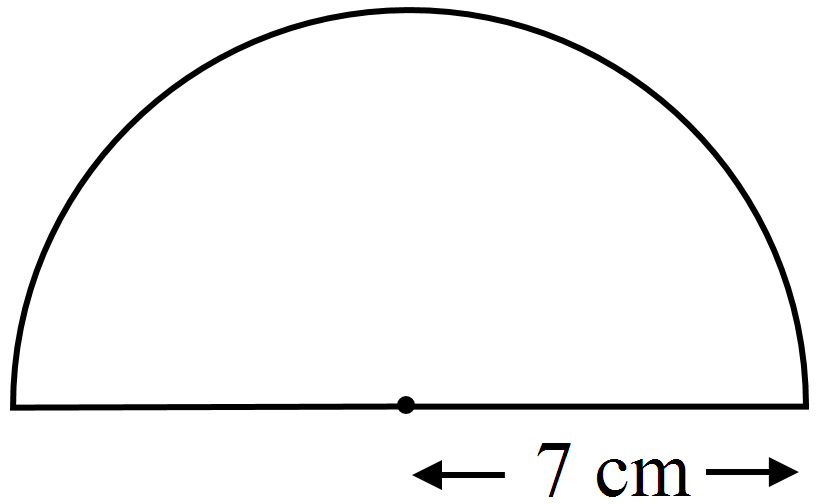
The area of the figure is:
- ✓
$77\ cm^2$
- B
$154\ cm^2$
- C
$38.5\ cm^2$
- D
AnswerCorrect option: A. $77\ cm^2$
A. $77\ cm^2$
Solution:
$\text{Area}= \frac{1}{2}\times\frac{22}{7} \times 7 \times 7=77\text{cm}^2$
View full question & answer→MCQ 21 Mark
If the dimensions of a room are $I, b$ and $ h, (\therefore l →$ length, $l →$ breadth and $h →$ hight$)$ them which of the following is the area of its four walls$?$
- ✓
$2h(1 + b)$
- B
$2h(1 + h)$
- C
$21(h + h)$
- D
$2h + 1 + b$
AnswerCorrect option: A. $2h(1 + b)$
The length of the room $= l$
The breadth of the room $= b$
The height of the room $= h$
Therefore, the area of four walls will be
$= 2(l × h + h × b)$
$= 2h(l + b)$
View full question & answer→MCQ 31 Mark
The base of a triangle is $14\ cm$ and its height is $8\ cm.$ The area of the triangle is:
- A
$112\ cm^2$
- ✓
$56\ cm^2$
- C
$122\ cm^2$
- D
$66\ cm^2$
AnswerCorrect option: B. $56\ cm^2$
B. $56\ cm^2$
Solution:
Area of the triangle $=\Big(\frac{1}{ 2}\times14\times8\Big)\text{cm}^2$
$=56\text{cm}^2$
View full question & answer→MCQ 41 Mark
All six faces of a cube are:
AnswerAll six faces are squares and identical.
View full question & answer→MCQ 51 Mark
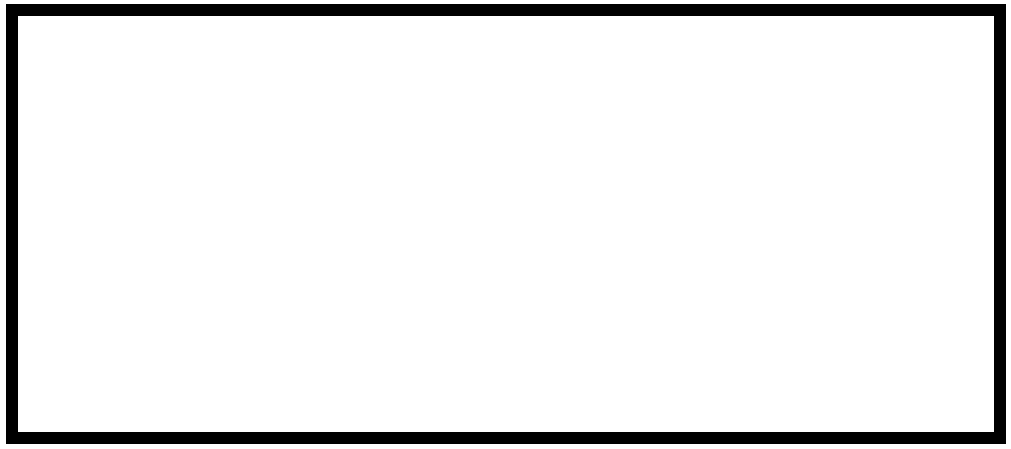
The diagram has the shape of a:
MCQ 61 Mark
A greeting card is of rectangular shape, having the top as a semi-circle. The total length of the card (including the top part) is $20$ inches. The width of the card is $14$ inches. Find the total area of the card.
- A
$350$ inches$^2$
- B
$357$ inches
- C
$375$ inches$^2$
- ✓
$357$ inches$^2$
AnswerCorrect option: D. $357$ inches$^2$
D. $357$ inches$^2$
Solution:
We know that, Area of rectangle $=$ length $\times$ breath $=1 \times b$
Here, $1=20$ inches
$b=14$ inches
Putting the values,
Area of rectangular portion $=280$ inches $^2$..
Also, we know that, Area of a circle $=\pi r ^2$
Here, $r =\frac{14}{2}=7$ inches
Putting the values, we' II get
Area of semicircular portion $=\frac{\pi \times(7)^2}{2}=\frac{22}{7} \times \frac{1}{2} \times 7 \times 7$
$A=11 \times 7$
$A=77$ inches $^2$
Adding (i) and (ii), we'll get
Total area $=280+77=357$ inches $^2$
View full question & answer→MCQ 71 Mark
If the total surface area of cylinder is $1144\ cm$ and the radius is $7\ cm.$ Find its height.
- A
$22\ cm$
- ✓
$19\ cm$
- C
$16\ cm$
- D
$13\ cm$
AnswerCorrect option: B. $19\ cm$
Here, radius$(r) = 7\ cm$
Let the height be $= h\ cm$
We Know that the total surface area of a cylinder is given by the formula
$=2\pi\text{r}(\text{h + r)}$
Putting the Values
$\Rightarrow 2\times\frac{22}{7}\times7\times(\text{h + 7)}=1144$
$= 44\times(\text{h + 7)} = 1144$
$= \text{h} = 26 - 7 = 19\text{cm}$
View full question & answer→MCQ 81 Mark
A covered wooden box has the inner measures as $115\ cm, 75\ cm$ and $35\ cm$ and thickness of wood as $2.5\ cm.$ The volume of the wood is:
- A
$85,000\ cm^3$
- B
$80,000\ cm^3$
- ✓
$82,125\ cm^3$
- D
$84,000\ cm^3$
AnswerCorrect option: C. $82,125\ cm^3$
C. $82,125\ cm^3$
Solution:
Given, inner measures of a wooden box as $115\ cm, 75\ cm$ and $35\ cm .$
Since, thickness of the box is $2.5\ cm ,$ then outer measures will be $115+5.75+5$ and $35+5$ i.e. $120\ cm, 80\ cm$ and $40\ cm .$
$\therefore$ The outer volume $=120 \times 80 \times 40=384000\ cm^3$
and the inner volume $=115 \times 75 \times 35=301875\ cm^3[\because$ volume of cuboid $= I \times b \times h ]$
$\therefore$ Volume of the wood $=$ Outer volume - Inner volume
$=384000-301875=82125\ cm^3$
View full question & answer→MCQ 91 Mark
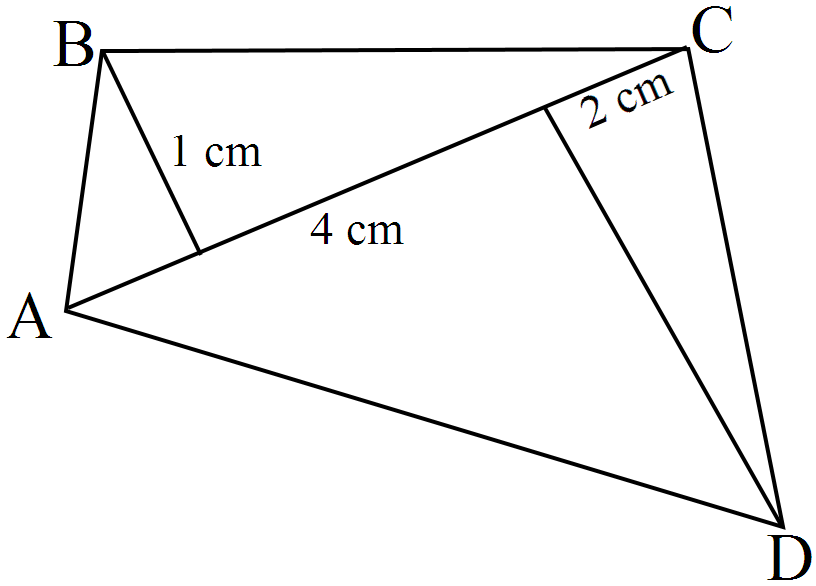
The area of the quadrilateral is:
- ✓
$6\ cm^2$
- B
$12\ cm^2$
- C
$3\ cm^2$
- D
$8\ cm^2$
AnswerCorrect option: A. $6\ cm^2$
A. $6\ cm^2$
Solution:
$\text{Area} = \frac{4\times(1+2)}{2} = 6\text{cm}^2$
View full question & answer→MCQ 101 Mark
The quantity that a container holds is called its.
MCQ 111 Mark
The ratio between the length and the perimeter of a rectangular plot is $1 : 3$ and the ratio between the breadth and perimeter of that plot is $1 : 6.$ What is the ratio between the length and area of that plot$?$
- A
$1 : 6$
- B
$2 : 1$
- C
$1 : 8$
- ✓
View full question & answer→MCQ 121 Mark
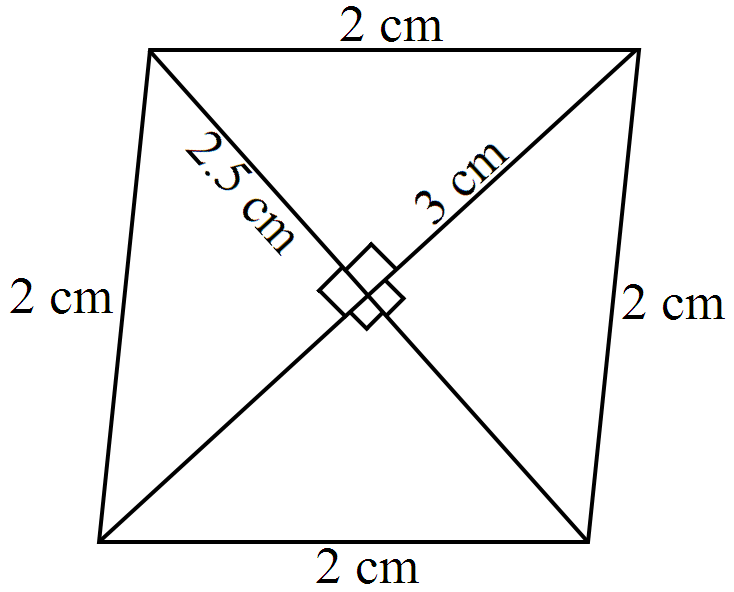
The area of the quadrilateral is:
- ✓
$3.75\ cm^2$
- B
$7.5\ cm^2$
- C
$3\ cm^2$
- D
$10\ cm^2$
AnswerCorrect option: A. $3.75\ cm^2$
A. $3.75\ cm^2$
Solution:
$\text{Area} = \frac{1}{2}\times3\times2.5 = 1.5 \times 2.5$
$= 3.75\ \text{cm}^2$
View full question & answer→MCQ 131 Mark
If the height of a cylinder becomes $\frac{1}{4}$ of the original height and the radius is doubled, then which of the following will be true?
- A
Total surface area of the cylinder will be doubled.
- B
Total surface area of the cylinder will remain unchanged.
- C
Total surface of the cylinder will be halved.
- ✓
AnswerTotal surface area of cylinder having radius $r$ and height $\text{h}=2\pi\text{r}(\text{h + r})$
Total surface area of the cylinder with new height $\Big(\frac{\text{h}}{\text{u}}\Big)$ and radius $2r$
$=2\pi(2\text{r})\Big(2\text{r}+\frac{1}4{}\text{h}\Big)$
$=4\pi\text{r}(8\text{r}+\text{h})\times\frac{1}4{}$
$=\pi\text{r}(8\text{r + h})$
View full question & answer→MCQ 141 Mark
The perimeter of a trapezium is $52\ cm$ and its each non-parallel side is equal to $10\ cm$ with its height $8\ cm.$ Its area is:
- A
$124\ cm^2$
- B
$118\ cm^2$
- ✓
$128\ cm^2$
- D
$112\ cm^2$
AnswerCorrect option: C. $128\ cm^2$
Given, perimeter of a trapezium is $52\ cm$ and each non-parallel side is of $10\ cm.$
Then, sum of its parallel sides
$= 52 - (10 + 10) = 52 - 20 = 32\ cm$
$\therefore$ Area of the trapezium $=\frac{1}{2}(\text{a + b})\times\text{h}$
$=\frac{1}{2}\times32\times8$ [$\because h = 8\ cm$ and $a + b = 32\ cm]$
$=128\text{cm}^2$
View full question & answer→MCQ 151 Mark
The surface area of a cube of edge a is:
- A
$4a^2$
- ✓
$6a^2$
- C
$3a^2$
- D
$a^2$
AnswerCorrect option: B. $6a^2$
B. $6a^2$
View full question & answer→MCQ 161 Mark
The area of a parallelogram is $60\ cm^2$ and one of its altitude is $5\ cm.$ The length of its corresponding side is:
- ✓
$12\ cm$
- B
$6\ cm$
- C
$4\ cm$
- D
$2\ cm$
AnswerCorrect option: A. $12\ cm$
A. $12\ cm$
Solution:
Area of a parallelogram = Side $\times$ Altitude
$\Rightarrow a \times h = 60$
$\Rightarrow a \times 5 = 60$
$\Rightarrow\text{a}=\frac{60}{5}$
$\therefore a = 12\ cm$
View full question & answer→MCQ 171 Mark
The base radius and height of a right circular cylinder are $5\ cm$ and $10\ cm.$ Its total surface area is:
- ✓
$150\pi\text{cm}^2$
- B
$300\pi\text{cm}^2$
- C
$150\text{cm}^2$
- D
$300\text{cm}^2$
AnswerCorrect option: A. $150\pi\text{cm}^2$
Total surface area $=2\pi\text{r} (\text{h+r)}$
$=2\pi\ 5(10+5)$
$=150\pi\text{cm}^2$
View full question & answer→MCQ 181 Mark
A cylindrical tank has a capacity of $5632\ m^3.$ If the diameter of its base is $16\ m,$ find its depth.
- A
$66\ m$
- B
$30\ m$
- C
$26\ m$
- ✓
$28\ m$
AnswerCorrect option: D. $28\ m$
D. $28\ m$
View full question & answer→MCQ 191 Mark
The area of an isosceles triangle having base $x\ cm$ and one side $y\ cm$ is:
AnswerCorrect option: A. $\frac{\text{x}}{2}\sqrt\frac{4\text{y}^2-\text{x}^2}{4}\text{cm}^2$
$\frac{\text{x}}{2}\sqrt\frac{4\text{y}^2-\text{x}^2}{4}\text{cm}^2$
View full question & answer→MCQ 201 Mark
A wooden box is to be covered with a cloth. How much meter of cloth of width $90\ cm$ is required to cover $100$ wooden boxes if the dimension of one box is $90\ cm \times 50\ cm \times 25\ cm.$
- A
$14,600\ cm$
- B
$15,500\ cm$
- ✓
$16,000\ cm$
- D
$16,800\ cm$
AnswerCorrect option: C. $16,000\ cm$
C. $16,000\ cm$
Solution:
We know that, Total surface area of a cuboid is given by $2( l h+ bh + lb )$
Here,
$I=90 \ cm $
$b =50\ cm $
$h =25 \ cm $
$\text { Total surface area }=2(90 \times 25+50 \times 25+90 \times 50) $
$=2(2250+1250+4500) $
$=16000 cm^2$
For $100$ boxes
$\text { Total surface area }=16000 \times 100$
$=16000\ cm^2$
Required cloth $=$ length $\times$ breath
$\text { Length }=\frac{16,00,000}{100} $
$=16,000 cm$
View full question & answer→MCQ 211 Mark
The area of a trapezium is $480\ cm^2$, the distance between two parallel sides is $15\ cm$ and one of the parallel side is $20\ cm.$ The other parallel side is:
- A
$20\ cm$
- B
$50\ cm$
- C
$34\ cm$
- ✓
$44\ cm$
AnswerCorrect option: D. $44\ cm$
D. $44\ cm$
Solution:
Area of trapezium $= \frac{1}{2}\text{h(a + b)}$
$a = 20\ cm, h = 15\ cm, \ Area = 480\ sq.cm$
$480 = \frac{1}{2}\text{(15)(20 + b)}$
$20 + \text{b} = \frac{(480 \times 2)}{15}$
$20 + b = 64$
$b = 44\ cm$
View full question & answer→MCQ 221 Mark
The length of parallel sides of trapezium is $14\ cm$ and $6\ cm$ and its height is $5\ cm.$ Its area will be,
- ✓
$50\ cm^2$
- B
$100\ cm^2$
- C
$210\ cm^2$
- D
$10\ cm^2$
AnswerCorrect option: A. $50\ cm^2$
A. $50\ cm^2$
View full question & answer→MCQ 231 Mark
What change in percent is made in the area of a rectangle by decreasing its length and increasing its breadth by $5\%?$
- ✓
$0.25\%$ decrease
- B
$2.5\%$ increase
- C
$25\%$ increase
- D
$2.5\%$ decrease
AnswerCorrect option: A. $0.25\%$ decrease
$0.25\%$ decrease
View full question & answer→MCQ 241 Mark
A cuboid has ______ pairs of identical faces.
Answer All six faces are rectangular, and opposites faces are identical. So there are three pairs of identical faces.
View full question & answer→MCQ 251 Mark
If base area of a room $12m^2$and height is $3\ m$ then its volume is:
- A
$4\ m^3$
- ✓
$36\ m^3$
- C
$12\ m^3$
- D
$18\ m^3$
AnswerCorrect option: B. $36\ m^3$
B. $36\ m^3$
Solution:
Given,
Base Area of the room $= 12\ m^2$
Height of the room $= 3\ m$
To find: Volume of the room.
Room is an Example of Prism.
We know that,
Volume of Prism $=$ Base Area $\times$ Height
$= 12 \times 3$
$= 36\ m^3$
Therefore, Volume of the Room is $36\ m^3.$
View full question & answer→MCQ 261 Mark
A cylindrical box has $...........$ curved surface and $............$ circular faces, which are identical.
AnswerA cylindrical box having circular bases have identical top.
One curved surface and two circular faces which are identical.
View full question & answer→MCQ 271 Mark
Tick the correct answer in the following: The lengths of the parallel sides of a trapezium are $19\ cm$ and $19\ cm$ and its area is $128\ cm^2.$ The distance between the parallel sides is:
- A
$9\ cm$
- B
$7\ cm$
- ✓
$8\ cm$
- D
$12.5\ cm$
AnswerCorrect option: C. $8\ cm$
C. $8\ cm$
Solution:
Length of parallel sides are $19\ cm, 13\ cm,$
Area of trapezium $= 180\ cm^2$
Distance between then,
$=\frac{\text{Area}\times2}{\text{Sum of parallel sides}}$
$=\frac{128\times2}{19+13}=\frac{128\times2}{32}=8\text{cm}$
View full question & answer→MCQ 281 Mark
Which of the following has the formula $\frac{1}{2}$ sum of parallel sides $\times h.$
View full question & answer→MCQ 291 Mark
The area of a rhombus is $240\ cm^2$ and one of the diagonals is $16\ cm.$ Find the other diagonal.
- A
$16\ cm$
- B
$20\ cm$
- ✓
$30\ cm$
- D
$36\ cm$
AnswerCorrect option: C. $30\ cm$
C. $30\ cm$
Solution:
$\text { Area }=240 cm^2 $
$ d_1=16 cm $
$ \text { Area of rhombus }=\frac{1}{2} d_1 \times d _2 $
$240=\frac{1}{2} \times 16 \times d _2 $
$d_2=\frac{480}{16} $
$ =30\ cm$
View full question & answer→MCQ 301 Mark
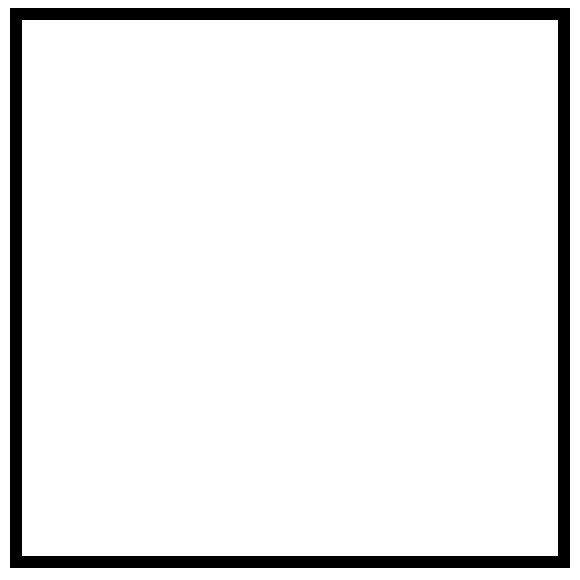
The diagram has the shape of a:
MCQ 311 Mark
If the length and breadth of a rectangle are $10\ cm$ and $5\ cm,$ respectively, then its area is:
- A
$100\ sq. cm$
- ✓
$150\ sq. cm$
- C
$115\ sq. cm$
- D
$200\ sq. cm$
AnswerCorrect option: B. $150\ sq. cm$
B. $150\ sq. cm$
Solution:
Length $= 10\ cm$
And breadth $= 5\ cm$
Area of rectangle $=$ Lenght $\times$ breadth
$= 10 \times 5$
$= 150\ cm^2$
View full question & answer→MCQ 321 Mark
A regular hexagon is inscribed in a circle of radius $r.$ The perimeter of the regular hexagon is:
- A
$3r.$
- ✓
$6r.$
- C
$9r.$
- D
$12r.$
Answer A regular hexagon comprises $6$ equilateral triangles, each of them having one of their vertices at the centre of the hexagon.
The sides of the equilateral triangle are equal to the radius of the smallest circle inscribing the hexagon.
Hence, each side of the hexagon is equal to the radius of the hexagon and the perimeter of the hexagon is $6r.$
View full question & answer→MCQ 331 Mark
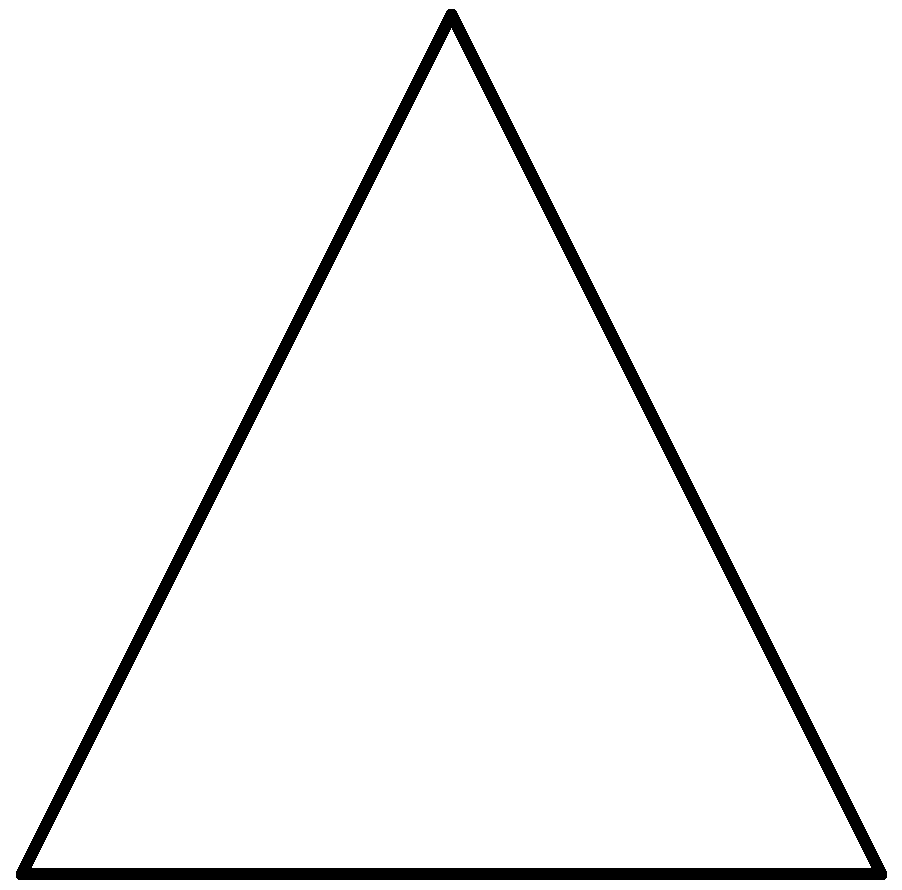
The diagram has the shape of a:
MCQ 341 Mark
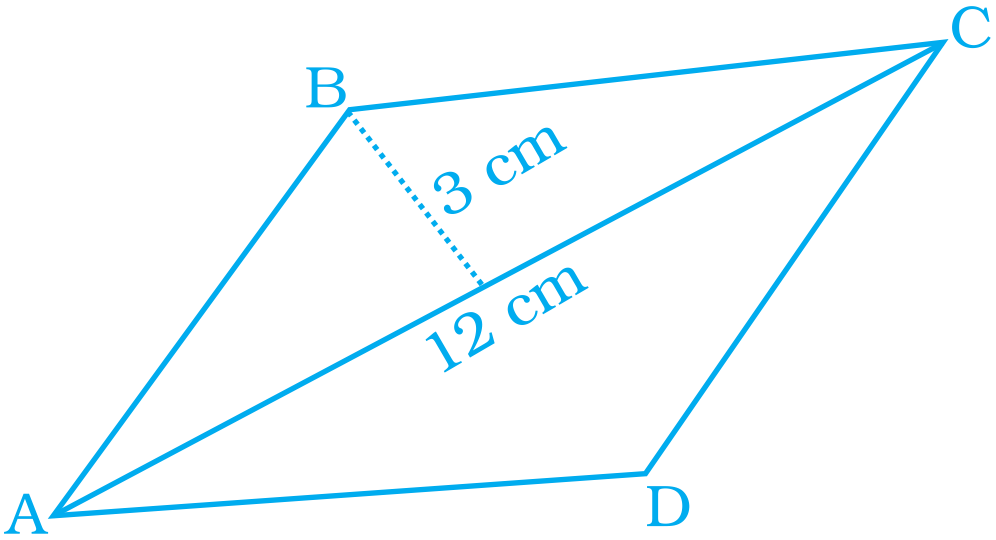
The figure $ABCD$ is a quadrilateral in which $AB = CD$ and $BC = AD.$ Its area is:
- A
$72\ cm^2$
- ✓
$36\ cm^2$
- C
$24\ cm^2$
- D
$18\ cm^2$
AnswerCorrect option: B. $36\ cm^2$
It Is clear from the figure that, quadrilateral $ABCD$ is a parallelogram. The diagonal $AC$ of the given paralelogram $ABCD$ divides it into two triangles of equal areas.
Area of the $\triangle\text{ABC}=\frac{1}{2}$ $\times$ Base $\times$ Height
$=\frac{1}{2}\times12\times3=18\text{cm}^2$
$\therefore$ Area of the parallelogram $ABCD = 2\ ×$ Area of $\triangle\text{ABC}$
$= 2 \times 18$
$= 36\ cm^2$
View full question & answer→MCQ 351 Mark
$1m^3 =\ ?$
- A
$1\ L$
- B
$10\ L$
- C
$100\ L$
- ✓
$1000\ L$
AnswerCorrect option: D. $1000\ L$
D. $1000\ L$
View full question & answer→MCQ 361 Mark
The surface area of the three coterminus faces of a cuboid are $6, 15$ and $10cm^2$ respectively. The volume of the cuboid is:
- ✓
$30cm^3$
- B
$40cm^3$
- C
$20cm^3$
- D
$35cm^3$
AnswerCorrect option: A. $30cm^3$
A. $30cm^3$
Solution:
If l, b and h are the dimensions of the cuboid. Then,
Volume of the cuboid $= l \times b \times h$
Here, $6 = l \times b$
$15 = l \times h$
$\therefore$ $6 \times 15 \times 10 = l^2b^2h^2$
$\therefore$ Volume $= l \times b \times h$
$=\sqrt{6\times15\times10}=30\text{cm}^3$
View full question & answer→MCQ 371 Mark
$1\ m^3$ is ______________ .
- A
$10\ L$
- B
$100\ L$
- ✓
$1000\ L$
- D
$10000\ L$
AnswerCorrect option: C. $1000\ L$
C. $1000\ L$
View full question & answer→MCQ 381 Mark
The perimeter of a triangular field is 144m and the ratio of the sides is $3 : 4 : 5.$ The area of the field is:
- A
$824m^2$
- B
$468m^2$
- ✓
$864m^2$
- D
AnswerCorrect option: C. $864m^2$
C. $864m^2$
View full question & answer→MCQ 391 Mark
The surface areas of the six faces of a rectangular solid are $16, 16, 32, 32, 72$ and $72$ square centimetres. The volume of the solid, in cubic centimetres, is:
- ✓
$192$
- B
$384$
- C
$480$
- D
$2592$
AnswerSince, the solid has rectangular faces.
So, we have $I \times b =16 \ldots (i)$
$b \times h=32 \ldots$
$l \times h =72 \ldots$
where $I , b$ and $h$ are the length, breadth and height respectively, of the solid. On multiplying Eqs. $(i), (ii)$ and $(iii),$ we get
$I \times b \times b \times h \times I \times h =16 \times 32 \times 72 $
$\Rightarrow I ^2 \times b ^2 \times h ^2=36864 $
$\Rightarrow( Ibh )^2=36864 $
$\therefore Ibh =192$
Hence, the volumne of the solid is $192$ cu cm .
View full question & answer→MCQ 401 Mark
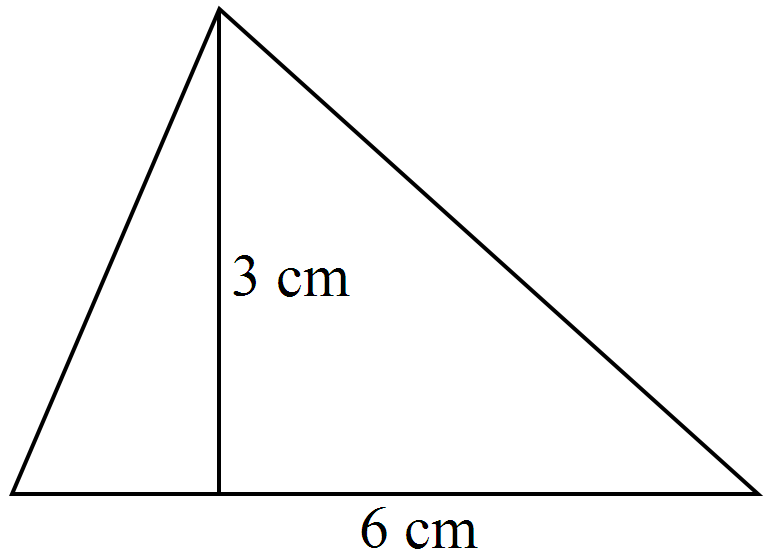
AThe area of the figure is:
- ✓
$9cm^2$
- B
$18cm^2$
- C
$12cm^2$
- D
$15cm^2$
AnswerCorrect option: A. $9cm^2$
A. $9cm^2$
Solution:
$\text{Area}=\frac{6\times3}{2}\ 9\text{cm}^2 $
View full question & answer→MCQ 411 Mark
The cost of papering the wall of a room, $12m$ long, at the rate of $Rs. 1.35$ per square meter is $Rs. 340.20.$ The cost of matting the floor at $Rs. 0.85$ per square metre is $Rs. 91.80.$ Find the height of the room.
View full question & answer→MCQ 421 Mark
Ramesh has three containers.
$A.$ Cylindrical container $A$ having radius $r$ and height $h,$
$B.$ Cylindrical container $B$ having radius $2r$ and height $\frac{1}{2}$ $h.$
$C.$ Cuboidal container $C$ having dimensions $r \times r \times h.$
The arrangement of the containers in the increasing order of their volumes is:
- A
$A, B, C.$
- B
$B, C, A.$
- ✓
$C, A, B.$
- D
AnswerCorrect option: C. $C, A, B.$
$(i)$ The volume of the cylindrical container having radius $r$ and height h $=\pi\text{r}^2\text{h}$
$(ii)$ The volume of the cylindrical container with radius $2r$ and height $\frac{1}{2}=\pi(2\text{r})^2\times\frac{1}{2}\text{h}$
$=\pi\times4\text{r}^2\times\frac{1}{2}\text{h}$
$=2\pi\text{r}^2\text{h}$
$(iii)$The volume of the cuboidal container having dimensions $r \times r \times h = r^2h$
From parts $(i), (ii)$ and $(iii),$ we have the following order $C, A, B.$
View full question & answer→MCQ 431 Mark
Surface area of cube of edge $‘a’$ is:
- A
$4a^2$
- B
$3a^2$
- C
$a^2$
- ✓
$6a^2$
AnswerCorrect option: D. $6a^2$
$6a^2$
View full question & answer→MCQ 441 Mark
The perimeter of a trapezium is $52\ cm.$ Its non-parallel sides are $10\ cm$ each and the distance between two parallel sides is $8
\ cm.$ Find the area of the trapezium.
- ✓
$128\ cm^2$
- B
$144\ cm^3$
- C
$144\ cm$
- D
AnswerCorrect option: A. $128\ cm^2$
A. $128\ cm^2$
View full question & answer→MCQ 451 Mark
If the diagonals of rhombus are $6cm$ and $8cm,$ its area will be.
- A
$48cm^2$
- B
$24cm$
- C
$48cm$
- ✓
$24cm^2$
AnswerCorrect option: D. $24cm^2$
D. $24cm^2$
View full question & answer→MCQ 461 Mark
The perimeter of the figure is:
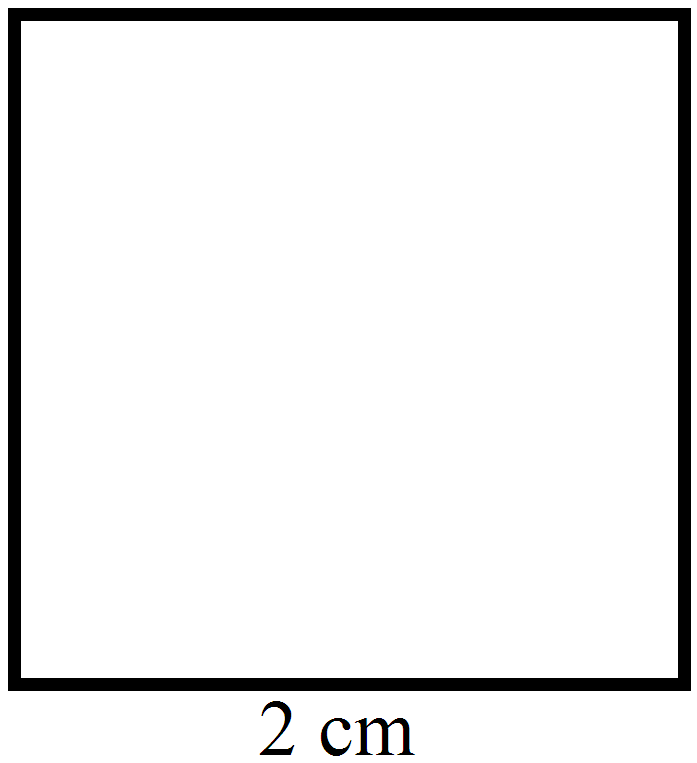
- A
$4\ cm$
- B
$6\ cm$
- ✓
$8\ cm$
- D
$12\ cm$
AnswerCorrect option: C. $8\ cm$
Perimeter $= 4 × 2 = 8\ cm$
View full question & answer→MCQ 471 Mark
If the parallel sides of a parallelogram are $2\ cm$ apart and their sum is $10\ cm$ then its area is:
- A
$20\ cm^2$
- ✓
$10\ cm^2$
- C
$5\ cm^2$
- D
AnswerCorrect option: B. $10\ cm^2$
B. $10\ cm^2$
Solution:
(IMAGE)
Given,
$\overline{\text{AO}} = 2\text{cm}$
And sum of $\overline{\text{AB}}$ and $\overline{\text{DC}} =1 0\text{cm}$
Let us assume that both sides,
Are equal so each side equals to $= 5\ cm$
Area of a parallelogram = Base $\times$ Height
$= 2 \times 5$
$= 10\ cm^2$
View full question & answer→MCQ 481 Mark
A rectangular field with width of $80\ cm$ and a square field of side $120\ cm$ have same perimeter. Which one will be having a greater area?
- A
Both will have the same area.
- B
- ✓
- D
AnswerC. Square field.
Solution:
Perimeter of the square field $= 4 \times 120 = 480\ cm^2$
According to the question, both the fields have same perimeter.
$\therefore$ Perimeter of the rectangular field $= 2(length + 80)$
$\Rightarrow480 = 2(\text{l} + 80)$
$240 =$ length $+ 80$
Length $= 160\ cm$
Now, area of the square field $=$ side$^2 = 120^2 = 14400\ cm^2$
Area of the rectangular field $= l \times w = 160 \times 80 = 12800\ cm^2$
$\therefore$ Square field is having the greater area.
View full question & answer→MCQ 491 Mark
The area of a trapezium is $40\ cm^2.$ Its parallel sides are $12\ cm$ and $8\ cm.$ The distance between the parallel sides is:
- A
$1\ cm$
- B
$2\ cm$
- C
$3\ cm$
- ✓
$4\ cm$
AnswerCorrect option: D. $4\ cm$
D. $4\ cm$
Solution:
$\frac{(12+8)\text{d}}{2} = 40$
$\Rightarrow \text{d} = 4\ \text{cm}.$
View full question & answer→MCQ 501 Mark
$1\ cm^3 =$
- ✓
$0.000001\ m^3$
- B
$0.01\ m^3$
- C
$0.1\ m^3$
- D
$1000\ m^3$
AnswerCorrect option: A. $0.000001\ m^3$
A. $0.000001\ m^3$
View full question & answer→