Observe the following pattern and find the missing numbers:
$11^2= 121$
$101^2= 10201$
$10101^2= 102030201$
$1010101^2= \_\_\_\_\_\_\_\_$
$\_\_\_\_\_\_\_\_^2 = 10203040504030201$
Find the least number that must be added to $1300$ so as to get a perfect square. Also find the square root of the perfect square.
Answer
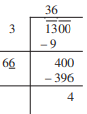
First finding $\sqrt {1300}$ by long division method.
The remainder is $4$. This shows that $36^2< 1300.$
Next perfect square number is $37^2= 1369.$
Hence, the number to be added is $37^2- 1300 = 1369 - 1300 = 69.$
And the square root of the perfect square = $\sqrt {1369}$ $= 37$.
Find the greatest $4$-digit number which is a perfect square.
Answer
Greatest number of $4$-digits $= 9999$
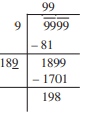
First finding $\sqrt9999$ by long division method.
The remainder is $198$. This shows $99^2$ is less than $9999$ by $198$.
This means if we subtract the remainder from the number, we get a perfect square.
Therefore, the greatest $4$-digit number which is a perfect square is $= 9999 – 198 = 9801$
Find the least number that must be subtracted from $5607$ so as to get a perfect square. Also find the square root of the perfect square number.
Answer
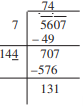
First finding $\sqrt{5607}$ by long division method.
We get the remainder $131$. It shows that $74^2$ is less than $5607$ by $131$.
This means if we subtract the remainder from the number, we get a perfect square.
Thus, the least number that must be subtracted from $5607$ so as to get a perfect square is $131$.
And the required perfect square number is $5607 - 131 = 5476$. So, $\sqrt{5476}$ $= 74$.