MCQ 11 Mark
How many sides does a regular polygon have if the measure of an exterior angle is $24^\circ ?$
AnswerNumber of sides $\frac{360^\circ}{24^\circ}=15$
View full question & answer→MCQ 21 Mark
$PQRS$ is a trapezium in which $PQ || SR$ and $\angle\text{P}=130^\circ, \angle\text{Q}= 110^\circ.$ Then $\angle\text{R}$ is equal to:
- ✓
$70^\circ$
- B
$50^\circ$
- C
$65^\circ$
- D
$55^\circ$
AnswerCorrect option: A. $70^\circ$
Since, $PQRS$ is a trapezium and $PQ \ || \ SR$
$\therefore\angle\text{Q}+\angle\text{R}=180^\circ$
$\Rightarrow\angle\text{R}= 180^\circ − 110^\circ= 70^\circ$
View full question & answer→MCQ 31 Mark
If $AB$ and $CD$ are two parallel sides of a parallelogram, then:
- ✓
$AB = CD$
- B
$AB > CD$
- C
$AB < CD$
- D
AnswerCorrect option: A. $AB = CD$
$AB = CD$
View full question & answer→MCQ 41 Mark
In the quadrilateral $ABCD,$ the diagonals $AC$ and $BD$ are equal and perpendicular to each other. What type of a quadrilateral is $ABCD?$
View full question & answer→MCQ 51 Mark
Tick the correct answer in the following$?$
The measure of each exterior angle of a regular polygon is $40^\circ .$ How many sides does it have$?$
AnswerEach exterior angle of a regular n-sided polygon $=\frac{160}{\text{n}}=40$
$\Rightarrow\text{n}=\frac{360}{\text{40}}=9$
View full question & answer→MCQ 61 Mark
The number of sides of a regular polygon whose each interior angle is of $135^\circ $ is:
AnswerWe know that, the measures of each exterior angle of a polygon having n sides is given by $\frac{360^\circ}{\text{n}}$
$\therefore$ The number of sides, $\text{n}=\frac{360^\circ}{\text{Exterior angle}}=\frac{360^\circ}{180^\circ}=\frac{360^\circ}{45^\circ}=8$
View full question & answer→MCQ 71 Mark
A simple closed curve made up of only line segments is called a $..............$
View full question & answer→MCQ 81 Mark
How many diagonals does a triangle have?
MCQ 91 Mark
Which of the following statement is true?
- A
All the rectangles are squares.
- B
All the parallelograms are rhombuses.
- ✓
All the squares are rhombuses.
- D
Each parallelogram is a trapezium.
AnswerCorrect option: C. All the squares are rhombuses.
All the squares are rhombuses.
View full question & answer→MCQ 101 Mark
The four angles of a pentagon are $40^\circ , 75^\circ , 125^\circ and 135^\circ .$ The measure of the fifth angle is:
- ✓
$165^\circ$
- B
$170^\circ $
- C
$160^\circ$
- D
$175^\circ$
AnswerCorrect option: A. $165^\circ$
$ n= 5, (n - 2) 180^\circ = (5 - 2) 180^\circ = 540^\circ $
Fifth angle
$= 540^\circ - (40^\circ + 75^\circ + 125^\circ + 135^\circ )$
$= 540^\circ - 375^\circ = 165^\circ $
View full question & answer→MCQ 111 Mark
How many non-overlapping triangles can we make in a $n-$gon (polygon having n sides), by joining the vertices$?$
- A
$n - 1$
- ✓
$n - 2$
- C
$n - 3$
- D
$n - 4$
AnswerCorrect option: B. $n - 2$
The number of non-overlapping triangles in a $n-$gon $= n - 2,$ i.e., $2$ less than the number of sides.
View full question & answer→MCQ 121 Mark
$\text{ABCD}$ is a quadrilateral. If $\text{AC}$ and $\text{BD}$ bisect each other, what is $\text{ABCD}?$
View full question & answer→MCQ 131 Mark
The perimeter of a parallelogram is $180\ cm.$ One side exceeds another by $10\ cm.$ The sides of the parallelogram are:
- ✓
$40\ cm, 50\ cm$
- B
$50\ cm$ each
- C
$45\ cm$ each
- D
AnswerCorrect option: A. $40\ cm, 50\ cm$
$40\ cm, 50\ cm$
View full question & answer→MCQ 141 Mark
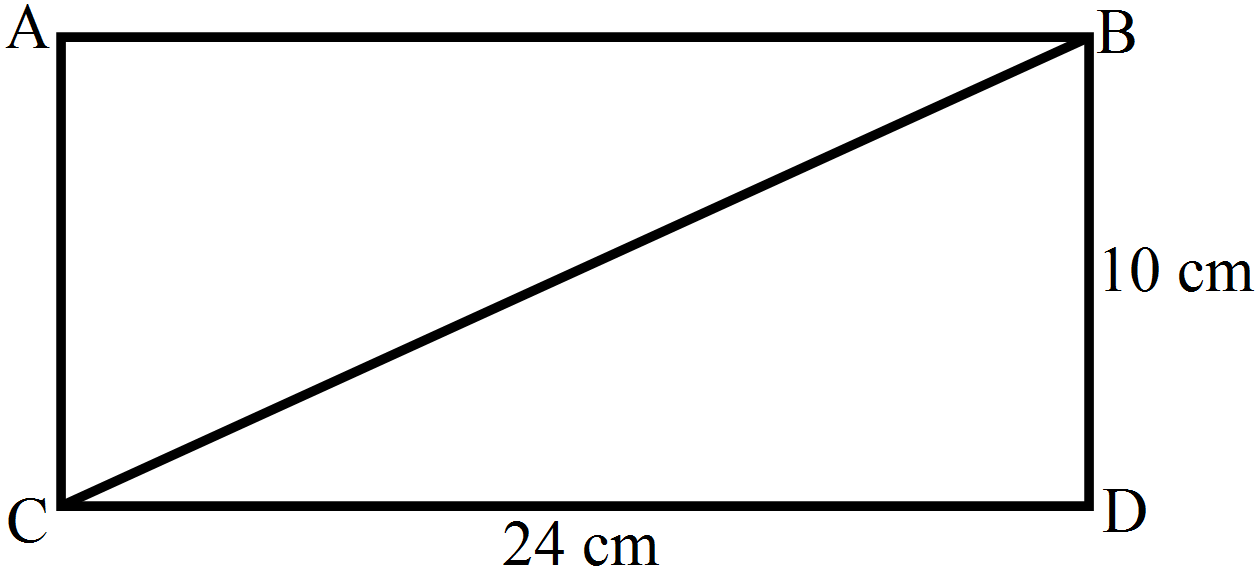
Length of one of the diagonals of a rectangle whose sides are $10\ cm$ and $24\ cm$ is.
- A
$25\ cm$
- B
$20\ cm$
- ✓
$26\ cm$
- D
$3.5\ cm$
AnswerCorrect option: C. $26\ cm$
In $\triangle\text{BDC}=90^\circ$
Using Pythagoras Theorem, We have,
$\text{BC}^2=\text{BD}^2+\text{CD}^2$
$\Rightarrow\text{BC}^2=10^2+24^2=100+576$
$\Rightarrow\text{BC}^2=676$
$\Rightarrow\text{BC}=\sqrt{676}$
$\Rightarrow\text{BC}=256\text{cm}$
View full question & answer→MCQ 151 Mark
A quadrialateral whose opposite sides and all the angles are equal is a.
AnswerWe know that, in a rectangle, opposite sides and all the angles are equal.
View full question & answer→MCQ 161 Mark
Out of the three equal angles of a quadrilateral, each measures $70^\circ .$ The measure of the fourth angle is:
- A
$90^\circ$
- B
$140^\circ$
- ✓
$150^\circ$
- D
$70^\circ$
AnswerCorrect option: C. $150^\circ$
Fourth angle $= 360^\circ - (70^\circ + 70^\circ + 70^\circ )$
$= 150^\circ .$
View full question & answer→MCQ 171 Mark
If a quadrilateral has two adjacent sides equal and the other two sides equal, it is called:
MCQ 181 Mark
Which of the following quadrilaterals is a regular quadrilateral?
AnswerA rhombus is a quadrilateral with all the sides equal and its diagonals bisect each other, but all of its angles are not equal.
We already know that only the parallel sides or the opposite sides of a parallelogram are equal.
In a trapezium no side is equal to another.
A rectangle has only its opposite sides as equal. Therefore, square is the only regular quadrilateral.
So, the correct answer is “square”.
Note: Do not confuse that rectangle is also a regular quadrilateral.
It is not because all the sides are not equal in a rectangle whereas all the angles are equal and diagonals bisect each other.
For a quadrilateral to be regular it should have all the sides equal.
So the rectangle is not.
When all the sides are equal in a rectangle, then it can be considered as a square.
View full question & answer→MCQ 191 Mark
The sum of angles of a concave quadrilateral is:
- A
more than $360^\circ$
- B
less than $360^\circ$
- ✓
equal to $360^\circ$
- D
twice of $360^\circ$
AnswerCorrect option: C. equal to $360^\circ$
C. equal to $360^\circ$
Solution:
We know that, the sum of interior angles of any polygon (convex or concave) having n sides is $(n − 2) \times 180^\circ$
$\therefore$ The sum of angles of a concave quadrilateral is $(4 – 2) \times 180^\circ$, i.e. $360^\circ$
View full question & answer→MCQ 201 Mark
The diagonals of a rectangle are $2x + 1$ and $3x - 1,$ respectively. Find the value of $x.$
Answer The diagonals of a rectangle are equal in length.
$2x + 1 = 3x - 1$
$1 + 1 = 3x - 2x$
$2 = x$
Thus, the value of $x$ is $2.$
View full question & answer→MCQ 211 Mark
Tick the correct answer in the following$?$ How many diagonals are there in a polygon having $12$ sides$?$
Answer For an n-sided polygon:
Number of diagonals $=\frac{\text{n}(\text{n}-3)}{2}$
$\therefore\text{n}=12$
$\Rightarrow\frac{12(12-3)}{2}=54$
View full question & answer→MCQ 221 Mark
$ABCD$ is a rectangle and $AC$ & $BD$ are its diagonals. If $AC = 10\ cm,$ then $BD$ is:
- A
$20\ cm$
- ✓
$10\ cm$
- C
$5\ cm$
- D
$15\ cm$
AnswerCorrect option: B. $10\ cm$
The diagonals of a rectangle are always equal.
View full question & answer→MCQ 231 Mark
The closed curve which is also a polygon is:
Answer
is polygon as no two line segments intersect each other.
View full question & answer→MCQ 241 Mark
The measures of the three angles of a quadrilateral are $65^\circ , 75^\circ $ and $85^\circ $. The measure of the fourth angle is:
- A
$65^\circ$
- B
$75^\circ$
- C
$85^\circ$
- ✓
$135^\circ$
AnswerCorrect option: D. $135^\circ$
$135^\circ$
View full question & answer→MCQ 251 Mark
Two adjacent angles of a quadrilateral measure $130^\circ $ and $40^\circ .$ The sum of the remaining two angles is:
- ✓
$190^\circ$
- B
$180^\circ$
- C
$360^\circ$
- D
$90^\circ$
AnswerCorrect option: A. $190^\circ$
$190^\circ$
View full question & answer→MCQ 261 Mark
The angle sum of a convex polygon with number of sides $8$ is:
- A
$720^\circ$
- B
$900^\circ$
- ✓
$1080^\circ $
- D
$1440^\circ$
AnswerCorrect option: C. $1080^\circ $
$n = 8$
$(n - 2) 180^\circ = 1080^\circ .$
View full question & answer→MCQ 271 Mark
The sides of a pentagon are produced in order. Which of the following is the sum of its exterior angles?
- A
$540^\circ$
- B
$180^\circ$
- C
$720^\circ$
- ✓
$360^\circ $
AnswerCorrect option: D. $360^\circ $
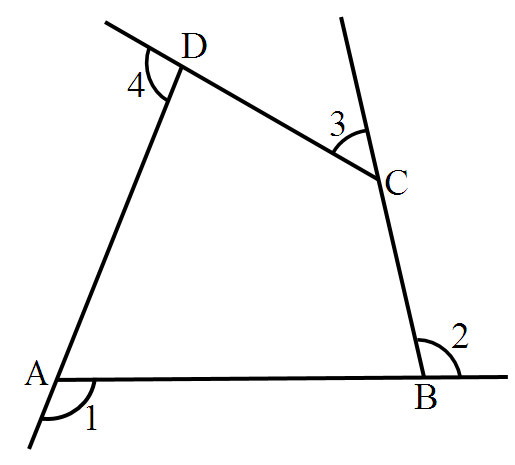
$\because ABCD$ is a Quadrilateral
To Proof $\angle\text{1}+ \angle\text{2}+\angle\text{3}+\angle\text{4}=360^\circ$
$\angle\text{A}+ \angle\text{B}+\angle\text{C}+\angle\text{D}=360^\circ$
$\angle\text{A}+ \angle\text{1}=180^\circ$
$\angle\text{B}+ \angle\text{2}=180^\circ$
$\angle\text{C}+ \angle\text{3}=180^\circ$
$\angle\text{D}+ \angle\text{4}=180^\circ$
$\angle\text{A}+ \angle\text{B}+\angle\text{C}+\angle\text{D}+ \angle\text{1}+ \angle\text{2}+\angle\text{3}+\angle\text{4}$
$= 180^\circ+180^\circ+180^\circ+180^\circ$
$=720^\circ$
$360^\circ+\angle1+\angle2+\angle3+\angle4=720^\circ$
$\angle1+\angle2+\angle3+\angle4=360^\circ$
Each polygon have $360^\circ $ as it's exterior angel but it's Interior angle is depend on it's sides, so the answer is $D.$
View full question & answer→MCQ 281 Mark
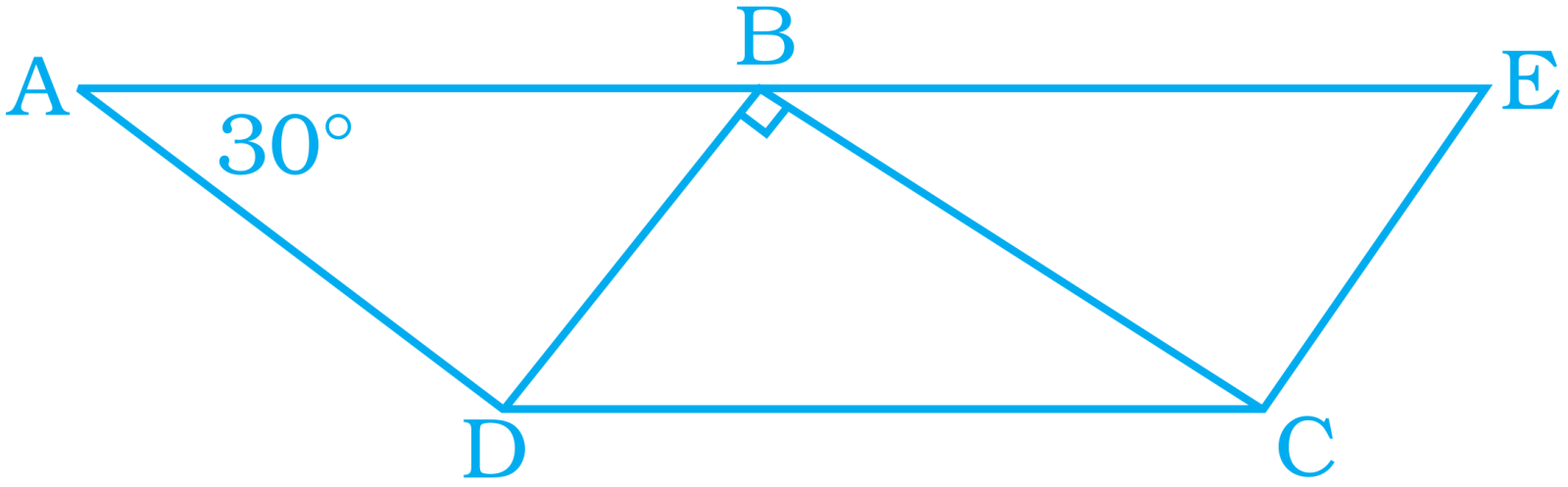
In the given figure, $ABCD$ and $BDCE$ are parallelograms with common base $DC.$ If $BC ⊥ BD,$ then $\angle\text{BEC}=$
- ✓
$60^\circ$
- B
$30^\circ$
- C
$150^\circ$
- D
$120^\circ$
AnswerCorrect option: A. $60^\circ$
$\angle\text{BCD}=30^\circ$
$\therefore\angle\text{BCD}=30^\circ$,
in $\triangle\text{CBD}$ by angle sum property of a triangle, we have
$\Rightarrow\angle\text{DBC}+\angle\text{BCD}+\angle\text{CDB}=180^\circ$
$\Rightarrow90^\circ+30^\circ+\angle\text{CDB}=180^\circ$
$\Rightarrow\angle\text{CDB}=180^\circ-120^\circ=60^\circ$
$\Rightarrow\angle\text{BEC}=60^\circ$
View full question & answer→MCQ 291 Mark
If two adjacent angles of a parallelogram are $(5x – 5)^\circ$ and $(10x + 35)^\circ$, then the ratio of these angles is:
- ✓
$1 : 3$
- B
$2 : 3$
- C
$1 : 4$
- D
$1 : 2$
AnswerCorrect option: A. $1 : 3$
A. $1 : 3$
Solution:
We know that, adjacent angles of a parallelogram are supplementary, i.e., their sum equals $180^{\circ}$
$\therefore(5-5)+(10 x+35)=180^{\circ} $
$\Rightarrow 15 x+30^{\circ} .=180^{\circ} . \Rightarrow 15 x=180^{\circ}$
$\Rightarrow x=10^{\circ}$. Thus, the angles are $(5 \times 10-5)$ and $(10 \times 10+35)$ i.e., $45^{\circ}$ and $135^{\circ}$. Hence, the required ratio is $45^{\circ}: 135^{\circ}$ i.e., $1: 3$.
View full question & answer→MCQ 301 Mark
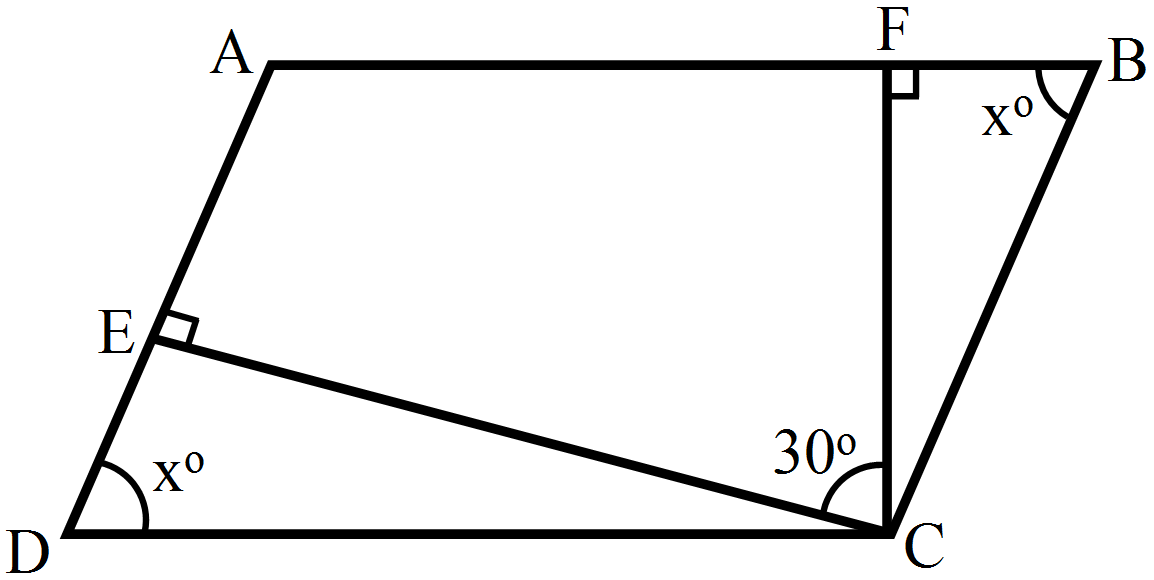
The angle between the two altitudes of a parallelogram through the same vertex of an obtuse angle of the parallelogram is $30^\circ$. The measure of the obtuse angle is.
- A
$100^\circ$
- ✓
$150^\circ$
- C
$105^\circ$
- D
$120^\circ$
AnswerCorrect option: B. $150^\circ$
B. $150^\circ$
Solution:
Let EC and FC be altitudes and $\angle\text{EBC}=30^\circ$
let $\angle\text{EDC}=\text{x}=\angle\text{FBC}$
so, $\angle\text{EDC}=90-\text{x}\ \text{and}\ \angle\text{BCF}=90-\text{x}$
So, by property of the parallelogram,
$\Rightarrow\angle\text{ADC}+\angle\text{DCB}+180^\circ$
$\Rightarrow\angle\text{ADC}+(\angle\text{ECD}+\angle\text{ECF})=180^\circ$
$\Rightarrow\text{x}+90^\circ-\text{x}+30^\circ+90^\circ-\text{x}=180^\circ$
$\Rightarrow-\text{x}=180^\circ-210^\circ=-30^\circ$
$\Rightarrow\text{x}=30^\circ$
Hence, $\angle\text{DCB}=30^\circ+60^\circ+60^\circ=150^\circ$
View full question & answer→MCQ 311 Mark
What is the maximum exterior angle possible for a regular polygon$?$
- A
$60^\circ$
- B
$80^\circ$
- ✓
$120^\circ$
- D
$160^\circ$
AnswerCorrect option: C. $120^\circ$
Since of increasing size of regular polygon $\Rightarrow $ its exterior angle decreases.
$\therefore$ Mass exterior angle is for a regular triangle (equilateral triangle) and $= 180 -$ interior angle
$= 180^\circ - 60^\circ = 120^\circ $
View full question & answer→MCQ 321 Mark
The length and breadth of a rectangle is $4\ cm$ and $2\ cm$ respectively. Find the perimeter of the rectangle.
- A
$8\ cm$
- B
$16\ cm$
- ✓
$12\ cm$
- D
$6\ cm$
AnswerCorrect option: C. $12\ cm$
Given, length of rectangle is $4\ cm$
Breadth of rectangle $= 2\ cm$
By the formula of perimeter of rectangle, we know that;
Perimeter $= 2 ($Length $+$ Breadth$)$
$P = 2(4 + 2)$
$P = 2 × 6$
$P = 12\ cm.$
View full question & answer→MCQ 331 Mark
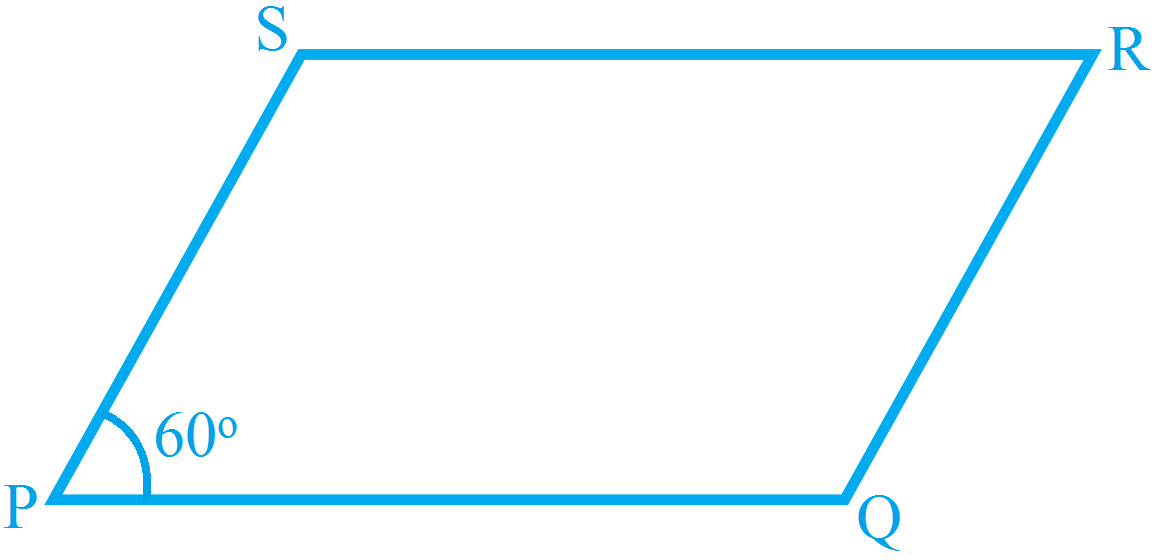
In a parallelogram $PQRS,$ if $\angle\text{P}=60^\circ$, then other three angles are:
- A
$45^\circ, 135^\circ, 120^\circ$
- ✓
$60^\circ, 120^\circ, 120^\circ$
- C
$60^\circ, 135^\circ, 135^\circ$
- D
$45^\circ, 135^\circ, 135^\circ$
AnswerCorrect option: B. $60^\circ, 120^\circ, 120^\circ$
B. $ 60^\circ, 120^\circ, 120^\circ$
Solution:
Given,$\angle\text{P}=60^\circ$ Since, in a parallelogram, adjacent angles are supplementary,
$\Rightarrow\angle\text{P}+\angle\text{Q}=180^\circ$
$\Rightarrow60^\circ+\angle\text{Q}=180^\circ$
$\Rightarrow\angle\text{Q}=120^\circ$
Also, opposite angles are equal in a parallelogram Therefore, $\angle\text{R}=\angle\text{P}=60^\circ,\angle\text{S}=\angle\text{Q}=120^\circ$
Hence, other three angles are $60^\circ, 120^\circ, 120^\circ.$
View full question & answer→MCQ 341 Mark
What is the number of vertices of a quadrilateral?
MCQ 351 Mark
A diagonal of a rectangle is inclined to one side of the rectangle at $25^\circ .$ The acute angle between the diagonals is:
- A
$25^\circ$
- ✓
$50^\circ$
- C
$40^\circ$
- D
$55^\circ$
AnswerCorrect option: B. $50^\circ$
$50^\circ$
View full question & answer→MCQ 361 Mark
Tick the correct answer in the following? In a regular polygon, each interior angle is thrice the exterior angle. The number os sides of the polygon is:
Answer For a regular polygon with $n$ sides:
Each exterior angle $=\frac{ 360}{ \text{n}}$
Each interior angle $=180-\frac{360}{\text{n}}$
$\therefore180-\frac{360}{\text{n}}=3\Big(\frac{360}{\text{n}}\Big)$
$\Rightarrow180=4\Big(\frac{360}{\text{n}}\Big)$
$\Rightarrow\text{n}=\frac{4\times360}{180}=8$
View full question & answer→MCQ 371 Mark
The sum of the measures of the three angles of a triangle is ________.
- A
$360^\circ$
- B
$210^\circ$
- ✓
$180^\circ$
- D
AnswerCorrect option: C. $180^\circ$
$180^\circ$
View full question & answer→MCQ 381 Mark
Which of the following is not true for an exterior angle of a regular polygon with $n$ sides?
- A
Each exterior angle$=\frac{360^\circ}{\text{n}}$
- B
Exterior angle $=180^{\circ}$ – interior angle
- C
$n =\frac{360^\circ}{\text{exterior angle}}$
- ✓
Each exterior angle $= \frac{(\text{n}-2)\times180^\circ}{\text{n}}$
AnswerCorrect option: D. Each exterior angle $= \frac{(\text{n}-2)\times180^\circ}{\text{n}}$
Each exterior angle $= \frac{(\text{n}-2)\times180^\circ}{\text{n}}$
View full question & answer→MCQ 391 Mark
If the two diagonals of a rhombus are $8\ cm\ \& \ 6\ cm,$ its area is?
- A
$28\ cm^2$
- B
$48\ cm^2$
- C
$14\ cm^2$
- ✓
$24\ cm^2$
AnswerCorrect option: D. $24\ cm^2$
D. $24\ cm^2$
View full question & answer→MCQ 401 Mark
A parallelogram which has equal diagonals is a:
MCQ 411 Mark
The lengths of the diagonals of a rhombus are $16\ cm$ and $12\ cm$. The length of each side of the rhombus is:
- A
$8\ cm$
- B
$9\ cm$
- ✓
$10\ cm$
- D
$12\ cm$
AnswerCorrect option: C. $10\ cm$
$\text{AO}=\frac{1}{2}\text{AC}=\Big(\frac{1}{2}\times16\Big)=8\text{cm}$
$\text{BO}=\frac{1}{2}\text{BD}=\Big(\frac{1}{2}\times12\Big)=6\text{cm}$
From the right $\triangle\text{AOB},$ we have,
$\therefore\text{AB}^2=\text{AO}^2+\text{BO}^2$
$\Rightarrow\text{AB}^2=\big\{(8)^2+(6)^2\big\}\text{cm}^2$
$\Rightarrow\text{AB}=\sqrt{100}=10\text{cm}$
View full question & answer→MCQ 421 Mark
The number of sides of a regular polygon, whose each exterior angle has a measure of $45^\circ $, is:
View full question & answer→MCQ 431 Mark
The two diagonals are not necessarily equal in a:
AnswerAll sides of Rhombus are equal in length but in case of angle it is not necessary to be equal.
If all the angles are equal then it will become a square.
That’s why diagonals of rhombus are not necessary to be equal in length.
View full question & answer→MCQ 441 Mark
If an angle of a parallelogram is two-thirds of its adjacent angle, the smallest angle of the parallelogram is:
- A
$54^\circ$
- ✓
$72^\circ $
- C
$81^\circ $
- D
$108^\circ $
AnswerCorrect option: B. $72^\circ $
Let the measure of the angle be $x^\circ .$
$\therefore\text{x}+\Big(\frac{2}{3}\times\text{x}\Big)=180$
$\Rightarrow\frac{3\text{x}+2\text{x}}{3}=180$
$\Rightarrow5\text{x}=3\times180$
$\Rightarrow\text{x}=\frac{3\times180}{5}=180$
Hence the anlge is $180^\circ .$
Its adjacent $= (180 - 108^\circ ) = 72^\circ .$
Therefore, the smallest angle is $72^\circ .$
View full question & answer→MCQ 451 Mark
What is the name of a regular polygon of $6$ sides?
View full question & answer→MCQ 461 Mark
Two adjacent angles of a parallelogram are of equal measure. The measure of each angle of the parallelogram is:
- A
$45^\circ $
- B
$30^\circ $
- C
$60^\circ $
- ✓
$90^\circ $
AnswerCorrect option: D. $90^\circ $
$x^\circ + x^\circ = 180^\circ$
$\Rightarrow x^\circ = 90^\circ .$
View full question & answer→MCQ 471 Mark
The quadrilateral whose diagonals are perpendicular to each other is:
MCQ 481 Mark
The length and breadth of a rectangle are in the ratio $4 : 3.$ If the diagonal measures $25\ cm$ then the perimeter of the rectangle is:
- A
$56\ cm$
- B
$60\ cm$
- ✓
$70\ cm$
- D
$80\ cm$
AnswerCorrect option: C. $70\ cm$
C. $70\ cm$
Solution:
Let the length $A B$ be $4 x$ and Breadth $B C$ be $3 x$.
Each angle of a rectangle is a right angle. We have,
$\therefore \angle ABC =90^{\circ}$
From the right $\triangle ABC$ :
$A C 2=A B 2+B C 2$
$\Rightarrow(25)^2=(4 x)^2+(3 x)^2$
$\Rightarrow 16 x^2+9 x^2=625$
$\Rightarrow 25 x^2=625$
$\Rightarrow x^2=25$
$\Rightarrow x=5$
Therefore, lenght $=4 \times 5=2\ cm$ and breadth $=3 \times 5=15\ cm$.
View full question & answer→MCQ 491 Mark
If the two adjacent angles of a parallelogram are equal, then each of its angle is?
- A
$70^\circ $
- B
$80^\circ$
- ✓
$90^\circ$
- D
$100^\circ$
AnswerCorrect option: C. $90^\circ$
$90^\circ $
View full question & answer→MCQ 501 Mark
What is the number of sides of a quadrilateral?