Questions · Page 2 of 5

M.C.Q. [I MARKS]

MCQ 511 Mark
Cheek cells are made up of which of the following cells?
  • A
    Bone cells
  • Epithelial cells
  • C
    Nerve cells
  • D
    Brain cells
Answer
Correct option: B.
Epithelial cells
Epithelial cells line the hollow organs and glands and also cover the whole surface of the body. They secrete a variety of chemicals and are involved in receiving external stimuli.
View full question & answer
MCQ 521 Mark
The liquid material in the nucleus is:
  • A
    Chromosomes
  • B
    Bacteria
  • Nucleoplasm
  • D
    Nucleolus
Answer
Correct option: C.
Nucleoplasm
View full question & answer
MCQ 531 Mark
Which one of the following lacks in prokaryotic cell?
  • A
    Cytoplasm
  • B
    Cell membrane
  • C
    Chromosome
  • Membrane $-$ bound nucleus
Answer
Correct option: D.
Membrane $-$ bound nucleus
View full question & answer
MCQ 541 Mark
Which of the following statements is/ are correct?
$(i)$
The nucleoplasm and the cytoplasm together make up the protoplasm.
$(ii)$
Chloroplasts are a type of plastids, which occur in plant cells.
$(iii)$
In many multicellular organisms, all cells have projections called cilia and flagella.
$(iv)$
Cell destruction occurs by centrosomes.
  • $(i)$ and $(ii)$ only
  • B
    $(i), (ii)$ and $(iii)$ only
  • C
    $(i)$ only
  • D
    $(iii)$ and $(iv)$ only
Answer
Correct option: A.
$(i)$ and $(ii)$ only
In multicellular organisms few cells have cilia and flagella e.g., in humans, cells lining the respiratory tract have cilia and sperm has flagellum. Cell destruction occurs by lysosomes as they contain hydrolytic enzymes.
View full question & answer
MCQ 551 Mark
Which of the following components is/ are present in the nervous system?
  • A
    Brain
  • B
    Spinal cord
  • C
    Cranial and spinal nerves
  • All of these
Answer
Correct option: D.
All of these

Nervous system consists of brain, spinal cord and nerves.

View full question & answer
MCQ 561 Mark
Which of the following is the intracellular transport structure that helps in the protein and lipid synthesis?
  • A
    Ribosomes.
  • B
    Microtubules and microfilaments.
  • C
    Golgi complex.
  • Endoplasmic reticulum.
Answer
Correct option: D.
Endoplasmic reticulum.
Endoplasmic Reticulum$(ER)$ is tubular in structure which helps in the transport of substances within the cell. It is also called as endoskeleton of the cell.
View full question & answer
MCQ 571 Mark
Shefali accidentally touched a glass of hot water and immediately withdrew her hand back. She reacted on sensing the heat due to:
  • A
    Liver cells
  • B
    Skin surface
  • C
    Heart cells
  • Nerve cells
Answer
Correct option: D.
Nerve cells
View full question & answer
MCQ 581 Mark
A suitable term for the various components of cells is:
  • A
    Tissue.
  • Cell organelles.
  • C
    Chromosomes.
  • D
    Genes.
Answer
Correct option: B.
Cell organelles.
Various components of cells are called cell organelles. Tissue is a group of similar cells which worktogether to perform a particular function. Also, Refer to Ans $3$.
View full question & answer
MCQ 591 Mark
The power house of cell is called.
  • A
    Cell wall
  • B
    Mitochondria
  • C
    Ribosomes
  • Nucleus
Answer
Correct option: D.
Nucleus
View full question & answer
MCQ 601 Mark
The basic structural and functional unit of all living organism is:
  • Cell
  • B
    Cell wall
  • C
    Cell membrane
  • D
    Chloroplasts
Answer
Correct option: A.
Cell
View full question & answer
MCQ 611 Mark
The table given below has certain terms and four blank spaces named $A, B, C$ and $D$.
Cell Future/ part Function
Amoeba Plant Cell $C$ Nerve cell $A$ Plastid Spindle Spindle shaped $D$ Movement $B$ Contraction Stimuli and response
From the options given below choose the correct combination of terms.
  • A
    $A$-Pseudopodia; $B$-Respirations; $C$-Muscle cell; $D$-Branched.
  • $A$-Pseudopodia; $B$-Photosynthesis; $C$-Muscle cell; $D$-Branched.
  • C
    $A$-Contractile vacuole; $B$-Photosynthesis; $C$-Blood cell; $D$-Spindle shaped.
  • D
    $A$-Pseudopodia; $B$-Photosynthesis; $C$-Cheek cell; $D$-Spindle shaped.
Answer
Correct option: B.
$A$-Pseudopodia; $B$-Photosynthesis; $C$-Muscle cell; $D$-Branched.
Amoeba keeps changing its shape due to the formation of pseudopodia that helps in movement and capturing food.
In a plant cell, green coloured plastids called chloroplasts are present. They are the sites of photosynthesis. Muscle cells are spindle-shaped to bring about movement of body by contracting and relaxing. Nerve cells are long and branched to receive the stimuli and transmit message to brain that sends the response.
View full question & answer
MCQ 621 Mark
A cell without organized nucleus is called:
  • Prokaryotic cell.
  • B
    Eukaryotic cell.
  • C
    Virus
  • D
    None of the above.
Answer
Correct option: A.
Prokaryotic cell.
View full question & answer
MCQ 631 Mark
Which of the following functions is performed by the carbohydrates of the plasma membrane?
  • A
    Passive transport
  • B
    Active transport
  • C
    Cell adhesion
  • Cellular recognition
Answer
Correct option: D.
Cellular recognition
The carbohydrate present in the plasma membrane helps in cellular recognition.
View full question & answer
MCQ 641 Mark
The structural and functional unit of life called cell was discovered by:
  • A
    Robert Boyle.
  • B
    Charles Darwin.
  • C
    Robert Koch.
  • Robert Hooke.
Answer
Correct option: D.
Robert Hooke.
The structural and functional unit of life called cell was discovered by Robert Hooke.
View full question & answer
MCQ 651 Mark
The organism containing only a single cell is called:
  • Unicellular organism
  • B
    Multicellular organism
  • C
    Organelle
  • D
    All of these
Answer
Correct option: A.
Unicellular organism
View full question & answer
MCQ 661 Mark
All the living matter in a cell is called:
  • A
    Endoplasm.
  • Protoplasm.
  • C
    Cytoplasm.
  • D
    Cell sap.
Answer
Correct option: B.
Protoplasm.
The entire content of a living cell is known as protoplasm. It includes the cytoplasm and the nucleus. Protoplasm is called the living substance of the cell.
View full question & answer
MCQ 671 Mark
Which of the following gives the cell its shape, maintains its size, protects the internal structures inside and is selectively permeable?
  • A
    Cell wall
  • B
    Nuclear membrane
  • Cell membrane
  • D
    Tonoplast
Answer
Correct option: C.
Cell membrane

Plasma membrane or cell membrane does all the tasks mentioned in the question.

View full question & answer
MCQ 681 Mark
The other name of cell membrane is:
  • Plasma membrane
  • B
    Cell wall
  • C
    Nuclear membrane
  • D
    None of these
Answer
Correct option: A.
Plasma membrane
View full question & answer
MCQ 691 Mark
The part of a cell which plays a role in inheritance is:
  • Nucleus
  • B
    Cytoplasm
  • C
    Plasma membrane
  • D
    Mitochondria
Answer
Correct option: A.
Nucleus
Nucleus contains thread-like structures called chromosomes. These carry genes and help in inheritance or transfer of characters from the parents to the offspring.
View full question & answer
MCQ 711 Mark
In a science quiz competition, payel is asked a question where she had to choose the statement which was/were incorrect?
  • A
    Nucleus controls all the activity of cell.
  • Mitochondria are tiny structure of nucleus.
  • C
    Gene is a unit of inheritance in living organisms.
  • D
    Chloroplast are the green coloured organelles present in the plant cell.
Answer
Correct option: B.
Mitochondria are tiny structure of nucleus.
Mitochondria are the tiny-rod shaped organelles which are found in all the cells. Mitochondria provide energy for all the activities of the cell. This energy is produced by the process of respiration in which food is broken down by oxygen. So, mitochondria use glucose and oxygen to produce energy. And in the other hand, nucleus contains thread like structure called chromosomes. Chromosomes contain genes which are the units of inheritance.
View full question & answer
MCQ 721 Mark
Which of the following tissues include blood cell?
  • A
    Epithelial tissue
  • B
    Muscle tissue
  • Connective tissue
  • D
    Nervous tissue
Answer
Correct option: C.
Connective tissue
Connective tissue includes blood.
View full question & answer
MCQ 731 Mark
The basic similarity among all the living organisms is that they are made up of:
  • A
    Tissue.
  • B
    Organs.
  • Cells.
  • D
    Organ systems.
Answer
Correct option: C.
Cells.
The basic similarity among all the living organisms is that they are made up of cells. Cell is the structural and functional unit of life.
View full question & answer
MCQ 741 Mark
Which of the following cells are long cells?
  • A
    Reproductive cells
  • Nerve cells
  • C
    Blood cells
  • D
    Cuboidal cells
Answer
Correct option: B.
Nerve cells
Nerve cells are branched structures.
View full question & answer
MCQ 751 Mark
Based on the given statements, choose the correct option.

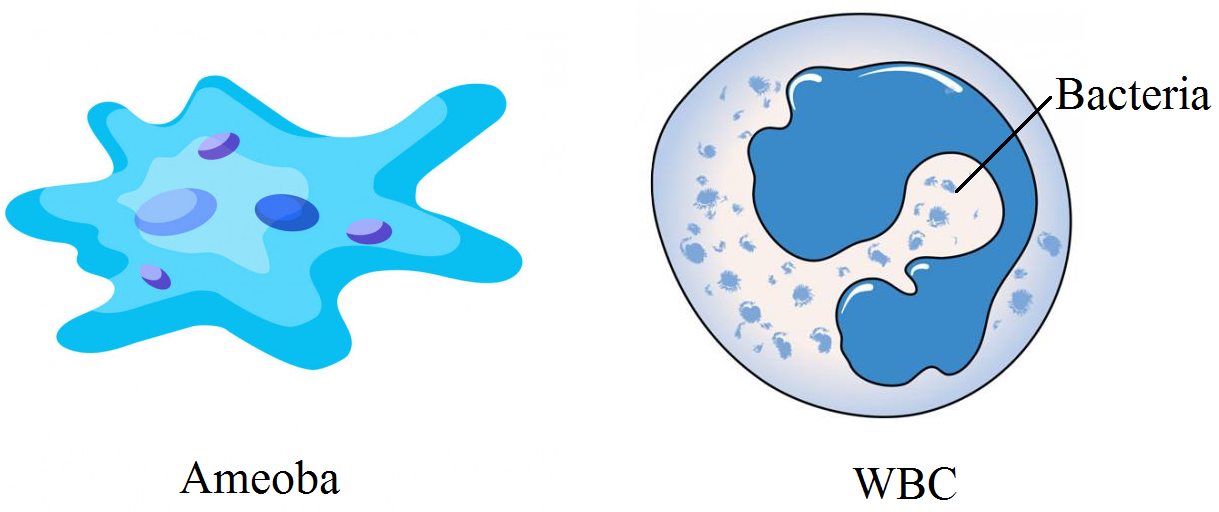
Statement 1: Amoeba and $WBCs$ use pseudopodia for locomotion.
Statement 2: Amoeba and $WBCs$ are both capable of independent existence.
Statement 3: Amoeba and $WBCs$ can change their shapes.
Statement 4: Amoeba and $WBCs$ have cell membrane.
  • Statement $1$ and $2$ are incorrect.
  • B
    Statement $3$ is incorrect.
  • C
    Statement $4$ is incorrect.
  • D
    Statement $1, 2, 3$ and $4$ are incorrect.
Answer
Correct option: A.
Statement $1$ and $2$ are incorrect.
Amoeba and $WBCs$ have cell membranes and can change their shapes. $WBCs$ use pseudopodia to engulf pathogens during phagocytosis, while amoeba uses pseudopodia for locomotion and engulfing food. Amoeba is a unicellular organism and can exist independently. $WBCs$, on the other hand, are incapable of independent existence.
View full question & answer
MCQ 761 Mark
Consider the following statements and select the option which correctly identifies true $(T)$ and false $(F)$ ones.
$(i)$
Robert Brown discovered nucleus in the cells.
$(ii)$
The plasma membrane is made up of a double layer of lipid molecules and protein molecules.
$(iii)$
Chloroplast helps in osmoregulation and maintains the osmotic pressure in a cell.
$(iv)$
Carbohydrates and fats are completely oxidised with the help of enzymes present in the mitochondria.
  • A
    $(i)$
    $(ii)$
    $(iii)$
    $(iv)$
    $T$
    $T$
    $F$
    $F$
  • $(i)$
    $(ii)$
    $(iii)$
    $(iv)$
    $T$
    $T$
    $F$
    $T$
  • C
    $(i)$
    $(ii)$
    $(iii)$
    $(iv)$
    $T$
    $F$
    $T$
    $T$
  • D
    $(i)$
    $(ii)$
    $(iii)$
    $(iv)$
    $T$
    $F$
    $F$
    $T$
Answer
Correct option: B.
$(i)$
$(ii)$
$(iii)$
$(iv)$
$T$
$T$
$F$
$T$
Vacuole helps in osmoregulation and maintains the osmotic pressure in a cell.
View full question & answer
MCQ 771 Mark
Which of the following organelles is responsible for mechanical support and enzyme transport?
  • A
    Mitochondria
  • Endoplasmic reticulum
  • C
    Chloroplast
  • D
    Golgi complex
Answer
Correct option: B.
Endoplasmic reticulum
In the given options $B$ represents endoplasmic reticulum. It helps in giving mechanical support and enzyme transportation.
View full question & answer
MCQ 781 Mark
Badal appeared in class test but he confused to know the correct statement. Would you help him to know that?
  • A
    A plant cell has a cell wall around it whereas an animal cell does not have a cell wall around it.
  • B
    In plant cell has a large vacuole in it whereas an animal cell has usually no vacuole.
  • C
    Photosynthetic plant cell has chloroplast in it whereas an animal cell does not have chloroplast or other plastids.
  • All the above.
Answer
Correct option: D.
All the above.
View full question & answer
MCQ 791 Mark
The parts which are not present in an animal cell are:
$A.$ Cell membrane.
$B.$ Chloroplast.
$C.$ Cell wall.
$D.$ Mitochondria.
  • A
    $A$ and $B$
  • $B$ and $C$
  • C
    $A$ and $D$
  • D
    $B$ and $D$
Answer
Correct option: B.
$B$ and $C$
View full question & answer
MCQ 801 Mark
Which organelle is called power house of the cell?
  • A
    Centrosome
  • B
    Lysosomes
  • C
    Plastids
  • Mitochondria
Answer
Correct option: D.
Mitochondria
View full question & answer
MCQ 811 Mark
Majority of cells cannot be seen directly with our naked eyes because:
  • A
    Organisms are generally unicellular.
  • Cells are microscopic.
  • C
    Cells are present only inside the body.
  • D
    Cells are grouped into tissues.
Answer
Correct option: B.
Cells are microscopic.
A cell is the smallest and basic unit of life which has definite structure and performs a specific function. Most of them cannot be seen with naked eyes because they are microscopic (i.e., very-very small).
View full question & answer
MCQ 821 Mark
Cell is discovered by:
  • A
    Robert Brown.
  • Robert Hooke.
  • C
    John Mendal.
  • D
    Charse Darwin.
Answer
Correct option: B.
Robert Hooke.
View full question & answer
MCQ 831 Mark
Which of the following statements is incorrect about Endoplasmic Reticulum?
  • A
    It is involved in lipid synthesis.
  • B
    Involved in detoxifying chemicals.
  • C
    It is involved in ribosome synthesis.
  • It is the post office of the cell.
Answer
Correct option: D.
It is the post office of the cell.
$i.$ Golgi apparatus is called as the post office of the cell since it is involved in the packaging, processing and transportation of substances.
$ii. \text{SER} ($Smooth endoplasmic reticulum$)$ is involved in detoxification and lipid synthesis, while $\text{RER}$ is involved in protein synthesis. Ribosomes are not synthesised by the $\text{ER}$.
View full question & answer
MCQ 841 Mark
Correct the given statements by replacing the underlined words and select the correct option.
$(i)$
The viscous fluid present in the nucleus is called $...........$ cytoplasm $...........$
$(ii)$
$...........$ Vacuoles $...........$ are rod shaped structures which oxidise food to provide energy.
$(iii)$
$...........$ Mitochondria $...........$ contain green pigment chlorophyll and take part in photosynthesis.
$(iv)$
$...........$ Lysosomes $...........$ take part in synthesis of proteins.
  • A
    $(i)-$Nucleoplasm,
    $(ii)-$Lysosomes,
    $(iii)-$Plastids,
    $(iv)-$Centrosomes
  • B
    $(i)-$Protoplasm,
    $(ii)-$Ribosomes,
    $(iii)-$Centrosomes,
    $(iv)-$Golgi bodies
  • $(i)-$Nucleoplasm,
    $(ii)-$Mitochondria,
    $(iii)-$Chloroplasts,
    $(iv)-$Ribosomes
  • D
    $(i)-$Protoplasm,
    $(ii)-$Plastids,
    $(iii)-$Chloroplasts,
    $(iv)-$Ribosomes
Answer
Correct option: C.
$(i)-$Nucleoplasm,
$(ii)-$Mitochondria,
$(iii)-$Chloroplasts,
$(iv)-$Ribosomes
View full question & answer
MCQ 851 Mark
Which of the following is a correct sequence?
$(i)$
Cell
$(ii)$
Tissue
$(iii)$
Organ system
$(iv)$
Organ
$(v)$
Organism
  • $(i) \rightarrow (ii) \rightarrow (iv) \rightarrow (iii) \rightarrow (v)$
  • B
    $(i) \rightarrow (iii) \rightarrow (iv) \rightarrow (ii) \rightarrow (v)$
  • C
    $(i) \rightarrow (v) \rightarrow (iv) \rightarrow (iii) \rightarrow (ii)$
  • D
    $(i) \rightarrow (v) \rightarrow (iii) \rightarrow (ii) \rightarrow (iv)$
Answer
Correct option: A.
$(i) \rightarrow (ii) \rightarrow (iv) \rightarrow (iii) \rightarrow (v)$
View full question & answer
MCQ 861 Mark
Which of the following organelles act as the digestive system within the cell?
  • A
    Golgi bodies
  • B
    Centrosomes
  • Lysosomes
  • D
    Mitochondria
Answer
Correct option: C.
Lysosomes
Lysosomes are known as the digestive organs of the cell. They engulf food materials and other substances which are hydrolyzed by enzymes.
View full question & answer
MCQ 871 Mark
Read the given paragraph.
The cytoplasm of the cells of a tomato plant contains organelle $X$ having different pigments. Pigment $Y$ present in leaves of plant and impart green colour whereas pigment $Z$ present in fruits of plant and impart red colour. Select the option which correctly identifies $X, Y$ and $Z$.
  • A
    $X$
    $Y$
    $Z$
    Plastid
    Leucoplast
    Chromoplast
  • $X$
    $Y$
    $Z$
    Plastid
    Chloroplast
    Chromoplast
  • C
    $X$
    $Y$
    $Z$
    Plastid
    Chloroplast
    Leucoplast
  • D
    $X$
    $Y$
    $Z$
    Plastid
    Chromoplast
    Chloroplast
Answer
Correct option: B.
$X$
$Y$
$Z$
Plastid
Chloroplast
Chromoplast
View full question & answer
MCQ 881 Mark
Which one of the following statements is correct?
$(i)$
They have membrane bound organelles including a nucleus.
$(ii)$
Bacteria are examples of prokaryotic cells.
$(iii)$
Lysosomes are present in eukaryotic cells.
$(iv)$
Fungi are prokaryotes.
  • A
    $(i)$ and $(ii)$
  • B
    $(ii), (iii)$ and $(iv)$
  • $(ii)$ and $(iii)$
  • D
    $(iii)$ and $(iv)$
Answer
Correct option: C.
$(ii)$ and $(iii)$
View full question & answer
MCQ 891 Mark
The jelly$-$like fluid substance present in cells is called:
  • A
    Protoplasm
  • B
    Chromosome
  • Chloroplast
  • D
    Cytoplasm
Answer
Correct option: C.
Chloroplast
Cytoplasm is the transparent jelly like fluid which fills the cell between nucleus and cell membrane. Most of the chemical reactions which keep the cell alive takes place here.
$i.$ Protoplasm is the living substance of the cell. It includes the cytoplasm and nucleus.
$ii.$ Chromoplasts are coloured plastids present in plant cell.
$iii.$ Chromosomes are thread like structures present in nucleus.
View full question & answer
MCQ 901 Mark
Which of the following human system includes oesophagus?
  • A
    Respiratory system.
  • B
    Circulatory system.
  • Digestive system.
  • D
    Reproductive system.
Answer
Correct option: C.
Digestive system.
Oesophagus is a part of human digestive system. It is a muscular tube which connects the pharynx to the stomach. It is also known as food pipe.
View full question & answer
MCQ 911 Mark
Which one of the following is not included in the nucleus?
  • Endoplasmic reticulum
  • B
    $\text{DNA}$
  • C
    Gene
  • D
    Chromosome
Answer
Correct option: A.
Endoplasmic reticulum
View full question & answer
MCQ 921 Mark
Under a microscope Paheli observes a cell that has a cell wall but no distinct nucleus. The cell that she observes is:
  • A
    A plant cell.
  • B
    An animal cell.
  • A nerve cell.
  • D
    A bacterial cell
Answer
Correct option: C.
A nerve cell.
The cell observed by Paheli is a bacterial cell. It is a prokaryotic cell that has a cell wall (like plants) but no distinct nucleus.
A plant cell has a cell wall and a well defined nucleus, whereas in an animal cell, the former is not present.
A nerve cell is an animal cell that is long and branched to function as transmitter between brain and other parts.
View full question & answer
MCQ 931 Mark
Match column $I$ with column $II$ and select the correct option from the codes given below.
 
Column $I$
 
Column $II$
$(a)$
Ribosomes
$(i)$
Jelly$-$like substance
$(b)$
Lysosomes
$(ii)$
Powerhouse of the cell
$(c)$
Endoplasmic reticulum
$(iii)$
Site of protein synthesis
$(d)$
Mitochondria
$(iv)$
Suicide bags
  • $(a) - (iii), (b) - (v), (c) - (iv), (d) - (i), (e) - (ii)$
  • B
    $(a) - (iv), (b) - (v), (c) - (iii), (d) - (i), (e) - (ii)$
  • C
    $(a) - (iii), (b) - (v), (c) - (i), (d) - (iv), (e) - (ii)$
  • D
    $(a) - (iv), (b) - (v), (c) - (ii), (d) - (i), (e) - (iii)$
Answer
Correct option: A.
$(a) - (iii), (b) - (v), (c) - (iv), (d) - (i), (e) - (ii)$
View full question & answer
MCQ 941 Mark
Consider the following statements and choose the incorrect one:
  • A
    The epidermal cells from a layer around the plant organs and protected the cells below from injury.
  • Xylem cells are the tube$-$like plant cell having thick and strong walls which carry water from leaves to other parts of the body.
  • C
    Photosynthesis cells of the plant contain chlorophyll and prepare food by photosynthesis.
  • D
    None of the above
Answer
Correct option: B.
Xylem cells are the tube$-$like plant cell having thick and strong walls which carry water from leaves to other parts of the body.
View full question & answer
MCQ 951 Mark
Cheek cells do not have _______.
  • A
    Cell membrane.
  • B
    Nucleus.
  • C
    Golgi apparatus.
  • Plastids.
Answer
Correct option: D.
Plastids.
Cheek cells are animal cells. So, there will be no plastids. All other cell organelles such as nucleus, $GA$, ribosomes, etc are enclosed in the cell membrane of cell.
View full question & answer
MCQ 961 Mark
Red blood cells do not have:
$(i)$
Cell membrane
$(ii)$
Cytoplasm
$(iii)$
Plastid
$(iv)$
Nucleus
  • A
    $(i)$ and $(ii)$
  • B
    $(ii)$ and $(iii)$
  • $(iii)$ and $(iv)$
  • D
    $(i)$ and $(iv)$
Answer
Correct option: C.
$(iii)$ and $(iv)$
View full question & answer
MCQ 971 Mark
The largest cell is of $..........$
  • A
    Bacteria.
  • B
    Human neuron.
  • Egg of an ostrich.
  • D
    Egg of blue whale.
Answer
Correct option: C.
Egg of an ostrich.
View full question & answer
MCQ 981 Mark
Which of the following is a type of plastid?
  • A
    Chloroplasts
  • B
    Chromoplasts
  • C
    Leucoplasts
  • All the above
Answer
Correct option: D.
All the above
View full question & answer
MCQ 991 Mark
Chloroplast is found in.
  • Plant cell only.
  • B
    Animal cell only.
  • C
    Both of these.
  • D
    None of these.
Answer
Correct option: A.
Plant cell only.
View full question & answer
MCQ 1001 Mark
The control centre of all the activities of a cell is:
  • Nucleus
  • B
    Nucleoplasm
  • C
    Cytoplasm
  • D
    Organelles
Answer
Correct option: A.
Nucleus
View full question & answer