Questions · Page 3 of 5

M.C.Q. [I MARKS]

MCQ 1011 Mark
Which of the following is the jellylike substance inside the plasma membrane in which all the cell organelles are found floating?
  • A
    Tonoplasm
  • Cytoplasm
  • C
    Karyoplasm
  • D
    Cell sap
Answer
Correct option: B.
Cytoplasm
Cytoplasm is divided into cytoplasm and nucleoplasm.
View full question & answer
MCQ 1021 Mark
Green colour of leaves is due to presence of the pigment:
  • Chlorophyll
  • B
    Ribosomes
  • C
    Mitochondria
  • D
    Chloroplast
Answer
Correct option: A.
Chlorophyll

The pigment chlorophyll present in the chloroplasts, which is responsible for green colour of leaves. It can absorb solar energy for photosynthesis.

View full question & answer
MCQ 1031 Mark
$............$ is carried out by ribosomes.
  • A
    Lipid synthesis
  • Protein synthesis
  • C
    Respiration
  • D
    Photosynthesis
Answer
Correct option: B.
Protein synthesis
View full question & answer
MCQ 1041 Mark
The main parts of our digestive system where digestion takes place are stomach, small intestine and large intestine. Digestion starts in mouth itself and continues till large intestine. The last part of large intestine where undigested food is stored for some time is called:
  • Rectum
  • B
    Colon
  • C
    Jejunum
  • D
    Duodenum
Answer
Correct option: A.
Rectum
View full question & answer
MCQ 1051 Mark
Cell theory was given by:
  • A
    Charles Darwin
  • B
    Theodor Schwann
  • C
    Matthias Jakob Schleiden
  • Both $[b]$ and $[c]$
Answer
Correct option: D.
Both $[b]$ and $[c]$
View full question & answer
MCQ 1071 Mark
Read the given statements and select the option which correctly fill the blanks $(i) - (iv).$
$(i)$
________ is membrane bound sac filled with fluid.
$(ii)$
________ is found in cytoplasm and on endoplasmic reticulum.
$(iii)$
________ is involved in the formation of lysosome and peroxisome.
$(iv)$
________is capable of digesting any microorganism that enters the cell.
  • A
    $(i)$
    $(ii)$
    $(iii)$
    $(iv)$
    Ribosome
    Lysosome
    Golgi apparatus
    Vacuole
  • $(i)$
    $(ii)$
    $(iii)$
    $(iv)$
    Vacuole
    Ribosome
    Golgi apparatus
    Lysosome
  • C
    $(i)$
    $(ii)$
    $(iii)$
    $(iv)$
    Ribosome
    Lysosome
    Vacuole
    Golgi apparatus
  • D
    $(i)$
    $(ii)$
    $(iii)$
    $(iv)$
    Lysosome
    Ribosome
    Vacuole
    Golgi apparatus
Answer
Correct option: B.
$(i)$
$(ii)$
$(iii)$
$(iv)$
Vacuole
Ribosome
Golgi apparatus
Lysosome
 
$(i)$
$(ii)$
$(iii)$
$(iv)$
Vacuole
Ribosome
Golgi apparatus
Lysosome
View full question & answer
MCQ 1081 Mark
A cell with a definite nucleus and nuclear membrane is called as $...........$
  • A
    Virus
  • B
    Plant cell
  • C
    Prokaryote
  • Eukaryote
Answer
Correct option: D.
Eukaryote
View full question & answer
MCQ 1091 Mark
Which of the following is the small rod shaped structure bound by a double membrane which helps in the oxidation of food to release energy?
  • Mitochondrion
  • B
    Golgi complex
  • C
    Nucleus
  • D
    Vacuole
Answer
Correct option: A.
Mitochondrion
Mitochondria are the sites of cell respiration.
View full question & answer
MCQ 1101 Mark
$...........$ is the power house of the cells.
  • A
    Ribosome
  • Mitochondria
  • C
    Nucleus
  • D
    Cell wall
Answer
Correct option: B.
Mitochondria
View full question & answer
MCQ 1121 Mark
The unit of measurement used for expressing dimension (Size) of cells is:
  • A
    Centimeter.
  • B
    Millimeter.
  • Micrometer.
  • D
    Metre.
Answer
Correct option: C.
Micrometer.
Micrometer is the unit of measurement used for expressing dimension of cell.
View full question & answer
MCQ 1131 Mark
Which of the following statements is/ are incorrect regarding genes?
$(i)$
They control the transfer of hereditary characteristics.
$(ii)$
Nucleolus carries all the genes.
$(iii)$
They are part of chromosomes.
$(iv)$
They are found only in the nucleus.
  • A
    $(iii)$ only
  • B
    $(iii)$ and $(iv)$ only
  • C
    $(i)$ only
  • $(ii)$ and $(iv)$ only
Answer
Correct option: D.
$(ii)$ and $(iv)$ only
Nucleus carries genes as they are part of chromosomes (made up of $DNA$) and chromosomes are present in the nucleus. Genes are also found in mitochondria and chloroplasts as these organelles contain their own $DNA$.
View full question & answer
MCQ 1141 Mark
Read the following parts of examples of organisms.
  • A
    Moss and sponge.
  • B
    Yeast and Amoeba.
  • Bacteria and blue-green algae.
  • D
    Penicillium and Spirogyra.
    The pair that belongs to the group of prokaryotes is:
Answer
Correct option: C.
Bacteria and blue-green algae.
Bacteria and blue-green algae are examples of prokaryotes. These organisms consist of prokaryotic cell no nuclear membrane, no well defined nucleus and no other cell organelles.
View full question & answer
MCQ 1151 Mark
Which of the following is not a cell?
  • A
    Red Blood Corpuscle $(RBC)$.
  • B
    Bacterium.
  • C
    Spermatozoa.
  • Virus.
Answer
Correct option: D.
Virus.
Virus is not considered a cell. It is an exception to the cell theory and cannot survive on its own.
View full question & answer
MCQ 1161 Mark
Which of the following cell organelles does $NOT$ contain $DNA$?
  • A
    Mitochondria
  • B
    Chloroplast
  • C
    Nucleus
  • Lysosome
Answer
Correct option: D.
Lysosome

In the given options lysosomes do not contain $DNA$.

View full question & answer
MCQ 1171 Mark
The thread-like structures present in the nucleus are:
  • A
    Nucleolus
  • Chromosomes
  • C
    Genes
  • D
    Ribosomes
Answer
Correct option: B.
Chromosomes

Chromosomes are the thread-like structures present in the nucleus. They contain genes that functions to transfer the characteristics from the parents to the offsprings.

View full question & answer
MCQ 1181 Mark
Which of the following cells have irregular shape?
  • A
    White Blood Cells.
  • B
    Amoeba
  • Both $(a)$ and $(b).$
  • D
    None of these.
Answer
Correct option: C.
Both $(a)$ and $(b).$
View full question & answer
MCQ 1191 Mark
Which of the following have cell walls?
  • A
    Epidermal cell and epithelial cell.
  • B
    Epithelial cell and mesophyll cell.
  • Epidermal cell and mesophyll cell.
  • D
    Epithelial cell and liver cell.
Answer
Correct option: C.
Epidermal cell and mesophyll cell.
Cell wall is a characteristics of plant cell only and absent in animal cell. It is an outer, rigid, protective and supportive covering of plant cells. The cell wall lies outside of the plasma membrane. Epidermal cell and mesophyll cell are examples of plant cells. Thus, they have cell wall.
View full question & answer
MCQ 1201 Mark
Which of the following is a plant cell?
  • A
    Cartilage cell.
  • B
    Neuron.
  • Epidermal cell.
  • D
    Epithelial cell.
Answer
Correct option: C.
Epidermal cell.
Epidermal cell is a plant cell while cartilage cell, neuron and epithelial cell are animal cells.
View full question & answer
MCQ 1211 Mark
Based on the following options, how does a plant cell differ from an animal cell?
  • A
    Cell wall
  • B
    Mitochondrion
  • Both $A$ and $B$
  • D
    Chloroplast
Answer
Correct option: C.
Both $A$ and $B$
An outer thick layer of plant cell is called the cell wall. This additional layer surrounding the cell membrane is required by the plants for protection and for the shape of the cell. All the green plants contain the pigment chlorophyll. It traps sunlight required for photosynthesis. Chlorophyll are present inside the chloroplasts. Mitochondria (sing. mitochondrion) is present in both animal and plant cell. It produces energy in the form of
$ATP$.
View full question & answer
MCQ 1221 Mark
The cell wall in onion peel cell is made of:
  • A
    Starch.
  • B
    Gelatin.
  • Cellulose.
  • D
    Cell sap.
Answer
Correct option: C.
Cellulose.
The cell wall in onion peel cell is made of cellulose.
View full question & answer
MCQ 1231 Mark
Father of microbiology is:
  • A
    Robert Swanson
  • Leeuwenhoek
  • C
    Robert Hooke
  • D
    Robert Brown
Answer
Correct option: B.
Leeuwenhoek
View full question & answer
MCQ 1241 Mark
Payel is completed her science chapter where she wrote some statements. She wants to know whether the statements are correct or not? Payel wants to take help from you:
  • A
    Bacteria and blue green algae are prokaryotes.
  • B
    The cell having nuclear material without a nuclear membrane around it are called prokaryotic cells.
  • C
    The cells having nuclear material enclosed by a nuclear membrane and eukaryotic cells.
  • All the above.
Answer
Correct option: D.
All the above.
View full question & answer
MCQ 1251 Mark
Which of the following are the dense threadlike and rod like structures present in the nucleus?
  • A
    Golgi complex and chromatin.
  • B
    Chromosomes and Endoplasmic reticulum.
  • C
    Centrosome and chromatin.
  • Chromatin and chromosome.
Answer
Correct option: D.
Chromatin and chromosome.
Nucleus contains thread-like structures called chromosomes which are visible in a cell in the resting stage as chromatin threads. These threads unwind, shorten and thicken during cell division to become chromosomes.
View full question & answer
MCQ 1261 Mark
Protoplasm inside the nucleus is called:
  • A
    Cytoplasm
  • B
    Elaioplast
  • Nucleoplasm
  • D
    Amyloplast
Answer
Correct option: C.
Nucleoplasm
View full question & answer
MCQ 1271 Mark
Which of the following cell organelles are respectively called suicidal bags and power houses of the cell?
  • A
    Mitochondria and lysosomes.
  • Lysosomes and mitochondria.
  • C
    Lysosomes and Golgi complex.
  • D
    Golgi complex and lysosomes.
Answer
Correct option: B.
Lysosomes and mitochondria.
When cell becomes old or damaged beyond repair, the lysosmes secrete enzymes in the cytoplasm that leads to the death of the cell. Hence, they are called the suicide bags of the cell. The energy in the form of $ATP$ is stored in mitochondria and hence are called the power house of the cell.
View full question & answer
MCQ 1281 Mark
The membrane which binds the chromosomes and nucleolus inside the nucleus is:
  • A
    Cytoplasm
  • B
    Nucleoplasm
  • Nuclear membrane
  • D
    Cell membrane
Answer
Correct option: C.
Nuclear membrane
View full question & answer
MCQ 1291 Mark
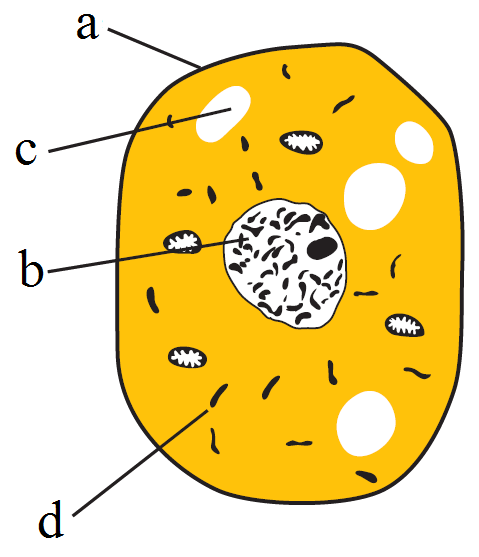
Choose the correct option for labelling the given figure of an animal cell.
  • A
    $A$ - membrane, b - golgi body, c - mitochondria, d - nucleus.
  • $A$ - cell membrane b - nucleus, c - mitochondria, d - golgi body.
  • C
    $A$ - cell wall, b - nucleus, c - mitochondria, d - golgi body.
  • D
    $A$ - cell wall, b - golgi body; c - mitochondria, d - nucleus.
Answer
Correct option: B.
$A$ - cell membrane b - nucleus, c - mitochondria, d - golgi body.
View full question & answer
MCQ 1301 Mark
One millionth of a metre is.
  • A
    Millimetre
  • Micrometre
  • C
    Nanometre
  • D
    Centimetre
Answer
Correct option: B.
Micrometre
View full question & answer
MCQ 1311 Mark
Living substance of cell is called $..........$
  • A
    Cytoplasm
  • Protoplasm
  • C
    Nucleus
  • D
    Chromosmes
Answer
Correct option: B.
Protoplasm
View full question & answer
MCQ 1321 Mark
Name the smallest cell:
  • Bacteria mycoplasma.
  • B
    Ostrich egg.
  • C
    Human egg.
  • D
    Red blood cells.
Answer
Correct option: A.
Bacteria mycoplasma.
Bacteria mycoplasma is the smallest cell. The size of this cell is $0.0001mm$ or $0.1$ micrometre.
View full question & answer
MCQ 1331 Mark
Which of the following is a saclike structure that store food, wastes and water?
  • A
    Lysosomes
  • B
    Centrosomes
  • C
    Chromosomes
  • Vacuoles
Answer
Correct option: D.
Vacuoles
Vacuoles are called the store houses of the cell and store water, food and the excreted substances of the cell.
View full question & answer
MCQ 1341 Mark
Paheli accidentally placed her hand over a flame and immediately pulled it back. She felt the sensation of heat and reacted due to the action of:
  • A
    Blood cells.
  • B
    Skin surface.
  • Nerve cells.
  • D
    Nucleus of cells.
Answer
Correct option: C.
Nerve cells.
Nerve cells have a special shape-long and branched $($with projections$)$ to receive and transmit message between the brain and other body parts. Thus they help to feel sensations and in responding to them.
View full question & answer
MCQ 1351 Mark
Who is known as father of microbiology?
  • A
    Alexander Fleming
  • B
    Robert Hook
  • Leeuwenhoek
  • D
    $E.$ Adams
Answer
Correct option: C.
Leeuwenhoek
View full question & answer
MCQ 1361 Mark
Who discovered cell first time by observing cork?
  • A
    Alexander Fleming.
  • Robert Hook.
  • C
    Leeuwenhoek.
  • D
    Isaac Newton.
Answer
Correct option: B.
Robert Hook.
View full question & answer
MCQ 1371 Mark
Which of the following pairs are correctly matched?
$(i)$
Protoplasm $-$ Purkinje
$(ii)$
Discovery of cell $-$ Leeuwenhoek
$(iii)$
Cell theory $-$ Schwann
$(iv)$
Omnis cellula$-$e$-$cellula $-$ Virchow
$(v)$
Nucleolus $-$ Robert Brown
  • $(i), (iii)$ and $(iv)$ only
  • B
    $(i), (iii), (iv)$ and $(v)$ only
  • C
    $(i), (ii)$ and $(iv)$ only
  • D
    $(ii), (iv)$ and $(v)$ only
Answer
Correct option: A.
$(i), (iii)$ and $(iv)$ only
Robert Hook discovered cell. Robert Brown discovered nucleus.
View full question & answer
MCQ 1381 Mark
The unit of measurement used for expressing the dimension $($size$)$ of cells is:
  • A
    Centimetre
  • B
    Millimetre
  • Micrometre
  • D
    Metre
Answer
Correct option: C.
Micrometre
Micrometre is the unit of measurement used for expressing dimension of cell.
View full question & answer
MCQ 1391 Mark
Excretion is the integral part of the life process. Excretion takes place in both plants and animals. Which one of the following methods given below is not the method of excretions in plants?
  • A
    Transpiration
  • B
    Gums
  • C
    Resins
  • Sweating
Answer
Correct option: D.
Sweating
View full question & answer
MCQ 1401 Mark
Identify the correct statement:
  • A
    The tissue is a group of dissimilar cells.
  • B
    An organ consists of similar cells.
  • C
    Vacuoles are not found in plant cells.
  • Prokaryotes do not have a nucleus.
Answer
Correct option: D.
Prokaryotes do not have a nucleus.
Pokaryotes do not have a well$-$defined nucleus. The irregularly-shaped region that contains their genetic material is called nucleoid. The other statements in correct form are: tissue is a group of similar cells. And organ consists of different tissues. Large vacuoles are found in plant cells.
View full question & answer
MCQ 1411 Mark
A suitable term of the various components of cells is:
  • A
    Tissue
  • Cell organdies
  • C
    Chromosomes
  • D
    Genes
Answer
Correct option: B.
Cell organdies
View full question & answer
MCQ 1431 Mark
Which type of tissue is responsible for receiving, interpreting and producing a response to stimuli?
  • A
    Muscle tissue
  • Nervous tissue
  • C
    Epithelial tissue
  • D
    Connective tissue
Answer
Correct option: B.
Nervous tissue
The nervous tissue is present in the brain, the spinal cord and nerves.
View full question & answer
MCQ 1441 Mark
Jelly$-$like substance present between the cell membrane and the nucleus is:
  • A
    Water
  • B
    Nucleoplasm
  • Cytoplasm
  • D
    Oil
Answer
Correct option: C.
Cytoplasm
View full question & answer
MCQ 1451 Mark
Which of the following statements are true for eukaryotic cells?
  • A
    They have a well-organized nucleus and blue$-$green algae are eukaryotic cells.
  • They have a well$-$organized nucleus and they have a nuclear membrane.
  • C
    They do not have a nuclear membrane and they have a well$-$organized nucleus.
  • D
    They do not have a nuclear membrane and blue$-$green algae are eukaryotic cells.
Answer
Correct option: B.
They have a well$-$organized nucleus and they have a nuclear membrane.
The cells having well defined nucleus containing nuclear material, enclosed by a nuclear membrane are called eukaryotic cells. Example cheek cells. Blue green algae are prokaryotic cells that do not have a nuclear membrane.
View full question & answer
MCQ 1461 Mark
Which of the following tissues is/ are present in stomach?
  • A
    Muscle tissue
  • B
    Epithelial tissues
  • C
    Connective tissues
  • All of these
Answer
Correct option: D.
All of these
Muscle tissues, epithelial tissues and connective tissues are present in stomach.
View full question & answer
MCQ 1471 Mark
Endoplasmic reticulum is a network of interconnecting membranous structures filled with fluid. Which of the following cells would most likely have high concentration of densely packed rough endoplasmic reticulum?
  • A
    A bioluminescent bacterial cell.
  • B
    A functional phloem at maturity.
  • C
    An amoeba engulfing small ciliates.
  • A pancreatic cell engaged in the production of digestive enzymes.
Answer
Correct option: D.
A pancreatic cell engaged in the production of digestive enzymes.
Endoplasmic reticulum helps in the transport of substances within the cell. Rough endoplasmic reticulum $(\text{RER})$ bears ribosomes on the cytoplasmic surface and synthesize secretory and membranous proteins. Then the modified proteins move into the transitional area where they are further processed and packed into secretory vesicles. Thus, $\text{RER}$ is rich in cells which are actively engaged in protein synthesis and secretory activity, e.g., pancreatic cells engaged in the production of digestive enzymes, etc.
View full question & answer
MCQ 1481 Mark
Which of the following organelles differentiate between plant cell and animal cell?
$(i)$
Cytoplasm
$(ii)$
Nucleus
$(iii)$
Cell wall
$(iv)$
Large vacuole
  • A
    $(i)$ and $(ii)$ only
  • B
    $(i)$ and $(iii)$ only
  • C
    $(ii)$ and $(iv)$ only
  • $(iii)$ and $(iv)$ only
Answer
Correct option: D.
$(iii)$ and $(iv)$ only
View full question & answer
MCQ 1491 Mark
Which of the following cells can change its shape
  • White blood cell.
  • B
    Egg cell.
  • C
    Red blood cell.
  • D
    All of the above.
Answer
Correct option: A.
White blood cell.
View full question & answer
MCQ 1501 Mark
Read the following sentences carefully, and choose the correct one:
  • A
    Different organisms have different number of cells in their bodies.
  • B
    The cells in multicellular organisms can have many different sizes.
  • C
    The cells in multicellular organisms $($plants and animals$)$ have many different shapes.
  • All the above.
Answer
Correct option: D.
All the above.
View full question & answer
M.C.Q. [I MARKS] - Page 3 - Science STD 8 Questions - Vidyadip