Questions · Page 4 of 5

M.C.Q. [I MARKS]

MCQ 1511 Mark
Which of the following is not a unicellular organism?
  • Amoeba.
  • B
    Yak.
  • C
    Yeast.
  • D
    Rhizobium.
Answer
Correct option: A.
Amoeba.
Amoeba, yeast and rhizobium are examples of unicellular organisms while Yak is an example of multicellular organisms.
View full question & answer
MCQ 1521 Mark
David takes a potted plant and places it in dark for $48$ hours. He experiments photosynthesis with the help of iodine solution, and finds that there is no change in colour. Which one of the following has not formed on the leaf that resulted in no change of colour?
  • A
    Protein
  • B
    Carbohydrate
  • Starch
  • D
    Fats
Answer
Correct option: C.
Starch
View full question & answer
MCQ 1531 Mark
The liquid containing dissolved sugars and salts in the plant vacuole is:
  • A
    Xylem
  • B
    Phloem
  • Cell sap
  • D
    All the above
Answer
Correct option: C.
Cell sap
View full question & answer
MCQ 1541 Mark
The part of a cell which plays a role in inheritance is:
  • Nucleus.
  • B
    Cytoplasm.
  • C
    Plasma membrane.
  • D
    Mitochondria.
Answer
Correct option: A.
Nucleus.
Nucleus contains thread-like structures called chromosomes. These carry genes and help in inheritance or transfer of characters from the parents to the offspring.
View full question & answer
MCQ 1551 Mark
If your father has brown eyes, you may also have brown eyes. If your mother has curly hair, you might also end up having curly hair. This transfer of characteristics is due to the transfer of $...........$
  • A
    Mitochondria
  • B
    Lysosomes
  • Chromosomes
  • D
    Chloroplasts
Answer
Correct option: C.
Chromosomes
Nucleus contains thread-like structures called chromatins. Chromosomes are condensed form of chromatin. During cell division, these chromosomes carry genes and help in transfer of characters from parents to offspring.
View full question & answer
MCQ 1561 Mark
The group of similar cell which work together to perform a particular functions is called:
  • A
    Organ.
  • B
    Organelle.
  • C
    Organisms.
  • Tissue.
Answer
Correct option: D.
Tissue.
The group of similar cells which work together to perform a particular function is called tissue.
View full question & answer
MCQ 1571 Mark
Hen’s egg is:
  • A
    An organ
  • A Single cell
  • C
    A tissue
  • D
    Is none of the above.
Answer
Correct option: B.
A Single cell
View full question & answer
MCQ 1581 Mark
Functions of a cell are controlled by:
  • A
    Tissues
  • B
    Cell membrane
  • Nucleus
  • D
    Nucleus membrane
Answer
Correct option: C.
Nucleus
View full question & answer
MCQ 1591 Mark
Which of the following combinations are present in plant cell but not in animal cell.
  • Cell Wall $\&$ Plastid.
  • B
    Cell wall and Cell membrane.
  • C
    Plastid and Nucleus.
  • D
    Cell Membrane and Cytoplasm.
Answer
Correct option: A.
Cell Wall $\&$ Plastid.
View full question & answer
MCQ 1601 Mark
Which of the following cell organelles receives the substances synthesized and released by the $\text{ER}$, condenses, modifies, packs and releases them in the form of secretory vesicles?
  • Golgi complex
  • B
    Mitochondrion
  • C
    Lysosome
  • D
    Ribosome
Answer
Correct option: A.
Golgi complex
Golgi complex receives the substances synthesized and release by the $\text{ER,}$ condenses, modifies, packs and releases them in the form of secretory vesicles.
View full question & answer
MCQ 1611 Mark
The fluid present between the cell membrane and the nucleus is called.
  • A
    Nucleoplasm
  • B
    Protoplasm
  • C
    Serum
  • Cytoplasm
Answer
Correct option: D.
Cytoplasm
The jelly$-$like fluid present between the cell membrane and the nuclear membrane is called the cytoplasm. It houses all the cellular organelles and is the site for most of the metabolic activities taking place in the cell.
View full question & answer
MCQ 1621 Mark
Nucleus is separated from cytoplasm by.
  • A
    Protoplasm.
  • B
    Cell membrane.
  • C
    Cell Wall.
  • Nuclear membrane.
Answer
Correct option: D.
Nuclear membrane.
View full question & answer
MCQ 1631 Mark
Which of the following scientists discovered cells in cork slices?
  • A
    Louis Pasteur.
  • Robert Hooke.
  • C
    Antonie van Leeuwenhoek.
  • D
    Carl Linnaeus.
Answer
Correct option: B.
Robert Hooke.
Robert Hooke in $1665$ observed thin slices of cork under a simple magnifying device. He observed box$-$like structures and named them 'cells'. This is because these structures reminded him of the cells in a monastery.
View full question & answer
MCQ 1641 Mark
What is the major difference between a human skin cell and a human egg cell?
  • A
    The egg cell has twice as many chromosomes as the skin cell.
  • The egg cell has half as many chromosomes as the skin cell.
  • C
    The skin cell has no genetic information in its chromosomes.
  • D
    Only the egg cell has a nucleus.
Answer
Correct option: B.
The egg cell has half as many chromosomes as the skin cell.
View full question & answer
MCQ 1651 Mark
Which of the following organelle is not found in the root cells of a plant?
  • A
    Nucleus.
  • B
    Vacuole.
  • C
    Mitochondria.
  • Chloroplasts.
Answer
Correct option: D.
Chloroplasts.
Chloroplasts are found only in those plant cells which carry out photosynthesis like the cells in green leaves. So, chloroplasts are not found in the root cells of a plant.
View full question & answer
MCQ 1661 Mark
Which of the following is/ are made up of cellulose?
  • A
    Cell membrane
  • B
    Plasma membrane
  • Cell wall
  • D
    All of these
Answer
Correct option: C.
Cell wall
The cell wall is made up of cellulose.
View full question & answer
MCQ 1671 Mark
Small rod$-$like organelles which oxidize food to produce energy are:
  • A
    Golgi bod
  • Mitochondria
  • C
    Lysosomes
  • D
    Endoplasmic reticulum
Answer
Correct option: B.
Mitochondria
View full question & answer
MCQ 1681 Mark
Plastids present in roots, seeds and underground stem of a plant is:
  • A
    Chloroplast
  • Leucoplast
  • C
    Chromoplast
  • D
    Chlorophyll
Answer
Correct option: B.
Leucoplast
View full question & answer
MCQ 1691 Mark
Choose the correct statement$(s):$
$i.$ Ribosomes are located on the chromosomes.
$ii.$ Cell is located in the nucleus.
$iii.$ Chloroplasts are located in the nucleolus.
$iv.$ Cell membrane surrounds the cell.
  • A
    $(i), (ii)$ and $(iii)$
  • B
    $(iii)$ and $(iv)$
  • C
    $(i)$ and $(ii)$
  • Only $(iv)$
Answer
Correct option: D.
Only $(iv)$
$i.$ Freely floating in the cytoplasm.Ribosomes are protein synthesising units which are present attached to the $\text{RER}$ or are.
$ii.$ Nucleus is present in the cell.
$iii.$ Chloroplasts are present in the cytoplasm of plant cells.
$iv.$ Nuclear membrane surrounds the nucleus and cell membrane surrounds the cell.
View full question & answer
MCQ 1701 Mark
Which of the following sets contains unicellular organisms only?
  • A
    Amoeba, Allium, Saccharomyces.
  • Euglena, Chlorella, Escherichia.
  • C
    Euglena, Saccharomyces, Allium.
  • D
    Rhizopus, Amoeba, Solatium.
Answer
Correct option: B.
Euglena, Chlorella, Escherichia.
Unicellular organisms are those organisms that have single cell. Euglena, Chlorella and Escherichia are unicellular organisms.
View full question & answer
MCQ 1711 Mark
Which one of the following represents the correct level of organization ranging from simplest to most complex?
  • Cells Tissues Organs Organ systems Organisms.
  • B
    Tissues Organs Cells Organisms Organ system.
  • C
    Cells Tissues Organ system Organisms Organs.
  • D
    Cells Organs Tissues Organ systems Organisms.
Answer
Correct option: A.
Cells Tissues Organs Organ systems Organisms.
View full question & answer
MCQ 1721 Mark
Which one of the following terms is not a part of the nucleus?
  • Ribosome.
  • B
    Nucleolus.
  • C
    Chromosome.
  • D
    Gene.
Answer
Correct option: A.
Ribosome.
Ribosome is not a part of nucleus. They are found floating in the cytosol or attached to the endoplasmic reticulum.
Nucleus is the largest organelle in cell that contain thread$-$like structures called chromosomes on which genes are present. Nucleolus is the round irregular structures present inside nucleus.
View full question & answer
MCQ 1731 Mark
Which of the following structures regulate cell division in animal cells?
  • A
    Chromosomes
  • B
    Chromatin
  • Centrosome
  • D
    Spindle fibrils
Answer
Correct option: C.
Centrosome
Centrosome is an organelle present near the nucleus of an animal cell. It initiates the process of cell division. In plant cells, centrioles appear only at the time of cell division.
View full question & answer
MCQ 1741 Mark
Choose the correct statements.
  • Genes are located in the chromosomes.
  • B
    Cell is located in the nucleus.
  • C
    Chromosomes are located in the nucleolus.
  • D
    Cell membrane surrounds the nucleus.
Answer
Correct option: A.
Genes are located in the chromosomes.
Genes are the unit of inheritance located in the chromosomes. The other statements are incorrect and their correct form are as:
Nucleus is located in the cell Chromosomes are located in the nucleus.
Cell membrane surrounds the cell and nuclear membrane surrounds the nucleus.
View full question & answer
MCQ 1751 Mark
Which among the following organelles synthesise lipids?
  • Smooth Endoplasmic Reticulum.
  • B
    Lysosome.
  • C
    Rough Endoplasmic Reticulum.
  • D
    Golgi apparatus.
Answer
Correct option: A.
Smooth Endoplasmic Reticulum.
Lipids are synthesised by the Smooth Endoplasmic Reticulum $(\text{SER}),$ while the Rough Endoplasmic Reticulum $(\text{RER})$ synthesises proteins with the help of ribosomes attached to them.
View full question & answer
MCQ 1761 Mark
Which one of the following is related to inheritance of characters from one generation to another?
  • A
    Cell membrane and cytoplasm
  • B
    Nucleolus and mitochondria
  • C
    Chloroplast and cell membrane
  • Chromosomes and Genes
Answer
Correct option: D.
Chromosomes and Genes
View full question & answer
MCQ 1771 Mark
The empty blank looking structures in the cytoplasm is:
  • Vacuoles
  • B
    Plastids
  • C
    Plasma membrane
  • D
    Nucleus
Answer
Correct option: A.
Vacuoles
View full question & answer
MCQ 1781 Mark
Which of the following organelle is not found in the root cells of a plant?
  • A
    Nucleus
  • B
    Vacuole
  • C
    Mitochondria
  • Chloroplasts
Answer
Correct option: D.
Chloroplasts
Chloroplasts are found only in those plant cells which carry out photosynthesis like the cells in green leaves. So, chloroplasts are not found in the root cells of a plant.
View full question & answer
MCQ 1791 Mark
Which of the following statements is/ are the functions of golgi apparatus?
  • A
    Transporting proteins that are to be released from the cell.
  • Packaging proteins into vesicles.
  • C
    Altering or modifying proteins.
  • D
    All of these.
Answer
Correct option: B.
Packaging proteins into vesicles.
Golgi bodies are usually called dictyosomes in plants. The main function of golgi body is to secrete digestive enzymes through membrane-bound vesicles.
View full question & answer
MCQ 1801 Mark
In eukaryotes genes are located in $..........$ of the cell.
  • A
    Cytoplasm
  • Nucleus
  • C
    Vacuoles
  • D
    Chlorophyll
Answer
Correct option: B.
Nucleus
View full question & answer
MCQ 1811 Mark
Which of the following is true of the colourless plastid and its function?
  • A
    Chloroplasts performs photosynthesis.
  • B
    Leucoplasts performs respiration.
  • C
    Chromoplasts are involved with protection from sunlight.
  • Leucoplasts help in the storage of food.
Answer
Correct option: D.
Leucoplasts help in the storage of food.
Plastids are of three types, i.e. chloroplasts, leucoplasts and chromoplasts. Leucoplasts are colourless plastids which are capable of storing food materials.
View full question & answer
MCQ 1821 Mark
The liquid in the nucleus is:
  • A
    Nuclear membrane
  • Nucleoplasm
  • C
    Nucleolus
  • D
    Chromosome
Answer
Correct option: B.
Nucleoplasm
View full question & answer
MCQ 1831 Mark
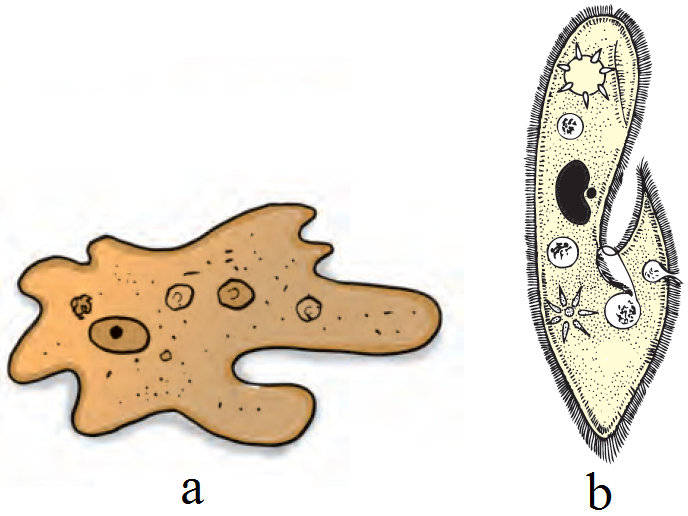
Which of the following is incorrect about the given figures?
  • A
    Both are unicellular eukaryotic organisms.
  • A is unicellular while $b$ is multicellular organism.
  • C
    Both are capable of independent existence.
  • D
    Both $(b)$ and $(c)$
Answer
Correct option: B.
A is unicellular while $b$ is multicellular organism.
Figure a is of Amoeba and figure $b$ is of Paramecium. Both are unicellular eukaryotic organisms and are capable of independent existence.
View full question & answer
MCQ 1841 Mark
The table given below has certain terms and five spaces named $a, b, c, d$ and $e.$
Cell
Feature/ Part
Function
Bacteria plant cell $\text{CE}$
A Chloroplast Spindle shaped Selectively permeable.
Movement $\text{BD}$ Protect the cell from its surroundings.
From the options given below choose the correct Combination of terms.
  • A
    $A -$ pseudopodia, $B -$ respiration, $C -$ muscle cell, $D -$ expansion, $E -$ nucleus.
  • B
    $A -$ flagella, $B -$ photosynthesis, $C -$ nerve cell, $D -$ contraction, $E -$ cell vacuole.
  • C
    $A -$ cilia, $B -$ reproduction, $C -$ blood cell, $D -$ contraction, $E -$ nucleus.
  • $A -$ flagella, $B -$ photosynthesis, $C -$ muscle cell, $D -$ contraction, $E -$ cell membrane.
Answer
Correct option: D.
$A -$ flagella, $B -$ photosynthesis, $C -$ muscle cell, $D -$ contraction, $E -$ cell membrane.
View full question & answer
MCQ 1851 Mark
Refer to the given paragraph.
$X$ and $Y$ are the two type of cells. The $X$ have a well organised nucleus which is separated from the cytoplasm by the nuclear membrane. On the other hand, $Y$ do not have a true nucleus and their nuclear material is in direct contact with cytoplasm. Identify $X$ and $Y$ and select the correct option.
  • A
    $X$ could be Mycoplasma whereas $Y$ could be Amoeba.
  • $X$ could be Amoeba whereas $Y$ could be Mycoplasma.
  • C
    $X$ could be nerve cells whereas $Y$ could be xylem cells.
  • D
    $X$ could be xylem cells whereas $Y$ could be nerve cells.
Answer
Correct option: B.
$X$ could be Amoeba whereas $Y$ could be Mycoplasma.
In the given paragraph, $X$ and $Y$ could be eukaryotic and prokaryotic cell respectively. Amoeba is an eukaryotic organism while Mycoplasma is a prokaryotic organism. Nerve cells and xylem cells are tissues.
View full question & answer
MCQ 1861 Mark
A long and branched animal cell is:
  • A
    Muscle cell.
  • B
    Epithelial cell.
  • Nerve cell.
  • D
    Cartilage cell.
Answer
Correct option: C.
Nerve cell.
Nerve cells (neurons) are long, branched and have thread-like projections so that they can connect other nerves cells and transmit messages over long distance.
View full question & answer
MCQ 1871 Mark
Which of the following is the largest organelle in the cell?
  • Nucleus
  • B
    Mitochondria
  • C
    Golgi complex
  • D
    Lysosomes
Answer
Correct option: A.
Nucleus
The nucleus consists of genetic material in the form of a dense mass. It is surrounded by double membrane called nuclear envelope. It is the controlling centre of the cell.
View full question & answer
MCQ 1891 Mark
Which of these cell organelles and their functions is matched correctly?
  • A
    Chloroplast - Controls all activities.
  • B
    Nucleus - Gives shape to the body.
  • C
    Cell wall - Synthesize food.
  • Mitochondria - Provides energy.
Answer
Correct option: D.
Mitochondria - Provides energy.
Mitochondria - provides energy, chloroplast - helps in synthesis of food, nucleus - controls all the activities of the cell and cell wall, gives shape to the cell.
View full question & answer
MCQ 1901 Mark
Different colours of flowers in plants is due to the presence of:
  • A
    Cell membrane
  • B
    Cell wall
  • Plastid
  • D
    Mitochondria
Answer
Correct option: C.
Plastid
View full question & answer
MCQ 1911 Mark
Entamoeba and Giardia are:
  • A
    Multicellular, prokaryotic protozoan.
  • Unicellular, eukaryotic protozoan.
  • C
    Unicellular, prokaryotic protozoan.
  • D
    Multicellular, eukaryotic amoeba.
Answer
Correct option: B.
Unicellular, eukaryotic protozoan.
View full question & answer
MCQ 1921 Mark
The calls capable of changing shapes are.
  • A
    Amoeba cell.
  • B
    $\text{WBC}$.
  • Both of these.
  • D
    None of these.
Answer
Correct option: C.
Both of these.
View full question & answer
MCQ 1931 Mark
Which of the following is the longest cell in human body?
  • Nerve cells
  • B
    Muscle cells
  • C
    Bone cells
  • D
    Gland cells
Answer
Correct option: A.
Nerve cells
A nerve cell is the longest cell in the human body.
View full question & answer
MCQ 1941 Mark
Which of the following is the non-living part of the cell?
  • A
    Cell membrane
  • B
    Mitochondrion
  • Cell wall
  • D
    Cytoplasm
Answer
Correct option: C.
Cell wall

Cell wall is the non-living part of the cell. It allows all the substances to pass through it. They only have structural function and determines shape of cells. On the contrary, cell membrane which is living, is active and has molecules present in it that are always dynamic.

View full question & answer
MCQ 1961 Mark
Which of the following contain more mitochondria?
  • Germinating seeds
  • B
    Dry seeds
  • C
    Dormant seeds
  • D
    Soaked seeds
Answer
Correct option: A.
Germinating seeds
Germinating seeds contain more mitochondria.
View full question & answer
MCQ 1971 Mark
Chromosome carry $..........$ which transfers characters from parents to offsprings.
  • A
    Ribosome
  • Genes
  • C
    Plastid
  • D
    Mitochondria
Answer
Correct option: B.
Genes
View full question & answer
MCQ 1981 Mark
Which of the following given below is in the ascending order of the number of nuclei present in cells?
  • A
    Paramoecium, brain cell, RBC of mammals.
  • $RBC$ of mammals, brain cell, paramoecium.
  • C
    Brain cell, $RBC$ of mammals, paramoecium.
  • D
    All of these.
Answer
Correct option: B.
$RBC$ of mammals, brain cell, paramoecium.
$RBC$ of mammals do not contain nucleus, brain cells contain single nucleus and a paramoecium contains two nuclei.
View full question & answer
MCQ 1991 Mark
Identify the reaction given below $\ce{6CO_2 + 6H_2O + Lightenergy -> C_6H_{12}O_6 + 6O_2}$
  • A
    Combination reaction
  • B
    Reduction reaction
  • C
    Respiration reaction
  • Photosynthesis
Answer
Correct option: D.
Photosynthesis
View full question & answer
MCQ 2001 Mark
Read the following terms and select the pair that is related to inheritance of characters.
  • A
    Cell wall and cell membrane.
  • B
    Chromosome and mitochondria.
  • C
    Chloroplast and cell membrane.
  • Chromosome and genes.
Answer
Correct option: D.
Chromosome and genes.

Chromosome and genes are related to inheritance of characters. Chromosomes are present in nucleus. They contain genes, which are unit of inheritance.

View full question & answer
M.C.Q. [I MARKS] - Page 4 - Science STD 8 Questions - Vidyadip