Questions · Page 2 of 5

M.C.Q

Question 511 Mark
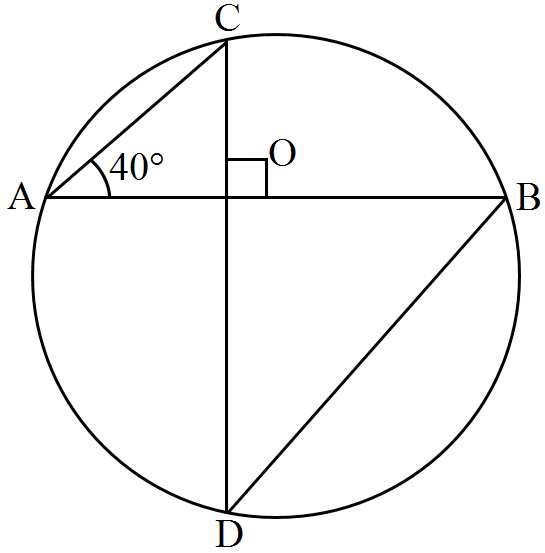
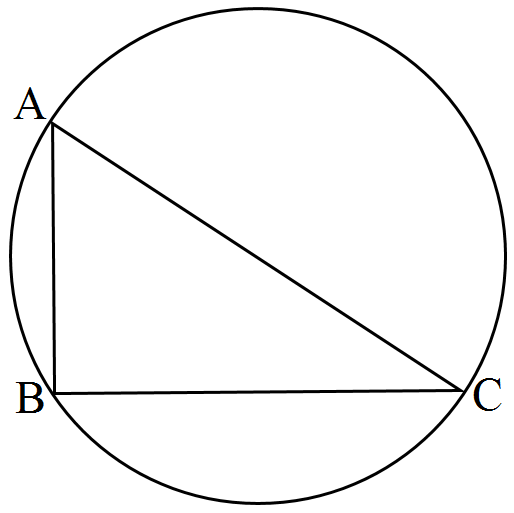
ABCD is a cyclic quadrilateral such that AB is a diameter of the circle circumscribing it and $\angle\text{ADC}=140^\circ,$ then $\angle\text{BAC}$ is equal to:
Answer
  1. 50º
    Solution:
    In the given quadrilateral,
    $\angle\text{ABC}+\angle\text{ADC}=180^\circ$
    $140^\circ+\angle\text{ABC}=180^\circ$
    $\angle\text{ABC}=40^\circ$
    Since, AB is diameter so ABCD lies in semi-circle.
    Thus, $\angle\text{BCA}=90^\circ$
    In triangle, ABC,
    $\angle\text{A}+\angle\text{B}+\angle\text{C}=180^\circ$
    $\angle\text{BAC}=180^\circ-40^\circ-90^\circ=180^\circ-130^\circ=50^\circ$
    $\angle\text{BAC}=50^\circ$
View full question & answer
Question 521 Mark
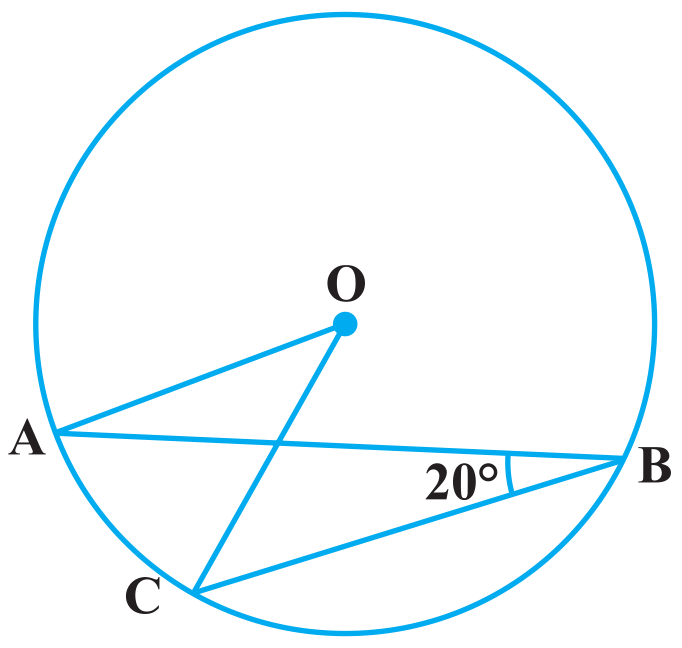
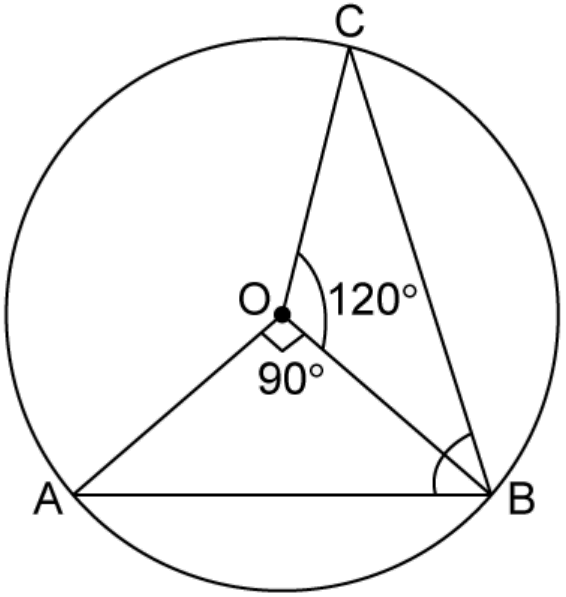
If A , B, C are three points on a circle with centre O such that $\angle\text{AOB} = 90^\circ$ and $\angle\text{BOC} = 120^\circ,$ then $\angle\text{ABC} =$
View full question & answer
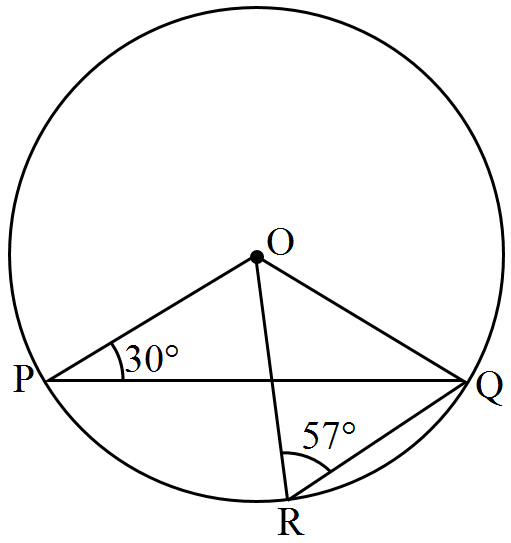
Question 531 Mark
Answer
  1. 54º
    Solution:
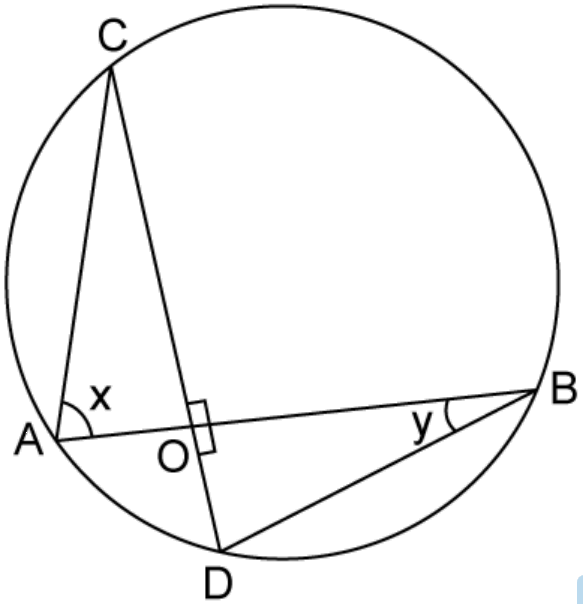
    $\angle\text{OPQ}=\angle\text{OQP}=30^\circ$ (Angles of isosceles triangle OPQ)
    Also, in triangle OPQ,
    $\angle\text{O}+\angle\text{P}+\angle\text{Q}=180^\circ$
    $\angle\text{O}=30^\circ+30^\circ=180^\circ$
    $\angle\text{O}=180^\circ-60^\circ=120^\circ$
    So, $\angle\text{POQ}=120^\circ\ ...(\text{i})$
    Again, in triangle ORQ
    $\angle\text{R}=\angle\text{Q}=57^\circ$
    And $\angle\text{O}+\angle\text{R}+\angle\text{Q}=180^\circ$
    $\angle\text{O}+57^\circ+57^\circ=180^\circ$
    $\angle\text{O}+180^\circ-114^\circ=66^\circ$
    So, $\angle\text{ROQ}=66^\circ\ ...(\text{ii})$
    From(1) and (2), we get :-
    $\angle\text{POR}=\angle\text{POQ}-\angle\text{ROQ}$
    $\Rightarrow\angle\text{POR}=120^\circ-66^\circ=54^\circ$
View full question & answer
Question 541 Mark
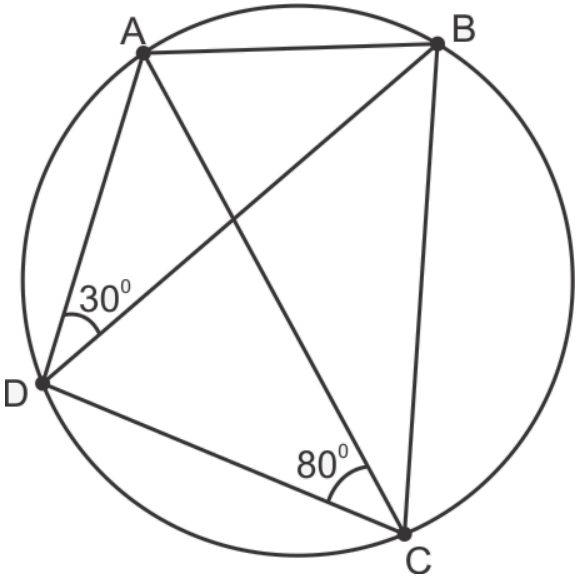
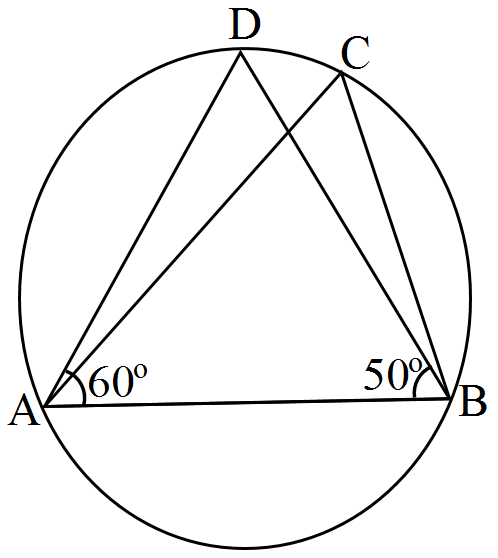
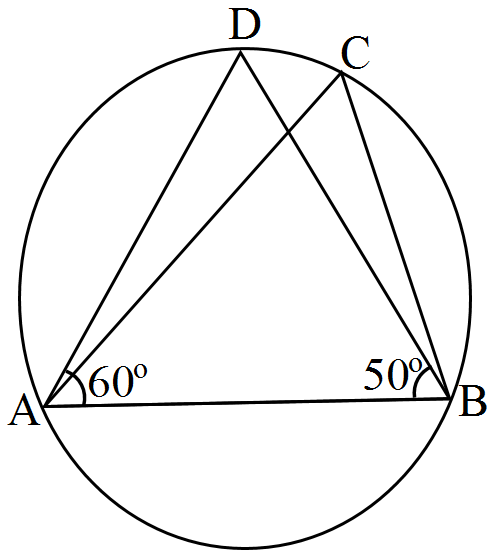
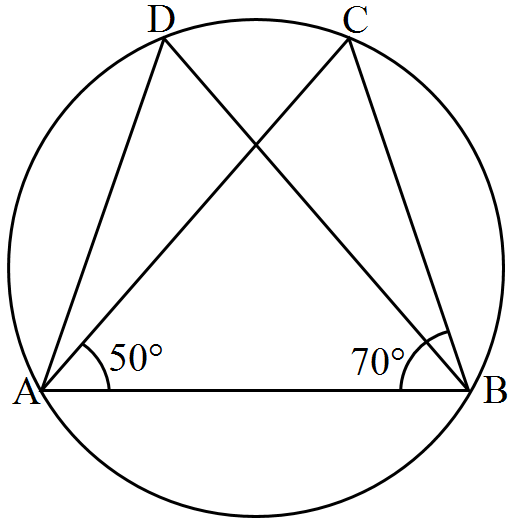
ABCD is a cyclic quadrilateral such that $\angle\text{ADB} = 30^\circ$ and $\angle\text{DCA} = 80^\circ,$ then $\angle\text{DAB} =$
View full question & answer
Question 561 Mark
The relation between diameter and radius of a circle is:
Answer
  1. d = 2r
    Solution:
    Radius is half the length of the diameter, thus diameter is twice the length of the radius.
View full question & answer
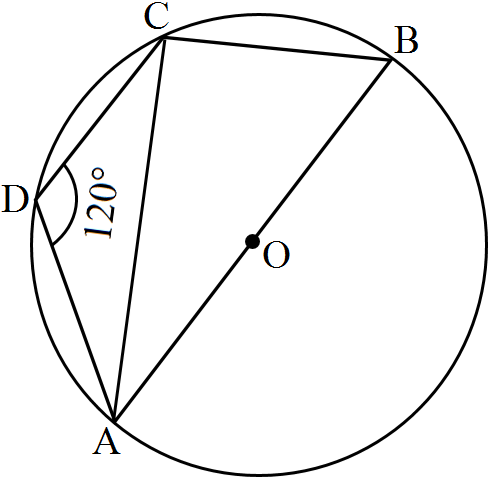
Question 591 Mark
Answer
  1. 30º
    Solution:
    We have:
    $\angle\text{ABC}+\angle\text{ADC}=180^\circ$ (Opposite angles of a cyclic quadrilateral)
    $\Rightarrow\angle\text{ABC}+120^\circ=180^\circ$
    $\Rightarrow\angle\text{ABC}=(180^\circ-120^\circ)=60^\circ$
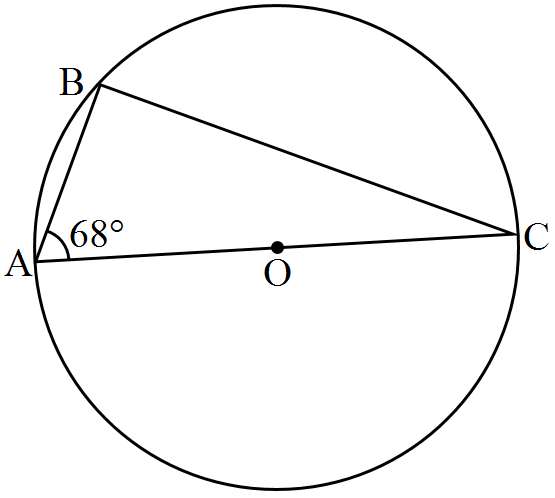
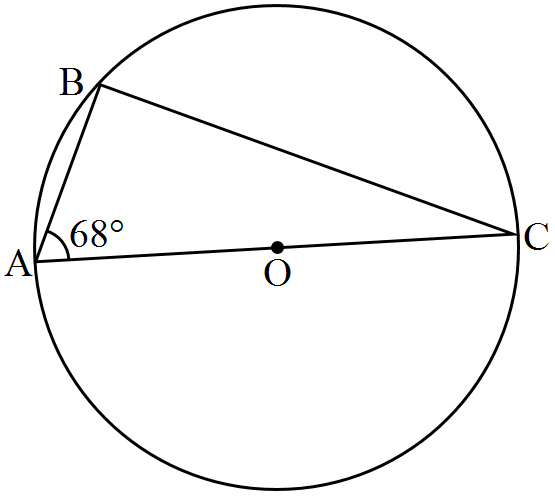
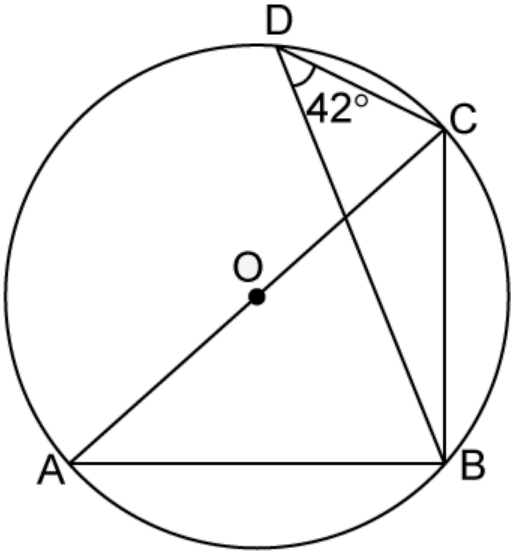
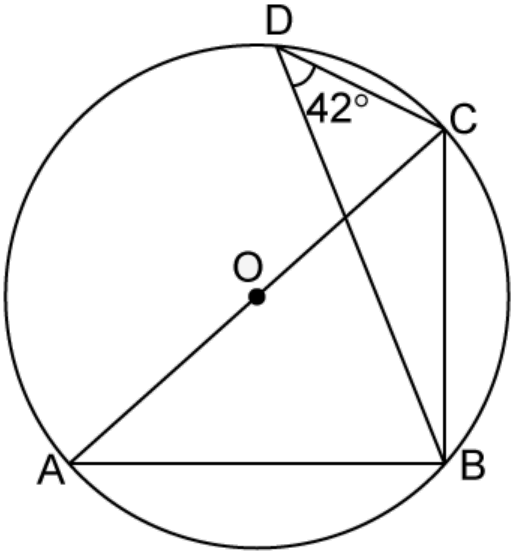
    $\Rightarrow\angle\text{ABC}=60^\circ$
    Also, $\angle\text{ACB}=90^\circ$ (Angle in a semicircle)
    In $\triangle\text{ABC},$ we have:
    $\angle\text{BAC}+\angle\text{ACB}+\angle\text{ABC}=180^\circ$ (Angle sum property of a triangle)
    $\Rightarrow\angle\text{BAC}+90^\circ+60^\circ=180^\circ$
    $\Rightarrow\angle\text{BAC}=(180^\circ-150^\circ)=30^\circ$
    $\Rightarrow\angle\text{BAC}=30^\circ$
View full question & answer
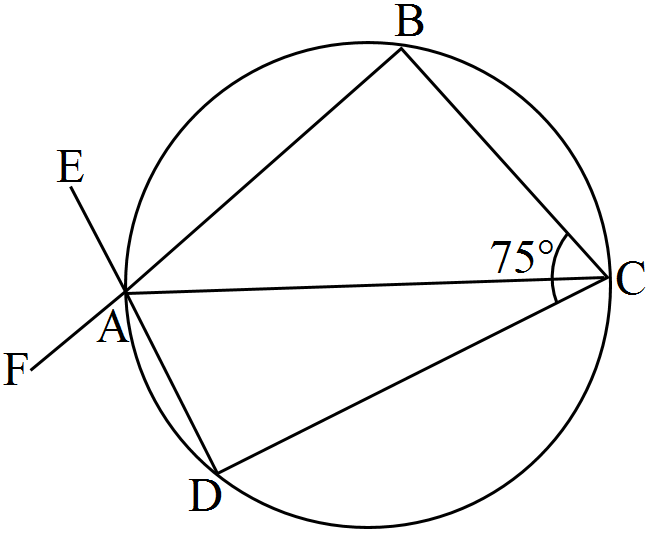
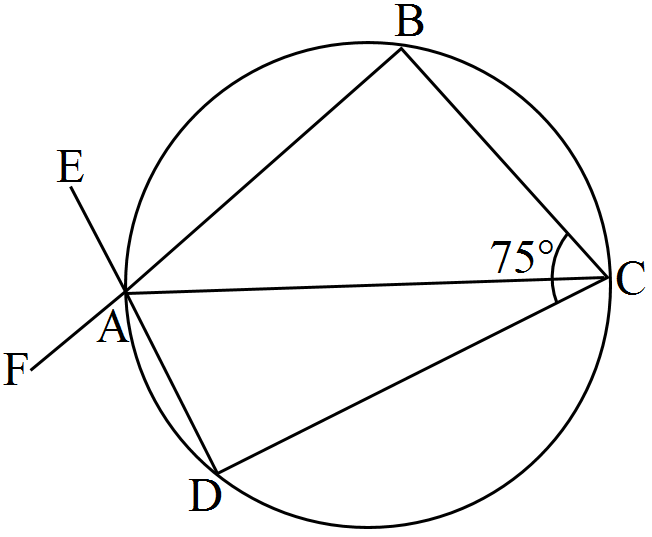
Question 601 Mark
View full question & answer
Question 611 Mark
Angle inscribed in a semicircle is:
Answer
  1. 90º
    Solution:
    Angle inscribed in a semicircle is a right angle. Its a given theorem.
View full question & answer
Question 621 Mark
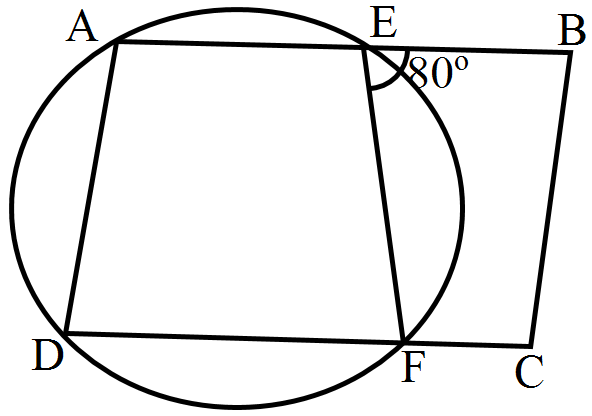
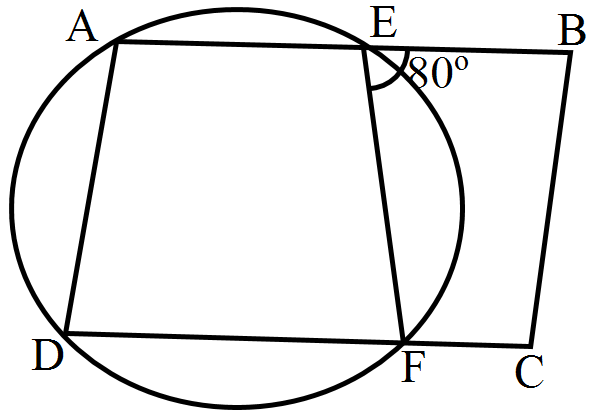
In the given figure, ABCD and ABEF are two cyclic quadrilaterals. If $\angle\text{BCD}=110^\circ$ then $\angle\text{BEF}=?$
Answer
  1. 110°
    Solution:
    Since ABCD is a cyclic qyadrilateral, we have:
    $\angle\text{BAD}+\angle\text{BCD}=180^\circ$
    $\Rightarrow\ \angle\text{BAD}+110^\circ=180^\circ$
    $\Rightarrow\ \angle\text{BAD}=70^\circ$
    Since ABEF is a cyclic qyadrilateral, we have:
    $\angle\text{BAD}+\angle\text{BEF}=180^\circ$
    $\Rightarrow\ 70^\circ+\angle\text{BEF}=180^\circ$
    $\Rightarrow\ \angle\text{BEF}=110^\circ$
View full question & answer
Question 641 Mark
View full question & answer
Question 661 Mark
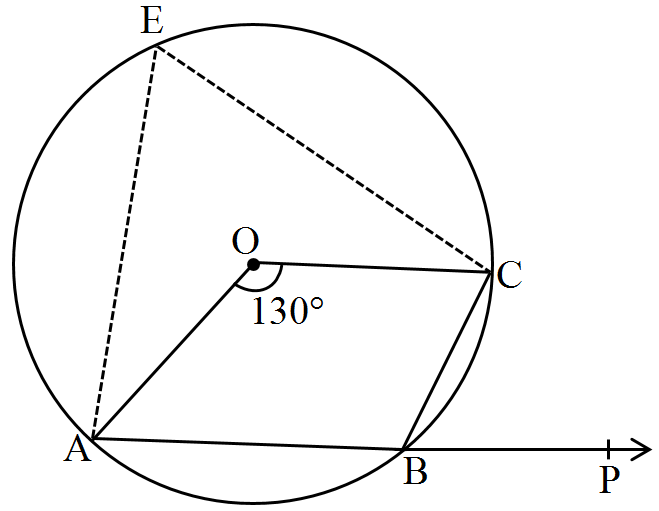
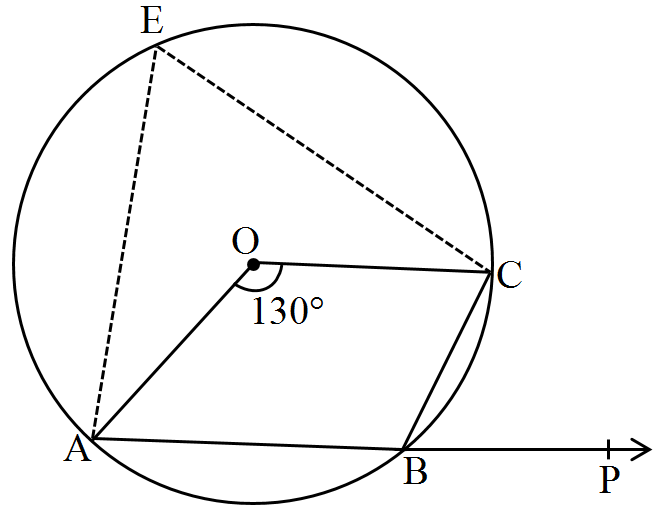
In the given figure, O is the centre of a circle and $\angle\text{AOB}=130^\circ.$ Then, $\angle\text{ACB}=?$
Answer
  1. 115°
    Solution:
    Minor $\angle\text{AOB}=130^\circ$
    Major $\angle\text{AOB}=360^\circ-130^\circ$
    ⇒ Major $\angle\text{AOB}=230^\circ$
    Since $\angle\text{ACB}=\frac{1}{2}\text{major}\angle\text{AOB}$
    $\Rightarrow\ \angle\text{ACB}=\frac{1}{2}(230^\circ)$
    $\Rightarrow\ \angle\text{ACB}=115^\circ$
View full question & answer
Question 671 Mark
Write the correct answer in the following:
If AB = 12cm, BC = 16cm and AB is perpendicular to BC, then the radius of the circle passing through the points A, B and C is:
Answer
  1. 10cm.
    Solution:
    AB is perpendicular to BC, therefore ABC is a right triangle.
    In right $\triangle\text{ABC},$ we have
    $\text{AC}=\sqrt{\text{AB}^2+\text{BC}^2}$
    $=\sqrt{(12)^2+(16)^2}$
    $\sqrt{144+256}$
    $\text{AC}=20\text{cm}$
    $\therefore\text{Radius}=\frac{1}{2}\times\text{diameter}=\frac{1}{2}\times20\text{cm}=10\text{cm}$
    Hence, (c) is the correct answer.
View full question & answer
Question 681 Mark
View full question & answer
Question 691 Mark
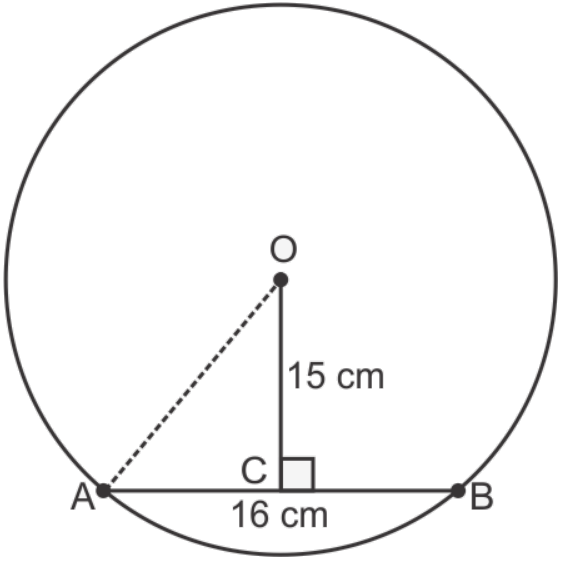
If $AB = 12\ cm, BC = 16$ and $AB$ is perpendicular to $BC,$ then the radius of the circle passing through the points $A, B$ and $C$ is:.
Answer

Since $AB$ is perpendicular to $BC,$ therefore $\text{ABC}$ is a right$-$angled triangle right angled at $B$. As clear from the figure$, AC$ would act as the diameter
$AB^2+ BC^2= AC^2$
$12^2+ 16^2= AC^2$
$AC = 20$
Since $AC$ is diameter so radius $= 10\ cm.$
View full question & answer
Question 711 Mark
Answer
  1. 100º
    Solution:
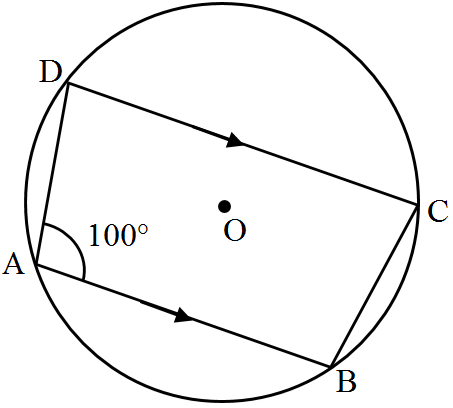
    Since ABCD is a cyclic quadrilateral, we have:
    $\angle\text{BAD}+\angle\text{BCD}=180^\circ$ (Opposite angles of a cyclic quadrilateral)
    $\Rightarrow100^\circ+\angle\text{BCD}=180^\circ$
    $\Rightarrow\angle\text{BCD}=(180^\circ-100^\circ)=80^\circ$
    Now, AB || DC and CB is the transversal.
    $\therefore\angle\text{ABC}+\angle\text{BCD}=180^\circ$
    $\Rightarrow\angle\text{ABC}+80^\circ=180^\circ$
    $\Rightarrow\angle\text{ABC}=(180^\circ-80^\circ)=100^\circ$
    $\Rightarrow\angle\text{ABC}=100^\circ$
View full question & answer
Question 731 Mark
In the given figure, O is the centre of a circle and chords AC and BD intersect at E. If $\angle\text{AEB}=110^\circ$ and $\angle\text{CBE}=30^\circ,$ then $\angle\text{ADB}=?$
Answer
  1. 80°
    Solution:
    $\angle\text{AED}=\angle\text{ECB}+\angle\text{EBC}$
    $\Rightarrow\ 110^\circ=\angle\text{ECB}+30^\circ$
    $\Rightarrow\ \angle\text{ECB}=80^\circ$
    Since angles in the same segment are equal,
    $\angle\text{ADB}=\angle\text{ECB}=80^\circ$
View full question & answer
Question 741 Mark
The line which meet a circle in two points is called a:
Answer
  1. Secant of circle.
    Solution:
    A line that meets a circle at any two points is called secant of that circle and secant intercepted between these two points is chord of that circle.
View full question & answer
Question 761 Mark
Answer
  1. 70º
    Solution:
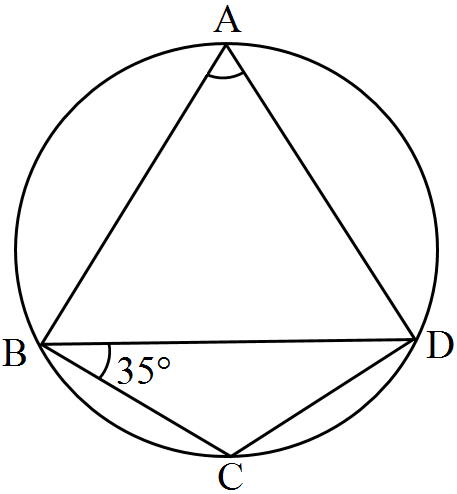
    BC = CD (given)
    $\Rightarrow\angle\text{BDC}=\angle\text{CBD}=35^\circ$
    In $\triangle\text{BCD},$ we have:
    $\angle\text{BCD}+\text{BDC}+\angle\text{CBD}=180^\circ$ (Angle sum property of a triangle)
    $\Rightarrow\angle\text{BCD}+35^\circ+35^\circ=180^\circ$
    $\Rightarrow\angle\text{BCD}=(180^\circ-70^\circ)=110^\circ\Rightarrow\angle\text{BCD}=110^\circ$
    In cyclic quadrilateral ABCD, we have:
    $\angle\text{BAD}+\angle\text{BCD}=180^\circ$
    $\Rightarrow\angle\text{BAD}+110^\circ=180^\circ$
    $\therefore\angle\text{BAD}=(180^\circ-110^\circ)=70^\circ$
    $\Rightarrow\angle\text{BAD}=70^\circ$
View full question & answer
Question 781 Mark
The constant distance of a point on a circle from the centre of the circle is called.
Answer
  1. Radius
    Solution:
    Radius is the fixed distance of a fixed point from a point on the circle.
    Also more precisely, a circle is the loci or the path of a point that moves to maintain a fixed distance from a given point.
View full question & answer
Question 801 Mark
In the given figure, O is the centre of a circle and $\angle\text{ACB}=30^\circ.$ Then, $\angle\text{AOB}=?$
Answer
  1. 60°
    Solution:
    We know that, the angle subtended by an arc of a circle at the centre is double the angle subtended by it at any point on the remaining part of the circle.
    So,
    $\angle\text{AOB}=2\angle\text{ACB}$
    $=2(30^\circ)$
    $=60^\circ$
View full question & answer
Question 821 Mark
In the given figure, AB is a chord of a circle with centre O and BOC is a diameter. If $\text{OD}\perp\text{AB}$ such that OD = 6cm, then AC = ?
Answer
  1. 12cm
    Solution:
    In $\triangle\text{BOD}$ and $\triangle\text{CAB},$
    Since BOC is the diameter, $\angle\text{CAB}=90^\circ.$
    Also, $\angle\text{ODB}=90^\circ.$
    So, $\angle\text{DBO}=\angle\text{ABC}$ [Common angles]
    $\Rightarrow\ \triangle\text{BOD}\sim\triangle\text{BCA}$ [AA congruence criterion]
    $\Rightarrow\ \frac{\text{OD}}{\text{CA}}=\frac{\text{BO}}{\text{BA}}$
    $\Rightarrow\ \frac{\text{OD}}{\text{CA}}=\frac{1}{2}$ [Since radius = 2 diameter]
    $\Rightarrow\ \frac{6}{\text{CA}}=\frac{1}{2}$
    ⇒ CA = 12cm that is, AC = 12cm.
View full question & answer
Question 851 Mark
Two point on a circle makes the:
Answer
  1. Chord
    Solution:
    A chord is the line joining any two points on the circle.
View full question & answer
Question 881 Mark
Angles in the same segment of a circle area are:
Answer
  1. Equal
    Solution:
    Angles in a the same segment of a circle area are equal.
View full question & answer
Question 891 Mark
View full question & answer
Question 901 Mark
In the given figure, O is the centre of a circle. Then, $\angle\text{OAB}=?$
Answer
  1. 65°
    Solution:
    OA = OB [Radii of the same circle]
    $\Rightarrow\ \angle\text{OAB}=\angle\text{OBA}$
    In $\triangle\text{OAB},$
    $\angle\text{BOA}+\angle\text{OAB}+\angle\text{OBA}=180^\circ$ [Angle sum property]
    $\Rightarrow\ 50^\circ+\angle\text{OAB}+\angle\text{OAB}=180^\circ$
    $\Rightarrow\ 2\angle\text{OAB}=130^\circ$
    $\Rightarrow\ \angle\text{OAB}=65^\circ$
View full question & answer
Question 911 Mark
In the given figure, O is the centre of a circle and $\angle\text{AOB}=140^\circ.$ Then, $\angle\text{ACB}=?$
Answer
  1. 110°
    Solution:
    Minor $\angle\text{AOB}=140^\circ$
    Major $\angle\text{AOB}=360^\circ-140^\circ$
    ⇒ Major $\angle\text{AOB}=220^\circ$
    Since $\angle\text{ACB}=\frac{1}{2}\text{major}\angle\text{AOB}$
    $\Rightarrow\ \angle\text{ACB}=\frac{1}{2}(220^\circ)$
    $\Rightarrow\ \angle\text{ACB}=110^\circ$
View full question & answer
Question 931 Mark
One half of the whole arc of a circle.
Answer
  1. Semi-circle
    Solution:
    A semi-circle is half the circle. In other words, half of the total length of the circle makes the semicircle.
View full question & answer
Question 941 Mark
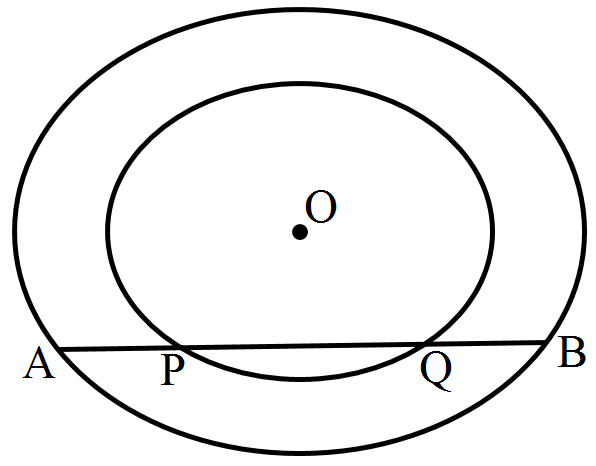
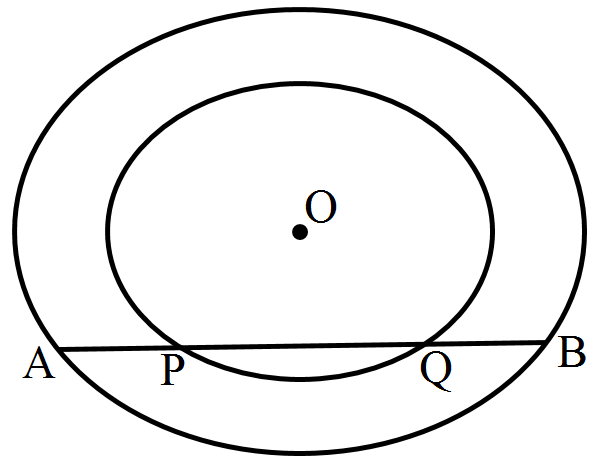
Circle having same centre are said to be:
Answer
  1. Concentric
    Solution:
    Concentric circles are those circle that is drawn with the same point as a centre but different radii.
View full question & answer
Question 961 Mark
In the given figure, O is the centre of a circle and $\angle\text{OAB}=50^\circ.$ Then, $\angle\text{CDA}=?$
Answer
  1. 50°
    Solution:
    OA = OB [Radii of the same circle]
    $\Rightarrow\ \angle\text{OBA}=\angle\text{OAB}=50^\circ$
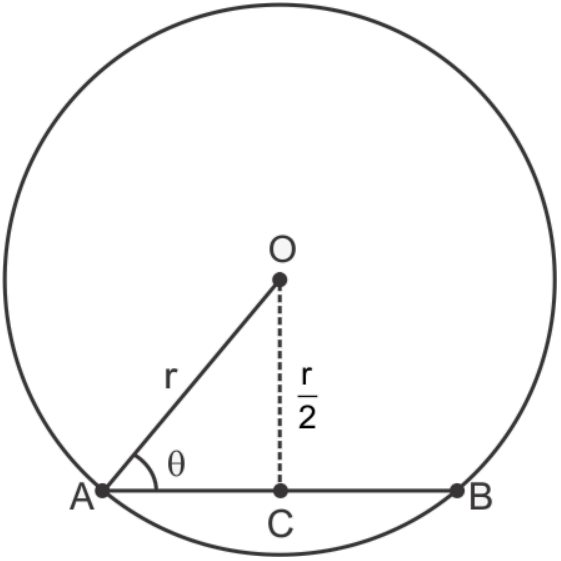
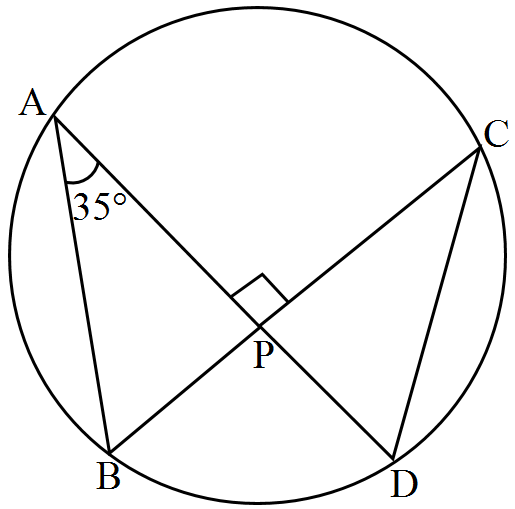
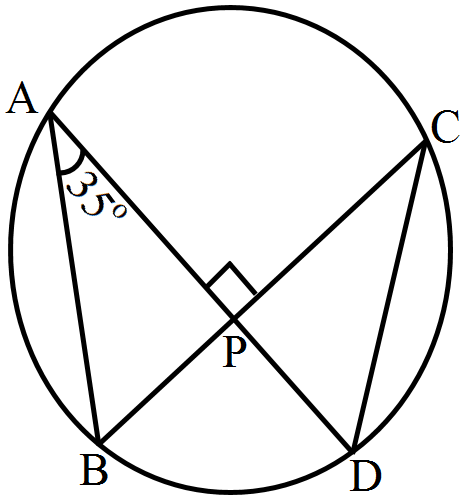
    Since angles in the same segment are equal, $\angle\text{ABC}=\angle\text{CDA}.$
    That is, $\angle\text{ABO}=\angle\text{CDA}=50^\circ$
View full question & answer
Question 981 Mark
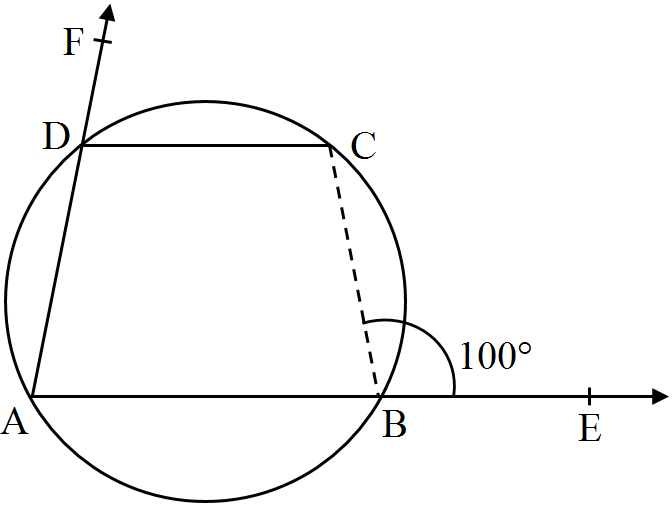
In the given figure, sides AB and AD of quad. ABCD are produced to E and F respectively. If $\angle\text{CBE}=100^\circ$ then $\angle\text{CDF}=?$
Answer
  1. 80°
    Solution:
    Since ABCD is a cyclic equilateral,
    $\angle\text{CBE}=\angle\text{ADC}=100^\circ$
    Since ADF is a straight line,
    $\angle\text{CDF}+\angle\text{ADC}=180^\circ$
    $\Rightarrow\ \angle\text{CDF}+100^\circ=180^\circ$
    $\Rightarrow\ \angle\text{CDF}=80^\circ$
View full question & answer
M.C.Q - Page 2 - MATHS STD 9 Questions - Vidyadip