If the length of a chord of a circle is $16\ cm$ and is at a distance of $15\ cm$ from the centre of the circle, then the radius of the circle is:
Answer
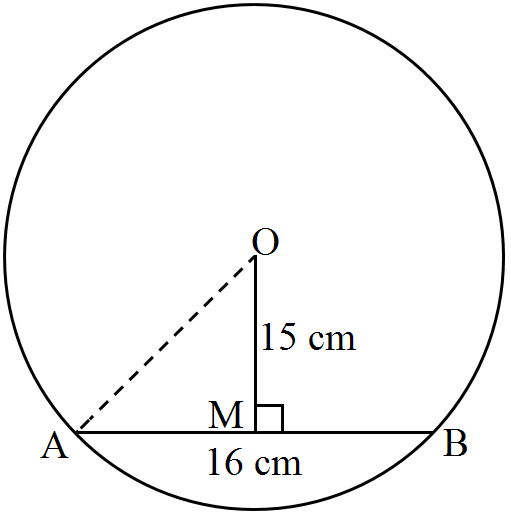
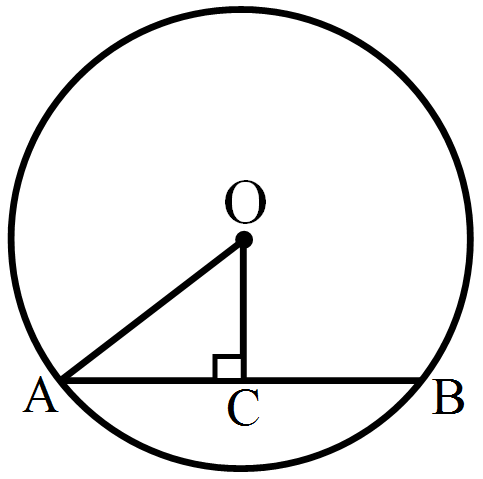
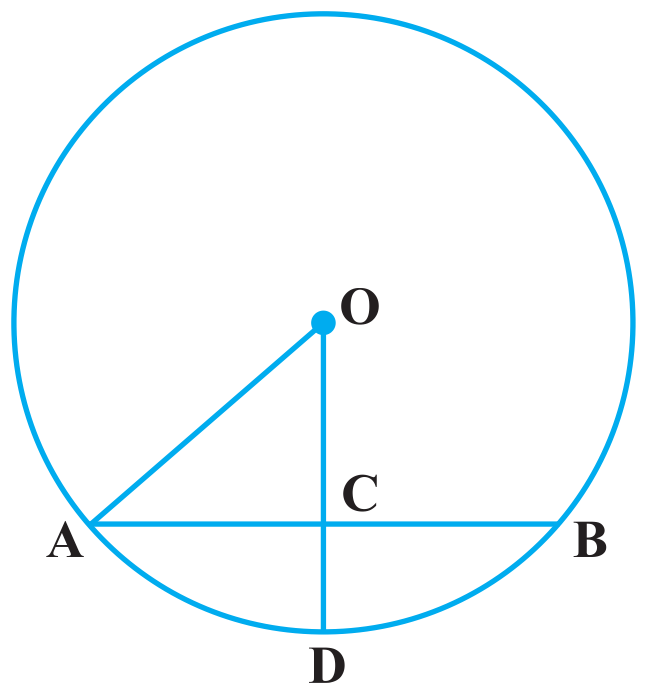
We will represent the given data in the figure
In the diagram$, AB$ is the given chord of $16\ cm$ length and $OM$ is the perpendicular distance from the centre to $AB.$
We know that perpendicular from the centre to any chord divides it into two equal parts.
So, $\text{AM}=\text{MB}=\frac{16}{2}=8\text{ cm}.$
Now consider right triangle $\triangle\text{OMA}$ and by using Pythagoras theorem $\angle\text{OMA}=90^\circ$
$AO^2 = AM^2 + OM^2$
$AO^2 = 8^2 + 15^2$
$AO^2 = 64 + 225 = 289$
$\text{AO}=\sqrt{289}=17\text{cm}$
In the given figure, BOC is a diameter of a circle with centre O. If AB and CD are two chords such that AB || CD. If AB = 10cm, then CD = ?
Answer
10cm Solution: In $\triangle\text{BEO}$ and $\triangle\text{CFO},$ OB = OC [Radii of the same circle] $\angle\text{OBE}=\angle\text{OCF}$ [Alternate angles since AB || CD] $\angle\text{BOE}=\angle\text{COF}$ [Vertically angles] $\Rightarrow\ \triangle\text{BEO}\cong\triangle\text{CFO}$ [ASA congruence criterion] ⇒ OE = OF [C.P.C.T.] Since chord are equidistant from the centre are equal, AB = CD = 10 cm.
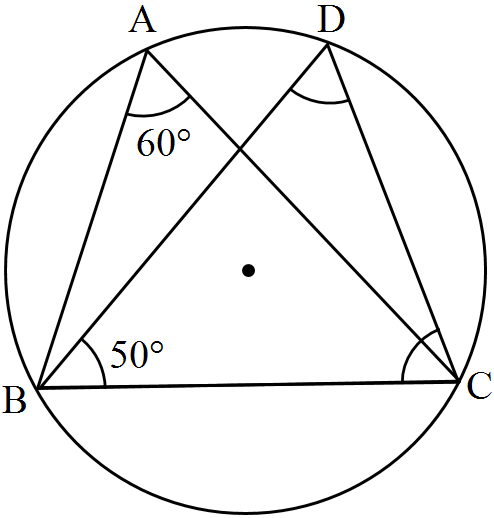
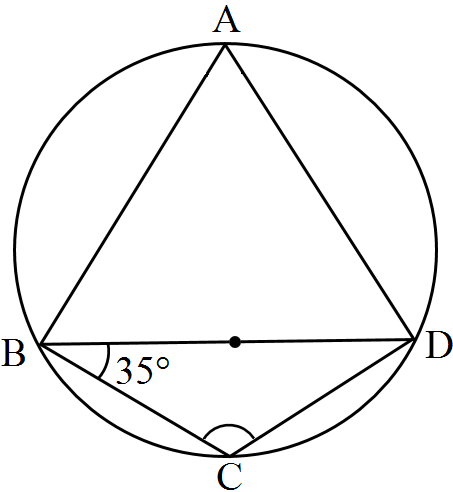
70º Solution: $\angle\text{BDC}=\angle\text{BAC}=60^\circ$ (Angles in the same segment of a circle) In $\triangle\text{BDC},$ we have $\angle\text{DBC}+\angle\text{BDC}+\angle\text{BCD}=180^\circ$ (Angle sum property of a triangle) $\therefore50^\circ+60^\circ+\angle\text{BCD}=180^\circ$ $\Rightarrow\angle\text{BCD}=180^\circ-(50^\circ+60^\circ)=(180^\circ-110^\circ)=70^\circ$ $\Rightarrow\angle\text{BCD}=70^\circ$
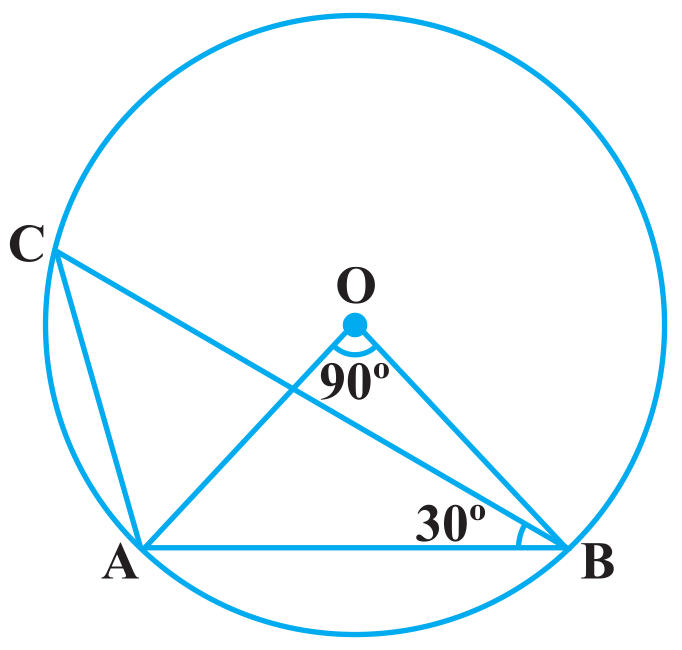
60°. Solution: In $\triangle\text{OAB},$ we have $\text{OA}=\text{OB}$ [Radii of the same circle] $\therefore\angle\text{OAB}=\angle\text{OBA}$ In triangle OAB, we have $\angle\text{OAB}+\angle\text{OBA}+\angle\text{AOB}=180^\circ$ $\therefore2\angle\text{OAB}=(180^\circ-\angle\text{AOB})$ $=(180^\circ-90^\circ)=90^\circ$ [$\because$ sum of angles of $\triangle$ is 180°] $\Rightarrow\angle\text{OAB}=\frac{1}{2}\times90^\circ=45^\circ$ Also, $\angle\text{ACB}=\frac{1}{2}\angle\text{AOB}=\frac{1}{2}\times90^\circ=45^\circ$ Now, in $\triangle\text{CAB},$ we have $\angle\text{CAB}=180^\circ-(\angle\text{ABC}+\angle\text{ACB})$ $=180^\circ-(30^\circ+45^\circ)=105^\circ$ Now, $\angle\text{CAO}=\angle\text{CAB}-\angle\text{OAB}$ $\Rightarrow\angle\text{CAO}=105^\circ-45^\circ=60^\circ$ Hence, (d) is the correct answer.
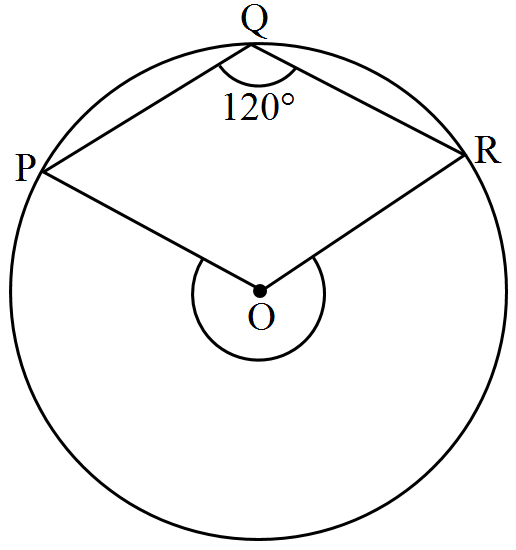
$\frac{1}{3}$ of the circle. Solution: Complete the cyclic quadrilateral PQRS, with S being a point on a point on the major arc. Then $\angle\text{S}=60^\circ$ (Opposite angles of a cyclic quadrilateral) Then Major $\angle\text{POR}=120^\circ$ Thus fraction the minor arc $=\frac{120^\circ}{130^\circ}=\frac{1}{3}$
50º Solution: We have: OA = OB (Radii of a circle) $\Rightarrow\angle\text{OBA}=\angle\text{OAB}=50^\circ$ $\therefore\angle\text{CDA}=\angle\text{OBA}=50^\circ$ (Angles in the same segment of a circle) $\Rightarrow\angle\text{CDA}=50^\circ$
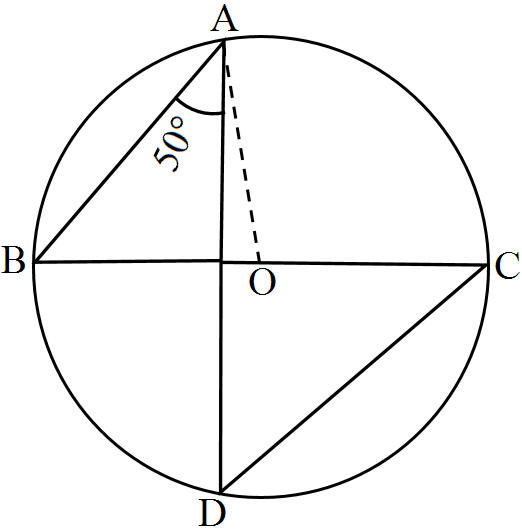
In the given figure, O is the centre of a circle. If $\angle\text{OAC}=50^\circ$ then $\angle\text{ODB}=?$
Answer
50° Solution: Since angles in the same segment of a circle are equal. $\angle\text{CDB}=\angle\text{BAC}$ That is , $\angle\text{ODB}=\angle\text{OAC}=50^\circ.$
Diameter Solution: Since diameter is the longest segment that can be drawn in a circle(touching the circle at both ends), therefore it is the longest possible chord also.
$AB$ and $CD$ are two parallel chords of a circle with centre $O$ such that $AB = 6\ cm$ and $CD = 12\ cm.$ The chords are on the same side of the centre and the distance between them is $3\ cm$. The radius of the circle, is:
Answer
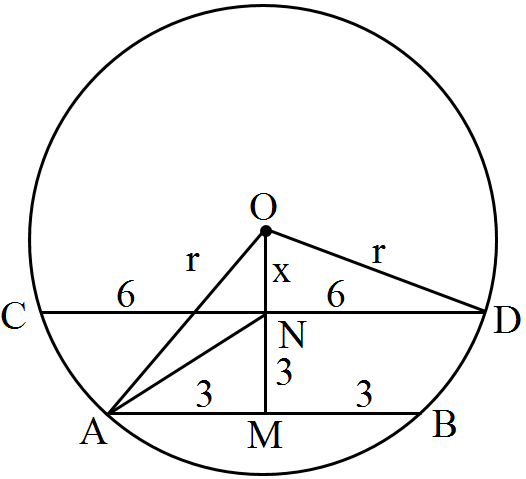
Let the distance between the center and the chord $CD$ be $x \ cm$ and the radius of the circle is $r \ cm$.
We have to find the radius of the following circle:
In right angled triangle, $\text{OND},$
$x^2 + 36 = r^2 ....(i)$
Now, in right angled triangle $\text{AOM},$
$r^2 = 9 + (x + 3)^2 ....(ii)$
From $(i)$ and $(ii),$ we have
$\text{r}^2=9+((\sqrt{\text{r}})^2-36+3)^2$
$\Rightarrow\text{r}^2=9+\text{r}^2-36+9+6\sqrt{\text{r}^2-36}$
$\Rightarrow3=\sqrt{\text{r}^2-36}$
$\Rightarrow9=\text{r}^2-36 [$squaring both the sides$]$
$\Rightarrow\text{r}^2=45$
$\Rightarrow\text{r}=3\sqrt{5}\text{cm}$
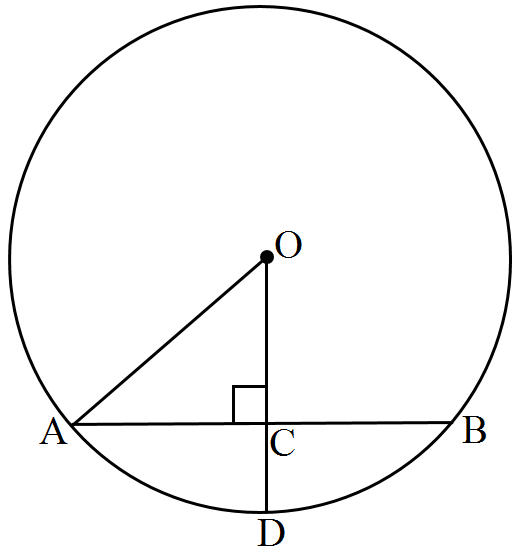
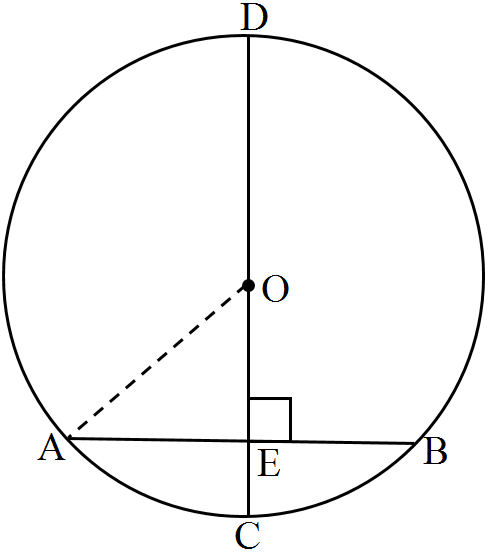
In the given figure, $CD$ is the diameter of a circle with centre $O$ and $CD$ is perpendicular to chord $AB. If AB = 12\ cm$ and $CE = 3\ cm,$ then radius of the circles is:
Answer
$OA = OC$
$\Rightarrow OA = OE + CE$
$\Rightarrow OA = OE + 3$
$\Rightarrow OE = OA - 3 ...(i)$
$\text{AE}=\frac{1}{2}\text{AB} [$Perpendicular drawn from the centre of a circle to the chord bisect the chord$]$
$=\frac{1}{2}(12)=6\text{cm}$
In right $\triangle\text{OEA},$
$OA^2 = OE^2 + AE^2$
$\Rightarrow OA^2 = (OA - 3)^2 + AE^2 [$From $(i)]$
$\Rightarrow OA^2 = OA^2 - 6OA + 9 + AE^2$
$\Rightarrow 6OA = 9 + 6^2$
$\Rightarrow 6OA = 9 + 36$
$\Rightarrow\ \text{OA}=\frac{45}{6}=7.5\text{cm}$
So, the radius of the circle is $7.5\ cm.$
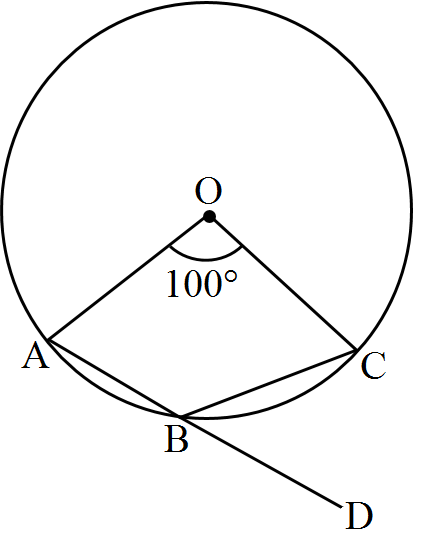
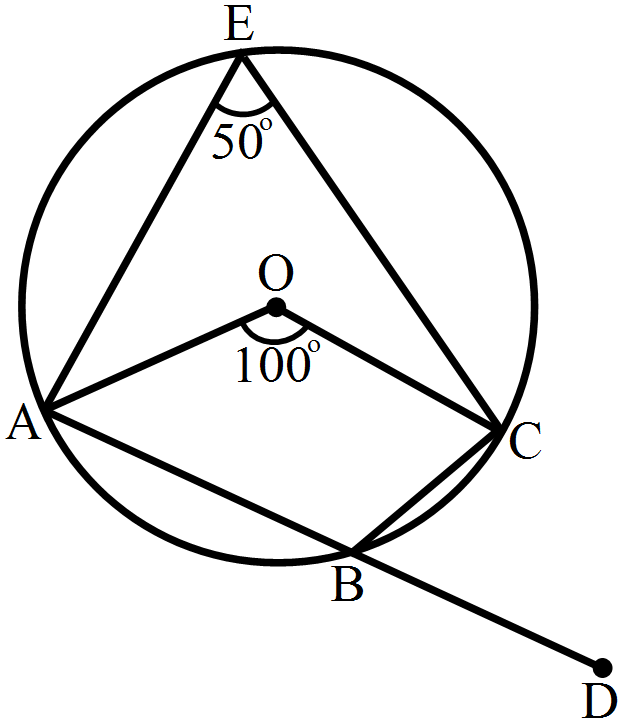
50º Solution: Take a point E on the remaining part of the circumference. Join AE and CE. Then, $\angle\text{AEC}=\frac{1}{2}\angle\text{AOC}=(\frac{1}{2}\times100^\circ)=50^\circ$ Now, side AB of the cyclic quadrilateral ABCE has been produced to D. $\therefore$ Exterior $\angle\text{CBD}=\angle\text{AEC}=50^\circ$ $\Rightarrow\angle\text{CBD}=50^\circ$
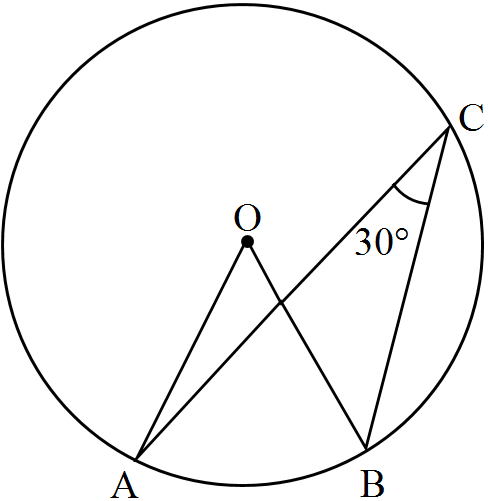
60º Solution: We know that the angle at the centre of a circle is twice the angle at any point on the remaining part of the circumference. Angles $\angle\text{AOB}$ and $\angle\text{ACB}$ are on the same arc AB. Thus, $\angle\text{AOB}=(2\times\angle\text{ACB})=(2\times30^\circ)=60^\circ$
In the given figure, O is the centre of a circle in which $\angle\text{AOC}=100^\circ.$ Side AB of quadrilateral OABC has been produced to D. Then, $\angle\text{CBD}=?$
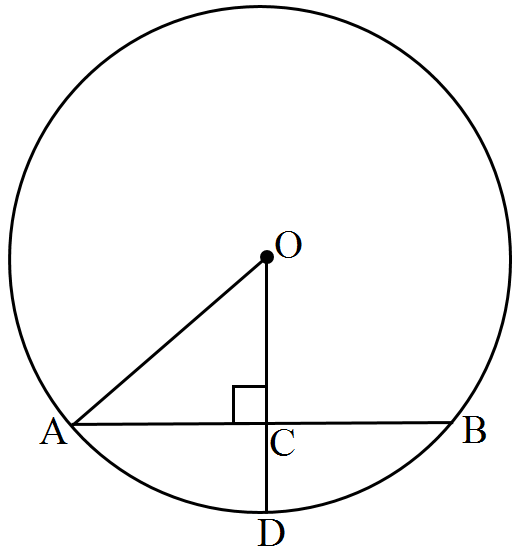
A chord is at a distance of $8\ cm$ from the centre of a circle of radius $17\ cm.$ The length of the chord is:
Answer
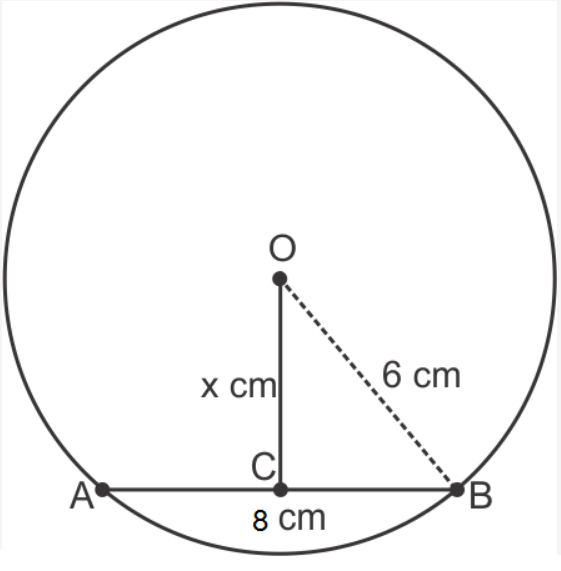
Let O be the centre of the circle with radius $OA = 17\ cm.$
Since $\text{OC}\perp\text{AB}.$
In right $\triangle\text{OCA},$
$OA^2= OC^2 + AC^2\ [$By pythagoras theorem$]$
$AC^2= OA^2 - OC^2$
$\Rightarrow AC^2 = 17^2 - 8^2$
$\Rightarrow AC^2 = 289 - 64$
$\Rightarrow AC^2 = 225$
$\Rightarrow AC = 15\ cm$
We know that, the perpendicular drawn from the centre to the chord bisects the chord.
$\Rightarrow AB = 2AC = 2(15) = 30\ cm.$
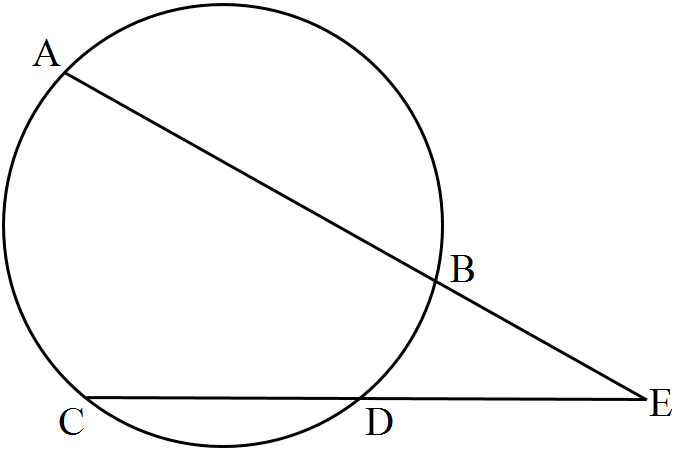
8.5cm Solution: Join AC. Then AE : CE = DE : BE (Intersecting secant theorem) $\therefore$ AE × BE = DE × CE ....(i) Let CD = x cm Then AE = (AB + BE) = (11 + 3)cm = 14cm; BE = 3cm; CE = (x + 3.5)cm; DE = 3.5cm $\therefore$ 14 × 3 = (x + 3.5) × 3.5 [FROM (1)] $\Rightarrow\text{x}+3.5=\frac{14\times3}{3.5}=\frac{42}{3.5}=12$ ⇒ x = (12 - 3.5)cm = 8.5cm Hence, CD = 8.5cm
4cm. Solution: As perpendicular from the centre to a chord the chord, $\text{AC}=\frac{1}{2}\times\text{AB}=\frac{1}{2}\times8=4\text{cm}$ $\text{OC}=\sqrt{(\text{OA})^2-(\text{AC})^2}=\sqrt{(5)^2-(4)^2}=\sqrt{25-16}=\sqrt{9}$ OC = 3cm Now, CD = OD - OC = 5cm - 3cm = 2cm Hence, (c) is the correct answer.
In the given figure$, CD$ is the diameter of a circle with centre $O$ and $CD$ is perpendicular to chord $AB.$ If $AB = 12\ cm$ and $CE = 3\ cm,$ then radius of the circles is:
Answer
Let $OA = OC = r \ cm.$
Then $OE = (r - 3)\ cm$ and $\text{AE}=\frac{1}{2}\text{AB}=6\text{ cm}$
Now, in right $\triangle\text{OAE},$ we have:
$OA^2 = OE^2+ AE^2\ [$Using paythagoras theorem$]$
$\Rightarrow (r)^2= (r - 3)^2 + 6^2$
$\Rightarrow r^2 = r^2 + 9 - 6r + 36$
$\Rightarrow 6r = 45$
$\Rightarrow\text{r}=\frac{45}{6}$
$=7.5\text{ cm}$
Hence, the required radius of the circle is $7.5\ cm.$
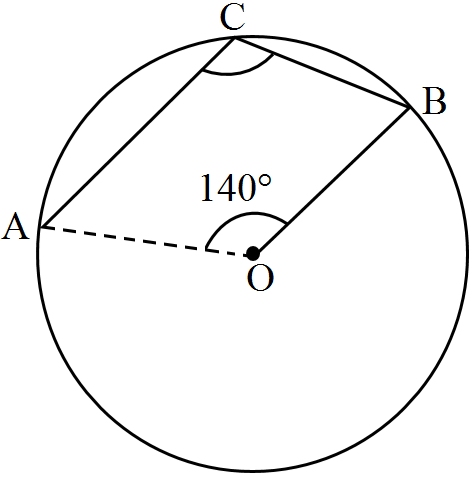
110º Solution: Let, D on any point on circumference and join AD and BD, Now, $\angle\text{ADB}=\frac{\angle\text{AOB}}{2}$ $\angle\text{ADB}=\frac{140}{2}=70^\circ$ Now, in cyclic quadrilateral ADBC $\Rightarrow\angle\text{ADB}+\angle\text{ACB}=180^\circ$ $\Rightarrow\angle\text{ACB}=180^\circ-\angle\text{ADB}$ $\Rightarrow\angle\text{ACB}=180^\circ-70^\circ$ $\Rightarrow\angle\text{ACB}=110^\circ$
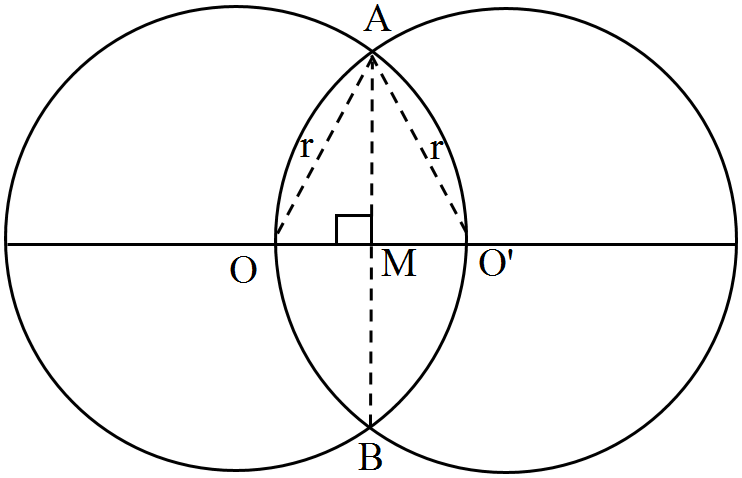
Two equal circles of radius r intersect such that each passes through the centre of the other. The length of the common chord of the circle is:
Answer
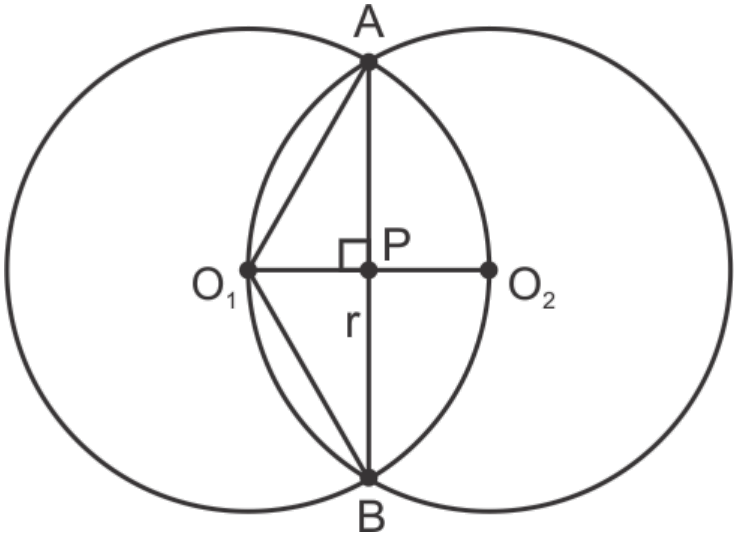
Both the circles pass through the centre of each other
$\Rightarrow O_1O_2 = r$
Common chord is $AB$
We know that perpendicular drawn from centre of circle to any chord bisects it.
$\Rightarrow P$ is the midpoint of $AB$
$\Rightarrow PA = PB$
$O_1A = r ($radius of circle$)$
Consider $\triangle\text{O}_1\ \text{PA}$
$\big(\text{O}_1\text{A}\big)^2=\text{AP}^2+\text{O}_1\ \text{P}^2$
$\Rightarrow\text{r}^2=\text{AP}^2+\Big(\frac{\text{r}}{2}\Big)^2 ...(P$ is also mid$-$point of $O_1\ O_2)$
$\Rightarrow\text{AP}^2=\text{r}^2-\frac{\text{r}^2}{4}=\frac{\text{3r}^2}{4}$
$\Rightarrow\text{AP}=\frac{\sqrt3}{2}\text{r}$
Lenght of chord $\text{AP}=\text{2AP}=\sqrt{3}\text{r}$
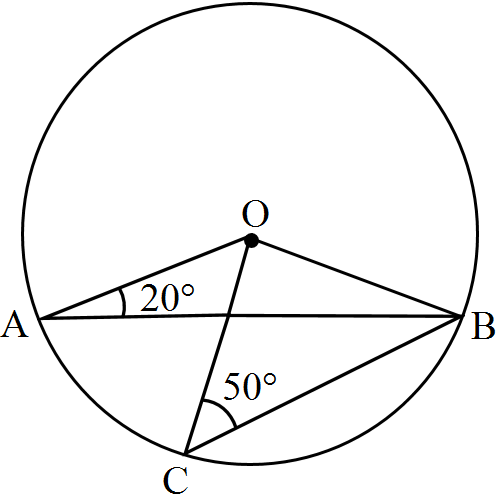
In the given figure, O is the centre of a circle in which $\angle\text{OAB}=20^\circ$ and $\angle\text{OCB}=50^\circ.$ Then, $\angle\text{AOC}=?$
Answer
60° Solution: OA = OC [Radii of the same circle] $\Rightarrow\ \angle\text{OBA}=\angle\text{OAB}=20^\circ$ In $\triangle\text{OAB,}$ $\angle\text{OBA}+\angle\text{OAB}+\angle\text{AOB}=180^\circ$ [Angle sum property] $\Rightarrow\ 20^\circ+20^\circ+\angle\text{AOB}=180^\circ$ $\Rightarrow\ \angle\text{AOB}=140^\circ$ Now, OB = OC [Radii of the same circle] $\Rightarrow\ \angle\text{OBC}=\angle\text{OCB}=50^\circ$ In $\triangle\text{OCB},$ $\angle\text{OBC}+\angle\text{OCB}+\angle\text{COB}=180^\circ$ [Angle sum property] $\Rightarrow\ 50^\circ+50^\circ+\angle\text{COB}=180^\circ$ $\Rightarrow\ \angle\text{COB}=80^\circ$ So, $\angle\text{AOB}=\angle\text{AOC}+\angle\text{COB}$ $\Rightarrow\ \angle\text{AOC}=\angle\text{AOB}-\angle\text{COB}$ $\Rightarrow\ \angle\text{AOC}=140^\circ-80^\circ$ $\Rightarrow\ \angle\text{AOC}=60^\circ$
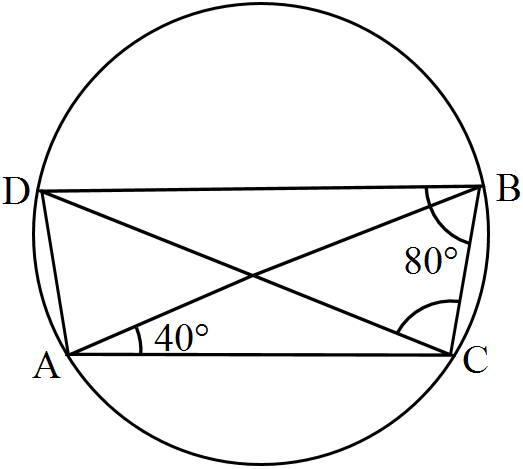
60º Solution: We have: $\angle\text{CDB}=\angle\text{CAB}=40^\circ$ (Angles in the same segment of a circle) In $\triangle\text{CBD},$ we have: $\angle\text{CDB}+\angle\text{BCD}+\angle\text{CBD}=180^\circ$ (Angle sum property of a triangle) $\Rightarrow40^\circ+80^\circ+\angle\text{CBD}=180^\circ$ $\Rightarrow\angle\text{CBD}=(180^\circ-120^\circ)=60^\circ$ $\Rightarrow\angle\text{CBD}=60^\circ$
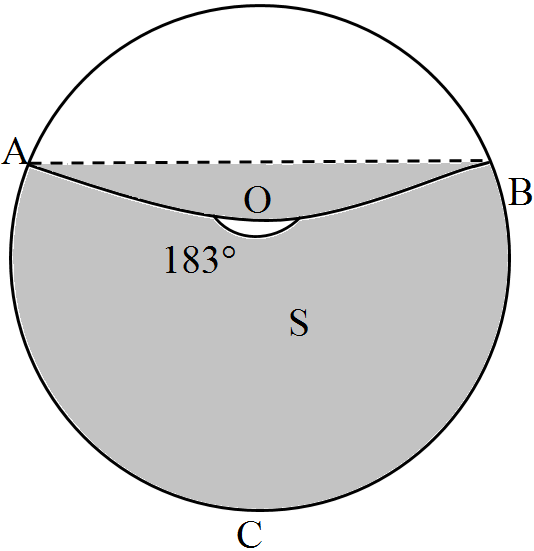
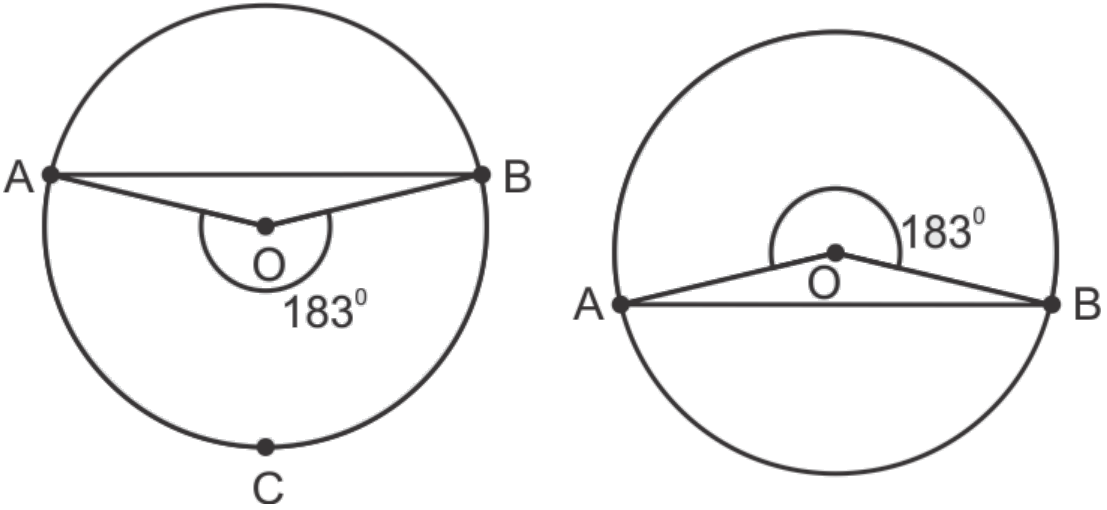
Let C be the mid-point of an arc AB of a circle such that m AB^ = 183º. If the region bounded by the arc ACB and line segment AB is denoted by S, then the centre O of the circle lies.
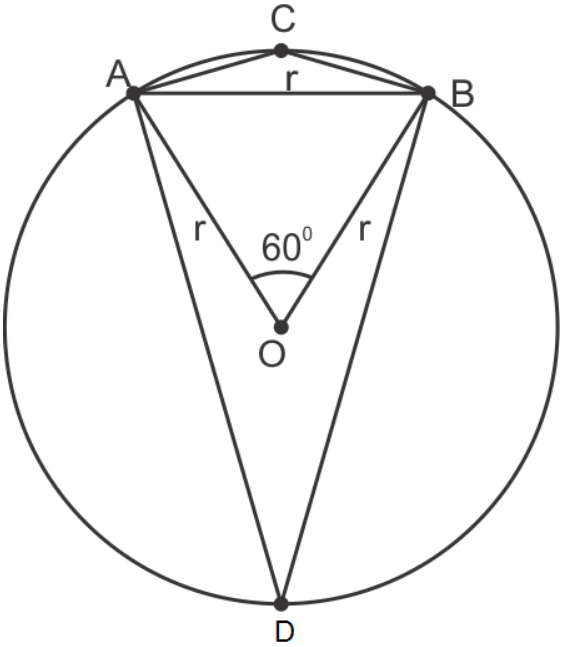
120º Solution: $\triangle\text{ABC}$ is an equilateral triangle so $\angle\text{BAC}=60^\circ$ In cyclic quadrilateral ABCD, we have: $\angle\text{BDC}+\angle\text{BAC}=180^\circ$ $\Rightarrow\angle\text{BDC}+60^\circ=180^\circ$ $\therefore\angle\text{BDC}=(180^\circ-60^\circ)=120^\circ$
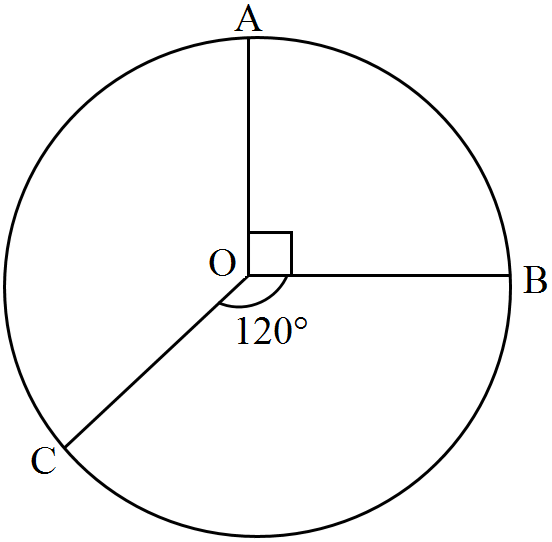
In the given figure, O is the centre of a circle. If $\angle\text{AOB}=100^\circ$ and $\angle\text{AOC}=90^\circ$ then $\angle\text{BAC}=?$
Answer
85° Solution: $\angle\text{BOA}+\angle\text{AOC}+\angle\text{BOC}=360^\circ$ [Angles around a point are 360°] $\Rightarrow\ 100^\circ+90^\circ+\angle\text{BOC}=360^\circ$ $\Rightarrow\ \angle\text{BOC}=170^\circ$ Now, $\angle\text{BAC}=\frac{1}{2}(\angle\text{BOC})=\frac{1}{2}(170^\circ)=85^\circ$
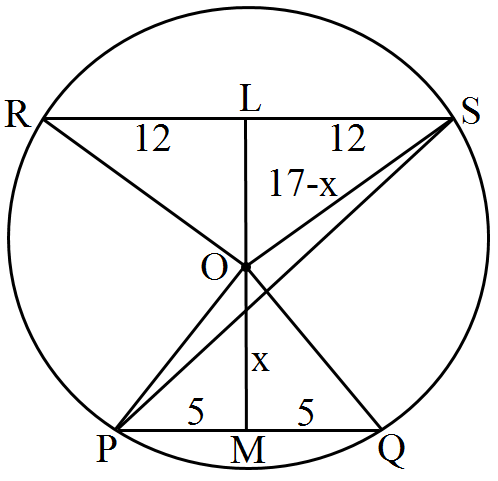
$PS$ and $RS$ are two chord's of a circle such that $PQ = 10\ cm$ and $RS = 24\ cm$ and $PQ || RS$. The distance between $PQ$ and $RS$ is $17\ cm.$ Find the radius of circle.
Answer
Let $L$ and $M$ be the midpoints of $Rs$ and $PQ$ respectively.
Let $OM = x $thus$, OL = 17 - x$
Now in triangle $\text{RLO}, RL = 12$ and
$RL2 + OL2 = r2$
$122 + (17 - x)2 = r2 .....(i)$
Similarly,
In triangle $\text{OMP}, PM = 5$ and
$PM2 + OM2 = OP2$
$(x)2 + 52 = r2 .....(ii)$
Equating $(i)$ and $(ii),$ we get :-
$122 + (17 - x)2 = x2 + 52$
$144 + 289 - 34x + x2 = x2 + 25 $ using $, (a - b)2$
On solving, we get:
$\text{x}=\frac{408}{34}=12$
So$, 17 - x = 17 - 12 = 5$
Thus, from$(i),$
$RL2 + OL2 = r2$
$122 + 52 = r2$
$144 + 25 = r2$
$r2 = 169$
so, radius $=\sqrt{169}$
Hence, the radius is $13\ cm.$
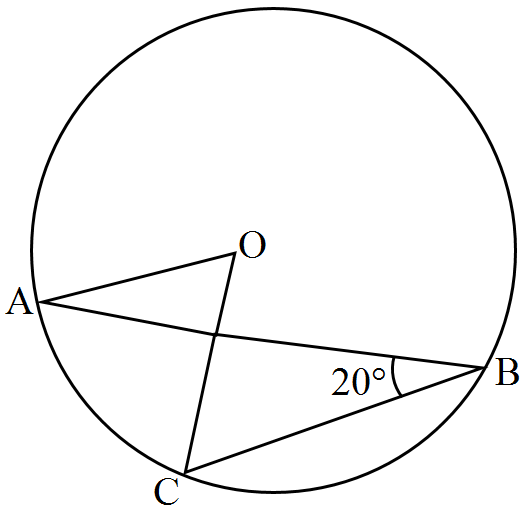
40º Solution: Angle made by a chord at the centre is twice the angle made by it on any point of the circumference. So, $\angle\text{AOC}=2\angle\text{ABC}=2\times20^\circ=40^\circ$
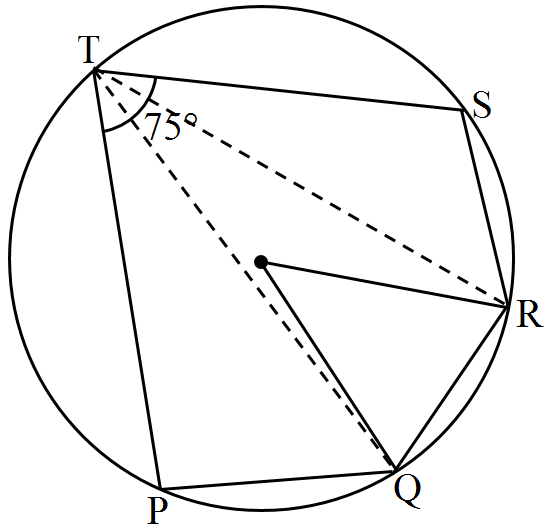
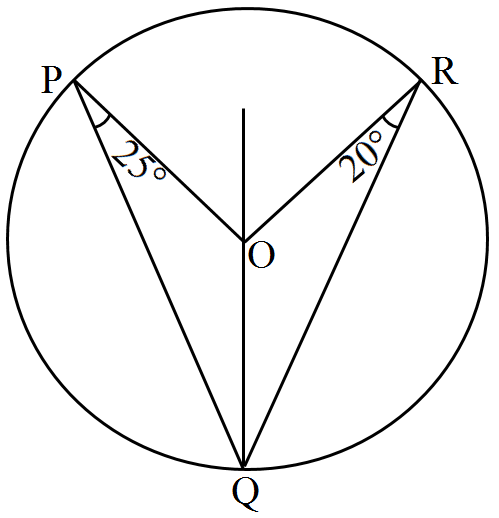
90º, 45º Solution: Here, given OP = OQ and OR = OQ (Radius of circle) So, {angles opposite to equal sides are also equal} Hence, PQR = 25º + 20º = 45º and PQR = 2 PQR = 2 45º = 90º {Angle subtended by same sides on centre is double the angle at opposite vertex}
Let C be the mid-point of an arc AB of a circle such that $\text{m}\widehat{\text{AB}}=183^\circ.$ If the region bounded by the arc ACB and the line segment AB is denoted by S, then the centre O of the circle lies: