Question 511 Mark
The length of the sides of a triangle are 5cm, 7cm and 8cm. Area of the triangle is:
Question 521 Mark
Area of the given triangle is:
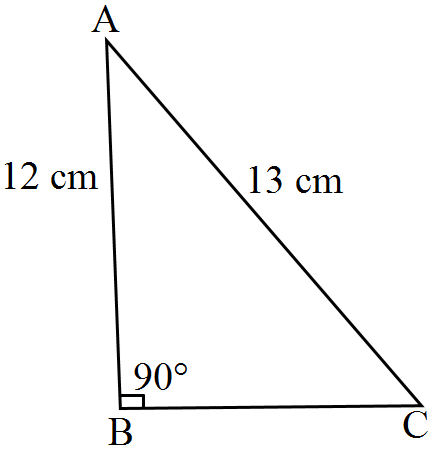
AnswerIn the given triangle,
$\text{Base}(\text{BC})=\sqrt{13^2-12^2}=\sqrt{169-144}=5 \ \text{cm}$
Area of triangle $ABC =\frac{1}{2}\times\text{BC}\times\text{AB}$
$=\frac{1}{2}\times5\times12$
$=30\text{ sq.cm}$
View full question & answer→Question 531 Mark
One of the diagonals of a rhombus is 12cm and the area is 96 sq.cm. The perimeter of the rhombus is:
Answer
- $40\text{cm}$
Solution:
$\text{d}_2=\frac{\text{Area}\times2}{\text{d}_1}$
$=\frac{96\times2}{12}$
$=16\text{cm}$
length of side of rhombus $=\sqrt{6^2+8^2}=10\text{cm}$
peimeter of rhombus = 4 × side
=4 × 10 = 40cm View full question & answer→Question 541 Mark
Write the correct answer in the following:
The perimeter of an equilateral triangle is 60m. The area is:
Answer
- $100\sqrt{3}\text{m}^2$
Solution:
Perimeter of triangle = 3a
Now, $3\text{a}=60$
$\Rightarrow\text{ a}=60\div3=20\text{m}$
Area of equilateral $\triangle=\frac{\sqrt{3}}{4}(\text{side})^2$
$=\frac{\sqrt{3}}{4}\times(20)^2=100\sqrt{3}\text{m}^2$ View full question & answer→Question 551 Mark
Two adjacent sides of a parallelogram are $74\ cm$ and $40\ cm$ and one of its diagonals is $102\ cm.$ Area of the parallelogram is:
AnswerLet the two adjacent sides of the parallelogram be $a = 74 \ cm, b = 40 \ cm$
Let the length of diagonal be $c = 102\ cm$
These two sides and the diagonal forms a triangle
semi perimeter, $\text{s}=\frac{\text{a}+\text{b}+\text{c}}{2}$
$\text{s}=\frac{74+40+102}{2}$
$=\frac{216}{2}$
$= 108\ cm$
By Heron's formula, we have area of triangle $=\sqrt{\text{s}(\text{s}-\text{a})(\text{s}-\text{b})(\text{s}-\text{c})}$
Area of triangle $=\sqrt{108(108-74)(108-40)(108-102)}$
$= 1224\ cm^2$
therefore, area of parallelogram $= 1224 \times 2$
$= 2448 \ sq.cm$
View full question & answer→Question 561 Mark
The area of a triangle with base $8\ cm$ and height $10\ cm$ is:
View full question & answer→Question 571 Mark
The perimeter of a rhombus is $20\ cm.$ If one of its diagonals is $6\ cm,$ then its area is:
AnswerSide $=\frac{20}{5}=5 \ \text{cm}$
Half diagonal $=\sqrt{5^2-3^2}=4 \ \text{cm}$
Diagonal $=4\times2=8 \ \text{cm}$
Area $=\frac{1}{2}\times6\times8=24 \ \text{cm}^2.$
View full question & answer→Question 581 Mark
Each equal side of an isosceles triangle is 13cm and its base is 24cm Area of the triangle is:
Answer
- $60\text{cm}^2$
Solution:
$\text{s}=\frac{13+13+24}{2}=25\text{cm}$
Area of triangle $=\sqrt{\text{s}(\text{s}-\text{a})(\text{s}-\text{b})(\text{s}-\text{c})}$
$=\sqrt{25(25-13)(25-13)(25-24)}$
$=\sqrt{25\times12\times12\times1}$
$=60\text{ sq.cm}$ View full question & answer→Question 591 Mark
The perimeter of a rhombus is $20\ cm.$ One of its diagonals is $8\ cm.$ Then area of the rhombus is:
View full question & answer→Question 601 Mark
The area of an equilateral triangle of side 6cm is:
Question 611 Mark
If the perimeter of an equilateral triangle is 24m, then its area is:
Answer
- $16\sqrt{3}\text{m}^2$
Solution:
$\text{Side}=\frac{24}{3}=8\text{m}$
$\text{Area}=\frac{\sqrt{3}}{4}\times8\times8$
$=16\sqrt{3}\text{m}^2.$ View full question & answer→Question 621 Mark
The length of the sides of a triangle are 5cm, 7cm and 8cm. Area of the triangle is:
Answer
- $10\sqrt{3}\text{cm}^2$
Solution:
$\text{s}=\frac{5+7+8}{2}=10\text{cm}$
Area of triangle $=\sqrt{\text{s}(\text{s}-\text{a})(\text{s}-\text{b})(\text{s}-\text{c})}$
$=\sqrt{10(10-5)(10-7)(10-8)}$
$=\sqrt{10\times5\times3\times2}$
$=10\sqrt{3}\text{ sq.cm}$ View full question & answer→Question 631 Mark
The edges of a triangular board are $6\ cm, 8\ cm$ and $10\ cm.$ The cost of painting it at the rate of $70$ paise per $\ cm^2$ is:
View full question & answer→Question 641 Mark
The area of a rightangled triangle if the radius of its circumcircle is $3\ cm$ and altitude drawn to the hypotenuse is $2\ cm$.
View full question & answer→Question 651 Mark
Each of the equal sides of an isosceles triangle is $2\ cm$ greater than its height. If the base of the triangle is $12\ cm,$ then its area is:
AnswerLet the height of the isosceles triangle be $x \ cm$
Then length of equal side $= (x + 2)cm$
Since altitude of isosceles triangle bisects the base.
Then, in a right$-$angled triangle,
$(x + 2)^2 = x^2 + 6^2$
$\Rightarrow 4 + 4x = 36$
$\Rightarrow x = 8\ cm$
Now, area of triangle $ = \frac{1}{2}\times \text{Base}\times\text{Height}$
$=\frac{1}{2}\times12\times8=48 \ \text{cm}^2$
View full question & answer→Question 661 Mark
The area of an equilateral triangle with sides $2\sqrt3 \ \text{cm}$ is:
AnswerGiven: Side $=2\sqrt3 \ \text{cm}$
We know that, area of equilateral triangle $=\bigg(\frac{\sqrt3}{4}\bigg)\text{a}^2$ square units.
$=\bigg(\frac{\sqrt3}{4}\bigg)(2\sqrt3)^2$
$=\bigg(\frac{\sqrt3}{4}\bigg)(12)$
$=3\sqrt3$
$=3(1.732)$
$=5.196 \ \text{cm}^2$
View full question & answer→Question 671 Mark
The area of a triangle whose sides are $12\ cm, 16\ cm$ and $20\ cm$ is:
View full question & answer→Question 681 Mark
If the perimeter of an equilateral triangle is 180cm. Then its area will be:
Answer
- $900\sqrt3\text{cm}^2$
Solution:
Given, Perimeter = 180cm
3a = 180 (Equilateral triangle)
a = 60cm
Semi-perimeter $\frac{180}{2}=90\text{cm}$
Now as per Heron’s formula,
$\text{A}=\sqrt{\text{a}(8-\text{a})(8-\text{b})(8-\text{c})}$
In the case of an equilateral triangle, a = b = c = 60cm
Substituting these values in the Heron’s formula, we get the area of the triangle as:
$\text{A}=\sqrt{90(90-60)(90-60)(90-60)} $
$ = \sqrt{(90\times{30}\times{30}\times{30})}$
$\text{A}=900\sqrt{3\text{cm}^2}$ View full question & answer→Question 691 Mark
The base of a right triangle is $8\ cm$ and hypotenuse is $10\ cm.$ Its area will be:
AnswerPerpendicular $=\sqrt{10^2-8^2}$
$=\sqrt{100-64}$
$=\sqrt{36}$
$=6 \ \text{cm}$
Area of triangle $=\frac{1}{2}\times\text{Base}\times\text{Perpendicular}$
$=\frac{1}{2}\times8\times6$
$=24 \ \text{cm}^2$
View full question & answer→Question 701 Mark
The lengths of the sides of $\triangle\text{ABC}$ are consecutive integers. It $\triangle\text{ABC}$ has perimeter as an equilateral triangle triangle with a side of length 9cm, what is the length of the shortest side of $\triangle\text{ABC}?$
Answer
- 8
Solution:
Let the sides of $\triangle\text{ABC}$ be n, n + 1, n + 2
⇒ Perimeter = n + n + 1 + n + 2
⇒ (9 + 9 + 9) = 3n + 3
⇒ 27 = 3n + 3
⇒ 3n = 24
⇒ n = 8cm
Thus, the shortest side is 8cm. View full question & answer→Question 711 Mark
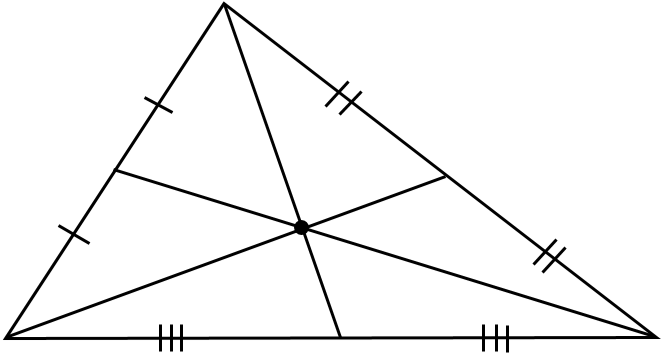
Length of perpendicular drawn on longest side of a scale $\triangle$ is:
Answer
- Smallest
Solution:
Length of the perpendicular drawn on the longest side of a scale is $\triangle$ smallest.
View full question & answer→Question 721 Mark
The area of an equilateral triangle having side length equal to $\frac{3}{\sqrt{4}}\text{cm}$ is:
Answer
- $\frac{3}{16}\text{sq.}\text{cm}$
View full question & answer→Question 731 Mark
The length of the sides of a triangle are $5x, 5x$ and $8x.$ The area of the triangle is:
Answer$\text{s}=\frac{5\text{x}+5\text{x}+8\text{x}}{2}=9\text{x}\text{ cm}$
Area of triangle $=\sqrt{\text{s}(\text{s}-\text{a})(\text{s}-\text{b})(\text{s}-\text{c})}$
$=\sqrt{9\text{x}(9\text{x}-5\text{x})(9\text{x}-5\text{x})(9\text{x}-8\text{x})}$
$=\sqrt{9\text{x}\times4\text{x}\times4\text{x}\times\text{x}}$
$=12\text{x}^2\text{ sq.cm}$
View full question & answer→Question 741 Mark
Write the correct answer in the following:
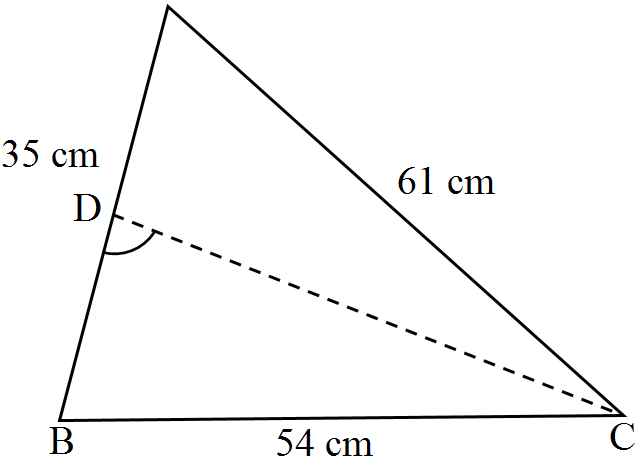
The sides of a triangle are 35cm, 54cm and 61cm, respectively. The length of its longest altitude:
Answer- $24\sqrt{5}\text{cm}$
Solution:
Sides of the triangle are 35cm, 54cm and 61cm
$\text{s}=\frac{35+54+61}{2}=75\text{cm}$
Area of $\triangle=\sqrt{75(75-35)(75-54)(75-61)}$
$=\sqrt{75\times40\times21\times14}$
$=\sqrt{5\times5\times3\times2\times2\times2\times5\times3\times7\times7\times2}$
$=5\times3\times2\times2\times7\sqrt{5}$
$=420\sqrt{5}\text{cm}^2$
Now, longest altitude will be the perpendicular on the smallest side of the triangle from the opposite vertex.
$\therefore$ Length of longest altitude $=\frac{2(\text{Area of }\triangle)}{35}$
$=\frac{2\times420\sqrt{5}}{35}=24\sqrt{5}\text{cm}$
View full question & answer→Question 751 Mark
The base of an isoscale triangle is 6cm and each of its equal sides is 5cm. The height of the triangle is:
Answer
- 4cm.
Solution:
Height of isoscale triangle $=\frac{1}{2}\sqrt{4\text{a}^2-\text{b}^2}$
$=\frac{1}{2}\sqrt{4(5)^2-6^2}$ (a = 5cm and b = 6cm)
$=\frac{1}{2}\times\sqrt{100-36}$
$=\frac{1}{2}\times\sqrt{64}$
$=\frac{1}{2}\times8$
$=4\text{cm}$ View full question & answer→Question 761 Mark
Write the correct answer in the following: The edges of a triangular board are $6\ cm, 8\ cm$ and $10\ cm.$ The cost of painting it at the rate of $9$ paise per$\ cm^2$ is:
AnswerSince, the edges of a triangular are $a = 6\ cm, b = 8\ cm$ and $c = 10\ cm$
Now, semi$-$perimeter of a triangular board.
$\text{s}=\frac{\text{a}+\text{b}+\text{c}}{2}$
$=\frac{6+8+10}{2}=\frac{24}{2}=12 \ \text{cm}$
Now, area of a triangular board $=\sqrt{\text{s}(\text{s}-\text{a})(\text{s}-\text{b})(\text{s}-\text{c})}$
$=\sqrt{12(12-6)(12-8)(12-10)}$
$=\sqrt{12\times6\times4\times2}$
$=\sqrt{(12)^2\times(2)^2}$
$=12\times2=24 \ \text{cm}^2$
Since, the cost of painting for area $1\ cm^2 = Rs. 0.09$
$\therefore$ Cost of paint for area $24\ cm^2 = 0.09 \times 24 = Rs. 2.16$
Hence, the cost of a triangular board is $Rs. 2.16$
View full question & answer→Question 771 Mark
Semiperimeter of scalene triangle of side k, 2k and 3k is:
Answer
- 3k
Solution:
Semiperimeter of scalene triangle of side k, 2k and 3k $=\frac{\text{k}+2\text{k}+3\text{k}}{2}=3\text{k}$ View full question & answer→Question 781 Mark
If the perimeter of a rhombus is 20cm and one of the diagonals is 8cm. The area of the rhombus is:
Answer- 24 sq.cm
Solution:
side of rhombus $=\frac{\text{Perimeter}}{4}$
$=\frac{20}{4}=5\text{cm}$
diagonal $=2\sqrt{52-44}=2\sqrt{25-16}=2\times3=6\text{cm}$
Area of rhombus $=\frac{1}{2}\times\text{Product of diagonal}$
$=\frac{1}{2}\times8\times6=24\text{ sq.cm}$
View full question & answer→Question 791 Mark
The sides of a triangle are 11m, 60m and 61m. The altitude to the smallest side is:
Answer
- 60m
Solution:
Area of $\triangle=\frac{1}{2}\text{Base}\times\text{Height}$
The smallest side is 11m
Area $=\frac{1}{2}\times11\times\text{Height}\ ....(\text{i})$
Area by Heron's Formula $=\sqrt{\text{s}(\text{s}-\text{a})(\text{s}-\text{b})(\text{s}-\text{c})}$
$\text{s}=\frac{11+60+61}{2}=66\text{m}$
Area $=\sqrt{66\times55\times6\times5}=330\text{m}^2$
From eq (i)
$330=\frac{1}{2}\times11\times\text{height}$
$\text{Height}=\frac{2\times330}{11}=60\text{m}$ View full question & answer→Question 801 Mark
The measure of each side of an equilateral triangle whose area is $\sqrt{3}\text{cm}^2$ is:
AnswerArea of equilateral triangle $=\frac{\sqrt{3}\text{a}^2}{4}$ where $a =$ side of the triangle
$\sqrt{3}=\frac{\sqrt{3}\text{a}^2}{4} $
Solving
$a^2 = 4$
$a = 2\ cm$
View full question & answer→Question 811 Mark
Ength of perpendicular drawn on smallest side of scalene triangle is:
Question 821 Mark
The area of a quadrilateral whose diagonals measure $48m$ and $32m$ respectively and bisect each other at right angles is:
AnswerAccording to the question,
Area of given quadrilateral $=\frac{1}{2}\times\text{Product of diagonals}$
$=\frac{1}{2}\times48\times32$
$=768\text{ sq.m}$
View full question & answer→Question 831 Mark
The area of a parallelogram whose base is $32m$ and the corresponding altitude is $6m$ is:
AnswerArea of parallelogram $=$ Base $\times $ Corresponding altitude
$= 32 \times 6$
$= 192 \ sq.m$
View full question & answer→Question 841 Mark
The sides of a triangle are $5\ cm, 12\ cm$ and $13\ cm.$ then its area is:
Answer$\text{s}=\frac{5+12+13}{2}=15 \ \text{cm}$
Area of triangle $=\sqrt{\text{s}(\text{s}-\text{a})(\text{s}-\text{b})(\text{s}-\text{c})}$
$=\sqrt{15(15-5)(15-12)(15-13)}$
$=\sqrt{15\times10\times3\times2}$
$=30\text{ sq. cm}$
$=0.003\text{m}^2$
View full question & answer→Question 851 Mark
The diagonal of a rhombus are 24cm and 10cm. Then its perimeter is:
Answer
- 52cm
Solution:
Since diagonals of a rhombus bisect each other at right angle.
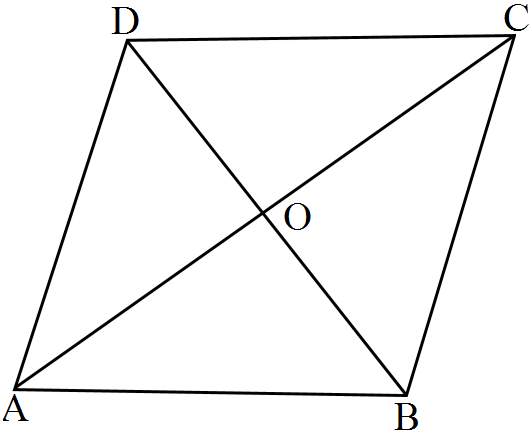
$\text{OB}=\frac{24}{2}=12\text{cm}$ and $\text{OC}=\frac{10}{2}=5\text{cm}$
In triangle OBC,
$\text{BC}=\sqrt{12^2+5^2}=\sqrt{144+25}=13\text{cm}$
Perimeter of rhombus $=4\times\text{side}=4\times13=52\text{cm}$ View full question & answer→Question 861 Mark
In $\triangle\text{ABC},$ it is given that base $= 12\ cm$ and height $= 5\ cm. $ Its area is:
Answer$30\ cm^2$
Area of triangle $=\frac{1}{2}\times\text{Base}\times\text{Height}$
Are of $\triangle\text{ABC}=\frac{1}{2}\times12\times5$
$= 30\ cm^2$
View full question & answer→Question 871 Mark
The base of a right triangle is $48\ cm$ and its hypotenuse is $50\ cm$ long. The area of the triangle is:
Answer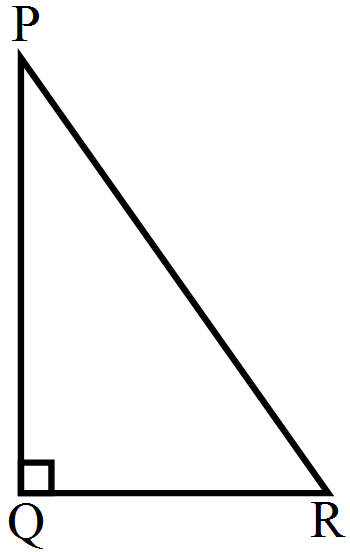
Let $\triangle\text{PQR}$ be a right$-$angled triangle and $\text{PQ} \ \bot \ \text{QR}.$
Now,
$\text{PQ}=\sqrt{\text{PR}^2-\text{QR}^2}$
$=\sqrt{50^2-48^2}$
$=\sqrt{2500-2304}$
$=\sqrt{196}$
$=14 \ \text{cm}$
$\therefore$ Area of triangle $=\frac{1}{2}\times\text{QR}\times\text{PQ}$
$=\frac{1}{2}\times48\times14=336 \ \text{cm}^2$ View full question & answer→Question 881 Mark
The sides of a triangular field are $325m, 300m$ and $125m.$ Its area is:
Answer$a = 325m, b = 30m, c = 125m$
$\text{s}=\frac{\text{a}+\text{b}+\text{c}}{2}=\frac{325+300+125}{2}=375\text{m}$
$s - a = 50m, s - b = 75m, s - c = 250m$
Area $=\sqrt{\text{s}(\text{s}-\text{a})(\text{s}-\text{b})(\text{s}-\text{c})}$
$=\sqrt{375\times50\times75\times250}$
$=\sqrt{15\times25\times25\times2\times3\times25\times25\times10}$
$=\sqrt{\underline{25\times25}\times\underline{25\times25}\times\underline{30\times30}}$
$=25\times25\times30$
$= 18750\text{m}^2$
View full question & answer→Question 891 Mark
A square and an equilateral triangle have equal perimeters. If the diagonal of the square is $12\sqrt{2}\text{cm},$ then area of the triangle is:
Answer
- $64\sqrt3\text{cm}^2$
Solution:
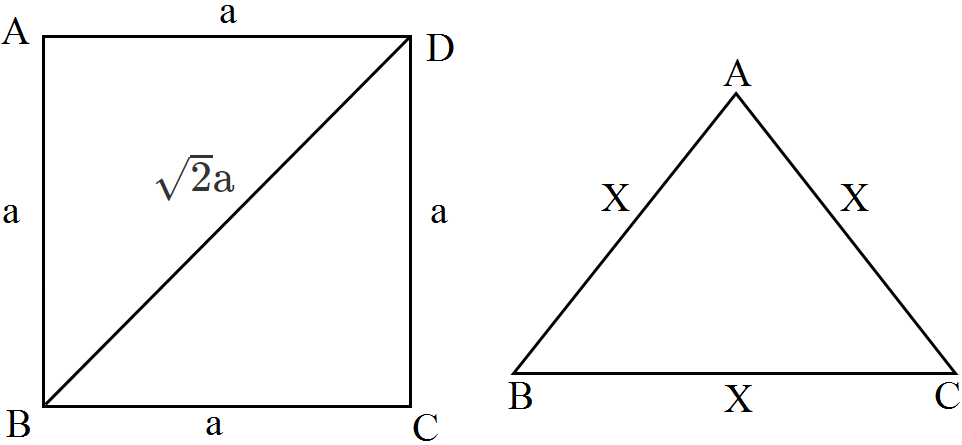
If side of a square is a cm then, its diagonal $=\sqrt2\text{ a cm}$
But diagonal $=12\sqrt2\text{cm}$
$\Rightarrow2-\sqrt{\text{a}}=12\sqrt2$
$\Rightarrow\text{a}=12\text{cm}$
⇒ Perimeter of a square = 4a = 4 × 12= 48cm
Now, perimeter of an equilateral triangle with side x = 3x cm
But, perimeter of equilateral triangle = Perimeter of square
⇒ 3x = 48
⇒ x = 16cm
Now, Area of equilateral $\triangle=\frac{\sqrt3\text{x}^2}{4}=\frac{\sqrt3}{4}\times16\times16=64\sqrt3\text{cm}^2$ View full question & answer→Question 901 Mark
The base of a right triangle is 8cm and the hypotenuse is 10cm. Its area will be
Answer
- $24\text{cm}^2$
Solution:
Given: Base = 8cm and Hypotenuse = 10cm
$\text{Hence,hight}=\sqrt{(10)^2-(8)^2}=\sqrt{36=6\text{cm}}$
$\text{Therefore,area}=(\frac {1}{2})\times\text{b}\times\text{h} =(\frac{1}{2})\times8\times6=24\text{cm}^2$
View full question & answer→Question 911 Mark
The perimeter and area of a triangle whose sides are of lengths $3\ cm, 4\ cm$ and $5\ cm$ respectively are:
AnswerPerimeter of triangle $= 3 + 4 + 5 = 12\ cm$
Now, $\text{s}=\frac{3+4+5}{2}=\text{6 cm}$
Area $=\sqrt{\text{s}(\text{s}-\text{a})(\text{s}-\text{b})(\text{s}-\text{c})}$
$=\sqrt{6(6-3)(6-4)(6-5)}=\sqrt{6\times3\times2\times1}$
$= 6 \text{ sq. cm}$
View full question & answer→Question 921 Mark
Each side of an equilateral triangle measures 8cm. The area of the triangle is:
Answer
- $16\sqrt3\text{cm}^2$
Solution:
Area of equilateral triangle $=\frac{\sqrt3}{4}\times(\text{Side})^2$
$=\frac{\sqrt3}{4}\times(8)^2$
$=\frac{\sqrt3}{4}\times64$
$=16\sqrt3\text{cm}^2$ View full question & answer→Question 931 Mark
Length of perpendicular drawn on longest side of a scale $\triangle$ is:
View full question & answer→Question 941 Mark
He base of an isosceles triangle is $10\ cm$ and one of its equal sides is $13\ cm.$ The area of the triangle is:
View full question & answer→Question 951 Mark
Write the correct answer in the following: The sides of a triangle are $56\ cm, 60\ cm$ and $52\ cm$ long. Then the area of the triangle is:
AnswerSince, the three sides of a triangle are $a = 56\ cm, b = 60\ cm$ and $c = 52\ cm$
Then, semi$-$perimeter of a triangle,
$\text{s}=\frac{\text{a}+\text{b}+\text{c}}{2}$
$=\frac{56+60+52}{2}$
$=\frac{168}{2}$
$=84 \ \text{cm}$
Area of triangle $=\sqrt{\text{s}(\text{s}-\text{a})(\text{s}-\text{b})(\text{s}-\text{c})}$ $[$by Heron's formula$]$
$=\sqrt{84(84-56)(84-60)(84-52)}$
$=\sqrt{4\times7\times3\times4\times7\times4\times2\times3\times4\times4\times2}$
$=\sqrt{(4)^6\times(7)^2\times(3)^2}$
$=4^3\times7\times3$
$=1344 \ \text{cm}^2$
View full question & answer→Question 961 Mark
If the length of a median of an equilateral triangle is x cm, then its area is:
Question 971 Mark
The sides of a triangle are 35cm, 54cm and 61cm, respectively. The length of its longest altitude.
Question 981 Mark
If the perimeter and base of an isosceles triangle are 11cm and 5cm respectively, then its area is:
Answer- $\frac{5}{4}\sqrt{11}\text{cm}^2$
Solution:
Let each of the equal sides be x cm. Then,
$\text{x}+\text{x}+5=11$
$\Rightarrow2\text{x}=6$
$\Rightarrow\text{x}=3\text{cm}$
$\text{s}=\frac{3+3+5}{2}=\frac{11}{2}\text{cm}$
$\text{Area}=\sqrt{\text{s}(\text{s}-\text{a})(\text{s}-\text{b})(\text{s}-\text{sc})}$
$=\sqrt{\frac{11}{2}\big(\frac{11}{2}-3\big)\big(\frac{11}{2}-3\big)\big(\frac{11}{2}-5\big)}$
$=\sqrt{\frac{11}{2}\times\frac{5}{2}\times\frac{5}{2}\times\frac{1}{2}}$
$=\frac{5}{4}\sqrt{11}\text{cm}^2$
View full question & answer→Question 991 Mark
The perimeter of a rhombus is $20\ cm.$ If one of its diagonals is $6\ cm,$ then its area is:
Answer$\text{Side}=\frac{20}{4}=5 \ \text{cm}$
$\text{half diagnoal} =\sqrt{5^2 - 3^2} = 4 \ \text{cm }$
$\text{diagnoal} = 4 \times 2 = 8 \ \text{cm} $
$\text{Area}=\frac{1}{2}\times6\times8=24 \ \text{cm}^2$
View full question & answer→Question 1001 Mark
The base of an isosceles triangle is $16\ cm$ and its area is $48\ cm^2.$ The perimeter of the triangle is:
Answer
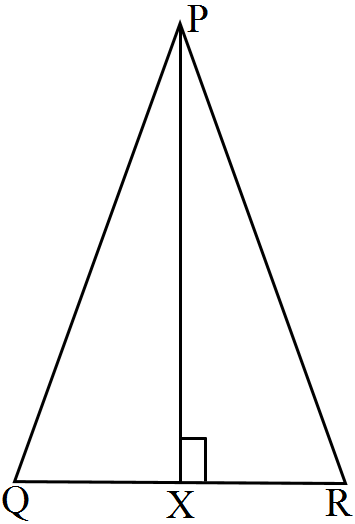
Let $\triangle\text{PQR}$ be an isosceles triangle and $PX \perp QR$
Now,
Area of triangle $= 48\ cm^2$
$\Rightarrow\frac{1}{2}\times\text{QR}\times\text{PX}=48$
$\Rightarrow\text{h}=\frac{96}{16}=6 \ \text{cm}$
Also,
$\text{QX}=\frac{1}{2}\times24$
$=12 \ \text{cm}$ and $PX =12\ cm$
$\text{PQ}=\sqrt{\text{QX}^2+\text{PX}^2}$
$\text{a}=\sqrt{8^2+6^2}$
$=\sqrt{64+36}$
$=\sqrt{100}$
$=10 \ \text{cm}$
$\therefore$ Perimeter $= (10 + 10 + 16)cm$
$= 36\ cm$
View full question & answer→