Question 1011 Mark
The sides of a triangle are $50\ cm, 78\ cm$ and $112\ cm.$ The smallest altitude is:
Answer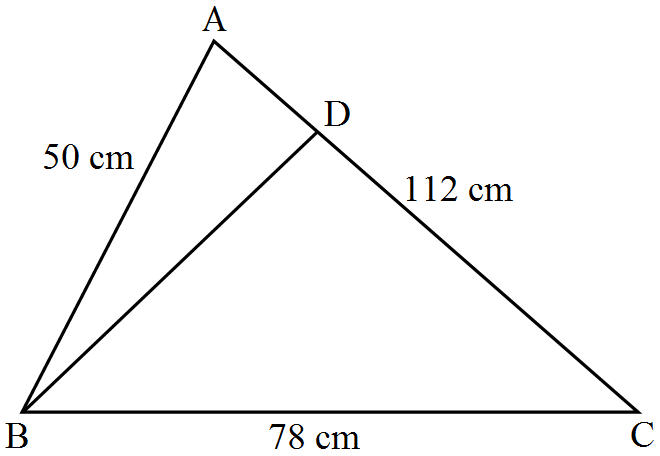
The smallest altitude is $\perp$ drawn to the largest side of a $\triangle$ From opposite point. i. e. $BD$
Area of $\triangle=\frac12\times\text{AC}\times\text{BD}=\frac12\times112\times\text{BD}=56\times\text{BD}$
$\text{s}=\frac{\text{a}+\text{b}+\text{c}}{2}=\frac{50+78+115}{2}=120 \ \text{cm}$
$s - AB = 70\ cm, s - BC = 42\ cm, s - AC = 8\ cm$
Area $=\sqrt{\text{s}(\text{s}-\text{a})(\text{s}-\text{b})(\text{s}-\text{c})}$
$=\sqrt{120\times70\times42\times8}=1680 \ \text{cm}^2$
Now, $56 \times BD = 1680\ cm^2$
$\Rightarrow\text{BD}=\frac{1680}{56}=30 \ \text{cm}$
View full question & answer→Question 1021 Mark
In the given figure, the ratio $AD$ to $DC$ is $3$ to $2.$ If the area of $\triangle\text{ABC}$ is $40\ cm^2,$ what is the area of $\triangle\text{BDC}?$
Answer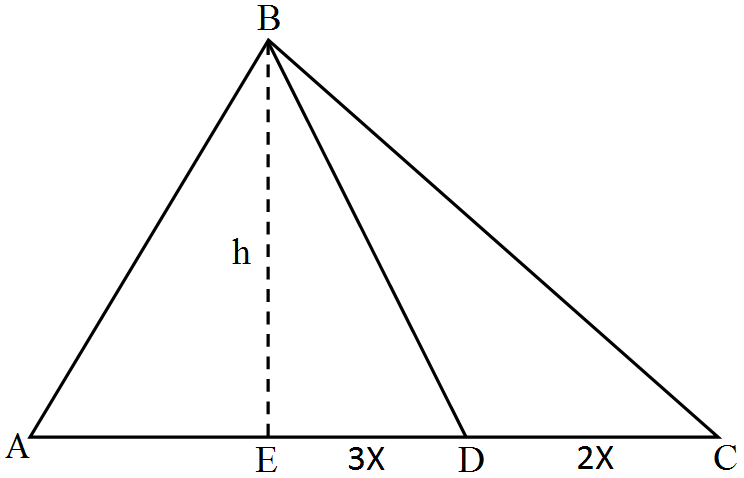
$\frac{\text{AD}}{\text{DC}}=\frac32$
Let $AD = 3x$ and $DC = 2x$
Area of $\triangle\text{ABC}=\frac12\times\text{AC}\times\text{BC}$ $(BE = h)$
$\Rightarrow40=\frac12\times5\text{x}\times\text{h}$
$\Rightarrow 80 = 5xh$
$\Rightarrow xh = 16\ cm^2 ....(1)$
Now, Area of $\triangle\text{ABD}$
$=\frac12\times3\text{x}\times\text{h}$
$=\frac{3\times\text{h}}{2}$
$=\frac{3}{2}\times16$
$=24 \ \text{cm}^2$
Area of $\triangle\text{BDC}=$ Area of $\triangle\text{ABC}-$ Area of $\triangle\text{ABD}$
$=40-24$
$=16 \ \text{cm}^2$
View full question & answer→Question 1031 Mark
In figure, the ratio of $AD$ to $DC$ is $3$ to $2$. If the area of $\triangle\text{ABC}$ is $40\ cm^2$ the area of $\triangle\text{BDC}?$
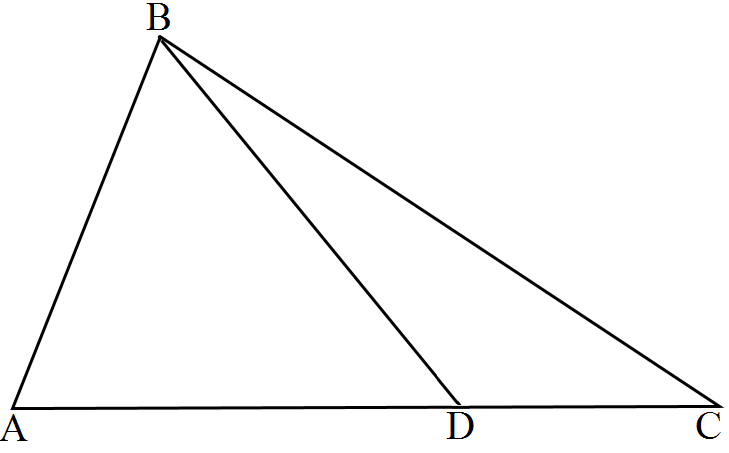
Answer$\frac{\text{AD}}{\text{DC}}=\frac{3}{2}$
Let $AD = 3x$ and $DC = 2x$
Area of $\triangle\text{ABC}=\frac{1}{2}\times\text{AC}\times\text{BE}\ (BE = h)$
$\Rightarrow40=\frac{1}{2}\times5\text{x}\times\text{h}$
$\Rightarrow80=5\times\text{h}$
$\Rightarrow\text{xh}=16\text{ cm}^2$
Area of $\triangle\text{ABD}=\frac{1}{2}\times3\text{x}\times\text{h}$
$=3\times\frac{\text{h}}{2}=\frac{3}{2}\times16$
$=24\text{ cm}^2$
Area of $\triangle\text{BDC} = $ Area of $\triangle\text{ABC}$ Area of $\triangle\text{ABD}$
$=40-24$
$=16\text{ cm}^2$
View full question & answer→Question 1041 Mark
The area of a right-angled triangle if the radius of its circumcircle is $3\ cm$ and altitude drawn to the hypotenuse is $2\ cm$ is:
AnswerSince in a right$-$angled triangle, the circumcentre is the mid$-$point of the hypotenuse, then
Hypotenuse $= 2 \times 3 $
$= 6\ cm$
Now$,$ Area of right$-$angled triangle $=\frac{1}{2}\times$ Base $\times$ Altitude
$=\frac{1}{2}\times6\times2$
$=6\text{ sq}.\text{ cm}.$
View full question & answer→Question 1051 Mark
The side of a triangle is 12cm, 16cm, and 20cm. Its area is:
Answer- 96 sq.cm
Solution:
$\text{S}=\frac{12+16+20}{2}=\frac{48}{2}=24\text{cm}$
Area of triangle $=\sqrt{\text{s}(\text{s}-\text{a})(\text{s}-\text{b})(\text{s}-\text{c})}$
$=\sqrt{24(24-16)(24-12)(24-20)}$
$=\sqrt{24\times8\times12\times4}$
$=12\times8=96\text{ sq.cm}$
View full question & answer→Question 1061 Mark
The sides of a triangle are 11cm, 15cm and 16cm. The altitude to the largest side is:
Answer
- $\frac{15\sqrt{7}}{2}\text{cm}$
Solution:
$\text{s}=\frac{11+60+61}{2}=66\text{m}$
Area of $\triangle=\sqrt{\text{s}(\text{s}-\text{a})(\text{s}-\text{b})(\text{s}-\text{c})}$
$=\sqrt{21\times10\times6\times5}=30\sqrt{7}\text{cm}^2$
Also if we choose largest side and its Altitude, the area would be
$\text{A}=\frac12\times\text{largest side}\times\text{h}$
$330=\frac12\times11\times\text{Height}$
$\Rightarrow\text{Height}=\frac{2\times330}{11}=60\text{m}$
Hence, correct option is (d). View full question & answer→Question 1071 Mark
The base of an isoscale triangle is 8cm long and each of its equal sides measures 6cm. The area of the triangle is:
Answer
- $8\sqrt{5}\text{cm}^2$
Solution:
Area of quadrilateral triangle $=\frac{\text{b}}{4}\sqrt{4\text{a}^2-\text{b}^2}$
Here,
a = 6cm and b = 8cm
Thus, we have:
$=\frac{8}{4}\times\sqrt{4(6)^2-8^2}$
$=\frac{8}{4}\times\sqrt{144-64}$
$=\frac{8}{4}\times\sqrt{80}$
$=\frac{8}{4}\times4\sqrt{5}$
$=8\sqrt{5}\text{cm}^2$ View full question & answer→Question 1081 Mark
The lengths of a triangle are 6cm, 8cm and 10cm. Then the length of perpendicular from the opposite vertex to the side whose length is 8cm is:
Question 1091 Mark
The sides of a triangle are in the ratio 12 : 17 : 25 and its perimeter is 540cm.The area is:
Answer- 9000 sq.cm
Solution:
The ratio of the sides is 12 : 17 : 25
Perimeter = 540cm
Let the sides of the triangle be 12x, 17x and 25x.
Hence,
12x + 17x + 25x = 540cm
54x = 540cm
x = 10
Therefore,
a = 12x = 12 × 10 = 120
b = 17x = 17 × 10 = 170
c = 25x = 25 × 10 = 250
$\text{Semi}-\text{perimeter, s}= \frac{540}{2}= 270\text{cm}$
Using Heron’s formula:
$\text{A}=\sqrt{8(8-\text{a})(8-\text{b})(8-\text{c})}$
$=\sqrt270{(270-120)(270-170)(270-250)}$
$=\sqrt(270\times150\times100\times20)$
$= 9000 \text{ sq.}\text{cm}$
View full question & answer→Question 1101 Mark
The lengths of three sides of a triangle are $20\ cm, 16\ cm$ and $12\ cm$. The area of the triangle is:
AnswerLet:
$a = 20\ cm, b = 16\ cm$ and $c = 12\ cm$
$\text{s}=\frac{\text{a}+\text{b}+\text{c}}{2}=\frac{26+16+12}{2}$
$=24\text{ cm}$
By Heron's formula, we have:
Area of triangle $=\sqrt{\text{s}(\text{s}-\text{a})(\text{s}-\text{b})(\text{s}-\text{c})}$
$=\sqrt{24(24-20)(24-16)(24-12)}$
$=\sqrt{24\times4\times8\times12}$
$=\sqrt{6\times4\times4\times4\times4\times6}$
$=6\times4\times4$
$=96\text{ cm} ^2$
View full question & answer→Question 1111 Mark
If the base and the corresponding altitude of a parallelogram are $60\ cm$ and $24\ cm$ respectively, then the area of the parallelogram is:
AnswerArea of parallelogram $=$ Base $\times$ corresponding height
$= 60 \times 24$
$= 1440 \ sq.\ cm.$
View full question & answer→Question 1121 Mark
The sides of a triangle are 122m, 22m and 120m respectively. The area of the triangle is:
Answer
- 1320 sq.m
Solution:
Explanation: Given,
a = 122m
b = 22m
c = 120m
$\text{Semi-perimeter, s}=\frac{(122+22+120)}{2}=132\text{m}$
Using heron’s formula:
$\text{A}=\sqrt{8(8-a)(8-b)(8-c)}$
$=\sqrt{132(132-122)(132-22)(132-120)}$
$=\sqrt{(132\times10\times110\times12)}$
= 1320 sq.m
View full question & answer→Question 1131 Mark
The area of quadrilateral $\text{PQRS},$ in which $PQ = 7\ cm, QR = 6\ cm, RS = 12\ cm, PS = 15\ cm$ and $PR = 9\ cm:$
Answer$74.98\ cm^2$
View full question & answer→Question 1141 Mark
The length of each side of an equilateral triangle having an area of $25\sqrt{3}\text{cm}^2$ is:
Answer- 10cm
Solution:
$\text{Area}=25\sqrt{3}\text{sq}.\text{cm}$
$25\sqrt{3}=\frac{\sqrt{3}}{4}\text{a}^2$
$\text{a}^2=\frac{25\times4\times\sqrt{3}}{\sqrt{3}}=100$
$\text{Side}=\text{10cm}.$
View full question & answer→Question 1151 Mark
The cost of turfing a triangular field at the rate of $Rs. 45$ per $100m^2$ is $Rs. 900.$ If the double the base of the triangle is $5$ times its height, then its height is:
AnswerCost of turfing a triangular field at the rate of $Rs. 45$ per $100 = Rs. 900$
$\frac{\text{Area}\times45}{100}=900$
$\Rightarrow$ Area $= 2000 \ sq\ .cm$
According to question,
$2 \times$ Base $= 5 \times$ Height
$\Rightarrow$ Base $=\frac{\text{Height}\times5}{2}$
Areo of triangle $= 2000 \ sq.\ cm$
$\Rightarrow\frac{1}{2}\times\text{Base}\times\text{Height}=2000$
$\Rightarrow\frac{1}{2}\times\frac{\text{Height}\times5}{2}\times\text{Height}=2000$
$\Rightarrow (Height)^2 = 1600$
$\Rightarrow Height = 40\ cm$
View full question & answer→Question 1161 Mark
Each of two equal sides of an isoscale right triangle is $10\ cm$ long. Its area is:
AnswerHere, the base and height of the triangle are $10\ cm$ and $10\ cm,$ respectively.
Thus, we have:
Area of triangle $=\frac{1}{2}\times$ Base $\times$ Height
$=\frac{1}{2}\times10\times10$
$=50\text{ cm}^2$
View full question & answer→Question 1171 Mark
The perimeter and area of a triangle whose sides are of lengths $3\ cm, 4\ cm$ and $5\ cm$ respectively are:
AnswerPerimeter of triangle $= 3 + 4 + 5$
$= 12\ cm$
Now, $\text{s}=\frac{3+4+5}{2}$
$=6\text{ cm}$
Area $=\sqrt{\text{s}(\text{s-a})(\text{s-b})(\text{s-c})}$
$=\sqrt{6(6-3)(6-4)(6-5)}$
$=\sqrt{6\times3\times2\times1}$
$=6\text{ sq}.\text{ cm}.$
View full question & answer→Question 1181 Mark
The sides of a triangular flower bed are 5m, 8m and 11m. the area of the flower bed is:
Answer
- $4\sqrt{21}\text{m}^2$
Solution:
$\text{s}=\frac{5+8+11}{2}=12\text{m}$
Area of triangle $=\sqrt{\text{s}(\text{s}-\text{a})(\text{s}-\text{b})(\text{s}-\text{c})}$
$=\sqrt{12(12-5)(12-8)(12-11)}$
$=\sqrt{12\times7\times4\times1}$
$=4\sqrt{21}\text{m}^2$ View full question & answer→Question 1191 Mark
The measure of each side of an equilateral triangle whose area is $\sqrt{3}\text{cm}^2$ is:
Answer
- 2cm
Solution:
Area of equilateral triangle $=\frac{\sqrt{3}\text{a}^2}{4}$ where a = side of the triangle
$\sqrt{3}=\frac{\sqrt{3}\text{a}^2}{4}$
Solving
$\text{a}^2=4$
$\text{a}=2\text{cm} $ View full question & answer→Question 1201 Mark
The area of a triangle whose sides are 15cm, 8cm and 19cm is:
Answer- $6\sqrt{91}\text{cm}^2$
Solution:
$\text{s}=\frac{15+8+19}{2}=21\text{cm}$
Area of triangle $=\sqrt{\text{s}(\text{s-a})(\text{s-b})(\text{s-c})}$
$=\sqrt{21(21-15)(21-8)(21-19)}$
$=\sqrt{21\times6\times13\times2}$
$=6\sqrt{91}\text{sq}.\text{cm}.$
View full question & answer→Question 1211 Mark
Each of the equal sides of an isoscale triangle is $13\ cm$ and its base is $24\ cm$. The area of the triangle is:
AnswerArea of isoscale triangle $=\frac{\text{b}}{4}\sqrt{4\text{a}^2-\text{b}^2}$
Here,
$a = 13\ cm$ and $b = 24\ cm$
Thus, we have:
$=\frac{24}{4}\times\sqrt{4(13)^2-24^2}$
$=6\times\sqrt{676-576}$
$=6\times\sqrt{100}$
$=6\times10$
$=60\text{ cm}^2$
View full question & answer→Question 1221 Mark
The sides of a triangle are 11m, 60m and 61m. The altitude to the smallest side is:
Answer- 60cm
Solution:
Area of $\triangle=\frac12\text{Base}\times\text{Height}$
The smallest side is 11m
$\Rightarrow\text{Area}=\frac12\times11\times\text{Height}\dots(1)$
Area by Heron's Formula $=\sqrt{\text{s}(\text{s}-\text{a})(\text{s}-\text{b})(\text{s}-\text{c})}$
$\text{s}=\frac{11+60+61}{2}=66\text{m}$
$\Rightarrow\text{Area}=\sqrt{66\times55\times6\times5}=330\text{m}^2$
From eq. (1)
$330=\frac12\times11\times\text{Height}$
$\Rightarrow\text{Height}=\frac{2\times330}{11}=60\text{m}$
Hence, correct option is (d).
View full question & answer→Question 1231 Mark
The equal sides of the isosceles triangle are 12cm, and the perimeter is 30cm. The area of this triangle is:
Answera. 9√15 sq.cmSolution:
Explanation: Given,
Perimeter = 30cm
$\text{Semiperimeter,s}=\frac{30}{2}=15\text{cm}$
a = b = 12cm
c = ?
a + b + c = 30
12 + 12 + c = 30
c = 30 – 24 = 6cm
Using Heron’s formula:
$\text{A}=\sqrt{8(8-\text{a})(8-\text{b})(8-\text{c})}$
$= \sqrt{15(15-12)(15-12(15-6)}$
$=\sqrt{(15\times3\times3\times9)}$
$=9\sqrt{15\text{sq}.\text{cm}}$
View full question & answer→Question 1241 Mark
Each of the two equal sides of an isosceles right triangle is 10cm long. Its area is:
Answer
- $50\text{cm}^2$
Solution:
Here, the base and height of the triangle are 10cm and 10cm, respectively.
Thus, we have
Area of triangle $=\frac{1}{2}\times\text{Base}\times\text{Height}$
$=\frac{1}{2}\times10\times10$
$=50\text{cm}^2$ View full question & answer→Question 1251 Mark
The area of an equilateral triangle having side length equal to $\sqrt\frac{3}{4}\text {cm}$ (using Heron’s formula) is:
Answerc. $3\sqrt\frac{3}{64}\text{sq.cm}$Solution:
$\text{Here, } \text{a}=\text{b}=\text{c}\sqrt{\frac{3}{4}}$
$\text{Semiperimeter}=\frac{(\text{a}+\text{b}+\text{c})}{2} \frac{3\text{a}}{2}=3\sqrt{\frac{3}{8}\text{cm}}$
Using Heron’s formula,
$\text{A}=\sqrt{\text{s}\text(s-a)\text(s-b)\text(s-c)}$
$(\sqrt{3\sqrt{\frac{3}{8}}}) (3\sqrt{\frac{3}{8}}-\sqrt{\frac{3}{4}}) (3\sqrt{\frac{3}{8}}-\sqrt{\frac{3}{4}}) \sqrt{\frac{3}{4}}) $
$=3\sqrt{\frac{3}{64}}\text{s}\text{q}.\text{c}\text{m}$
View full question & answer→Question 1261 Mark
The product of difference of semi$-$perimeter respective sides of $\triangle\text{ABC}$ are given as $13200\ m^2$.The area of $\triangle\text{ABC},$ if its semi-perimeter is $132\ m,$ is given by:
AnswerGiven: $(s - a) (s - b) (s - c) = 13200\ m$ and $s = 132\ m$
Area of triangle $=\sqrt{\text{s}(\text{s}-\text{a})(\text{s}-\text{b})(\text{s}-\text{c})}$
$=\sqrt{13200\times132}$
$=1320\text{ sq.m}$
View full question & answer→Question 1271 Mark
The sides of a triangular flower bed are 5m, 8m and 11m. the area of the flower bed is:
Answer
- $4\sqrt{21}\text{m}^2$
Solution:
$\text{s}=\frac{5+8+11}{2}=12\text{m}$
Area of triangle $=\sqrt{\text{s}(\text{s}-\text{a})(\text{s}-\text{b})(\text{s}-\text{c})}$
$=\sqrt{12(12-5)(12-8)(12-11)}$
$=\sqrt{12\times7\times4\times1}$
$=4\sqrt{21}\text{ sq.m}$ View full question & answer→Question 1281 Mark
Each side of an equilateral triangle is 2x cm. If $\text{x}\sqrt{3}=\sqrt{48},$ then area of the triangle is:
Answer
- $16\sqrt{3}\text{cm}^2$
Solution:
Here, $\text{x}\sqrt{3}=\sqrt{48}$
$\Rightarrow\text{x}=\sqrt{16}$
Side = 2x
Area of equilateral triangle $=\frac{\sqrt{3}}{4}\text{(Side)}^2$
$=\frac{\sqrt{3}}{4}(2\text{x})^2$
$=\sqrt{3}\text{x}^2\text{ sq. cm}$
$=\sqrt{3}(\sqrt{16})^2$
$=16\sqrt{3}\text{cm}^2$ View full question & answer→Question 1291 Mark
The lengths of the three sides of a triangular field are $40\ m, 24\ m$ and $32\ m$ respectively. The area of the triangle is:
AnswerLet:
$a = 40\ m, b = 24\ m$ and $c = 32\ m$
$\text{s}=\frac{40+24+32}{2}$
$=48\text{ cm}$
By Heron's formula, we have
Area of triangle $=\sqrt{\text{s}(\text{s}-\text{a})(\text{s}-\text{b})(\text{s}-\text{c})}$
$=\sqrt{48(48-40)(48-24)(48-32)}$
$=\sqrt{48\times8\times24\times16}$
$=\sqrt{24\times2\times8\times24\times8\times2}$
$=24\times8\times2$
$=384\text{ m}^2$
View full question & answer→Question 1301 Mark
The length of each side of an equilateral triangle having an area of $ 9\sqrt3\text{cm}^2$ is:
Answer- 6cm
Solution:
Given: Area of equilateral triangle $= 9\sqrt3\text{cm}^2$
Hence, $\bigg({\frac{\sqrt3}{4}}\bigg)\text{a}^2=9\sqrt{3}$
$\text{a}^2=\frac{[(9\sqrt3)(4)]}{\sqrt3}$
$\text{a}^2=36$
$\text{a}=6\text{cm}$
View full question & answer→Question 1311 Mark
The sides of a triangle are $5\ cm, 12\ cm$ and $13\ cm.$ then its area is:
Answer$\text{s}=\frac{5+12+13}{2}$
$=15\text{cm}$
Area of triangle $=\sqrt{\text{s}(\text{s}-\text{a})(\text{s}-\text{b})(\text{s}-\text{c})}$
$=\sqrt{15(15-5)(15-12)(15-13)}$
$=\sqrt{15\times10\times3\times2}$
$=30\text{ sq.cm}$
$=0.003\text{ sq.m}$
View full question & answer→Question 1321 Mark
Each of the equal sides of an isosceles triangle is $2\ cm$ greater than its height. If the base of the triangle is $12\ cm$, then its area is:
AnswerLet the height of the isosceles triangle be $x \ cm$
Then length of equal side $= (x + 2)\ cm$
Since altitude of isosceles triangle bisects the base. Then in a right angled triangle,
$(x + 2)^2 = x^2 + 6^2$
$\Rightarrow 4 + 4x = 36$
$\Rightarrow x = 8\ cm$
Now, area of triangle $=\frac{1}{2}\times$ Base $\times$ Height
$=\frac{1}{2}\times8$
$=48\text{ sq.cm}.$
View full question & answer→Question 1331 Mark
The sides of a triangle are $325\ m, 300\ m$ and $125\ m$. Its area is:
Answer$a = 325\ m, b = 300\ m, c = 125\ m$
$\text{s}=\frac{\text{a}+\text{b}+\text{c}}{2}=\frac{325+300+125}{4}$
$=375\text{ m}$
$s - a = 50\ m, s - b = 75\ m, s - c = 250\ m$
Area $=\sqrt{\text{s}}(\text{s}-\text{a})(\text{s}-\text{b})(\text{s}-\text{c})$
$=\sqrt{375\times50\times75\times250}$
$=\sqrt{15\times25\times25\times2\times3\times25\times25\times10}$
$=\sqrt{25\times25\times25\times25\times30\times30}$
$=25\times25\times30$
$=18750\text{ m}^2$
View full question & answer→Question 1341 Mark
Write the correct answer in the following:
The length of each side of an equilateral triangle having an area of $9\sqrt{3}\text{cm}^2$ is:
Answer- 6cm
Solution:
Area of equilateral $\triangle\text{ i.e., } 9\sqrt{3}=\frac{\sqrt{3}}{4}(\text{side})^2$
$\Rightarrow(\text{side})^2=\frac{9\sqrt{3}\times4}{\sqrt{3}}=36$
$\therefore\ \text{side}=\pm\sqrt{36}=6\text{cm}$
View full question & answer→Question 1351 Mark
Write the correct answer in the following:
If the area of an equilateral triangle is $16\sqrt{3}\text{cm}^2,$ then the perimeter of the triangle is:
Answer- 24cm
Solution:
Given, area of an equilateral triangle $=16\sqrt{3}\text{cm}^2$
Area of an equilateral triangle $=\frac{\sqrt{3}}{4}(\text{side})^2$
$\frac{\sqrt{3}}{4}(\text{side})^2={16}\sqrt{3}$
$\Rightarrow(\text{side})^2=64$
$\Rightarrow\text{sides}=8\text{cm}$
[taking positive square root because side is always positive]
Perimeter of an equilateral triangle = 3 × Side= 3 × 8 = 24cm
Hence, the perimeter of an equilateral triangle is 24cm.
View full question & answer→Question 1361 Mark
The area of an isosceles triangle having base 2cm and the length of one of the equal sides 4cm, is:
Answer
- $\sqrt{15}\text{cm}^2$
Solution:
$\text{s}=\frac{4+4+2}{2}=5\text{cm}$
Area of triangle $=\sqrt{\text{s}(\text{s}-\text{a})(\text{s}-\text{b})(\text{s}-\text{c})}$
$=\sqrt{5(5-4)(5-4)(5-2)}$
$=\sqrt{5\times1\times1\times3}$
$=\sqrt{15}\text{ sq.cm}$ View full question & answer→Question 1371 Mark
The edges of a triangular board are $6\ cm, 8\ cm$ and $10\ cm$. The cost of painting it at the rate of $9$ paise per $\ cm^2$ is:
Answer$\text{s}=\frac{6+8+10}{2}$
$=12\text{ cm}$
Area of triangle $=\sqrt{\text{s}(\text{s}-\text{a})(\text{s}-\text{b})(\text{s}-\text{c})}$
$=\sqrt{12(12-6)(12-8)(12-10)}$
$=\sqrt{12\times6\times4\times2}$
$=24\text{ sq.cm}$
Therefore, the cost of painting it at the rate of $Rs. 0.09$ per $sq.cm = 24 \times 0.09$
$= Rs. 216$
View full question & answer→Question 1381 Mark
The perimeter of a rhombus is $146\ cm.$ One of its diagonals is $55\ cm$. The length of the other diagonal and area of the rhombus are:
Answer$48\ cm, 1320\ cm^2$
View full question & answer→Question 1391 Mark
The perimeter of a triangle is 60cm. If its sides are in the ratio 1 : 3 : 2, then its smallest side is:
Answer- 10cm
Solution:
Given: Ratio of sides: 1 : 3 : 2
Let the sides of triangle be x, 3x and 2x cm
Perimeter = 60cm
x + 3x + 2x = 60
⇒ 6x = 60
⇒ x = 10
So, sides are
a = 1 × 10 = 10cm
b = 3 × 10 = 30cm
c = 2 × 10 = 20cm
Therefore, Length of smallest side = 10cm.
View full question & answer→Question 1401 Mark
The area of an equilateral triangle is $36\sqrt{3}\text{cm}^2.$ Its perimeter is:
Answer
- 36cm
Solution:
Area of equilateral triangle $=\frac{\sqrt{3}}{4}\times(\text{side})^2$
$\Rightarrow\frac{\sqrt{3}}{4}\times(\text{side})^2=36\sqrt{3}$
$\Rightarrow(\text{Side})^2=144$
$\Rightarrow\text{Side}=12\text{cm}$
Now,
Perimeter = 3 × 12 = 36cm View full question & answer→Question 1411 Mark
Each side of an equilateral triangle measures $10 \ cm.$ Then the area of the triangle is:
Answer$43.3\ cm^2$
View full question & answer→Question 1421 Mark
If one side and one diagonal of a rhombus and $20\ m$ and $24\ m,$ then its area $=$
AnswerSince diagonals of a rhombus bisect each other at right angle.
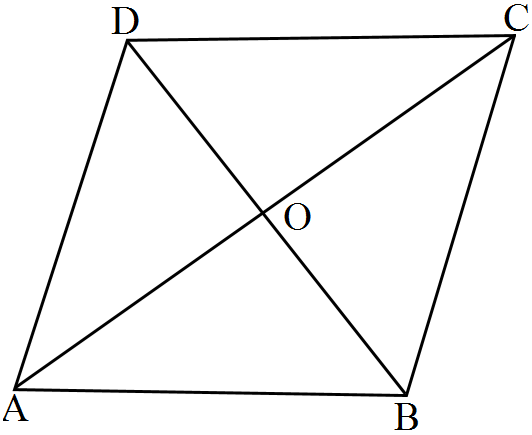
$\text{OB}=\frac{24}{2}=12\text{ m}$
In triangle $OBC, OC =\sqrt{20^2-12^2}=\sqrt{400-144}=16\text{ m}$
$\text{AC}=2\times16=32\text{ m}$
Area of rhombus $=\frac{1}{2}\times$ Product of diagonals
$=\frac{1}{2}\times24\times32$
$=384\text{ sq.m}$ View full question & answer→Question 1431 Mark
Area of the triangle is equal to:
Answer
- $\frac{1}{2}\text{(Base x Height)}$
View full question & answer→Question 1441 Mark
The sides of a triangle are $x, y$ and $z.$ If $x + y = 7\ m, y + z = 9\ m,$ and $z + x = 8\ m,$ then area of the triangle is:
AnswerAdding given three equaitons,
$2x + 2y + 2z = 24 $
$\Rightarrow x + y + z = 12$
Therefore, $\text{s}=\frac{12}{2}$
$=6\text{ cm}$
Area of triangle $=\sqrt{\text{s}(\text{s}-\text{a})(\text{s}-\text{b})(\text{s}-\text{c})}$
$=\sqrt{6(6-\text{x})(6-\text{y})(6-\text{z})}$
$=\sqrt{6(12-6-\text{x})(12-6-\text{y})(12-6-\text{z})}$
$=\sqrt{6(\text{y}+\text{z}-6)(\text{x}+\text{z}-6)(\text{x}+\text{y}-6)}$
$=\sqrt{6(9-6)(8-6)(7-6)}$
$=\sqrt{6\times3\times2\times1}$
$=6\text{ sq.m}$
View full question & answer→Question 1451 Mark
The sides of a triangle are in ratio $3 : 4 : 5$. If the perimeter of the triangle is $84\ cm,$ then area of the triangle is:
AnswerLet the sides be $3x, 4x$ and $5x.$
Then according to quesiton$, 3x + 4x + 5x = 84$
$\Rightarrow 12x = 84$
$\Rightarrow x = 7$
Therefore, the sides are $3 \times 7 = 21\ cm, 4 \times 7 = 28\ cm$ and $5 \times 7 $
$= 35\ cm$
$\text{s}=\frac{21+28+35}{2}$
$=42\text{ cm}$
Area of triangle $=\sqrt{\text{s}(\text{s}-\text{a})(\text{s}-\text{b})(\text{s}-\text{c})}$
$=\sqrt{42(42-21)(42-28)(42-35)}$
$=\sqrt{42\times21\times14\times7}$
$21\times7\times2$
$=294\text{ sq.cm}$
View full question & answer→Question 1461 Mark
If the height of a parallelogram having $500\ cm^2$ areas is $20\ cm,$ then its base is of length:
AnswerArea of parallelogram $=$ Base $\times$ Height
$\Rightarrow 500 =$ Base $\times \ 20$
$\Rightarrow$ Base $= 25\ cm.$
View full question & answer→Question 1471 Mark
A square and an equilateral triangle have equal perimeters. If the diagonal of the square is $12\sqrt{2}\text{cm},$ then area of the triangle is:
View full question & answer→Question 1481 Mark
If the height of a parallelogram having $500\ cm^2$ as the area is $20\ cm,$ then its base is of length:
View full question & answer→Question 1491 Mark
If every side of a triangle is doubled, then increase in the area of the triangle is:
Answer- $300\%$
Solution:
$\text{s}=\frac{\text{a}+\text{b}+\text{c}}{2},\text{A}=\sqrt{\text{s}(\text{s}-\text{a})(\text{s}-\text{b})(\text{s}-\text{c})}$
Now, if a' = 2a, b' = 2b and c' = 2c
Then, $\text{s}'=\frac{\text{a}'+\text{b}'+c'}{2}=\frac{2\text{a}+2\text{b}+2\text{c}}{2}=2\text{s}$
$\text{A}'=\sqrt{\text{s}'(\text{s},-\text{a}')(\text{s}'-\text{b}')(\text{s}'-\text{c}')}$
$=\sqrt{2\text{s}(2\text{s}-2\text{a})(2\text{s}-2\text{b})(2\text{s}-2\text{c})}$
$=4\sqrt{\text{s}(\text{s}-\text{a})(\text{s}-\text{b})(\text{s}-\text{c})}$
$\Rightarrow\text{A}' = 4\text{A}$
⇒ Increase in Area $=\frac{4\text{A}-\text{A}}{\text{A}}\times100\%=300\%$
Hence, correct optin is (c).
View full question & answer→Question 1501 Mark
The lengths of the three sides of a triangle are $30\ cm, 24\ cm$ and $18\ cm$ respectively. The length of the altitude of the triangle corresponding to the smallest side is:
AnswerLet:
$a = 30\ cm, b = 24\ cm$ and $c = 18\ cm$
$\text{s}=\frac{\text{a}+\text{b}+\text{c}}{2}=\frac{30+24+18}{2}$
$=36\text{ cm}$
On applying Heron's formula, we get
Area of triangle $=\sqrt{\text{s}(\text{s}-\text{a})(\text{s}-\text{b})(\text{s}-\text{c})}$
$=\sqrt{36(36-30)(36-24)(36-18)}$
$=\sqrt{36\times6\times12\times18}$
$=\sqrt{12\times3\times12\times6\times3}$
$=12\times3\times6$
$=216\text{ cm}^2$
The smallest side is $18\ cm.$
Hence, the altitude of the triangle corresponding to $18\ cm$ is given by:
Area of triangle $= 216\ cm^2$
$\Rightarrow\frac{1}{2}\times$ Base $\times$ Height $ 216$
$\Rightarrow$ Height $=\frac{216\times2}{18}$
$=24\text{ cm}$
View full question & answer→