Questions · Page 1 of 4

M.C.Q

🎯

Test yourself on this topic

50 questions · timed · auto-graded

Question 11 Mark
A point C is said to lie between the points A and B if:
Answer
  1. Points A, C and B are collinear.
    Solution:
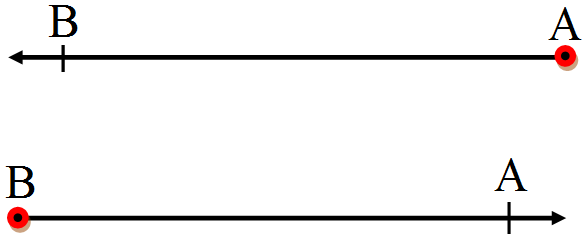
    A point C is said to lie between A and B if the points A, C and B are collinear.
View full question & answer
Question 21 Mark
The number of line segments determined by three non-collinear points is:
Answer
  1. 3
    Solution:
    You need two points to draw a line segment. If the points A, B and are non-collinear, we can draw the lines: AB, AC, BA, BC, CA, CB. Now, line AB is the same as line BA, same for lines AC and CA and BC and CB. So, the lines are AB, BC, and AC 3 lines only.
View full question & answer
Question 31 Mark
If $C$ lies between $A$ and $B$ and $AB = 10\ cm, AC = 3\ cm,$ then $BC =2$
Answer
Since, $AB = 10\ cm, C = 3\ cm,$ therefore $BC = AB - AC = 10 - 3 = 7\ cm.$ Hence, $BC^2 = 49\ cm^2.$
View full question & answer
Question 41 Mark
Write the correct answer in the following:
The number of dimensions, a surface has:
Answer
  1. 2
    Solution:
    Boundaries of a solid are called surfaces. A surface (plane) has only length and breadth. So, it has two dimensions.
View full question & answer
Question 51 Mark
Which of the following statements are true?
Answer
  1. A terminated line can be produced indefinitely on both sides.
View full question & answer
Question 61 Mark
Write the correct answer in the following:
Boundaries of solids are:
Answer
  1. Surfaces.
    Solution:
    Boundaries of solids are called surfaces.
View full question & answer
Question 81 Mark
The number of interwoven isosceles triangles in a Sriyantra is:
Answer
  1. Nine.
    Solution:
    The Sriyantra consists of nine interwoven isosceles triangles.
View full question & answer
Question 91 Mark
A pyramid is a solid figure, the base of which is:
Answer
  1. A polygon.
    Solution:
    A pyramid is a polyhedron formed by connecting of polygonal base and an apex. Each base edge and apex forms a triangle, called the lateral face. It is a conic solid with polygonal base.
View full question & answer
Question 101 Mark
A surface is that which has:
Answer
  1. Length and breadth only.
    Solution:
    Because the surface is a 2-dimensional structure.
View full question & answer
Question 111 Mark
If AB, AC, AD and AE are parallel to a line q, then the points A, B, C, D and E are:
Answer
  1. Collinear.
    Solution:
    Since, AB, AC, AD and AE are parallel to the line ‘q’, therefore, point A is outside 'q' and lines AB, AC, AD and AE are drawn through A and each line is parallel to 'q'. But by parallel line axiom one and only line can be drawn through A parallel to the line 'q'. This is possible only when the points A, B, C, D and E all lie on the same line.
View full question & answer
Question 121 Mark
If C is the mid-point of the line segment AB and L is the mid-point of AC, then:
Answer
  1. $\text{AL}=\frac{1}{4}\text{AB}$
    Solution:
    If C is the mid-point of the line segment AB, then, AB = 2AC.
    Now, L is the mid-point of AC, then, AC = 2AL. This follows that AB = 4AL. Hence, $\text{AL}=\frac{1}{4}\text{AB}.$
View full question & answer
Question 131 Mark
A is of the same age as B and C is of the same age as B. Euclid's which axiom illustrates the relative ages of A and C?
Answer
  1. Frist axiom.
    Solution:
    Euclid's first axiom states that 'Things which are equal to the same thing are equal to one another'.
    That is,
    A's age = B's age and C's age = B' age
    ⇒ A's age = C's age
View full question & answer
Question 141 Mark
The number of lines passing through one point.
Answer
  1. Infinite
    Solution:
    Infinite number of lines can pass through a single point.
View full question & answer
Question 161 Mark
Euclid’s fifth postulate implies the existence of:
Answer
  1. Parallel lines.
    Solution:
    According to Euclid's fifth postulate, if a straight line falling on two straight lines makes the interior angles on the same side of it taken together less than two right angles, then the two straight lines, if produced indefinitely, meet on that side on which the sum of angles is less than two right angles.
View full question & answer
Question 171 Mark
A point C is said to lie between the points A and B if.
Answer
  1. Point A, C and B are collinear.
    Solution:
    If direction ratios of three vectors a, b, c are proportional then they are collinear.
View full question & answer
Question 181 Mark
A line segment, when extended indefinitely in one direction is called a:
Answer
  1. Ray.
    Solution:
    A ray is part of a line, has one fixed endpoint, and extends infinitely along the line from the endpoint.
View full question & answer
Question 201 Mark
The side faces of a prism are:
Answer
  1. Rectangles.
    Solution:
    When the side faces of a polyhedron are rectangles then it is known as prism.
View full question & answer
Question 211 Mark
Every line has:
Answer
  1. Only one mid-point.
    Solution:
    The midpoint of a line segment divides it into two equal parts, therefore, a line can have only one mid-point.
View full question & answer
Question 221 Mark
Write the correct answer in the following:
‘Lines are parallel if they do not intersect’ is stated in the form of:
Answer
  1. A definition.
    Solution:
    ‘Lines are parallel, if they do not intersect’ is the definition of parallel lines.
View full question & answer
Question 231 Mark
Write the correct answer in the following:
Greek’s emphasised on:
Answer
  1. Deductive reasoning.
    Solution:
    The Greeks were interested in establishing the truth of the statements they discovered using deductive reasoning. A Greek mathematician, Thales is credited with giving the first known proof.
View full question & answer
Question 241 Mark
A pyramid is a solid figure, whose base is:
Answer
  1. Any polygon.
    Solution:
    A pyramid is a solid figure, whose base is any polygon.
View full question & answer
Question 261 Mark
Which of the following is a false statement?
View full question & answer
Question 271 Mark
The things which coincide with one another are:
Answer
  1. Equal.
    Solution:
    "The things which coincide with one another are equal" is one of the axioms given by Euclid.
    Example: Segment AB = Segment BA, $\angle\text{A}=\angle\text{A}.$
View full question & answer
Question 281 Mark
The number of end points a line has:
Answer
  1. 0
    Solution:
    A line has no endpoint. It extends in both the directions endlessly.
View full question & answer
Question 291 Mark
Write the correct answer in the following:
Euclid belongs to the country:
Answer
  1. Greece.
    Solution:
    Euclid belongs to the country Greece. Euclid around 300 B.C. collected all known work in the field of mathematics and arranged it in his famous treatise called Elements.
View full question & answer
Question 301 Mark
Two lines are said to be _______ if they intersect at a right angle.
Answer
  1. Perpendicular.
    Solution:
    Perpendicular lines are two or more lines that intersect at a 90-degree angle or right angle.
View full question & answer
Question 351 Mark
The basic facts which are taken for granted, without proof, are called:
Answer
  1. Axioms.
    Solution:
    An axiom is a proposition regarded as self-evidently true without proof.
View full question & answer
Question 371 Mark
The number of planes passing through 3 non-collinear points is:
Answer
  1. 1
    Solution:
    The number of planes passing through three non-collinear points is 1.
View full question & answer
Question 381 Mark
The number of planes passing through 3 noncollinear points is:
Answer
  1. 1
    Solution:
    A unique plane passes through 3 given noncollinear points.
View full question & answer
Question 391 Mark
The boundaries of solids are:
Answer
  1. Surfaces.
    Solution:
    Because solid has both inner and outer part separated by surface.
View full question & answer
Question 401 Mark
Euclid stated that all right angles are equal to each other in the form of:
Answer
  1. A postulate.
    Solution:
    Euclid's fourth postulate states that all right angles are equal to one another.
View full question & answer
Question 411 Mark
A and B have the same weight. If they gain weight by 3kg, then:
Answer
  1. Weight of A = Weight of B.
    Solution:
    Let the weights of A and B be x kgs. If both of them gain weight by 3 kgs, their new weight would be 'x + 3' kgs.
    According to Euclid's axiom if equals are added in equals, then whole are equal. Hence, Weight of A = Weight of B.
View full question & answer
Question 431 Mark
Which one of the following statements is false?
  1. Only one line can pass through a single point.
  2. Two circles are equal when their radii are equal.
  3. A figure formed by line segments is called a rectilinear figure.
  4. A terminated line can be produced indefinitely on both the sides.
    Answer
    1. A
      Solution:
      Infinite number of lines can pass through a single point.
    View full question & answer
    Question 441 Mark
    The two lines which are parallel to the same line are _______ to each other.
    Answer
    1. Parallel.
      Solution:
      There are 3 lines AB, CD, EF, where AB and EF are parallel, and CD and EF are parallel.
      Let line PQ cross AB at G, EF at H, CD at K. On parallel lines, AB and EF, angle AGK = GHF (Alternate interior angles).
      On parallel lines AB and EF, angle AGK = GHF. (Alternate interior angles)
      So, angle AGK = GKD. (Alternate interior angles)
      So, AB is parallel to CD.
    View full question & answer
    Question 451 Mark
    If the point P lies in between M and N, C is the mid-point of MP then:
    Answer
    1. MC + CN = MN
      Solution:
      Since, P lies between M and N, MN = MP + PN
      Now, C is the mid-point of MP,
      So, MP = MC + CP
      ⇒ MN = MC + CP + PN
      ⇒ MN = MC + CN (CP + PN = CN).
    View full question & answer
    Question 471 Mark
    The line drawn from the center of the circle to any point on its circumference is called:
    Answer
    1. Radius
    View full question & answer
    Question 481 Mark
    A statement whose truth can easily be deduced from a theorem is called:
    Answer
    1. Corollary.
      Solution:
      A corollary is a proposition that follows from (and is often appended to) one already proved.
    View full question & answer
    Question 501 Mark
    The boundaries of the solids are:
    Answer
    1. Surfaces.
      Solution:
      A solid has shape, size, position and can be moved from one place to another. Its boundaries are called surfaces. They separate one part of the space from the other.
    View full question & answer
    M.C.Q - MATHS STD 9 Questions - Vidyadip