A point C is said to lie between the points A and B if:
Question types
Introduction to Euclid Geometry question types
241 questions across 6 question groups — pick any mix to generate a MATHS paper with step-by-step answer keys.
241
Questions
6
Question groups
5
Question types
01
M.C.Q
188 Q→02Assertion (A) & Reason (B) MCQ
25 Q→03True False[1 Marks ]
5 Q→04Fill In The Blanks[1 Marks ]
4 Q→051 Marks Question
15 Q→06Case study (4 Marks)
4 Q→Sample Questions
Introduction to Euclid Geometry questions
One sample from each question group in this chapter. Select any group above to see the full set with answer keys.
View full solution →
The number of line segments determined by three non-collinear points is:
If $C$ lies between $A$ and $B$ and $AB = 10\ cm, AC = 3\ cm,$ then $BC =2$
View full solution →Write the correct answer in the following:
The number of dimensions, a surface has:
The number of dimensions, a surface has:
Which of the following statements are true?
Directions: In the following questions, the Assertions (A) and Reason(s) (R) have been put forward. Read both the statements carefully and choose the correct alternative from the following:
Assertion: If lines AB, AC, AD and AE are parallel to line l, the point A, B, C, D, E are collinear.
Reason: One and only one line can be drawn through A and parallel to l.
Assertion: If lines AB, AC, AD and AE are parallel to line l, the point A, B, C, D, E are collinear.
Reason: One and only one line can be drawn through A and parallel to l.
- Both assertion and reason are true and reason is the correct explanation of assertion.
- Both assertion and reason are true but reason is not the correct explanation of assertion.
- Assertion is true but reason is false.
- Assertion is false but reason is true.


Directions: In the following questions, the Assertions (A) and Reason(s) (R) have been put forward. Read both the statements carefully and choose the correct alternative from the following:
Assertion: Given two distinct points, there is a unique line that passes through them.
Reason: If A, B and C are three points on a line and B lies between A and C then AB + BC = AC.
Assertion: Given two distinct points, there is a unique line that passes through them.
Reason: If A, B and C are three points on a line and B lies between A and C then AB + BC = AC.
- Both assertion and reason are true and reason is the correct explanation of assertion.
- Both assertion and reason are true but reason is not the correct explanation of assertion.
- Assertion is true but reason is false.
- Assertion is false but reason is true.
Directions: In the following questions, the Assertions (A) and Reason(s) (R) have been put forward. Read both the statements carefully and choose the correct alternative from the following:
Assertion: If lines AB, AC, AD and AE are parallel to line l, the point A, B, C, D, E are collinear.
Reason: Infinite line can be drawn through A and parallel to l.
Assertion: If lines AB, AC, AD and AE are parallel to line l, the point A, B, C, D, E are collinear.
Reason: Infinite line can be drawn through A and parallel to l.
- Both Assertion and Reason are correct and Reason is the correct explanation for Assertion.
- Both Assertion and Reason are correct and Reason is not the correct explanation for Assertion.
- Assertion is true but the reason is false.
- Both assertion and reason are false.
Directions: In the following questions, the Assertions (A) and Reason(s) (R) have been put forward. Read both the statements carefully and choose the correct alternative from the following:
Assertion: If two circles are equal, then their radii are equal.
Reason: The circumference and the centre of both the circles coincide; and thus, the radius of the two circles should be equal.
Assertion: If two circles are equal, then their radii are equal.
Reason: The circumference and the centre of both the circles coincide; and thus, the radius of the two circles should be equal.
- Both Assertion and Reason are correct and Reason is the correct explanation for Assertion.
- Both Assertion and Reason are correct and Reason is not the correct explanation for Assertion.
- Assertion is true but the reason is false.
- Both assertion and reason are false.

If two circles are equal, then their radii are equal.
A terminated line can be produced indefinitely on both the sides.
There are infinitely many number of lines which passes through the two distinct points.
Only one line can pass through a single point.
Two distinct _______ in a plane cannot have more than one point in common.
Two distinct points in a plane determine a _______ line.
A line separates a plane into ______ parts namely the ______ and the _____ itself.
Given a line and a point, not on the line, there is one and only______ line which passes through the given point and is______ to the given line.
Two distinct lines cannot have more than one point in common.
Why is Axiom 5, in the list of Euclid's axioms, considered a 'universal truth'?
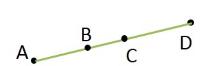
Point C is called a mid point of line segment AB, prove that every line segment has one and only one mid-point.
If a point 'C' lies between two points A and B such that AC = BC, then prove that AC = $\frac{1}{2}$AB. Explain by drawing the figure.
View full solution →The map shows three cities Conlen ©, Stratford (S), and Texhoma (T) on a straight highway.
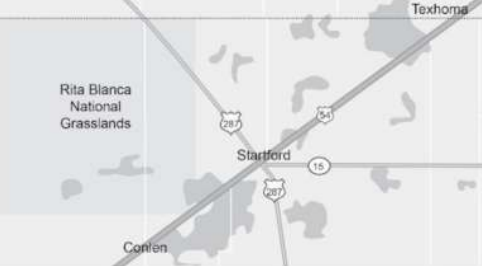
4. Which of the following is true for the length of the highway between them?
A. The length of the highway between C and S is equal to the length of the highway between S and T.
B. The length of the highway between C and S is three-fourth of the length of the highway between S and T.
C. The length of the highway between S and T is the sum of the lengths of the highway between CT and CS.
D. The length of the highway between C and T is the sum of the lengths of the highway between CS and ST.
5. A number Y is greater than a number X and another number Z < 0.
Which of the following relations can be true for a unique value of Z?
A. X × Z = Y × Z
B. X ÷ Z = Y ÷ Z
C. X – Z = Y
D. X + Z = Y
6. The area of a triangle is equal to the area of a rectangle.
The area of the rectangle is equal to the area of a parallelogram.
What is the relation between the area of the triangle and the area of the parallelogram?
Raghvan claims that the magnitude of the angle ABC is greater than the magnitude of the area of the right triangle PQR.
View full solution →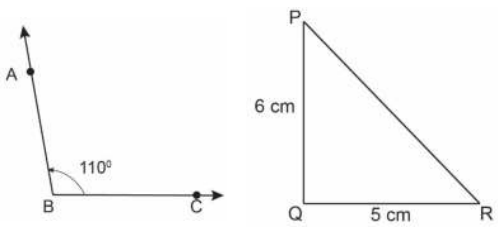
7. Is his claim correct? Why?
8. Two lines intersect at a point P.
Which of the following is true for the distance between the two lines as they travel beyond point P?
A. The distance becomes constant.
B. The distance increases continuously.
C. The distance decreases continuously.
D. The distance increases and decreases depending upon the intersection point.
9. Balan says, ‘The measure of all right angles cannot be equal as their arms can be of different lengths.’
Why is Balan’s statement not true?
A. The measure of an angle depends upon its orientation.
B. The measure of an angle depends upon the instrument used to measure it.
C. The measure of an angle depends on the length of its angle arms.
D. The measure of an angle depends upon the rotation of one arm on another.
10. TAB is a straight line. C is the mid-point of AB. D is the mid-point of AC.
Which of the following shows the relation between the line segments?
A. $AD =\frac{1}{2} AB$
B. $AD =\frac{1}{2} CB$
C. $AD =2 AC$
D. $AD =2 DC$
Karan marks his city on the map as point A.
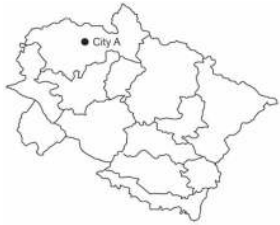
2. Savita says, ‘A dot is dimensionless, so your city is also dimensionless.’ Why is Savita wrong? Justify your answer.
3. Which of the following is not true?
A. A line has one dimension.
B. A plane has two dimensions.
C. A circle can be drawn with any radius and at any point.
D. Two distinct lines can pass through a point in the same direction.
1. Highways 20A and 56C run parallel to each other for 20 km in a state.
Which of the following statements is most likely to be true regarding them?
A. Both highways are of the same length.
B. There can be no link road between them.
C. The highways make an angle 90° with each other.
D. The distance between the two highways remains almost the same in the state.
Which of the following statements is most likely to be true regarding them?
A. Both highways are of the same length.
B. There can be no link road between them.
C. The highways make an angle 90° with each other.
D. The distance between the two highways remains almost the same in the state.
Generate a Introduction to Euclid Geometry paper free
Pick question groups from the list above, set marks and difficulty, and export a branded PDF with step-by-step answer keys. First 3 chapters free — no signup.