The cost of a notebook is twice the cost of a pen. The equation to represent this statement is:
Answer
x - 2y = 0 Solution: Let the cost of the notebook is ₹ x and pen is ₹ y and we have given that the cost of a notebook is twice the cost of a pen. So we have x = 2y Or x - 2y = 0.
If x represents the age of father and y represents the present age of the son, then the statement for ‘present age of father is 5 more than 6 times the age of the son’ in terms of mathematical equation is
The equation x = 7 in two variables can be written as:
Answer
1.x + 0.y = 7 Solution: The equation x = 7 in two variables can be written as exactly 1.x + 0.y = 7 because it contain two variable x and y and coefficient of y is zero as there is no term containing yin equation x = 7
The equation x = 7 in two variables can be written as:
Answer
1.x + 0.y = 7 Solution: The equation x = 7 in two variables can be written as exactly 1.x + 0.y = 7 because it contain two variable x and y and coefficient of y is zero as there is no term containing y in equation x = 7.
The graph of the linear equation x + y = 0 passes through the point.
Answer
(1, -1) Solution: The graph of the linear equation x + y = 0 passes through the point (1, -1) because the co-ordinate of x and y axis satisfy the given equation. x + y = 0 1 - 1 = 0 So we can say (1, -1) is a solution of above equation
Infinitely many solutions. Solution: The linear equation 3x - 5y = 15 has infinitely many solutions since any every point on this line will be a solution of this equation. For different values of x, we will get get the corresponding different values of y. Since x can take infinitely many values, y will also have infinite values. Hence, the line will have infinitely many solutions.
If the point (3, 4) lies on the graph of 3y = ax + 6, then the value of ‘a’ is:
Answer
2 Solution: The point (3, 4) lies on the graph of 3y = ax + 6 So it will satisfy the equation 3y = ax + 6 3(y) = ax + 6 12 = 3a + 6 12 - 6 = 3a 3a = 6 $\text{a}=\frac{6}{3}$ a = 2
The equation of a line parallel to y-axis and 4 units to the right of origin is:
Answer
x = 4 Solution: The equation of a line parallel to y-axis at a distance of 4 units from it, to its right from the origin. x = 4 Because when a line parallel to y-axis in that case equation of line is x = 4. So required equation is x = 4.
The graph of the linear equation 2x + 3y = 6 meets the y-axis at the point.
Answer
(0, 2) Solution: If the graph of the linear equation 2x + 3y = 6 meets the y-axis, then x = 0. Substituting the value of x = 0 in equation 2x + 3y = 6, we get 2(0) + 3y = 6 ⇒ 3y = 6 $\Rightarrow\text{y}=\frac{6}{3}$ ⇒ y = 2 So, the point of meeting is (0, 2).
If we multiply or divide both sides of a linear equation with a non-zero number, then the solution of the linear equation:
Answer
Remains the same. Solution: If we multiply or divide both sides of a linear equation with a non-zero number, then the solution of the linear equation remains the same.
If the point (3, 4) lies on the graph of 3y = ax + 6, then the value of 'a' is:
Answer
2 Solution: The point (3, 4) lies on the graph of 3y = ax + 6 So, it will satisfy the equation 3y = ax + 6 3(y) = ax + 6 12 = 3a + b 12 - 6 = 3a 3a = 6 $\text{a}=\frac{6}{3}$ $\text{a}=2$
The point of the form (a, –a) always lies on the line:
Answer
x + y = 0 Solution: Taking option (d), x + y = a + (-a) = a – a = 0 [since, give point is of the form (a, -a)] Hence, the point (a, – a) always lies on the line x + y = 0.
The graph of the linear equation 4x + 2y = 12, cuts the x-axis at the point:
Answer
(3, 0) Solution: The graph of the linear equation 4x + 2y = 12, cuts the x-axis at the point when line cut x-axis the co-ordinate of y becomes zero. So we put y = 0 in given equation to find the co-ordinate, 4x + 2y = 124x + 2(0) = 124x = 12 $\text{x}=\frac{12}{4}$ x = 3 So the required coordinate is (3, 0).
x = 5, y = 2 is a solution of the linear equation:
Answer
x + y = 7 Solution: Substituting x = 5 and y = 2 in L.H.S. of equation x + y = 7, We get: LHS = 5 + 2 7 = RHS Hence, x = 5 and y = 2 is a solution of the linear equation x + y = 7.
If a linear equation has solutions (1, 2), (-1, -16) and (0, -7), then it is of the form:
Answer
y = 9x - 7 Solution: Since all the given co- ordinate (1, 2), (-1, -16) and (0, -7) satisfy the given line y = 9x - 7 For point (1, 2) y = 9x - 7 2 = 9(1) - 7 2 = 9 - 7 2 = 2 Hence (2, 1) is a solution. For point (-1, -16) y = 9x - 7 -16 = 9(-1) - 7 -16 = -9 - 7 -16 = -16 Hence (-1, -16) is a solution. For point (0, -7) y = 9x - 7 -7 = 9(0) -7 -7 = -7 Hence (0, -7) is a solution.
If we multiply both sides of a linear equation with a non-zero number, then the solution of the linear equation:
Answer
Remains the same. Solution: If for any c. where c is any natural number. Like addition and subtraction, we can multiply and divide both sides of an equation by a number, c, without changing the equation, where c is any natural number
The equation 2x + 5y = 7 has a unique solution, if x, y are:
Answer
Natural numbers. Solution: There is only one pair i.e., (1, 1) which satisfies the given equation but in positive real numbers, real numbers and rational numbers there are many pairs to satisfy the given linear equation. Hence, unique solution is possible only in case of Natural numbers.
The graph of the linear equation x - y = 0 passes through the point:
Answer
$\Big(\frac{1}{1},\frac{1}{2}\Big)$ Solution: The graph of the linear equation x - y = 0 passes through the point $\Big(\frac{1}{1},\frac{1}{2}\Big)$ because the co-ordinate of x and y axis satisfy the given equation x - y = 0. $\frac{1}{1}-\frac{1}{2}=0$ 0 = 0 So we can say $\Big(\frac{1}{1},\frac{1}{2}\Big)$ is a solution of above equation. So we can say the value of x co-ordinate must be equal to y co-ordinate.
The line y + x = 0. Solution: The point (a, -a) lies on line x + y = 0 Here, is the verification Put x = a in equation x + y = 0 a + y = 0 y = -a Hence, it is prove that (a, -a) is a solution of x + y = 0.
The graph of the linear equation 3x - 2y = 6, cuts the x-axis at the point:
Answer
(2, 0) Solution: The linear equation 3x - 2y = 6, cuts the x-axis when y co-ordinate is 0. So we put y = 0 in given equation 3x - 2y = 6 3x - 2.0 = 6 3x = 6 $\text{x}=\frac{6}{3}$ x = 2 So the co-ordinates are (2, 0).
If a linear equation has solutions (-2, 2), (0, 0) and (2, -2), then it is of the form:
Answer
x + y = 0 Solution: Linear equation has solutions (-2, 2), (0, 0) and (2, -2), then the equation will be x + y = 0. As all the given three points satisfy the given equation.
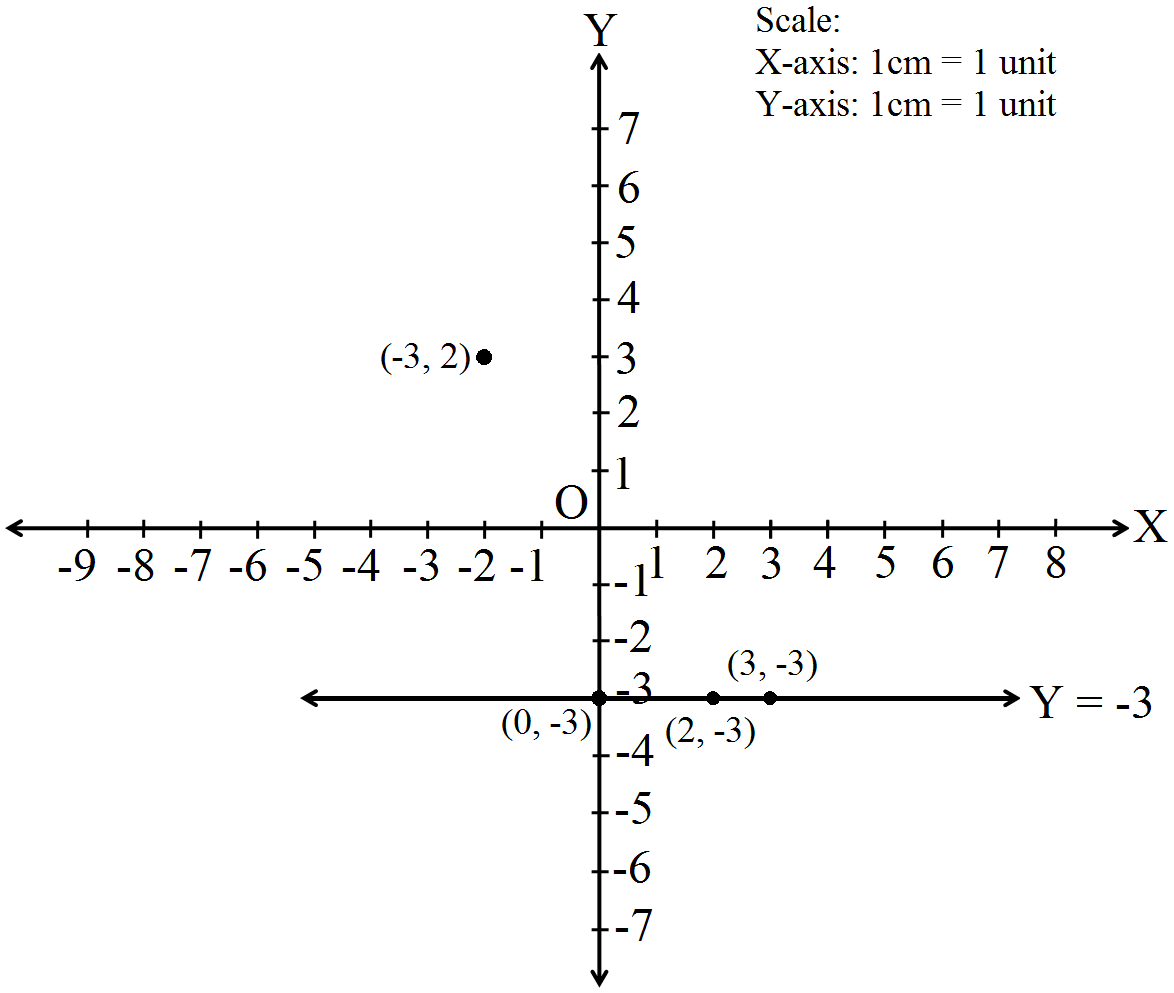
The equation of a line parallel to x-axis and 3 units above the origin is:
Answer
y = 3 Solution: The equation of a line parallel to x-axis and 3 units above the origin is y = 3. Because when a line parallel to x axis in that case equation of line is y = a where a is the co-ordinate of y-axis and 3 units above the origin value x-coordinate is 3 so required equation is y = 3.
The area of the triangle formed by the line 2x + 5y = 10 and the co-ordinate axis is:
Answer
5 sq. units. Solution: To find the area of the triangle formed by the line 2x + 5y = 10 and co-ordinate axis. We put x = 0 in given equation at x = 0, we get y = 2 at y = 0 we get x = 5. So the line cut y-axis at 2 and x-axis at 5. So the height of the triangle is 2 units and the base is 5 units. Area of triangle $=\frac{1}{2}$ base × heigh, $=\frac{1}{2}\times2\times5$ = 5 sq. units.
The graph of the linear equation 3x - 5y = 15, cuts the y-axis at the point:
Answer
(0, -3) Solution: The graph of the linear equation 3x - 5y = 15, cuts the y-axis at the point when line cut y-axis the co-ordinate of x becomes zero. So we put x = 0 in given equation to find the co-ordinate. 3x - 5y = 15 3(0) - 5y = 15 -5y = 15 $\text{y} = −\frac{15}{5}$ y = -3 So the required cordinate is (0, -3).
Making an intercept 5 on the y-axis. Solution: As, the graph of y = 5 is a line parallel to x-axis i.e. y = 0. ⇒ The line represented by the equation y = 5 is parallel to x-axis and intersects y-axis at y = 5. So, the graph of y = 5 is a line parallel to the x-axis at a distance of 5 units from the origin making an intercept 5 on the y-axis.
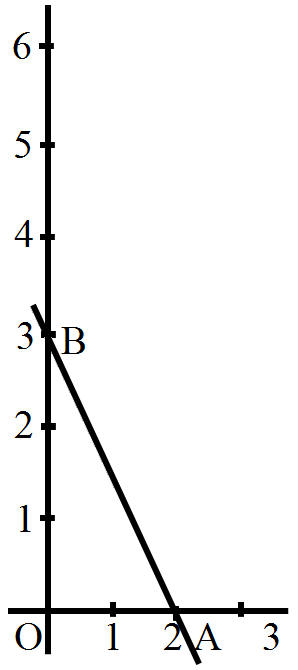
If the graph of the equation 4x + 3y = 12 cuts the coordinate axes at A and B, then hypotenuse of right triangle AOB is of length.
Answer
5 units. Solution: According to the given question, triangle so formed has sides of units 3 and 4, using pythagoras theorem, the largest side is of 5 units.
The graph of a linear equation $\text{y}=\frac{9}{5}\text{x}+32$ cuts the y-axis at the point:
Answer
(0, 32) Solution: When the graph cut at y axis in that case the value of x- coordinate is 0. $\text{y}=\frac{9}{5}\text{x}+32$ $\text{y}=\frac{9}{5}.0+\text{32}$ $\text{y}=32$ So, the co-ordinates are (32, 0)