Questions · Page 3 of 5

M.C.Q

Question 1031 Mark
View full question & answer
Question 1041 Mark
If one angle of a triangle is equal to the sum of the other two angles, then the triangle is:
Answer
  1. A right triangle.
    Solution:
    In a right triangle, one angle is 90° and the sum of acute angles of a right triangle is 90°.
View full question & answer
Question 1051 Mark
Answer
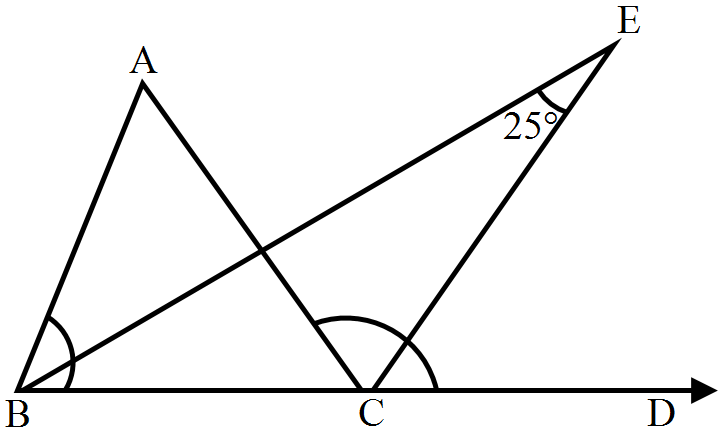
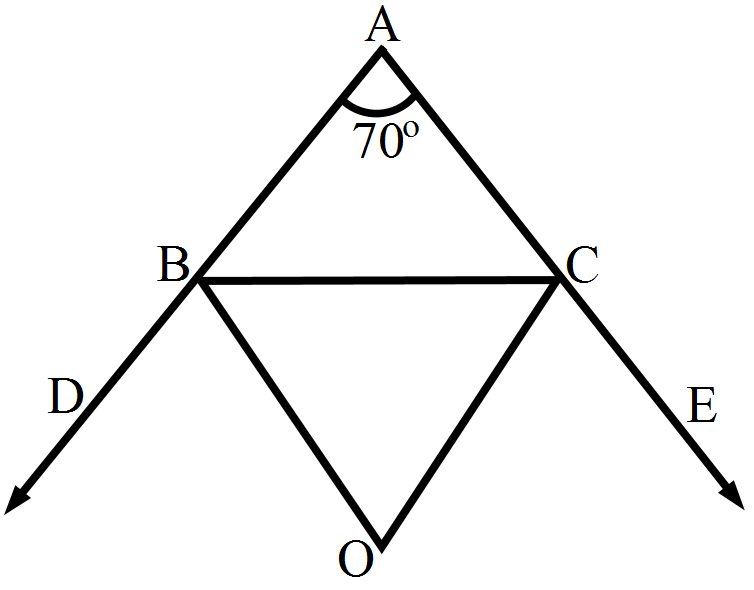
  1. $50^\circ$
    Solution:
    $\angle\text{BEC}+\angle\text{EBC}=\angle\text{ECD}$ (Exterior angle property)
    $\angle\text{BEC}=\angle\text{ECD}-\angle\text{EBC}$
    In $\triangle\text{ABC}$
    $\angle\text{ABC}+\angle\text{BAC}=\angle\text{ACD}$
    $\angle\text{ABC}+2\angle\text{EBC}=2\angle\text{ECD}$
    $\angle\text{ABC}=2(\angle\text{ECD}-\angle\text{EBC})$
    $\angle\text{ABC}=2(\angle\text{BEC})$
    $\angle\text{ABC}=50^\circ.$
View full question & answer
Question 1071 Mark
Answer
  1. 115º
    Solution:
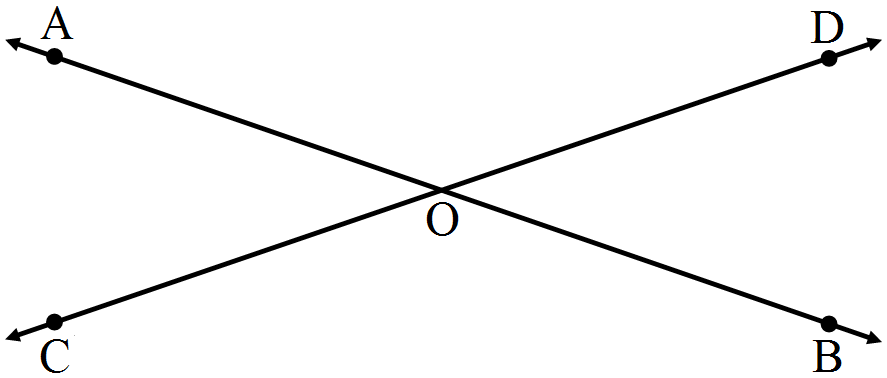
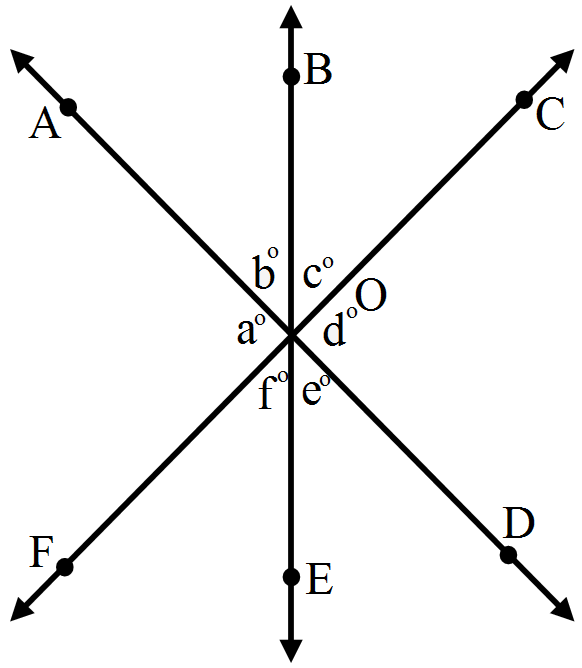
    $\angle\text{AOC}+\angle\text{BOD}=1306^\circ$ (given)
    But $\angle\text{AOC}=\angle\text{BOD}$ (Vartically Opposite angles)
    $\Rightarrow2\angle\text{AOC}=130^\circ$
    $\Rightarrow\angle\text{AOC}=65^\circ$
    Since COD is a straight line,
    $\angle\text{AOC}+\angle\text{AOD}=180^\circ$
    $\Rightarrow65^\circ+\angle\text{AOD}=180^\circ$
    $\Rightarrow\angle\text{AOD}=115^\circ$
View full question & answer
Question 1081 Mark
View full question & answer
Question 1091 Mark
Measurement of reflex angle is:
Answer
  1. Between 180º and 360º
    Solution:
    Let x be the angle
    then its reflex angle is 360º - x
    and in any triangle the angle lies between 0 to 180º
View full question & answer
Question 1101 Mark
View full question & answer
Question 1111 Mark
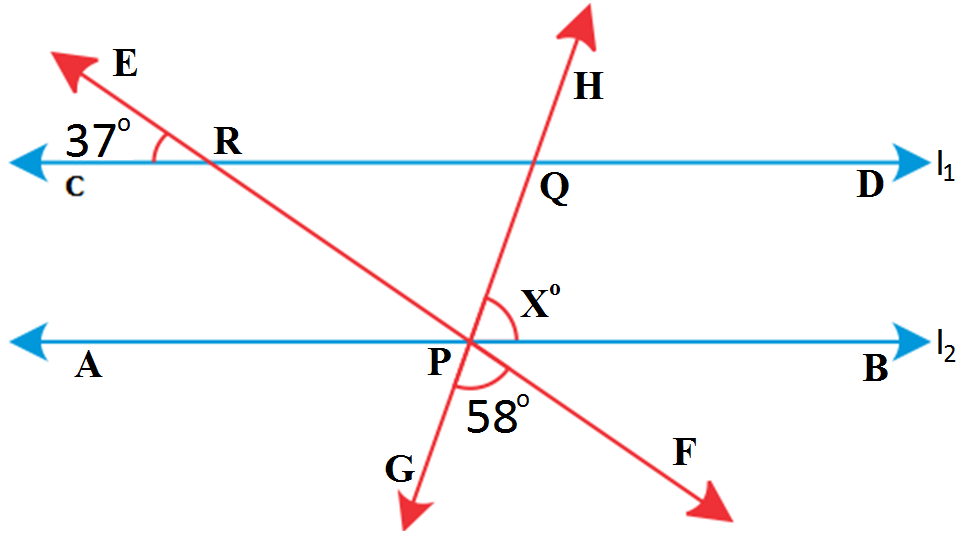
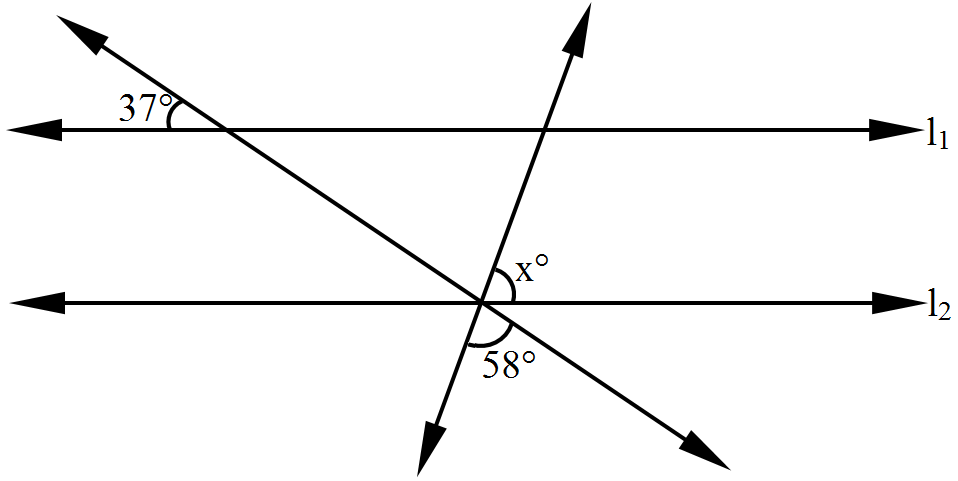
In figure, if $l_1 || l_{2,}$what is the value of $x$?
Answer

From figure,
$\angle\text{ERC}=\angle\text{RPA} [$Corresponding angles are equal$]$
$\Rightarrow \angle\text{ERC}=37^\circ=\angle\text{RPA}$
Also,
$\angle\text{RPA}=\angle\text{BPF} [$Opposite angles$]$
$\Rightarrow\ \angle\text{RPA}=37^\circ=\angle\text{BPF}$
Now,
$\angle\text{QPB}+\angle\text{BPF}+\angle\text{FPG}=180^\circ$
$\Rightarrow\ \text{x}^\circ+37^\circ+58^\circ=180^\circ$
$\Rightarrow\ \text{x}^\circ=85^\circ$
View full question & answer
Question 1121 Mark
If two angles are complements of each other then each angle is:
Answer
  1. An acute angle.
    Solution:
    If two angles are complements of each other, that is, the sum of their measures is 90º, then each angle is an acute angle.
View full question & answer
Question 1131 Mark
An angle which measures more than $180^\circ$ but less than $360^\circ ,$ is called.
Answer
An angle which measures more than $180^\circ$ but less than $360^\circ$ is called a reflex angle.
View full question & answer
Question 1141 Mark
Two complementary angles are such that twice the measure of the one is equal to three times the measure of the other. The larger of the two measures.
Answer
  1. 54º
    Solution:
    Let the measure of the required angle be xº
    Then, the measure of its complement will be (90 - x)º
    Therefore, 2x = 3 (90 - x)
    ⇒ 2x = 270 - 3x
    ⇒ 5x = 270
    ⇒ x = 54º.
View full question & answer
Question 1151 Mark
If two interior angles on the same side of a transversal intersecting two parallel lines are in the ratio 2 : 3, then the measure of the larger angle is:
View full question & answer
Question 1161 Mark
View full question & answer
Question 1171 Mark
Write the correct answer in the following:
If one of the angles of a triangle is 130$^\circ$, then the angle between the bisectors of the other two angles can be.
Answer
  1. 155°
    Solution:
    $$In $\Delta\text{ABC},$ we have $\angle\text{A}=130^\circ$
    OB and OC are the bisectors of the angles B and C.
    Let $\angle\text{OBC}=\angle\text{OBA}=\text{x}\ \text{and}\angle\text{OCB}=\angle\text{OCA}=\text{y}$
    In $\Delta\text{ABC},$
    $\angle\text{A}+\angle\text{B}+\angle\text{C}=180^\circ$
    $\Rightarrow130^\circ+2\text{x}+2\text{y}=180^\circ$
    $\Rightarrow\text{x}+\text{y}=25^\circ$
    $\text{i.e}\angle\text{OBC}+\angle\text{OCB}=25^\circ$
    Now, In $\Delta\text{BOC}$
    $\angle\text{BOC}=180^\circ-\big(\angle\text{OBC}+\angle\text{OCB}\big)$ (Angle sum Property)
    $=180^\circ-25^\circ=155^\circ$
    Hence, (d) is the correct answer.
View full question & answer
Question 1181 Mark
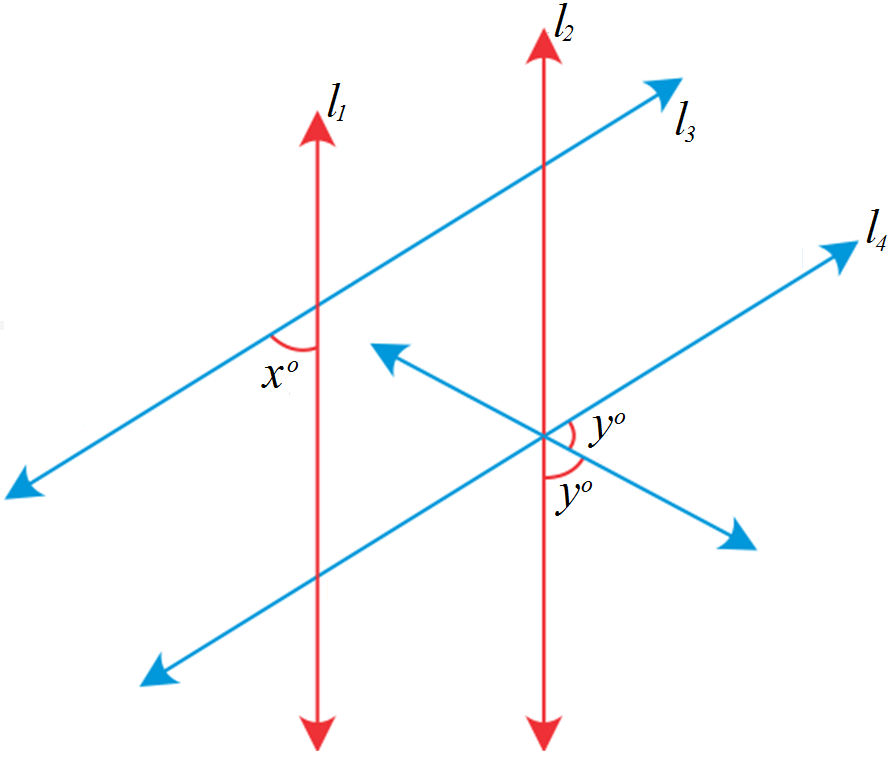
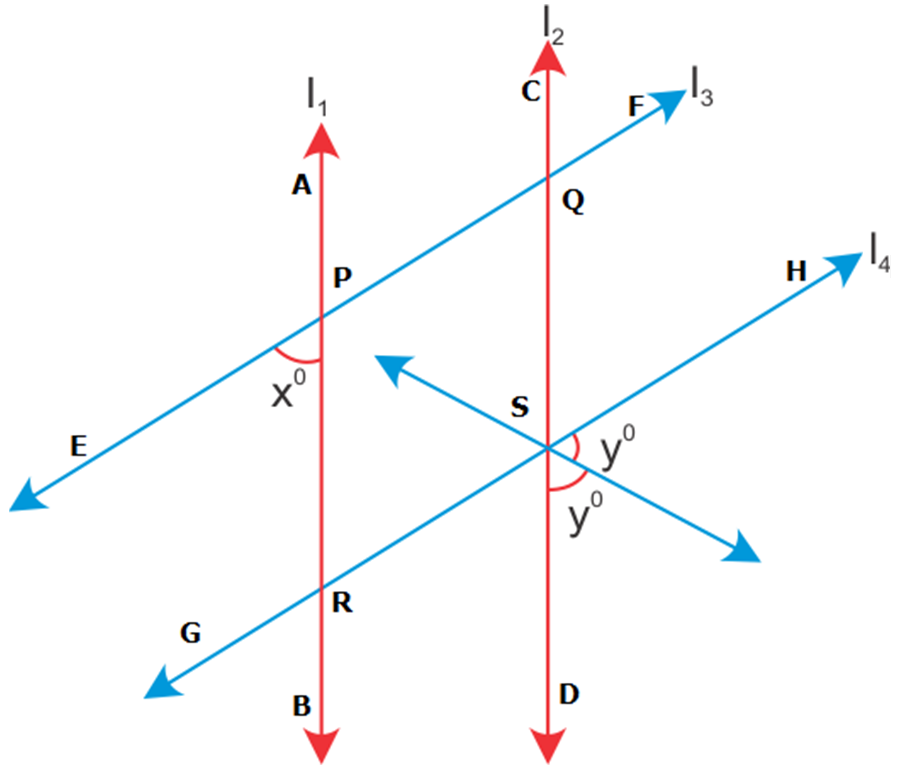
In figure, if $l_1 || l_2$ and $l_3 || l_4,$ what is $y$ in terms of $x$?
Answer

From figure,
$\angle\text{EPR}=\angle\text{PQS} [$Correspondence angles are equal$]$
$\Rightarrow\ \angle\text{PQS}=\text{x}^\circ$
Also,
$\angle\text{PQS}=\angle\text{RSD} [$Correspondence angles are equal$]$
$\Rightarrow\ \angle\text{RSD}=\text{x}^\circ$
Now,
$\angle\text{RSD}+\text{y}^\circ+\text{y}^\circ=180^\circ$
$\Rightarrow\ \text{x}^\circ+2\text{y}^\circ=180^\circ$
$\Rightarrow\ \text{y}^\circ=\frac{180^\circ-\text{x}^\circ}{2}$
$\Rightarrow\ \text{y}^\circ=90^\circ-\frac{\text{x}^\circ}{2}$
View full question & answer
Question 1191 Mark
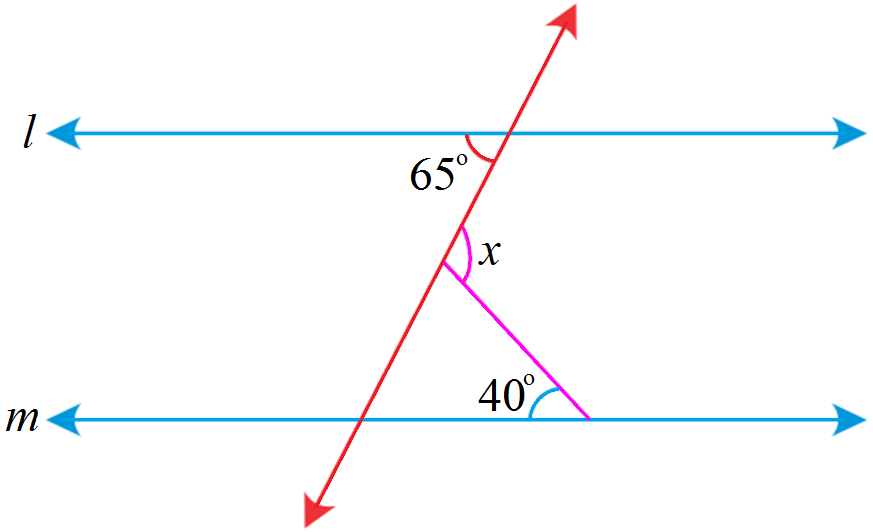
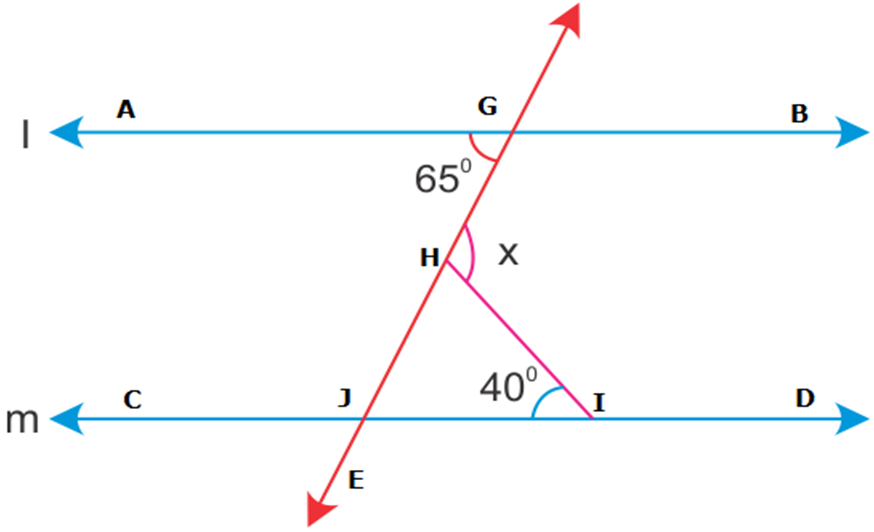
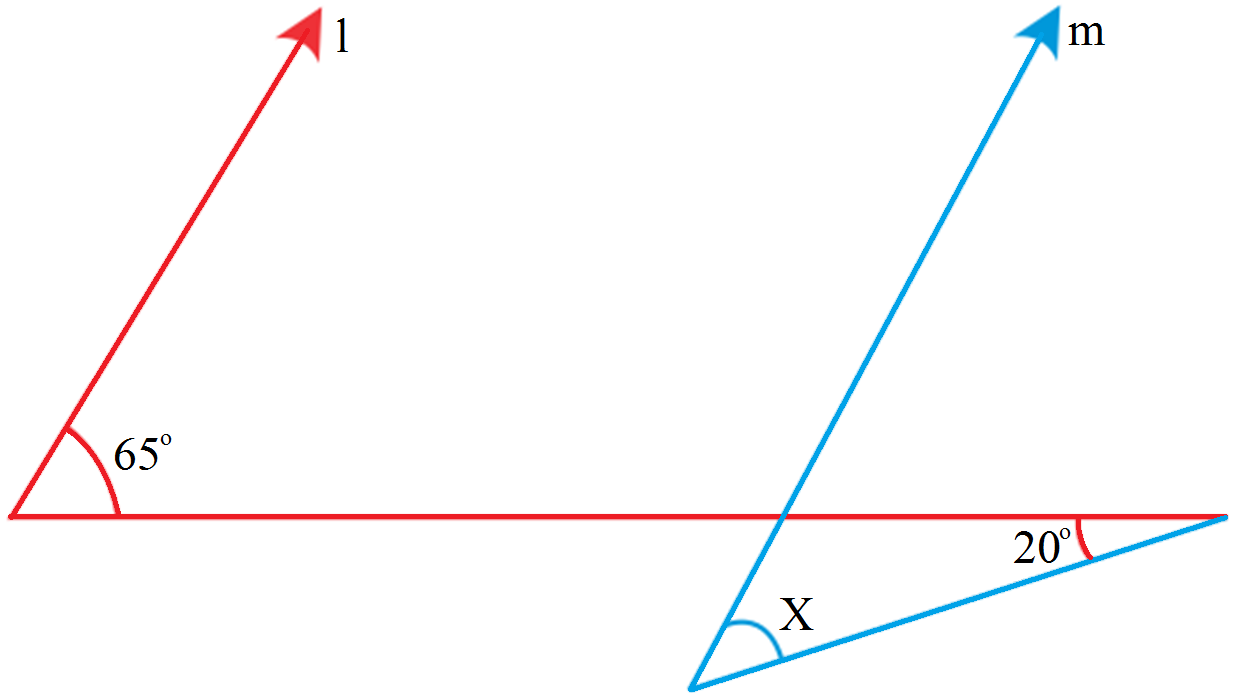
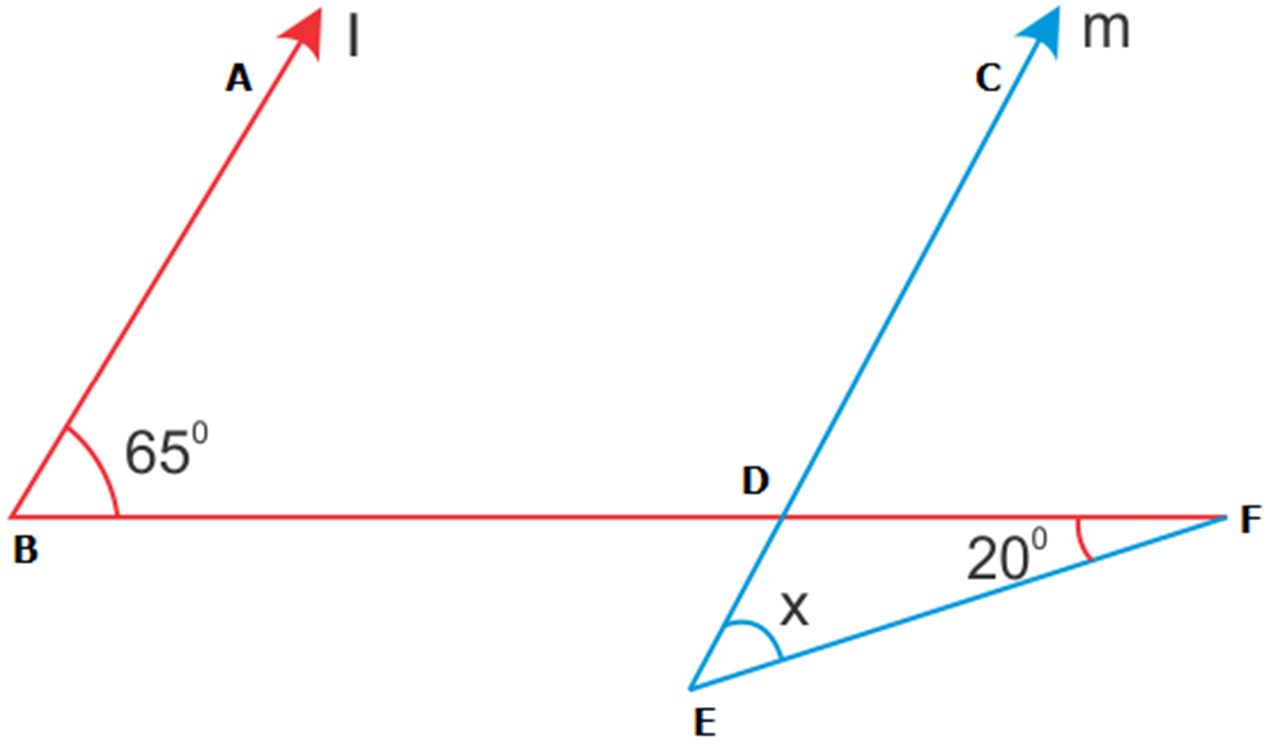
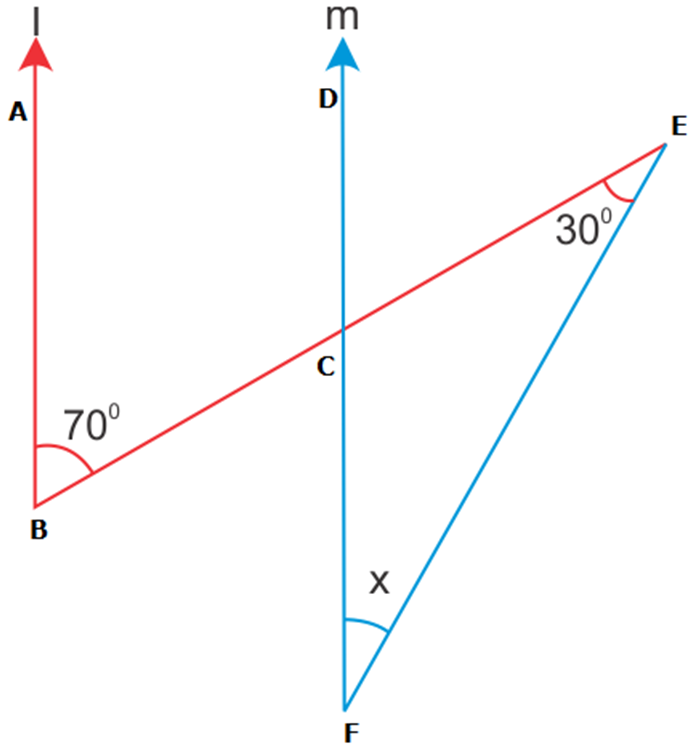
In figure, if lines l and m are parallel lines, then x =
View full question & answer
Question 1201 Mark
View full question & answer
Question 1211 Mark
One angle is equal to three times its supplement. The measure of the angle is:
Answer
  1. 135º
    Solution:
    Let the required angle be x
    Supplement = 180º - x
    According to question,
    x = 3 (180º - x)
    x = 540º - 3x
    x = 135º.
View full question & answer
Question 1231 Mark
View full question & answer
Question 1241 Mark
The angles of a triangle are in the ratio 5 : 3 : 7, the triangle is:
Answer
  1. An acute angled triangle.
    Solution:
    Let the angles of the triange be 5x, 3x and 7x
    We know that the sum of the angles of a triangle is 180º
    5x + 3x + 7x = 180º
    15x = 180º
    x = 12º
    Therefore the angles are
    5x = 5 × 120 = 60º
    3x = 3 × 120 = 36º
    7x = 7 × 120 = 84º
    Since all the angles are less than 90º, therefore it is a acute angled triangle.
View full question & answer
Question 1251 Mark
View full question & answer
Question 1261 Mark
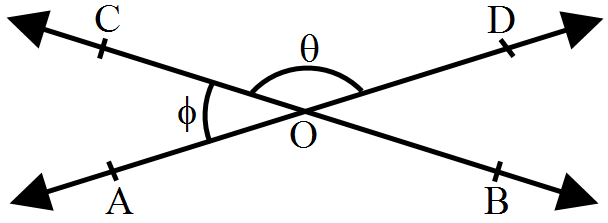
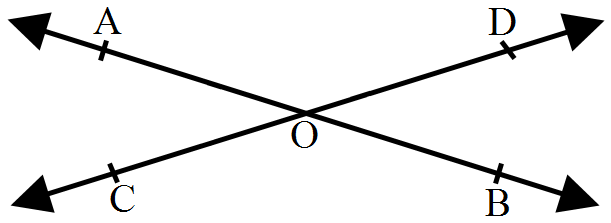
Two lines AB and CD intersect at O. If $\angle\text{AOC}+\angle\text{COB}+\angle\text{BOD}=270^\circ,$ then $\angle\text{AOC}=$
Answer
  1. 90º
    Solution:
    Given that,
    AB and CD intersect at O
    $\angle\text{AOC}+\angle\text{COB}+\angle\text{BOD}=270^\circ\text{(i)}$
    $\angle\text{COB}+\angle\text{BOD}=180^\circ$ (Linear pair) (ii)
    Using (ii) in (i), we get
    $\angle\text{AOC}+180^\circ=270^\circ$
    $\text{AOC}=90^\circ.$
View full question & answer
Question 1291 Mark
Write the correct answer in the following:
Angles of a triangle are in the ratio 2 : 4 : 3. The smallest angle of the triangle is,
Answer
  1. 40°
    Solution:
    Given that: The Ratio of angles of a triangle is 2 : 4 : 3
    Let the angles of the triangle be $\angle\text{A},\angle\text{B},$ and $\angle\text{C},$
    $\therefore\ \angle\text{A}=2\text{x},\angle\text{B}=4\text{x}$ and $\angle\text{C}=3\text{x}$
    In $\angle\text{ABC},$ $\angle\text{A}+\angle\text{B}+\angle\text{C}=180^\circ$
    [$\because\ $Sum of angles of a triangle is 180°]
    $\Rightarrow2\text{x}+4\text{x}+3\text{x}=180^\circ\Rightarrow9\text{x}=180^\circ\Rightarrow\text{x}=\frac{180^\circ}{9}=20^\circ$
    $\therefore\ \angle\text{A}=2\text{x}=2\times20^\circ=40^\circ$
    $\angle\text{B}=4\text{x}=4\times20^\circ=80^\circ$
    And $\angle\text{C}=3\text{x}=3\times20^\circ=60^\circ$
    Hence, the smallest angles of a triangle is 40° and option (b) is correct answer.
View full question & answer
Question 1311 Mark
View full question & answer
Question 1331 Mark
View full question & answer
Question 1341 Mark
Answer
  1. 75°
    Solution:
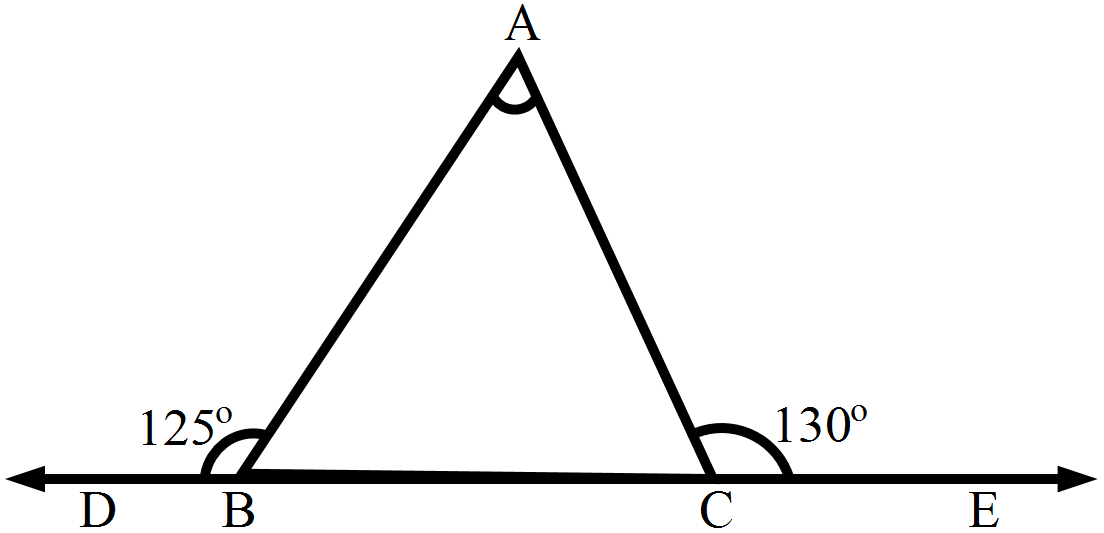
    $\angle\text{ABD}+\angle\text{ABC}=180^\circ$(Linear Pair)
    $\angle\text{ABC}=180^\circ-125^\circ=55^\circ$
    $\angle\text{ACE}+\angle\text{ACB}=180^\circ$(Linear Pair)
    $\angle\text{ACB}=180^\circ-130^\circ=50^\circ$
    In $\triangle\text{ABC}$
    $\angle\text{ABC}+\angle\text{ACB}+\angle\text{BAC}=180^\circ$(Angle sum property)
    $\angle\text{BAC}=180^\circ-50^\circ-55^\circ$
    $\angle\text{BAC}=75^\circ$
View full question & answer
Question 1351 Mark
Each angle of an equilateral triangle is:
Answer
  1. 60º
    Solution:
    Let the angle of an equilateral triangle be xo
    x + x + x = 180º (Angle sum property)
    3x = 180º
    x = 60º.
View full question & answer
Question 1361 Mark
Which of the following pairs of angles are complementary?
Answer
  1. 25º, 65º
    Solution:
    Complementary angles always add up to 90º
    25º + 65º = 90º
    Therefore this is the right option (by substitution).
View full question & answer
Question 1371 Mark
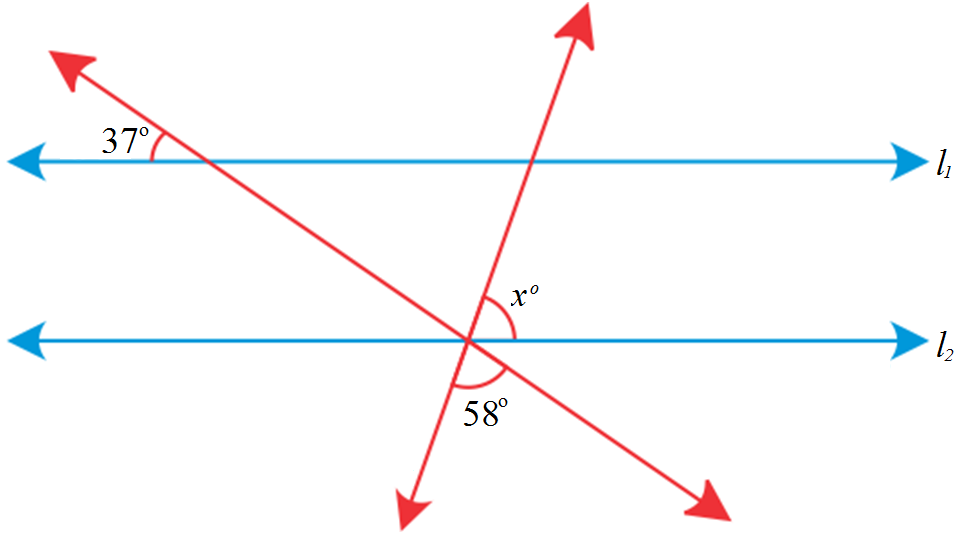
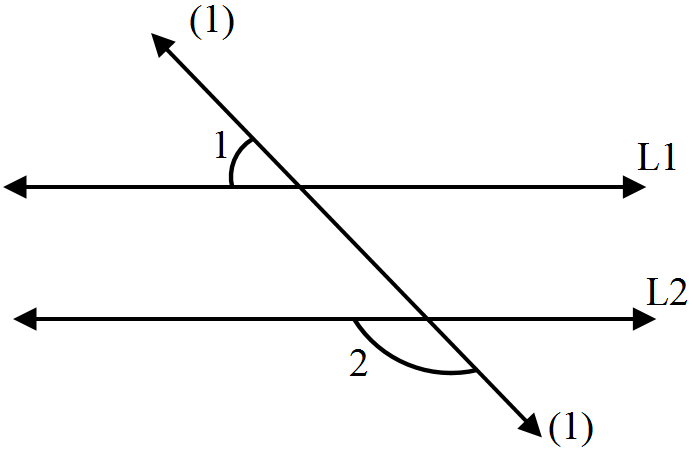
In Fig. if $l1 \ || \ l2,$ what is the value of $x$ ?
Answer
Given that,
$l1 \ || \ l2$
Let transversal $P$ and $Q$ cuts them
$\angle1=37^\circ$
$\angle4=58^\circ$
$\angle5=\text{x}^\circ$
$\angle1=\angle2=37^\circ$$($Corresponding angles$) (i)$
$\angle2=\angle3$ $($Vertically opposite angle$)$
$\angle3=37^\circ$
$\angle3+\angle4+\angle5=180^\circ$$($Linear pair$)$
$37^\circ + 58^\circ  + x = 180^\circ$
$x = 85^\circ .$
View full question & answer
Question 1381 Mark
The measure of an angle is five times its comlement. The angle measure.
Answer
  1. 75º
    Solution:
    Let the measure of the angle be xº,
    So, its complement = (90 - x)º
    According to the given condition,
    x = 5(90 - x)
    ⇒ x = 450 - 5x
    ⇒ 6x = 450
    ⇒ x = 75º
    So, the angle measures 75º.
View full question & answer
Question 1391 Mark
Answer
  1. 145°
    Solution:
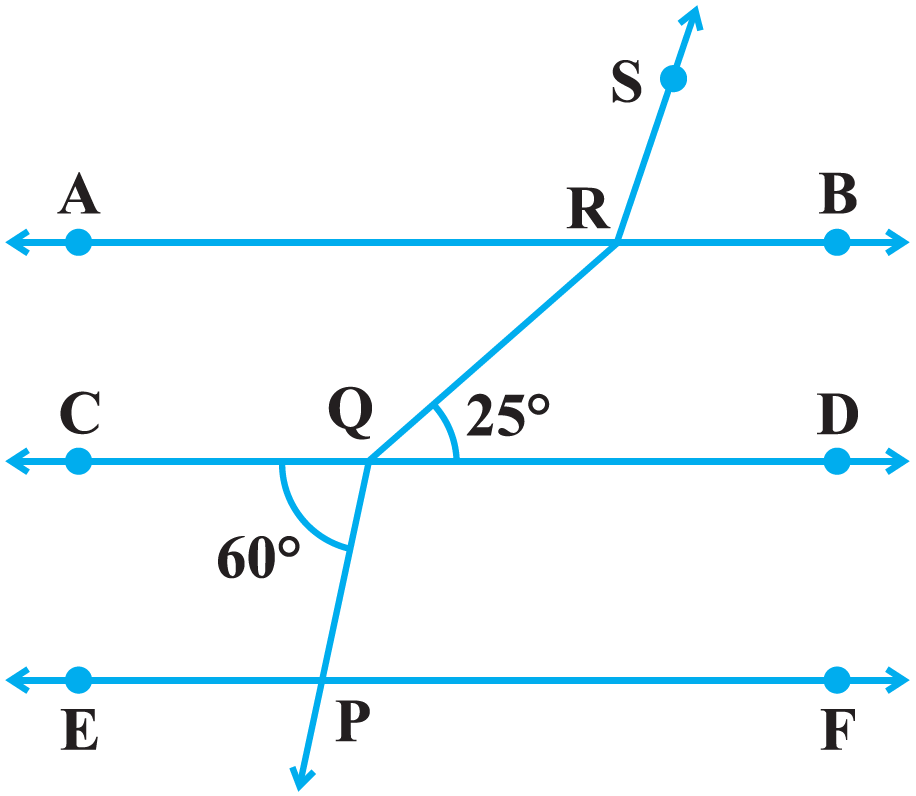
    Given, $\text{PQ}||\text{RS}$
    $\angle\text{PQC}=\angle\text{BRC}=60^\circ$$\big[$alternate exterior angles and $\angle\text{PQC}=60^\circ$ (given)$\big]$ and $\angle\text{DQR}$
    $=\angle\text{QRA}=25^\circ$ [alternate interior angles]
    $$$\big[\angle\text{DQR}=25^\circ,\text{(given)}\big]$
    $\angle\text{QRS}=\angle\text{QRA}+\angle\text{ARS}$
    $=\angle\text{QRA}+\big(180^\circ-\angle\text{BRS}\big)$ [linear pair axiom]
    $=25^\circ+180^\circ-60^\circ=205^\circ-60^\circ=145^\circ$
View full question & answer
Question 1401 Mark
Measurement of reflex angle is:
Answer
  1. Between 180º and 360º
    Solution:
    Let x be the angle then its reflex angle is 360º - x and in any triangle, the angle lies between 0 to 180º.
View full question & answer
Question 1411 Mark
A, B, C are the three angles of a triangle. If A - B = 15º and B - C = 30º, then angles A, B, C are respectively:
Answer
  1. 80º, 65º, 35º
    Solution:
    Since ABC is a triangle
    A + B + C = 180º (Angle sum property) (i)
    A - B = 15º
    A = 15º + B (ii)
    B - C = 30º
    C = B - 30º (iii)
    From (i) equation
    15º + B + B + B - 30º = 180º
    B = 65º
    From equation (ii) and (iii)
    A = 15º + B = 15º + 65º = 80º
    C = B - 30º = 65º - 30º = 35º.
View full question & answer
Question 1421 Mark
Answer
  1. 60º
    Solution:
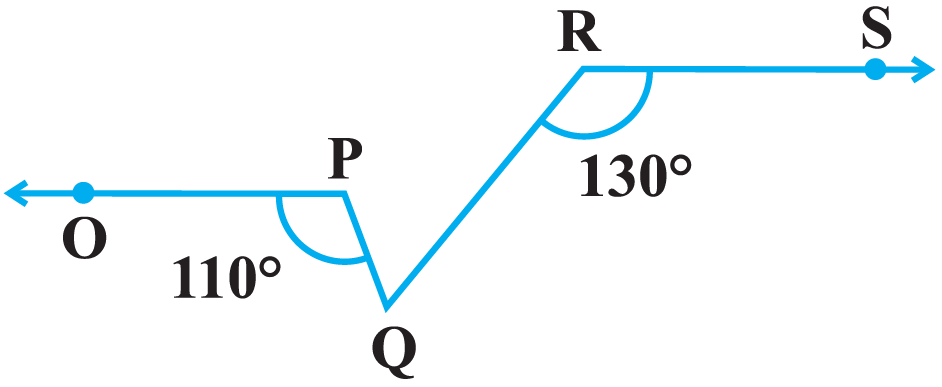
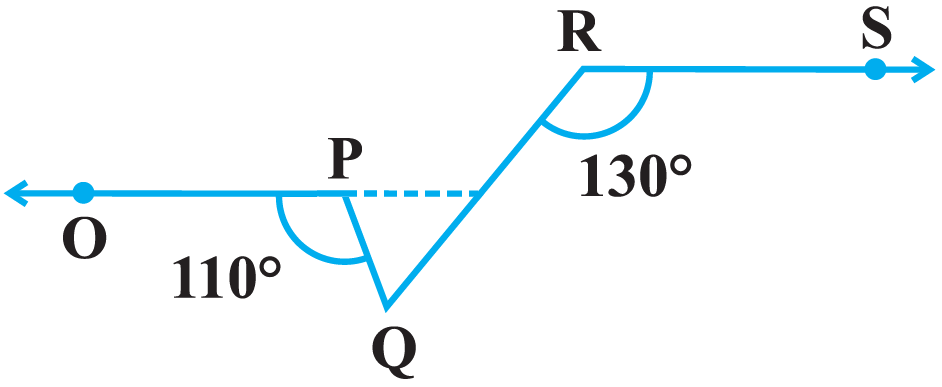
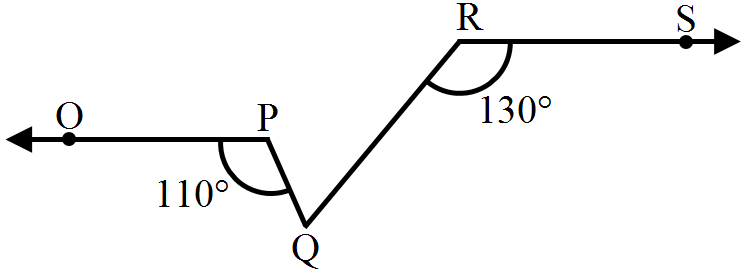
    Produce OP to intersect RQ at point N.
    Now, OP || RS and transversal RN intersects them at N and R respectively.
    $\therefore\angle\text{RNP}=\angle\text{SRN}$ (Alternate interior angles)
    $\Rightarrow\angle\text{RNP}=130^\circ$
    $\therefore\angle\text{PNQ}=180^\circ−130^\circ=50^\circ$ (Linear pair)
    $\angle\text{OPQ}=\angle\text{PNQ}+\angle\text{PQN}$ (Exterior angle property)
    $\Rightarrow110^\circ= 50^\circ+\angle\text{PQN}$
    $\Rightarrow\angle\text{PQN}=110^\circ-50^\circ=60^\circ=\angle\text{PQR}.$
View full question & answer
Question 1431 Mark
The number of line segments determined by three given non-collinear points is:
Answer
  1. Three.
    Solution:
    Three because non-collinear points means the point does not lies in a same line.
View full question & answer
Question 1441 Mark
Answer
  1. 115º
    Solution:
    We have,
    $\angle\text{AOC}=\angle\text{BOD}$ [Vertically-Opposite Angles]
    $\therefore\angle\text{AOC}+\angle\text{BOD}=130^\circ$
    $\Rightarrow\angle\text{AOC}+\angle\text{AOC}=130^\circ [\therefore\angle\text{AOC}=\angle\text{BOD}]$
    $\Rightarrow2\angle\text{AOC}=130^\circ$
    $\Rightarrow\angle\text{AOC}=65^\circ$
    Now,
    $\angle\text{AOC}+\angle\text{AOD}=180^\circ$ [$\because$ COD is a straight line]
    $\Rightarrow65^\circ+\angle\text{AOD}=180^\circ$
    $\Rightarrow\angle\text{AOC}=115^\circ.$
View full question & answer
Question 1461 Mark
The angles of a triangle are in the ratio 2 : 3 : 4. The largest angle of the triangle is:
Answer
  1. 80º
    Solution:
    Suppose $\triangle\text{ABC}$ such that $\angle\text{A}:\angle\text{B}:\angle\text{C} = 2 : 3 : 4$
    Let $\angle\text{A}=2\text{k},\angle\text{B}=3\text{k}$ and $\angle\text{C} = 4\text{k}$ where k is some constant
    In $\triangle\text{ABC},$
    $\angle\text{A}+\angle\text{B}+\angle\text{C}=180^\circ$ (Angle sum property)
    ⇒ 2k + 3k + 4k = 180º
    ⇒ 9k = 180º
    ⇒ k = 20º.
View full question & answer
Question 1491 Mark
Two straight lines$ AB$ and $CD$ intersect one another at the point $O$. If​​ $\angle\text{AOC}+​​\angle\text{COB}+​​\angle\text{BOD}=274^\circ, $ then $\angle\text{AOD}=$
Answer
Given,
$\angle\text{AOC}+\angle\text{COB}+\angle\text{BOD}=274^\circ\text{ (i)}$
$\angle\text{AOD}+\angle\text{AOC}+\angle\text{COB}+\angle\text{BOD}=360^\circ($Angles at a point$)$
$\angle\text{AOD}+274^\circ=360^\circ$
$\angle\text{AOD}=86^\circ.$
View full question & answer
Question 1501 Mark
The measure of an angle is five times its complement. The angle measures.
Answer
  1. 75º
    Solution:
    Let the measure of the required angle be xº
    Then, the measure of its complement will be (90 − x)º
    Therefore, x = 5 (90 - x)
    ⇒ x = 450 - 5x
    ⇒ 6x = 450
    ⇒ x = 75º.
View full question & answer
M.C.Q - Page 3 - MATHS STD 9 Questions - Vidyadip