Questions · Page 2 of 5

M.C.Q

Question 511 Mark
Two angles measure (70 + 2x)$^\circ$ and (3x - 15)$^\circ$. If each angle is the supplement of the other, then the value of x is:
Answer
  1. 25
    Solution:
    70 + 2x + 3x - 15 = 180 (Supplementary angles)
    5x = 180 - 55
    x = 25.
View full question & answer
Question 521 Mark
If two angles of a triangle are 30º and 45º, what is the measure of the third angle?
Answer
  1. 105º
    Solution:
    We know that the sum of all angles of a triangle is 180º
    $\angle\text{A}+\angle\text{B}+\angle\text{C}=180^\circ$
    Let $\angle\text{A}=30^\circ,\angle\text{B}=45^\circ$
    $30^\circ+45^\circ+\angle\text{C}=180^\circ$
    $75^\circ+\angle\text{C}=180^\circ$
    $\angle\text{C}=180^\circ-75^\circ$
    $\angle\text{C}=105^\circ.$
View full question & answer
Question 541 Mark
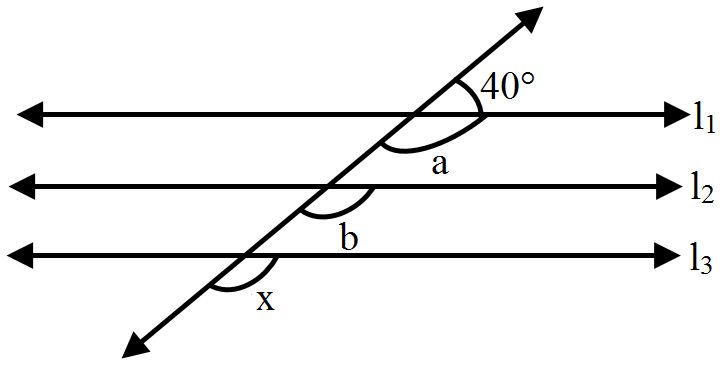
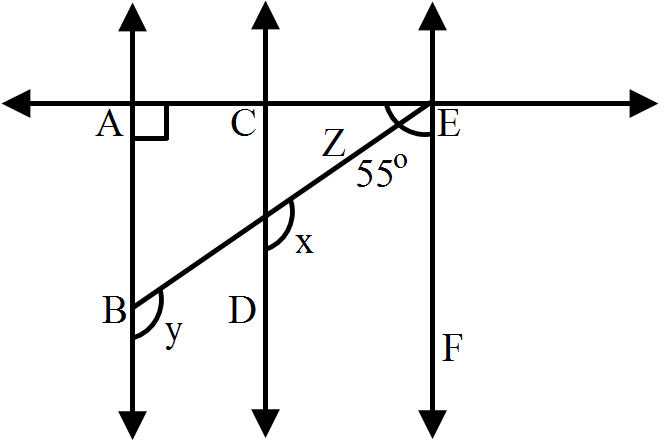
Given that lines $l_1, l_2$ and $l_3$ in figure are parallel. The value of $x$ is:
Answer

In the given figure
$40^\circ+\angle\text{a} = 180^\circ($linear $-$ pair$)$
Therefore $\angle\text{a}=180^\circ-40^\circ=140^\circ$
Now $\angle\text{a}=\angle\text{b} ($corresponding $-$ angles$)$
Similarly $\angle\text{b}=\angle\text{x}=140^\circ$
Therefore $\angle\text{x}=140^\circ.$
View full question & answer
Question 551 Mark
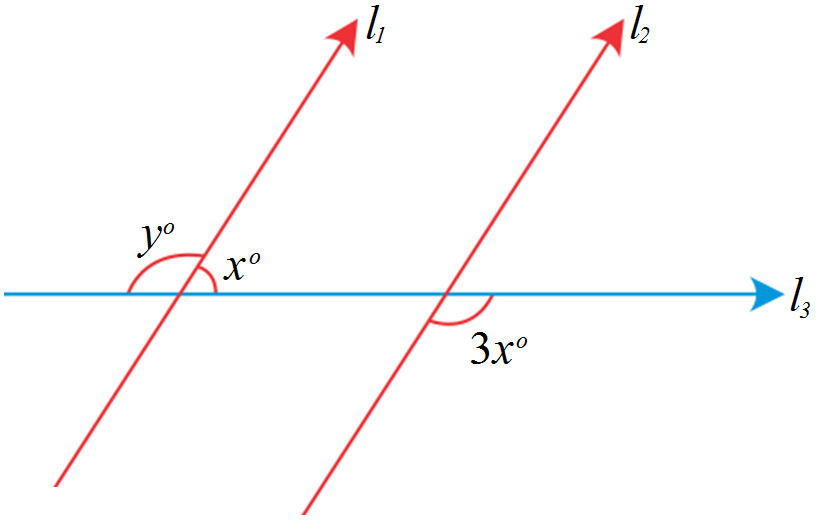
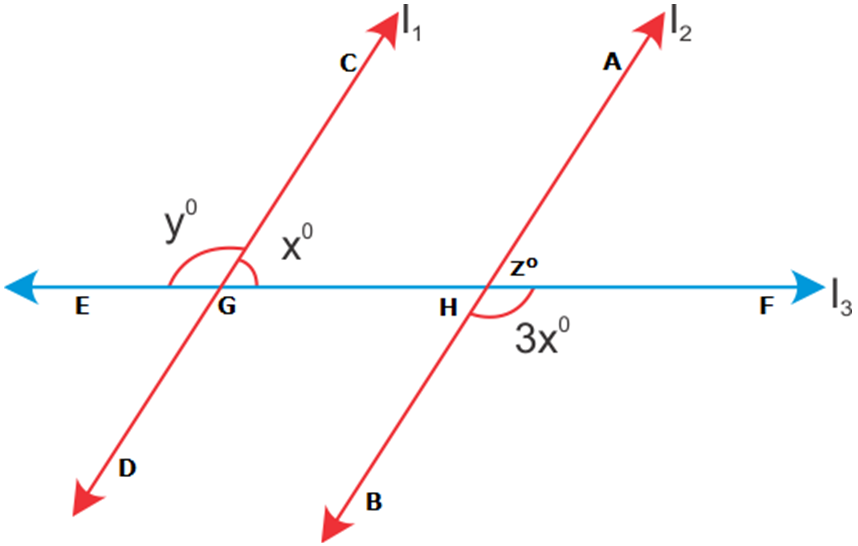
In figure, if $l_1 \ \| \ l_2,$ what isb the value of $y$ ?
Answer

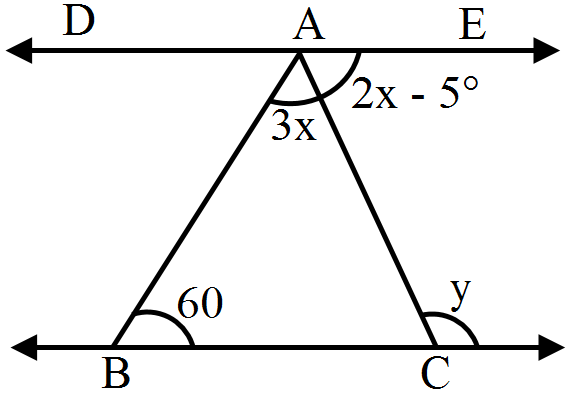
Let angle supplement of $3x^\circ$ be $Z^\circ$
$\Rightarrow z^\circ = 180^\circ - 3x^\circ$
$\Rightarrow\ \angle\text{AHF}+\angle\text{FHB}=180^\circ$
$\Rightarrow z^\circ + 3x^\circ = 180^\circ$
$\Rightarrow z^\circ = 180^\circ - 3x^\circ$
Now,
$x^\circ + y^\circ = 180^\circ$
Also,
$x^\circ = z^\circ [$Correspondence angles$]$
$\Rightarrow x^\circ = 180^\circ - 3x^\circ$
$\Rightarrow 4x^\circ = 180^\circ$
$\Rightarrow x^\circ = 45^\circ$
$x^\circ + y^\circ = 180^\circ$
$\Rightarrow y^\circ = 180^\circ - x^\circ = 180^\circ - 45^\circ = 135^\circ .$
View full question & answer
Question 561 Mark
If two angles are supplementary and the larger is $20^\circ$ less then three times the smaller, then the angles are:
Answer
Let the two supplimentary angles be $x^\circ$ and $180^0 - x^\circ$
Let $180^\circ - x$ be the larger angle
$180^\circ - x = 3x - 20^\circ$
$4x = 200^\circ$
$x = 50^\circ$
So the angles are $50^\circ$ and $130^\circ$
View full question & answer
Question 591 Mark
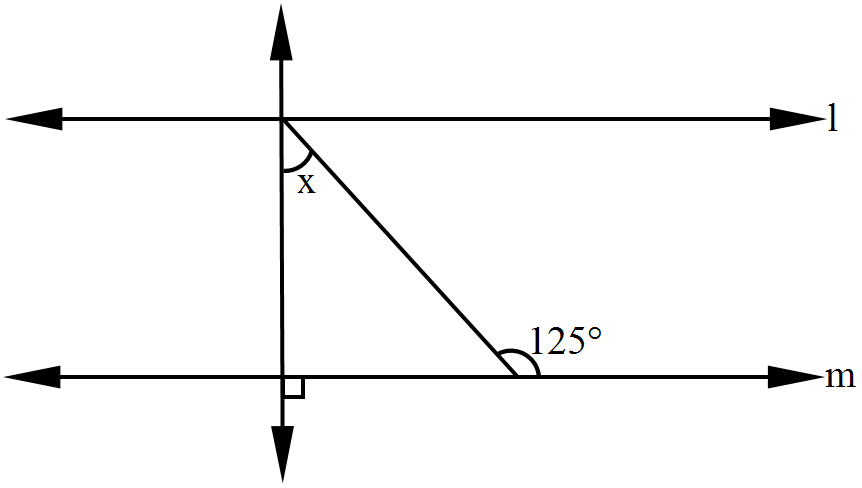
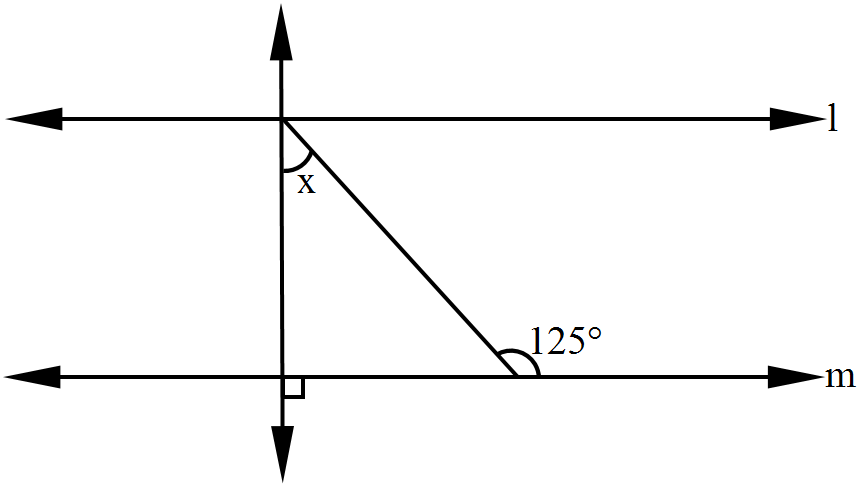
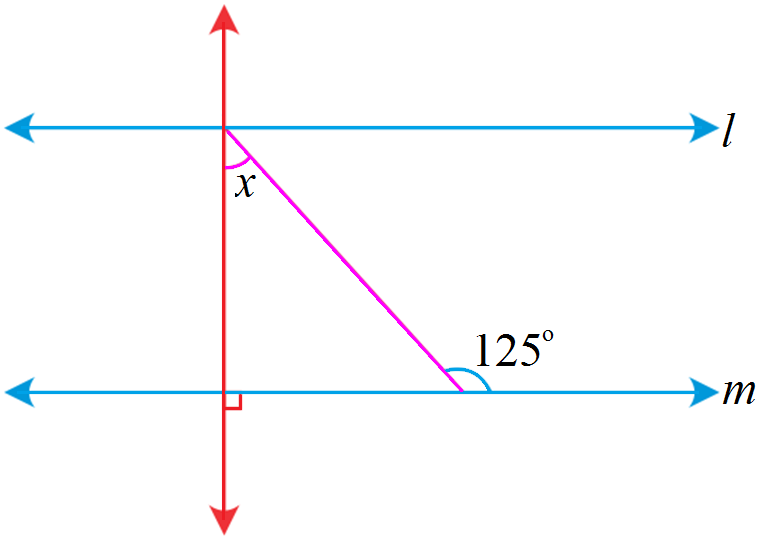
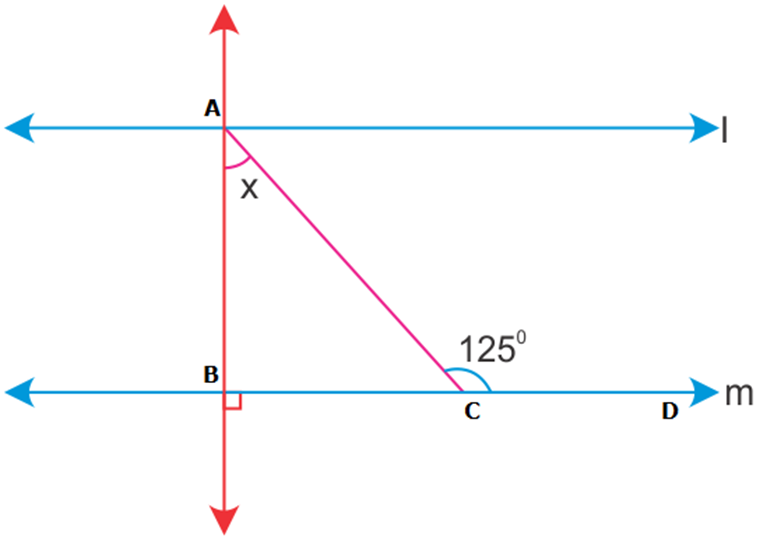
In Fig., if lines $l$ and $m$ are parallel, then the value of $x$ is:
Answer

Given that,

$l || m$ and $n$ cuts them
Let, $\angle1=\text{x}$
$\angle2=90^\circ$
$\angle3=125^\circ$
$\angle3+​​\angle5=180^\circ($Linear pair$)$
$125^\circ+​​\angle5=180^\circ$
$\angle5=55^\circ\text{ (i)}$
$\angle4=99^\circ\text{ (ii)}$
Now,
$\angle1+\angle4+\angle5=180^\circ ($Angle sum property$)$
$\text{x}+90^\circ+55^\circ=180^\circ$
$\text{x}=35^\circ.$
View full question & answer
Question 601 Mark
The incorrect statement is:
  1. Two lines drawn in a plane always intersect at a point.
  2. A line segment has definite length.
  3. Three lines are concurrent if and only if they have a common point.
  4. One and only one line can be drawn passing through a given point and parallel to a given line.
    Answer
    1. A
      Solution:
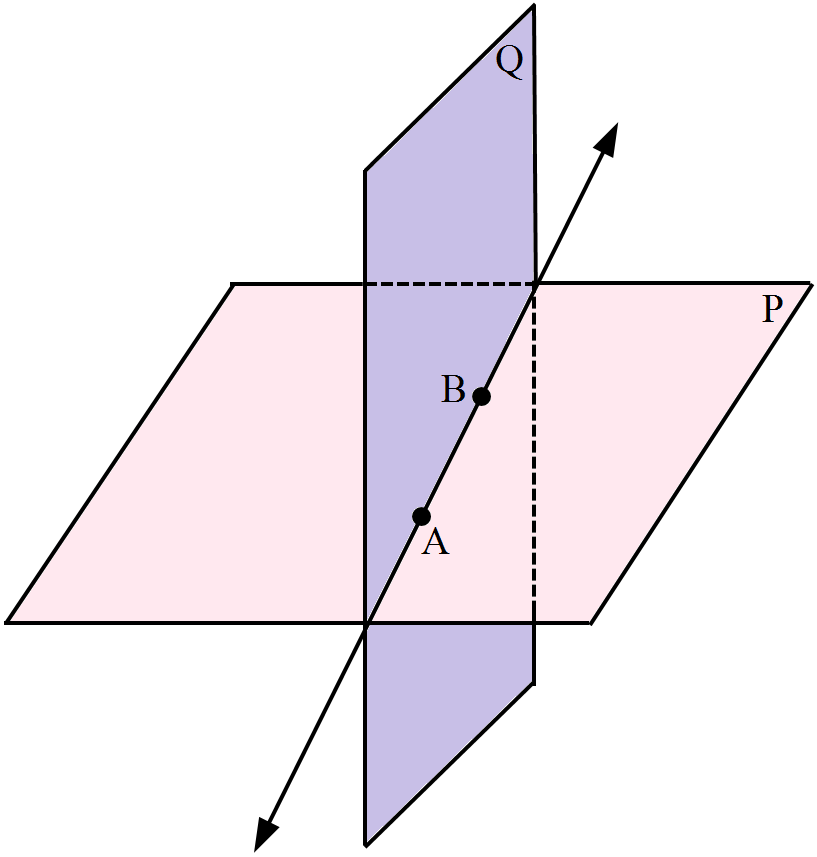
      If two lines intersect then they must lie in one plane but its converse is not necessarily true.
    View full question & answer
    Question 611 Mark
    View full question & answer
    Question 621 Mark
    The difference between two complementary angles is $400$. The angles are:
    Answer
    We know that the sum of two complementary angles is $90^\circ$
    Let the two angles be $x$ and $y$
    $x + y = 90^\circ (1)$
    We also know that the difference of the angles is $40^\circ$
    Therefore$, x - y = 40^\circ (2)$
    Combining $(1)$ and $(2)$
    We have
    $x + y = 90^\circ$
    $x - y = 40^\circ$
    Solving as simultaneous equations we get
    $2x = 130^\circ$
    Hence $x = 65^\circ$
    Substituting this value of $x$ in either one of the equations $(1)$ or $(2)$
    We get $y = 25^\circ .$
    View full question & answer
    Question 631 Mark
    View full question & answer
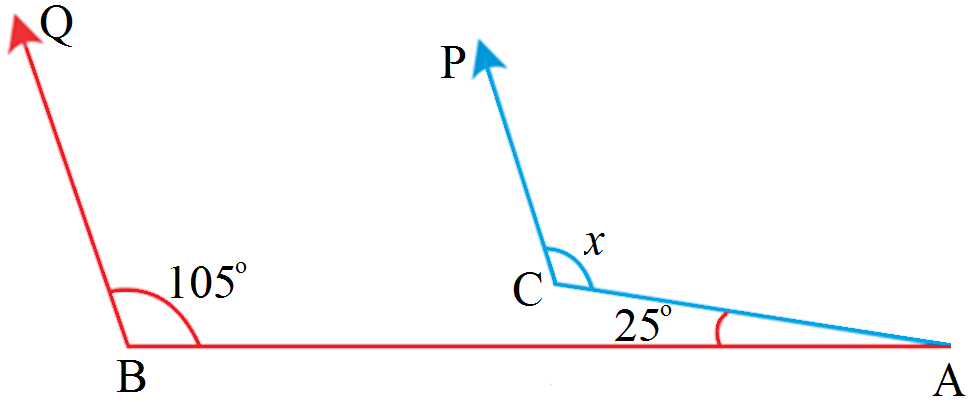
    Question 651 Mark
    Answer
    1. 25º
      Solution:
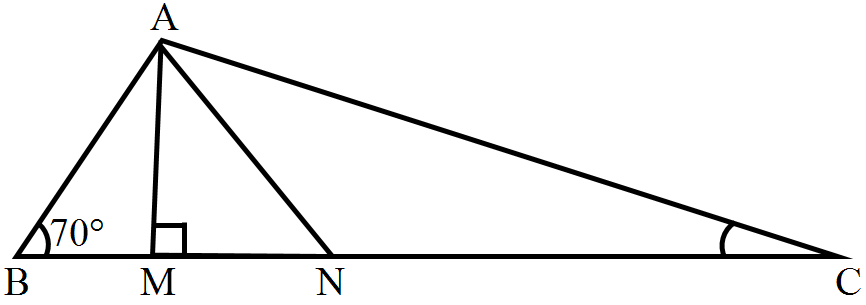
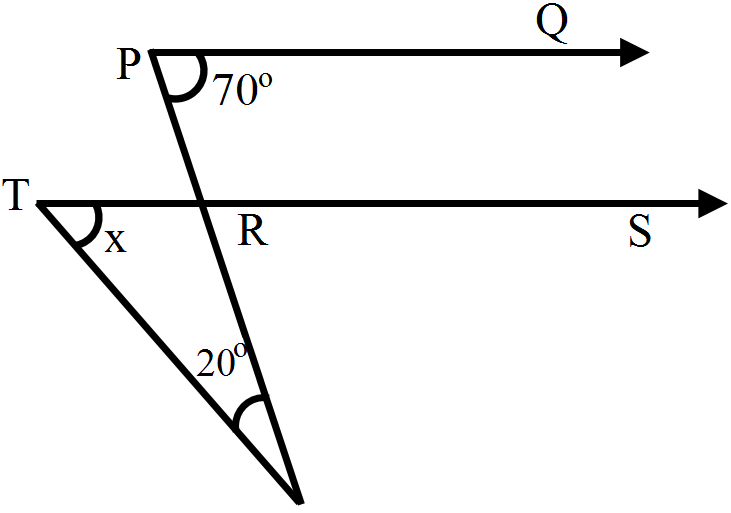
      In $\triangle\text{ABC}$
      $\angle\text{BAC}+\angle\text{ABC}+\angle\text{BCA}=180^\circ$ (Angle sum property)
      $\angle\text{BAC}=180^\circ-70^\circ-20^\circ$
      $\angle\text{BAC}=90^\circ$
      In $\triangle\text{ANC}$
      $\angle\text{ANC}+\angle\text{NAC}+\angle\text{ACN}=180^\circ$ (Angle sum property)
      $\angle\text{ANC}+45^\circ+20^\circ=180^\circ$ (AN is angle bisector of ∠A)
      $\angle\text{ANC}=115^\circ$
      In $\triangle\text{AMN}$
      $\angle\text{AMN}+\angle\text{MAN}=\angle\text{ANC}$ (Measure of exterior angle is equla to the sum of two opposite interior angles)
      $90^\circ+\angle\text{MAN}=115^\circ$
      $\angle\text{MAN}=25^\circ.$
    View full question & answer
    Question 661 Mark
    View full question & answer
    Question 671 Mark
    Answer
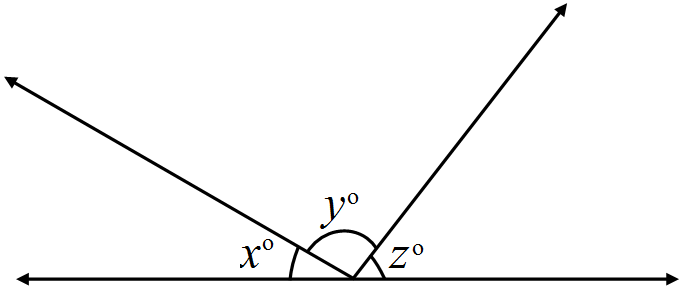
    1. (ii) and (iii) only
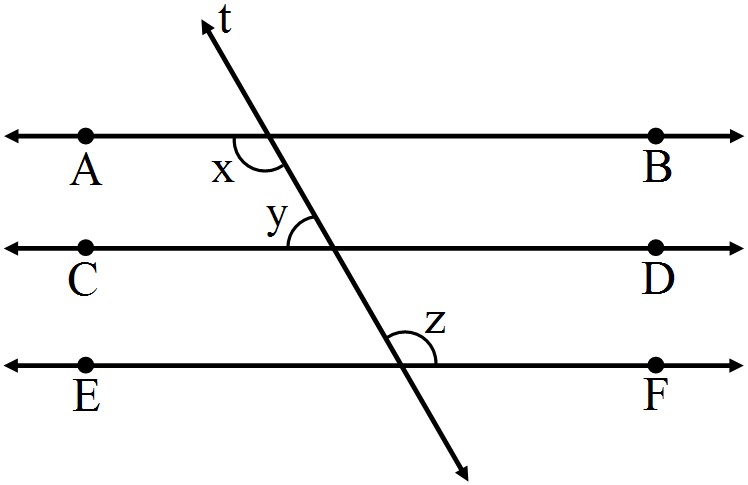
      Solution:
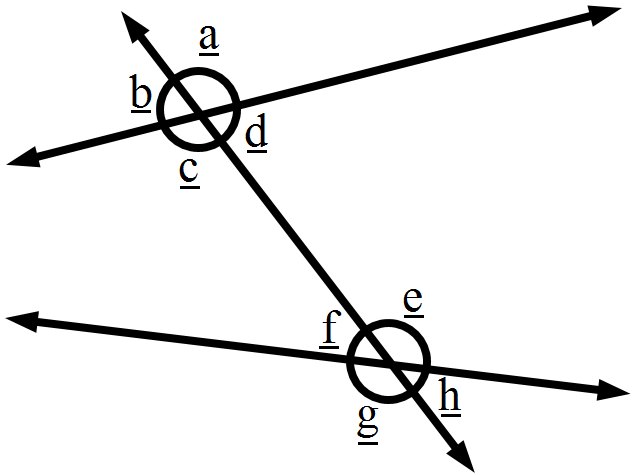
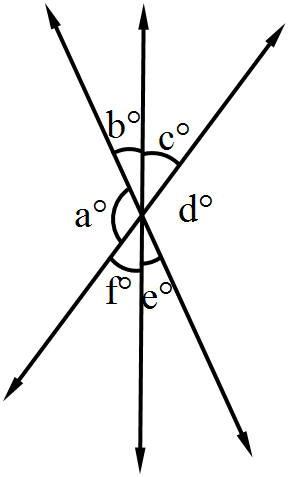
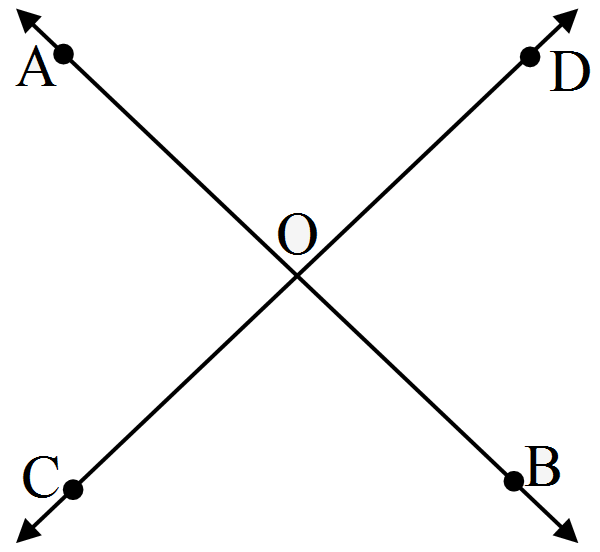
      Let AB, CD and EF intersect at O
      $\angle\text{AOD}=\angle\text{COB}$ (Vertically opposite angle)
      b = e (i)
      $\angle\text{EOC}=\angle\text{DOF}$ (Vertically opposite angle)
      f = c (ii)
      Adding (i) and (ii), we get
      b + f = c + e (iii)
      Now,
      $\angle\text{AOD}+\angle\text{EOC}+\angle​\text{COB}=180^\circ$
      a + f + e = 180º
      a + c + e = 180º [From (ii)].
    View full question & answer
    Question 681 Mark
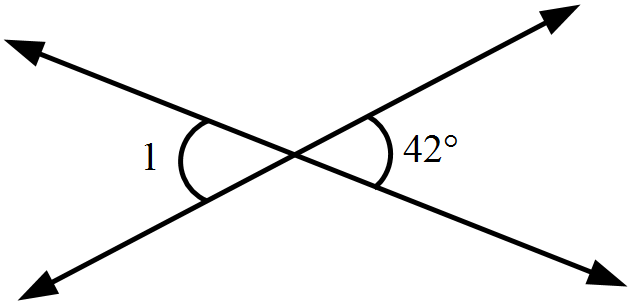
    When two straight lines intersect:
    1. Adjacent angles are complementary
    2. Adjacent angles are supplementary.
    3. Opposite angles are equal.
    4. Opposite angles are supplementary.
    Of these statements:
      Answer
      1. (ii) and (iii) are correct
        Solution:
        When two straight lines intersect them, Adjacent angles are supplementary and opposite angles are equal.
      View full question & answer
      Question 691 Mark
      Answer
      1. $50^\circ$
        Solution:
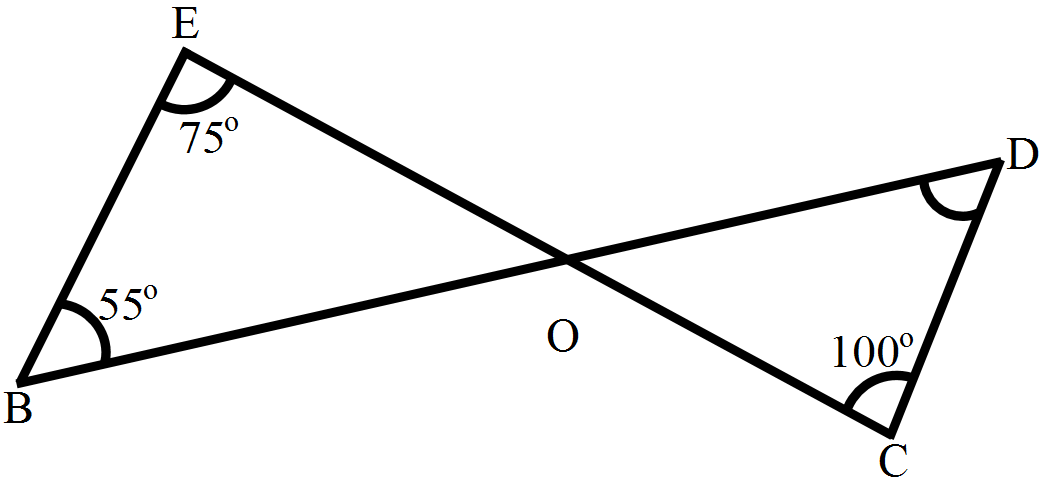
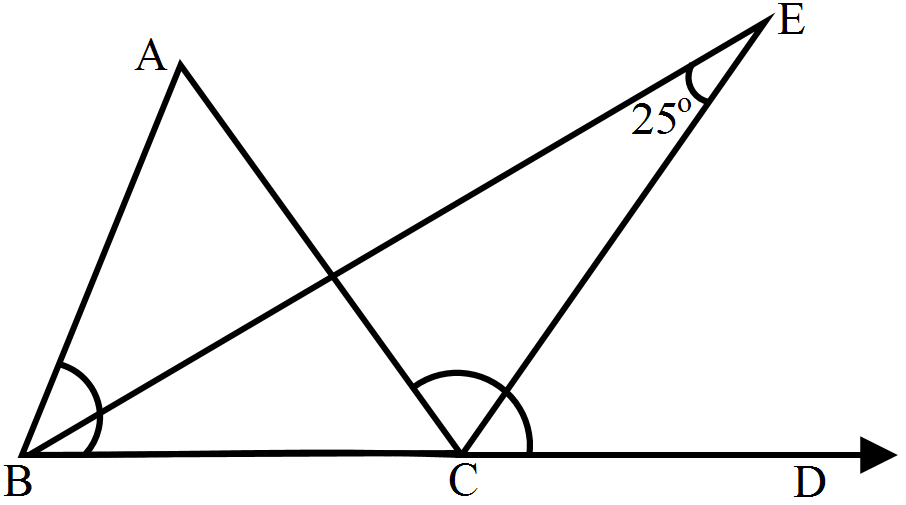
        In $\triangle\text{BEC}$
        $\angle\text{BEC}+\angle\text{EBC}+\angle\text{ECD}$ (Exterior angle property)
        $\angle\text{BEC}=\angle\text{ECD}-\angle\text{EBC}$
        In $\triangle\text{ABC}$
        $\angle\text{ABC}+\angle\text{BAC}=\angle\text{ACD}$
        $\angle\text{ABC}+2\angle\text{EBC}=2\angle\text{ECD}$
        $\angle\text{ABC}=2(\angle\text{ECD}-\angle\text{EBC})$
        $\angle\text{ABC}=2(\angle(\text{BEC}))$
        $\angle\text{ABC}=50^\circ$
      View full question & answer
      Question 711 Mark
      Answer
      1. 45º
        Solution:
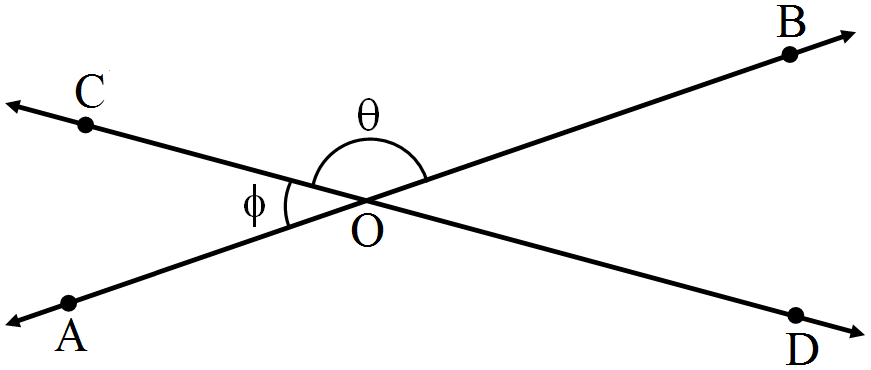
        $\angle\text{AOD}=\angle\text{COB}=\theta$
        $\angle\text{AOC}=\angle\text{BOD}=\phi$
        Since the sum of the measures of the angles around a point is 360º,
        $\angle\text{AOD}+\angle\text{COB}+\angle\text{AOC}+\angle\text{BOD}=360^\circ$
        $\Rightarrow\theta+\theta+\phi+\phi=360$
        $\Rightarrow2(\theta+\phi)=360$
        $\Rightarrow\theta+\phi=180$
        Given that $\theta=3\phi.$
        So, $3\phi+\phi=180$
        $\Rightarrow4\phi=180$
        $\Rightarrow\phi=45$
      View full question & answer
      Question 721 Mark
      View full question & answer
      Question 741 Mark
      Two complementary angles are such that two times the measure of one is equal to three times the measure of the other. The measure of the smaller angle is:
      Answer
      1. 36°
        Solution:
        Let one angle be $\theta$
        Then, its complementary $=90-\theta$
        According to question,
        $2\theta=3(90-\theta)$
        $=5\theta=270$
        $\theta=54^\circ$
        Then, $90-\theta^\circ=36^\circ$
        Hence, the smaller angle is 36°.
      View full question & answer
      Question 761 Mark
      Answer
      1. 145º
        Solution:
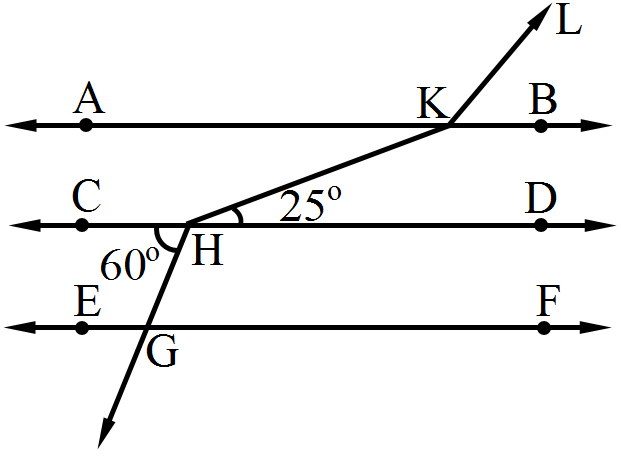
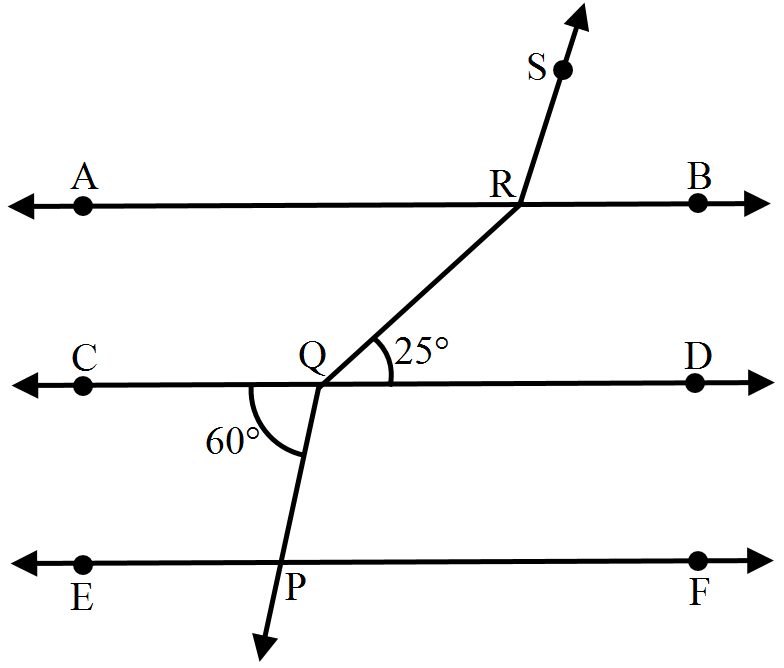
        Given, AB || CD || EF and GH || KL
        Produce HG to M and KL to N
        $\angle\text{MHD}$ and $\angle\text{CHG}=60^\circ$ (Vertically opposite angle)
        Since, MG || NL and transversal cuts them
        So, $\angle\text{MHD}+\angle1=180^\circ$ (Interior angles)
        $60^\circ+\angle1=180^\circ$
        $\angle1=120^\circ$
        $\angle3=\angle\text{HKD}=25^\circ$ (Alternate angles) (i)
        $\angle1=\angle\text{MKL}=120^\circ$ (Corresponding angles) (ii)
        Now, $\angle\text{HKL}=\angle3+\angle\text{MKL}$
        = 25º + 120º
        = 145º.
      View full question & answer
      Question 771 Mark
      If two interior angles on the same side of a transversal intersecting two parallel lines are in the ratio 2 : 3, then the greatest of two angles is:
      Answer
      1. 108º
        Solution:
        Let a and b are two interior angles on the same side of a transversal intersecting two parallel lines are in the ratio 2 : 3 and we know that If a transversal intersects two parallel lines, then each pair of interior angles on the same side of the transversal is supplementary.
        Let common ratio is x,
        a = 2x and b = 3x
        a + b = 180º
        2x + 3x = 180º
        5x = 180º
        $\text{x} = \frac{180^\circ}{5} = 36^\circ$
        x = 36º
        3x = 3 × 36º = 108º.
      View full question & answer
      Question 781 Mark
      If one of the angles of a triangle is 130º then the angle between the bisectors of the other two angles can be:
      View full question & answer
      Question 791 Mark
      Answer
      1. 75º
        Solution:
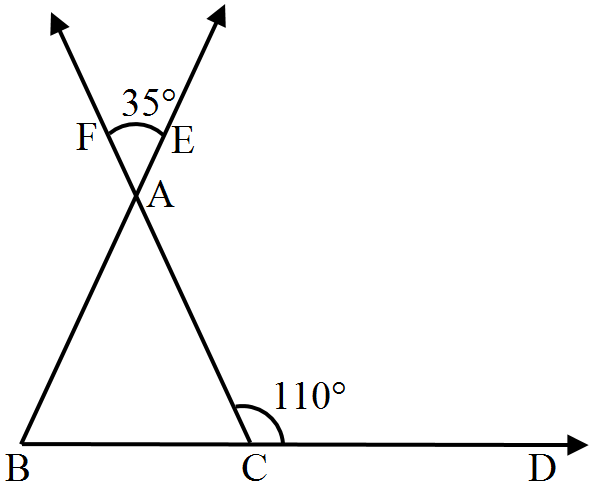
        $\angle\text{FAE}=\text{BAC}(\text{VOA})$
        $\angle\text{BAC}=35^\circ$
        $\angle\text{ACB}+\angle\text{ACD}=180^\circ$ (Linear Pair)
        $\angle\text{ACB}+110^\circ=180^\circ$
        $\angle\text{ACB}=180^\circ-110^\circ$
        $\angle\text{ACB}=70^\circ$
        $\angle\text{BAC}+\angle\text{B}+\angle\text{ACB}=180^\circ$
        $35^\circ+\angle\text{B}+70^\circ=180^\circ$
        $\angle\text{B}+105^\circ=180^\circ$
        $\angle\text{B}=180^\circ-105^\circ$
        $\angle\text{B}=75^\circ.$
      View full question & answer
      Question 811 Mark
      Answer
      1. 20º
        Solution:
        Let,
        AB, CD and EF intersect at O
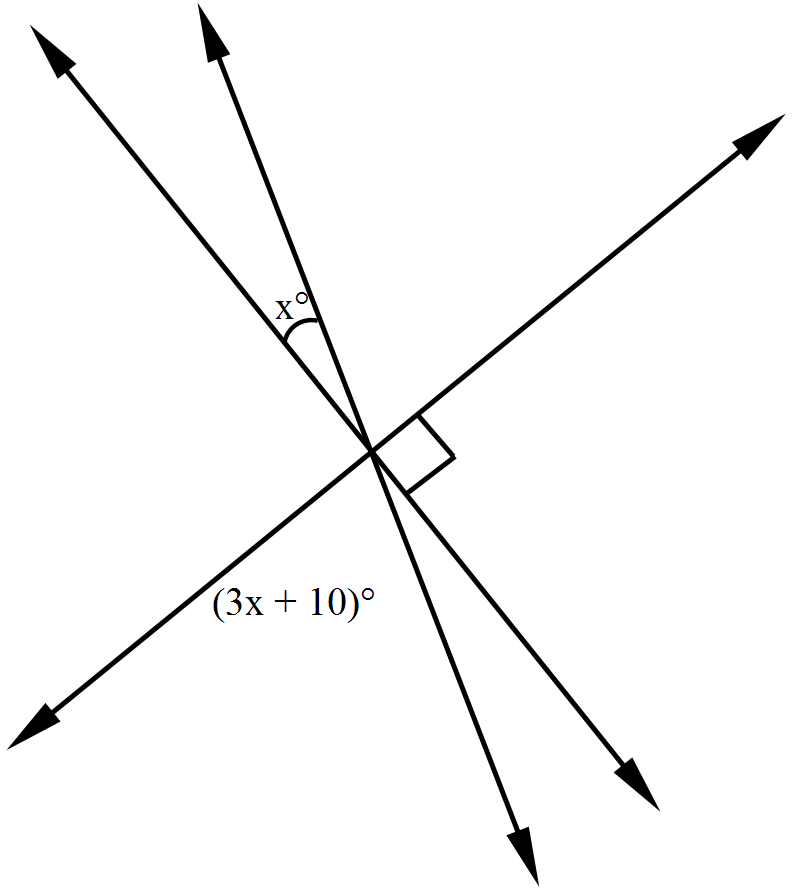
        $\angle\text{COB}=\angle\text{AOD}$ (Vertically opposite angle)
        $\angle\text{AOD}=3\text{x}+10\text{ (i)}$
        $\angle\text{AOE}+\angle\text{AOD}+\angle\text{DOF}=180^\circ$ (Linear pair)
        x + 3x + 10º + 90º = 180º
        4x + 100º = 180º
        4x = 80º
        x = 20º.
      View full question & answer
      Question 821 Mark
      The angles of a triangle in ascending order are $x, y, z$ and $y - x = z - y = 10^\circ .$ The smallest angles is:
      Answer
      $x + y + z = 180^\circ (i) ($Angle sum property$)$
      $y - x = 10^\circ$
      $y - 10^\circ = x (ii)$
      $z - y = 10^o$
      $z = 10^\circ + y (iii)$
      On putting the value of $x$ and $z$ in equation $(i)$
      $y - 10^\circ + y + 10^\circ + y = 180^\circ$
      $y = 60^\circ$
      $x = 50^\circ ($From equation $ii)$
      $z = 70^\circ ($From equation $iii)$
      Smallest angle is $x = 50^\circ .$
      View full question & answer
      Question 831 Mark
      Which of the following statements is false?
      Answer
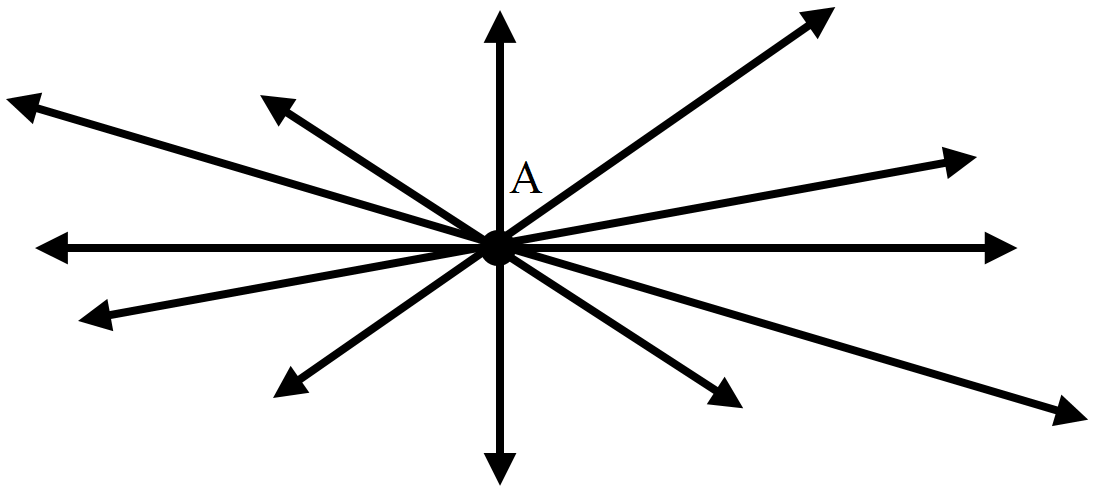
      1. Through a given point, only one straight line can be drawn.
        Solution:
        This statement is false because we can draw infinitely many straight lines through a given point.
      View full question & answer
      Question 871 Mark
      If two interior angles on the same side of a transversal intersecting two parallel lines are in the ratio 5 : 4, then the smaller of the two angles is:
      View full question & answer
      Question 881 Mark
      The angles of a triangle are in the ratio 2 : 3 : 4. The largest angle of the triangle is:
      Answer
      1. 80º
        Solution:
        By angle sum property,
        2x + 3x + 4x = 180°
        ⇒ 9x = 180°
        ⇒ x = 20°
        Hence, largest angle = 4x = 4(20°) = 80°
      View full question & answer
      Question 901 Mark
      In two interior angles on the same side of a transversal intersecting two parallel lines are in the ratio 5 : 4, then the smaller of the two angles is:
      Answer
      1. 80º
        Solution:
        We know that sum of two interior angles on the same side of a
        transversal intersecting two parallel lines is 180°
        let the common ratio is x so the angles are 5x ,4x
        So 5x + 4x = 180°
        9x = 180°
        $\text{x}=\frac{180^\circ}{9}$
        $\text{x}=20^\circ$
        So the angles are 5x = 100°
        4x = 80°
        So smallest angle is 80°
      View full question & answer
      Question 911 Mark
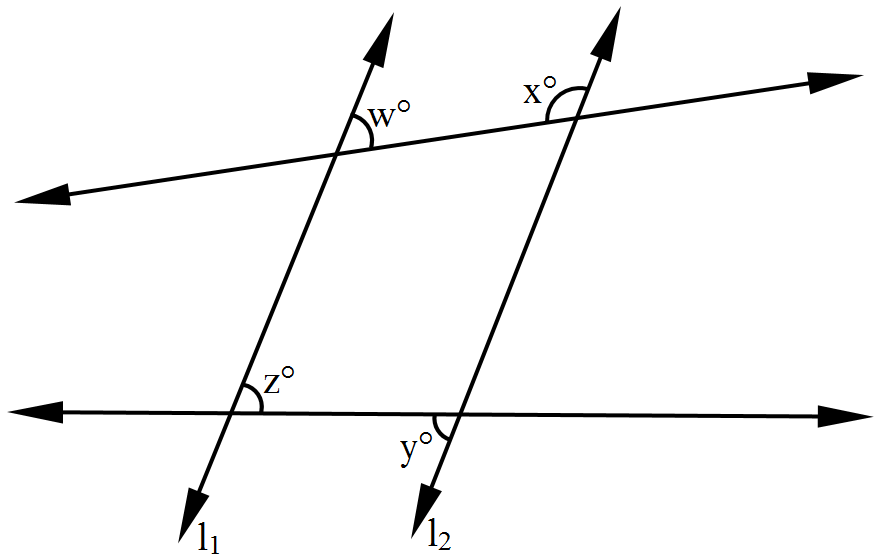
      In Fig. if $1_1 \ || \ 1_2,$ what is $x + y$ in terms of $w$ and $z$ ?
      Answer
      Given that,
      $1_1\ || \ 1_2$
      Let $m$ and $n$ be two transversal cutting them
      $\angle\text{w}+\angle\text{x}=180^\circ$ $($Consecutive interior angle$)$
      $x = 180^\circ - w (i)$
      $z = y ($Alternate angles$) (ii)$
      From $(i)$ and $(ii),$ we get
      $x + y = 180^\circ - w + z.$
      View full question & answer
      Question 921 Mark
      Two lines AB and CD intersect at O. If $\angle\text{AOC}+\angle\text{COB}+\angle\text{BOD}=270^\circ,$then $\angle\text{AOC}=$
      View full question & answer
      Question 931 Mark
      The complement of $(90 - a)^\circ$ is:
      Answer
      We know that the sum of complementary angles are $90^\circ$
      Let the complementary angle of $(90 - a)^\circ$ be $x$
      $x + (90 - a)^\circ  = 90^\circ$
      $x = 90^\circ  - (90 - a)^\circ$
      $x = 90^\circ - 90^\circ  + a^\circ$
      $x = a^\circ .$
      View full question & answer
      Question 941 Mark
      Answer
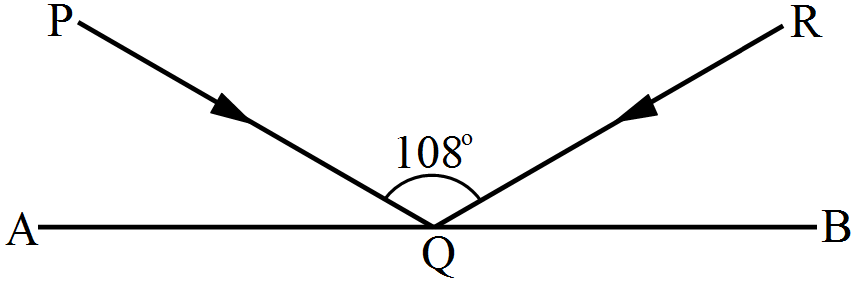
      1. 36º
        Solution:
        We know that, angle of incidance = angle reflection.
        that is, $\angle\text{AQP}=\angle\text{BQR}$
        Since AOB is a straight line,
        $\angle\text{AQP}+\angle\text{BQR}+\angle\text{PQR}=180^\circ$
        $\Rightarrow\angle\text{AQP}+\angle\text{AQP}+\angle\text{PQR}=180^\circ$
        $\Rightarrow2\angle\text{AQP}=72$
        $\Rightarrow \angle\text{AQP}=36^\circ$
      View full question & answer
      Question 951 Mark
      View full question & answer
      Question 961 Mark
      If one angle of a triangle is equal to the sum of the other two angles, then the triangle is:
      Answer
      1. A right triangle.
        Solution:
        The sum of the angles of triangle is 180 degrees.
        Let the angles of triangle be a, b, c
        we have given that one angle of a triangle is equal to the sum of the other two angles
        So we have,
        c = a + b
        a+ b + c = 180
        Substitute c for a + b
        c + c = 180
        2c = 180
        c = 90
        Therefore the triangle is a right triangle.
      View full question & answer
      Question 971 Mark
      In the given figure, the measure of $\angle\text{a}$ is:
      Answer
      1. 30º
        Solution:
        In the given figure
        $150^\circ\angle\text{a}=180^\circ$ (linear - pair)
        $\angle\text{a}=180^\circ=150^\circ$
        Therefore,
        $\angle\text{a}=30^\circ$
      View full question & answer
      Question 981 Mark
      View full question & answer
      Question 991 Mark
      Answer
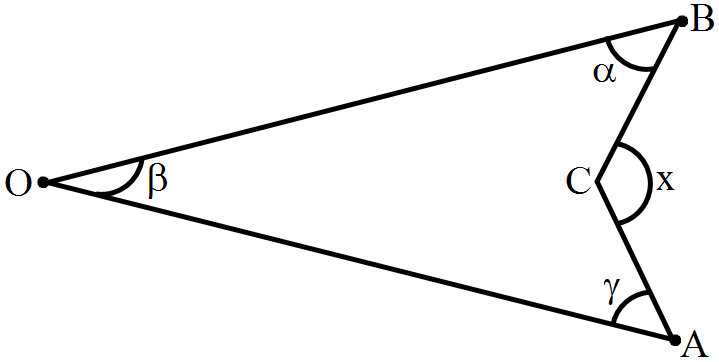
      1. $\alpha+\beta+\gamma$
        Solution:
        OBCA is a quadrilateral
        $\angle\text{OAC}+\angle\text{BOA}+\angle\text{ACB}+\angle\text{CBO}=360^\circ$
        $\gamma+\beta+\angle\text{ACB}+\alpha=360^\circ$
        $\angle\text{ACB}=360^\circ-\gamma-\beta-\alpha$
        $\text{x}=360^\circ-\angle\text{ACB}$
        $\text{x}=\alpha+\beta+\gamma.$
      View full question & answer
      Question 1001 Mark
      Answer
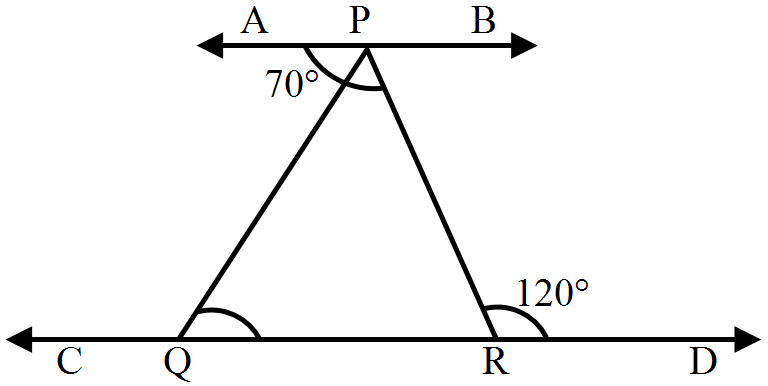
      1. 50º
        Solution:
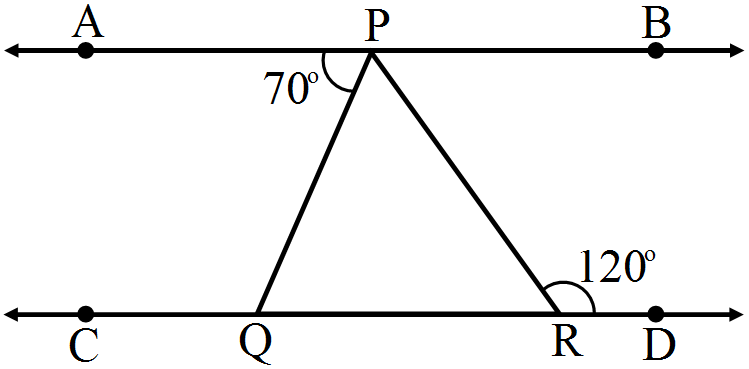
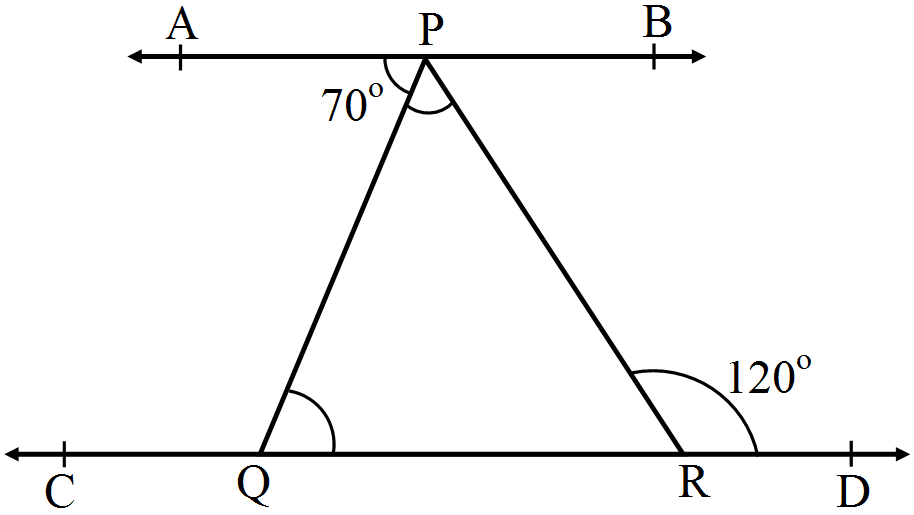
        $\angle\text{APQ}=\angle\text{PQR}=70^\circ$ (Alternate interior angles)
        $\angle\text{PRQ}+\angle\text{PRD}=180^\circ$ (Linear Pair)
        $\angle\text{PRQ}=180^\circ-120^\circ=60^\circ$
        In $\triangle\text{PQR}$
        $\angle\text{PQR}+\angle\text{PRQ}+\angle\text{QPR}=180^\circ$ (Angle sum property)
        $\angle\text{QPR}=180^\circ-70^\circ-60^\circ=50^\circ.$
      View full question & answer
      M.C.Q - Page 2 - MATHS STD 9 Questions - Vidyadip